


Community hub
Recent from talks
Contribute something
Nothing was collected or created yet.
Tehuelche language
View on Wikipedia| Tehuelche | |
|---|---|
| Patagón | |
| aonekko ʼaʼien | |
| Pronunciation | [aonekʼo ʔaʔjen] |
| Native to | Argentina |
| Region | Santa Cruz |
| Ethnicity | Tehuelche |
| Extinct | 2019, with the death of Dora Manchado[1] |
| Revival | few learners (2012)[2] |
Chonan
| |
| Language codes | |
| ISO 639-3 | teh |
| Glottolog | tehu1242 |
| ELP | Tehuelche |
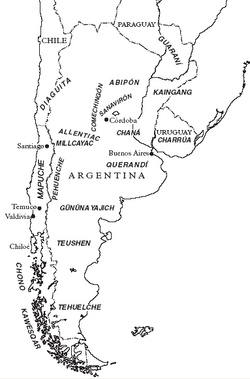
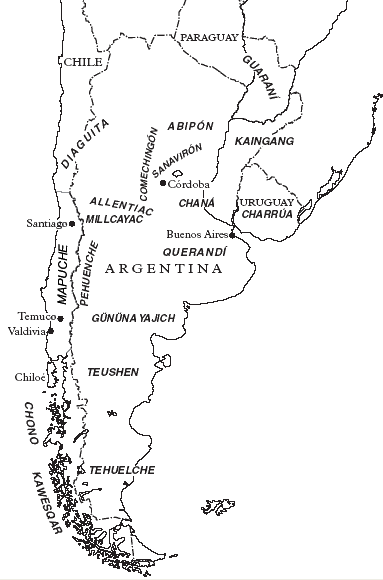
 Map with approximate distributions of languages in Patagonia at the time of the Spanish conquest. Source: W. Adelaar (2004): The Andean Languages, Cambridge University Press. | |
 | |
Tehuelche (Aoniken, Inaquen, Gunua-Kena, Gununa-Kena) is one of the Chonan languages of Patagonia. Its speakers, the Tehuelche people, were nomadic hunters who occupied territory in present-day Chile, north of Tierra del Fuego and south of the Mapuche people. It is also known as Aonekkenk or Aonekko ʼaʼien ([aonekʼo ʔaʔjen]).
The decline of the language started with the Mapuche invasion in the north, that was then followed by the occupation of Patagonia by the Argentine and Chilean states and state-facilitated genocide. Tehuelche was considerably influenced by other languages and cultures, in particular Mapudungun (the language of the Mapuche). This allowed the transference of morpho-syntactic elements into Tehuelche.[3] During the 19th and 20th centuries, Spanish became the dominant language as Argentina and Chile gained independence, and Spanish-speaking settlers took possession of Patagonia. Because of these factors the language began dying out. In 1983/84 there were 29 speakers, but by the year 2000 there were only 4 speakers left, and by 2012 only 2. In 2019 the last speaker, Dora Manchado, died. As of 2000, the Tehuelche ethnic group numbered 200. Today many members of the Tehuelche ethnic group have limited knowledge of the language and are doing their best to ensure language revival, as Tehuelche is still a very important symbol for the group of people who identify themselves as Tehuelche.[4][5]
In spite of the death of Manchado in 2019, the language has been documented (from her), recuperated and revitalized by various groups of Aonekkenks, with the collaboration of a group of linguists and anthropologists, that have made various studies and academic works about this language.[5][4]
Classification
[edit]Tehuelche belongs to the Chonan family together with Teushen, Selkʼnam (Ona) and Haush. The latter two languages, spoken by tribes in northeast and far northeast Tierra del Fuego, have different statuses of documentation and linguistic revitalization by their corresponding communities.
Dialects
[edit]History and demographics
[edit]The northern Tehuelche were conquered and later assimilated by the Mapuche during the Araucanization of Patagonia. Some 1.7 million Mapuche continue to live in Chile and southwest Argentina. Further south they traded peacefully with y Wladfa, the colony of Welsh settlers. Some Tehuelche learnt Welsh and left their children with the settlers for their education. A solid photographic record was made of this people. However, they were later nearly exterminated in the late 19th-century government-sponsored genocides of Patagonia.[7] Of some 5000 speakers in 1900, as of 2005[update] there were about 20 speakers left. Tehuelche is now extinct as of 2019.
Phonology
[edit]Vowels
[edit]Tehuelche has 3 vocalic qualities which can be short or long.[8]
| Front | Central | Back | |
|---|---|---|---|
| Mid | e eː | o oː | |
| Open | a aː |
Consonants
[edit]Tehuelche has 25 consonantal phonemes. Stops can be plain, glottalized or voiced.[9]
| Labial | Dental | Palatal | Velar | Uvular | Glottal | ||
|---|---|---|---|---|---|---|---|
| Nasal | m | n | |||||
| Stop | plain | p | t | tʃ | k | q | ʔ |
| ejective | pʼ | tʼ | tʃʼ | kʼ | qʼ | ||
| voiced | b | d | ɡ | ɢ | |||
| Fricative | s | ʃ | x | χ | |||
| Approximant | w | l | j | ||||
| Trill | r | ||||||
Morphology
[edit]Pronoun
[edit]| Singular | Dual | Plural | |
|---|---|---|---|
| 1st person | ia | okwa | oshwa |
| 2nd person | ma꞉ | mkma | mshma |
| 3rd person | ta꞉ | tkta | tshta |
Noun
[edit]![[icon]](https://en.wikipedia.org/wiki/File:Wiki_letter_w_cropped.svg) | This section is empty. You can help by adding to it. (January 2011) |
Verb
[edit] | This section is empty. You can help by adding to it. (January 2011) |
Alignment
[edit]Tehuelche is a nominative–accusative language. It marks the nominative but not the accusative, a phenomenon only found in six languages worldwide.[10]
References
[edit]- ^ "Museums of the mind: Why we should preserve endangered languages · Global Voices". Nov 6, 2019. Retrieved Oct 12, 2020.
- ^ "Did you know Tehuelche is critically endangered?". Endangered Languages. Retrieved 2025-03-14.
- ^ Fernández 2006.
- ^ a b "kketo sh m ʼekot – lengua tehuelche". kketo sh m ʼekot – lengua tehuelche (in Spanish). Retrieved 2025-02-17.
- ^ a b "qadeshiakk". qadeshiakk (in Spanish). Retrieved 2020-03-18.
- ^ Mason, John Alden (1950). "The languages of South America". In Steward, Julian (ed.). Handbook of South American Indians. Vol. 6. Washington, D.C., Government Printing Office: Smithsonian Institution, Bureau of American Ethnology Bulletin 143. pp. 157–317.
- ^ Brenzinger, 2007. Language diversity endangered. Walter de Gruyter.
- ^ Fernández 1998, pp. 87–88.
- ^ Fernández 1998, pp. 88–89.
- ^ Campbell, Lyle; Grondona, Verónica María, eds. (2012). The indigenous languages of South America: a comprehensive guide. The world of linguistics. Berlin ; Boston: Mouton de Gruyter. ISBN 978-3-11-025513-3.
- Fernández Garay, Ana (1997). Testimonios de los últimos tehuelches (in Spanish). Buenos Aires: Universidad de Buenos Aires.
- Fernández Garay, Ana (1998). El tehuelche: Una lengua en vías de extinción. Anejos de Estudios Filológicos 15 (in Spanish). Valdivia: Universidad Austral de Chile. ISBN 956710513-8.
- Fernández Garay, Ana (2004). Diccionario tehuelche-español / índice español-tehuelche. Indigenous Languages of Latin America 4 (in Spanish). Leiden: University of Leiden.
- Fernández Garay, Ana (2006). La nominalización en lenguas indígenas de la Patagonia (PDF) (in Spanish). National University of La Pampa. ISSN 1665-1200. Archived from the original (PDF) on 2017-08-29. Retrieved 2023-04-22.
- Malvestitti, Marisa (2014). "Aʰúnikʼənkʼ. Un vocabulario de la lengua tehuelche documentado por Roberto Lehmann-Nitsche". Indiana (in Spanish). 31: 377–408. doi:10.18441/ind.v31i0.377-408. ISSN 0341-8642.
- Viegas Barros, J. Pedro (2005). Voces en el viento. Raíces lingüísticas de la Patagonia (in Spanish). Buenos Aires: Mondragón.
External links
[edit]- Tehuelche (Intercontinental Dictionary Series)
- kketo sh m ʼekot – lengua tehuelche (Tehuelche community website)
- Qadeshiakk – Materials about the language

Tehuelche language
View on GrokipediaClassification
Genetic affiliation
The Tehuelche language, also known as Aónikenk, is classified as a member of the Chonan (or Chon) language family, which encompasses Tehuelche alongside the extinct Teushen, Selk'nam (Ona), and Haush languages spoken in Patagonia and Tierra del Fuego.[6] This affiliation rests on comparative linguistic evidence demonstrating systematic lexical and grammatical correspondences that preclude Tehuelche's status as a language isolate. Shared vocabulary in core semantic domains, including numerals and body parts, reveals cognates with regular sound shifts, such as those between Tehuelche and Selk'nam forms for basic terms.[7] Grammatical parallels further substantiate the genetic link, with all Chonan languages exhibiting polysynthetic morphology characterized by agglutinative verb complexes incorporating multiple affixes for nouns, tense, and evidentiality.[6] These features, combined with low rates of borrowing from unrelated neighbors like Mapudungun, indicate descent from a common proto-language rather than areal diffusion. The family's delineation, refined through analyses of limited but attested corpora, has been upheld in South American linguistic surveys despite data scarcity from early extinction events.[6]Debates on familial relations
The proposed Chonan language family, encompassing Tehuelche alongside the extinct Teushen, Selk'nam (Ona), and Haush languages, has faced scrutiny due to the limited lexical data available for comparative analysis. Early classifications, such as those relying on 19th-century word lists, often involved samples of fewer than 500 terms per language, raising concerns about coincidental resemblances mistaken for cognates in phylogenetic reconstruction.[8] This sparse corpus—totaling under 1,000 documented words across Tehuelche varieties—impedes rigorous testing of genetic relatedness, as small datasets amplify the risk of overclassification without sufficient grammatical or phonological correspondences to substantiate deeper ties.[6] Broader proposals, such as Macro-Chonan linkages incorporating Qawasqar or extensions to Pano-Tacanan families, similarly lack robust empirical support, relying on tentative lexical matches that fail to withstand scrutiny under systematic comparison methods. Linguists like Willem Adelaar have noted the challenges in establishing sound correspondences for Tehuelche given its phonological inventory and the fragmentary nature of attestations, advocating caution against unsubstantiated macro-family hypotheses. Critics argue that such expansions prioritize speculative patterns over verifiable innovations, particularly when areal diffusion from neighboring languages confounds signals of inheritance. An alternative perspective posits Tehuelche as a linguistic isolate, with apparent similarities to other Chonan candidates attributable to prolonged contact-induced convergence rather than shared ancestry. Extensive borrowing from Mapudungun (Araucanian), documented in domains like numerals and toponyms, exemplifies how geographic proximity in Patagonia could foster lexical overlap without implying genetic unity, a hypothesis testable via loanword identification in larger reconstructed etymologies.[8] This view underscores the need for expanded corpora or archaeological-linguistic correlations to resolve uncertainties, as current evidence remains inconclusive for affirming familial bonds.Dialects and regional variation
Inland Tehuelche
The Inland Tehuelche variety, spoken by northern Patagonian groups north of the Chubut River, adapted to the arid steppe environment of central Patagonia, where speakers pursued a nomadic hunting economy focused on horseback pursuits of large game.[9] These groups, known as Gününa küna, distinguished themselves from southern Tehuelche through dialectal features reflecting inland mobility and ecology, including lexicon for open-plains tracking and seasonal migrations.[10] Phonologically, the variety retained core Chonan traits such as a series of ejective consonants (e.g., /p'/, /t'/, /k'/), realized via glottalic airstream mechanisms that enhanced consonant contrast in windy steppe conditions.[11] Vocabularies emphasize terms tied to guanaco procurement, with words for bolos (hunting slings) and hide processing underscoring adaptation to herd-based hunting absent in coastal variants.[12] Documentation from 19th-century expeditions, including George Chaworth Musters' 1869–1870 traversal of inland territories, yielded over 1,000 Tsoneca (Inland Tehuelche) terms, confirming syntactic isolation and shared Chonan roots like basic kinship and faunal nomenclature with southern relatives.[12] Musters' records, collected from groups between the Chubut and Río Negro rivers, illustrate lexical continuity, such as verbs for pursuing camelids, while highlighting dialectal robustness prior to Mapuche incursions.[13] Earlier glimpses appear in Ramón Lista's 1879 Spanish-Tehuelche glossary from northern expeditions, reinforcing ejective phonemes and steppe-specific innovations without coastal maritime borrowings.[14]Coastal Tehuelche
The Coastal Tehuelche dialect, associated with Tehuelche populations along the Atlantic coast of Patagonia south of the Río Negro, incorporated lexical elements tied to maritime environments and early trade interactions, distinguishing it from inland variants primarily through adaptive vocabulary rather than profound grammatical divergence. Sparse historical vocabularies, such as those compiled by Roberto Lehmann-Nitsche in 1903 and 1905 from southern speakers, include terms like jonok for "marine" or sea-related, reflecting ecological adaptations to coastal hunting of marine mammals and gathering, though systematic dialectal contrasts remain underdocumented due to the nomadic lifestyle and oral tradition.[15][16] Early contacts with European traders introduced borrowed nautical terms, likely from Spanish explorers and sealers active from the late 18th century, though specific examples are rare in preserved records; for instance, general trade goods and sea terminology appear in ethnographic accounts of coastal exchanges. From the 1860s onward, interactions with Welsh settlers in Chubut Province—beginning with documented meetings in 1866—led to the adoption of Welsh loanwords, such as bara for "bread," integrated via barter networks involving Patagonian foodstuffs and manufactured items.[17][18] Limited evidence points to potential lexical overlap with neighboring Chonan languages through regional contacts, including possible Selk'nam influences in southern zones via inter-group mobility, but no verified coastal-specific borrowings from Selk'nam have been identified beyond shared proto-Chon roots for fauna and terrain; mutual intelligibility with inland Tehuelche is inferred from overall dialectal similarity noted in early 20th-century analyses, with prosodic variations like stress possibly diverging due to coastal intonational adaptations, though phonetic data are insufficient for confirmation.[19][20]Historical development
Pre-colonial context
The Tehuelche people, referred to as Aónikenk in their own language, inhabited the eastern Patagonian steppes as nomadic terrestrial hunter-gatherers for thousands of years before European contact in the early 16th century, relying on the Tehuelche language for daily coordination, social bonding, and knowledge exchange within small, egalitarian bands of up to 100 members.[21] [22] Their subsistence centered on hunting guanaco and gathering wild resources, necessitating a lexicon attuned to tracking, seasonal migrations, and resource distribution across vast, arid territories.[9] Lacking any form of writing system, as evidenced by the absence of graphic records in archaeological sites and analogies with other pre-contact Chonan-speaking groups, Tehuelche society transmitted cultural lore—encompassing myths, genealogies, environmental observations, and hunting rituals—exclusively through oral traditions.[23] [9] These verbal mechanisms supported adaptive strategies in a harsh climate, with linguistic correlations to archaeological patterns of mobility inferred from enduring toponyms and material culture continuity dating back over 14,000 years.[22] Pre-contact speaker numbers are estimated at 4,000 to 5,000, tied to population densities sustainable only through extensive territorial ranging and fission-fusion band structures that minimized resource strain.[21] This scale underscores the language's role in facilitating inter-band alliances via shared dialects and oral narratives, essential for occasional gatherings and conflict resolution in a landscape devoid of sedentary markers.[22]European contact and early documentation
The earliest European records of the Tehuelche language date to the 16th century, when Italian navigator Antonio Pigafetta, chronicler of Ferdinand Magellan's expedition, compiled a vocabulary of approximately 90 terms during encounters at San Julián Bay in 1520; these included basic nouns for body parts, numbers, and environmental features, transcribed in an Italian-influenced orthography that obscured phonetic details.[13] This list represents the initial attestation but is limited in scope and reliability, as interactions occurred amid tense hostilities and without sustained linguistic immersion.[13] More systematic early documentation emerged in the 18th century through English Jesuit missionary Thomas Falkner, who resided among Patagonian indigenous groups from the 1740s onward and published A Description of Patagonia and the Adjoining Parts of South America in 1774; his accounts incorporated ethnographic notes on the "Tehuelhets" (Tehuelche) and scattered lexical items, though not a comprehensive wordlist, drawn from missionary fieldwork south of Buenos Aires.[24] Falkner's efforts, informed by decades of direct contact, provided foundational insights into grammar and usage but were constrained by the Jesuit focus on conversion rather than philology, yielding data prone to interpretive overlays from Latin and Spanish frameworks.[24] During the 1830s–1850s, British naval expeditions, notably the HMS Beagle surveys under Robert FitzRoy, yielded wordlists of 200–300 Tehuelche terms collected from coastal and inland groups encountered along the Strait of Magellan and Río Santa Cruz; these appended FitzRoy's Narrative of the Surveying Voyages (1839) and emphasized practical vocabulary for navigation and trade, yet suffered from inconsistent spelling variations across recorders and reliance on ad hoc interpreters, potentially inflating apparent Spanish loanwords in basic lexicon.[25] Such biases, stemming from brief encounters and phonetic approximations by non-specialists, limited the datasets' utility for reconstructing proto-forms, as later analyses reveal orthographic discrepancies that conflate dialectal variants with transcription errors.[26]19th-20th century decline
The Tehuelche-speaking population, already limited by prior Mapuche incursions and intergroup assimilation, numbered no more than 1,500 individuals in 1871 according to explorer George Musters' estimate.[9] The Argentine Conquest of the Desert, a series of military campaigns from 1878 to 1885 led by General Julio Argentino Roca, targeted indigenous groups across Patagonia, including Tehuelche bands, resulting in direct killings, forced marches, and mass deaths from exposure, starvation, and outbreaks of diseases like smallpox and tuberculosis introduced by troops and settlers.[27] [28] Survivors, often numbering in the low hundreds by 1900, were displaced to marginal reservations or absorbed into expanding settler economies, where survival depended on adopting Spanish for labor, trade, and legal interactions.[29] These pressures compounded earlier linguistic shifts, as many Tehuelche had adopted Mapudungun for alliance and trade, but 19th-century European expansion enforced Spanish as the language of governance and compulsory schooling from the 1880s onward, eroding Tehuelche use in public and intergenerational contexts.[30] By the 1930s, active transmission had largely halted, with the language restricted to elderly speakers in isolated households amid widespread bilingualism or trilingualism involving Spanish and Mapudungun. Demographic data from linguistic surveys indicate that fluent proficiency persisted only among a dwindling cohort into the mid-20th century, after which passive recall dominated, reflecting the causal chain of population reduction and cultural assimilation.[29] By the 1980s, fieldwork recorded fewer than 29 individuals with any speaking ability, primarily aged over 60 and lacking full fluency.Current status and demographics
Speaker population trends
In 1931, linguistic records identified around 36 speakers of Tehuelche (also known as Günün a yajüch) in the Chubut plateau of Argentina.[31] Surveys in 1983–1984 documented 29 speakers, reflecting ongoing decline amid limited transmission.[32] By 2000, assessments by research groups and Ethnologue confirmed only four remaining speakers, characterized as semi-speakers with varying fluency.[33][6] The speaker population continued to dwindle, with two fluent individuals reported in 2012.[32] The death of Dora Manchado, the last known fluent speaker, on January 4, 2019, marked the effective extinction of native Tehuelche competence.[34] This linguistic attrition contrasts sharply with ethnic persistence, as approximately 31,000 individuals self-identify as Tehuelche (Aónikenk) descendants in Argentina, though proficiency in the ancestral language is absent among them, with Mapudungun serving as the primary tongue for most.[35]Factors contributing to extinction
The Tehuelche language's path to extinction stemmed from its speakers' small, dispersed population, which numbered in the low thousands at the onset of intensified European contact in the 19th century, rendering the community vulnerable to any interruption in oral transmission. Nomadic hunting practices over vast Patagonian expanses fostered low demographic density, limiting opportunities for consistent language socialization within peer groups. Without a pre-existing writing system or institutional mechanisms for standardization, the language relied entirely on familial and communal use, which faltered as speaker numbers dwindled below critical thresholds for viability.[5][3] High rates of exogamy accelerated assimilation, with Tehuelche individuals increasingly intermarrying non-speakers from Mapuche, Spanish-speaking settler, or mixed populations, resulting in children acquiring dominant languages like Spanish or Mapudungun instead. By the early 20th century, such unions had become prevalent in emerging mixed communities, diluting endogamous transmission and prioritizing economic integration over linguistic continuity. This pattern aligns with causal dynamics observed in other small isolate languages, where exogamy exceeding 50-70% of unions predictably erodes minority speech forms absent countervailing supports like enclaves or policy incentives. Pre-colonial pressures, including northward Mapuche expansions displacing southern groups, had already introduced hybrid elements and reduced pure-speaker pools, compounding later demographic attrition.[5][36] State-imposed Spanish monolingualism via mandatory schooling post-Conquest of the Desert (1878-1885) further severed transmission chains, as formal education prioritized assimilation without bilingual resources, leaving no institutional bulwark against shift. Low fertility amid high mortality from contact-era disruptions, coupled with urbanization drawing descendants into Spanish-dominant towns, ensured fluent speakers fell from an estimated few dozen in the mid-20th century to four by 2000, culminating in the death of the last fluent speaker, Dora Manchado, in 2019. These factors reflect inherent fragilities of unbacked isolates rather than exceptional external malice, as evidenced by parallel declines in non-colonized small-language contexts globally.[5][3][37]Revitalization efforts
Community initiatives
The Wenai Sh e Pekk collective launched a community project in 2020 aimed at recovering the Tehuelche language (aonekko 'a'ien) through grassroots workshops, video documentation of materials from the last fluent speaker Dora Manchado (deceased 2019), and creation of didactic resources including books, exercises, and online platforms.[38] These initiatives emphasize basic vocabulary acquisition and cultural identity reinforcement, with illustrations by community member Pablo Hidalgo, but reported outcomes remain limited to preparatory materials without verified participant fluency beyond rudimentary modules.[38] In March 2025, the legally recognized Fundación Wenai Sh e Pekk (established 2024) presented an annual revitalization agenda to provincial authorities, featuring deepened linguistic analysis and the release of the vocabulary compilation book Wenai sh e pekk, co-developed with anthropologist Javier Domingo.[39] The event, attended by indigenous communities and officials in Santa Cruz, included folk songs incorporating Tehuelche elements, yet no metrics indicated new speakers or conversational proficiency gains.[39] Broader grassroots efforts since 2016, led by activists in Río Gallegos and supported by Domingo's sessions, center on iconizing Manchado's legacy to sustain ethnic claims, producing linguistic tokens and basic conversational aids rather than fostering fluent usage in daily social practices.[40] Assessments highlight persistent challenges in embedding reclaimed words into active community dynamics, with success framed more in heritage reconnection than empirical fluency metrics.[41]Linguistic documentation and resources
The linguistic documentation of Tehuelche, also known as Aonekko 'a'ien, relies on sparse historical records and more recent fieldwork with the language's last fluent speakers, enabling partial reconstruction of its lexicon and basic structures. Early materials include wordlists and short texts transcribed by 19th-century European explorers and missionaries, such as those in vocabularies compiled for military and colonial use, which captured Pampa-influenced variants but lacked systematic analysis.[42] These were supplemented by 20th-century anthropological efforts, including ethnographic notes from interactions in Patagonia, though full immersion data remained limited due to the speakers' nomadic lifestyle and rapid language shift.[5] Key modern corpora stem from collaborative projects in the 2000s and 2010s, such as the Endangered Languages Documentation Programme (ELDP) initiative directed by Javier Domingo, which produced recordings of communicative contexts with elder Dora Manchado, one of the final fluent speakers.[43] This effort yielded a collection of elicited scenarios and natural speech samples, archived digitally with metadata for linguistic analysis.[44] Complementing this, a 2018 grant from the Endangered Language Fund supported documentation of at least 20 hours of audio material, focusing on everyday expressions and narratives to preserve phonetic and syntactic details.[45] Audio snippets from these projects are accessible via the Endangered Languages Archive (ELAR), including WAV files of sessions conducted in southern Patagonia.[46] Lexical resources include Ana Fernández Garay's Diccionario Tehuelche-Español, compiled from fieldwork in the 1990s and 2000s with remaining semi-speakers, offering over 1,000 entries with etymological notes but emphasizing descriptive rather than generative use.[6] Despite these advances, significant gaps hinder comprehensive revival: no complete reference grammar exists, with analyses limited to partial sketches of morphology and phonology derived from fragmented texts, restricting the creation of standardized pedagogical tools.[5] Digital archives provide searchable audio for reconstruction, yet the scarcity of long-form texts and inter-speaker dialogues limits verification of grammatical productivity and dialectal variation.[47]Prospects for revival
The death of Dora Manchado, the last fluent speaker of Tehuelche, on January 4, 2019, marked the language's transition to dormancy, with no remaining first-language acquirers to sustain natural transmission.[34][3] This generational rupture presents insurmountable hurdles for revival, as extinct languages without fluent native models typically fail to regain communal vitality; efforts reliant on archival reconstruction yield at best semi-speakers or hybrid forms, not full linguistic competence.[48] Historical precedents underscore the low probability of success: among documented cases, only Modern Hebrew achieved widespread revival from a long-dormant state, driven by ideological commitment, extensive literary resources, and state-backed immersion absent in Tehuelche's context.[49] Comparable initiatives for languages like Barngarla in Australia have produced limited, adapted usage from dictionaries but no native-like fluency generations later, reflecting broader patterns where over 90% of revival projects stall without early-childhood immersion.[49] Emerging possibilities include AI-assisted reconstruction from existing recordings and texts, such as the Tehuelche Talking Dictionary compiled from Manchado's contributions, potentially generating pedagogical tools or simulated dialogues.[34] However, such methods invite authenticity concerns, as algorithmically inferred grammar and idioms cannot replicate the tacit knowledge embedded in unobserved native usage, risking a sterile approximation divorced from cultural pragmatics. Community reclamation persists through metalinguistic activism—e.g., public linguistic artifacts to affirm Tehuelche identity—but remains symbolic, fostering awareness rather than viable speech communities.[40] Without scalable immersion infrastructure, prospects for Tehuelche approximating pre-extinction functionality remain negligible.[40]Phonology
Vowel system
The Tehuelche vowel system comprises three phonemic qualities—/a/, /e/, and /o/—each occurring in short and long variants that contrast phonemically to distinguish lexical meaning.[6][50] Long vowels are typically realized as approximately twice the duration of short ones, a distinction maintained across positions in the word, as documented through analysis of recordings by native speakers.[6] This minimal inventory, lacking high vowels such as /i/ or /u/, represents a small vowel quality system uncommon among the world's languages, with the mid vowels /e/ and /o/ filling roles analogous to front and back positions.[50] Vowel length is contrastive, yielding minimal pairs; for instance, short /a/ versus long /aː/ can alter word referents, though specific pairs depend on attested lexicon from limited speaker data.[6] Allophonic variation occurs primarily under stress, where short /e/ may raise toward [e̝] and /o/ toward [o̝], while long vowels exhibit greater stability in formant structure, as inferred from phonetic descriptions of preserved utterances.[51] No mid central unrounded vowel appears, reinforcing the peripheral quality of the system. Acoustic verification via spectrograms of 1990s field recordings confirms these qualities and durations, distinguishing Tehuelche from neighboring languages with expanded inventories.[6]Consonant inventory
The Tehuelche consonant inventory comprises 25 phonemes, characterized by a series of stops and affricates at multiple places of articulation, each contrasting plain voiceless, ejective (glottalized), and voiced series, alongside a limited set of fricatives, nasals, and approximants.[52] [50] Ejectives are present exclusively, without implosives or other glottalized types, as established through documentation of the language's final fluent speakers in the late 20th century.[53] This system reflects the Chonan family's areal features in Patagonia, with uvulars distinguishing it from neighboring languages.[54]| Bilabial | Alveolar | Post-alveolar | Palatal | Velar | Uvular | Glottal | |
|---|---|---|---|---|---|---|---|
| Nasal | m | n | |||||
| Stop | p pʼ b | t tʼ d | k kʼ ɡ | q qʼ ɢ | ʔ | ||
| Affricate | tʃ tʃʼ | ||||||
| Fricative | s | ʃ | x | χ | |||
| Tap/Flap | ɾ | ||||||
| Lateral | l | ||||||
| Approximant | w | j |
Prosodic features
Tehuelche prosody is characterized by fixed initial stress on words, a pattern documented in early grammatical descriptions and confirmed through comparative linguistic analysis.[56] This stress placement applies predictably to the first syllable, though phrasal contexts may introduce minor fluctuations due to interference from broader intonational prominence. Such fixed stress systems are typical in some Chonan languages, aiding in the rhythmic structure of utterances despite the language's complex consonant clusters.[50] Claims of tonal elements in Tehuelche prosody remain debated and unconfirmed, as available lexical and narrative data from the late 19th and early 20th centuries do not provide consistent evidence of lexical tone distinguishing meaning.[57] Primary documentation, including missionary treatises, emphasizes stress over pitch-based contrasts, with no systematic tonal inventory identified in peer-reviewed phonological surveys. Intonational contours in Tehuelche narratives, as preserved in limited recordings and transcriptions, feature rising patterns in questions and declarative falls, but detailed acoustic analysis is scarce due to the language's near-extinction by the mid-20th century.[57] These contours likely serve pragmatic functions, such as marking clause boundaries or emphasis, aligning with prosodic strategies observed in related Patagonian languages, though Tehuelche-specific data constraints limit generalization. Further revitalization efforts may yield instrumental studies to clarify these patterns.Morphology and grammar
Nominal and pronominal systems
The Tehuelche language, also known as Aonek'o ʔaʔjen, exhibits a nominal system characterized by lexical rather than inflectional categories. Nouns do not inflect for gender, number, or case; instead, they possess inherent lexical gender distinctions—masculine, feminine, or neuter—with agreement realized on predicates such as verbs and adverbs rather than on the nouns themselves.[6] The neuter gender typically applies to dual or collective/mass nouns, as in the case of "foot," which is masculine in the singular but shifts to neuter when denoting a pair.[6] Possession is marked by personal prefixes affixed directly to the noun stem, often triggering phonological adjustments such as the deletion of an initial consonant in nouns beginning with sounds like c, g, h, or u.[20] These prefixes derive from pronominal roots, integrating possession into the nominal morphology without separate genitive forms. The pronominal system includes free pronouns used for emphasis or topicalization, alongside bound forms that fuse as prefixes or clitics with verbs. Free personal pronouns distinguish singular, dual, and plural numbers across persons, with the first-person non-singular forms exhibiting an inclusive/exclusive distinction (e.g., exclusive for speaker and others excluding addressee, inclusive incorporating the addressee). Attested paradigms, drawn from late 19th- and 20th-century elicitations, are as follows:| Person | Singular | Dual | Plural |
|---|---|---|---|
| 1st (exclusive) | ja: | okwa: | ošwa: |
| 2nd | ma: | mkma: | mšma: |
| 3rd | ta: | tkta: | tšta: |