Respect all members: no insults, harassment, or hate speech.
Be tolerant of different viewpoints, cultures, and beliefs. If you do not agree with others, just create separate note, article or collection.
Clearly distinguish between personal opinion and fact.
Verify facts before posting, especially when writing about history, science, or statistics.
Promotional content must be published on the “Related Services and Products” page—no more than one paragraph per service. You can also create subpages under the “Related Services and Products” page and publish longer promotional text there.
Do not post materials that infringe on copyright without permission.
Always credit sources when sharing information, quotes, or media.
Be respectful of the work of others when making changes.
Discuss major edits instead of removing others' contributions without reason.
If you notice rule-breaking, notify community about it in talks.
Do not share personal data of others without their consent.
The Anatidae are the biological family of water birds that includes ducks, geese, and swans. The family has a cosmopolitan distribution, occurring on all the world's continents except Antarctica. These birds are adapted for swimming, floating on the water surface, and, in some cases, diving in at least shallow water. The family contains around 174 species in 43 genera (the magpie goose is no longer considered to be part of the Anatidae and is now placed in its own family, Anseranatidae).
They are generally herbivorous and are monogamous breeders. A number of species undertake annual migrations. A few species have been domesticated for agriculture, and many others are hunted for food and recreation. Five species have become extinct since 1600, and many more are threatened with extinction.
The ducks, geese, and swans are small- to large-sized birds with a broad and elongated general body plan.[2] Diving species vary from this in being rounder. Extant species range in size from the cotton pygmy goose, at as little as 26.5 cm (10.5 in) and 164 g (5.8 oz), to the trumpeter swan, at as much as 183 cm (6 ft) and 17.2 kg (38 lb). The largest anatid ever known is the extinct flightless Garganornis ballmanni at 22 kg (49 lb). The wings are short and pointed, and supported by strong wing muscles that generate rapid beats in flight. They typically have long necks, although this varies in degree between species. The legs are short, strong, and set far to the back of the body (more so in the more aquatic species), and have a leathery feel with a scaly texture. Combined with their body shape, this can make some species awkward on land, but they are stronger walkers than other marine and water birds such as grebes or petrels. They typically have webbed feet, though a few species such as the Nene have secondarily lost their webbing. The bills are made of soft keratin with a thin and sensitive layer of skin on top (which has a leathery feel when touched). For most species, the shape of the bill tends to be more flattened to a greater or lesser extent. These contain serrated lamellae which are particularly well defined in the filter-feeding species.[2]
Their feathers are excellent at shedding water due to special oils. Many of the ducks display sexual dimorphism, with the males being more brightly coloured than the females (although the situation is reversed in species such as the paradise shelduck). The swans, geese, and whistling-ducks lack sexually dimorphic plumage. Anatids are vocal birds, producing a range of quacks, honks, squeaks, and trumpeting sounds, depending on species; the female often has a deeper voice than the male.[3]
Anatids are generally herbivorous as adults, feeding on various water-plants, although some species also eat fish, molluscs, or aquatic arthropods. One group, the mergansers, are primarily piscivorous, and have serrated bills to help them catch fish. In a number of species, the young include a high proportion of invertebrates in their diets, but become purely herbivorous as adults.[3]
The anatids are generally seasonal and monogamous breeders. The level of monogamy varies within the family; many of the smaller ducks only maintain the bond for a single season and find a new partner the following year, whereas the larger swans, geese and some of the more territorial ducks maintain pair bonds over a number of years, and even for life in some species. However, forced extrapair copulation among anatids is common, occurring in 55 species in 17 genera.[4]
Anatidae is a large proportion of the 3% of bird species to possess a penis,[5][6] though they vary significantly in size, shape, and surface elaboration.[7] Most species are adapted for copulation on the water only. They construct simple nests from whatever material is close at hand, often lining them with a layer of down plucked from the mother's breast. In most species, only the female incubates the eggs. The young are precocial, and are able to feed themselves from birth.[3] One aberrant species, the black-headed duck, is an obligate brood parasite, laying its eggs in the nests of gulls and coots. While this species never raises its own young, a number of other ducks occasionally lay eggs in the nests of conspecifics (members of the same species) in addition to raising their own broods.
Duck, eider, and goose feathers and down have long been popular for bedspreads, pillows, sleeping bags, and coats. The members of this family also have long been used for food.
Humans have had a long relationship with ducks, geese, and swans; they are important economically and culturally to humans, and several duck species have benefited from an association with people. However, some anatids are agriculturalpests, and have acted as vectors for zoonoses such as avian influenza.
Since 1600, five species of ducks have become extinct due to the activities of humans,[citation needed] and subfossil remains have shown that humans caused numerous extinctions in prehistory. Today, many more are considered threatened. Most of the historic and prehistoric extinctions were insular species, vulnerable due to small populations (often endemic to a single island), and island tameness. Evolving on islands that lacked predators, these species lost antipredator behaviours, as well as the ability to fly, and were vulnerable to human hunting pressure and introduced species. Other extinctions and declines are attributable to overhunting, habitat loss and modification, and hybridisation with introduced ducks (for example the introduced ruddy duck swamping the white-headed duck in Europe). Numerous governments and conservation and hunting organisations have made considerable progress in protecting ducks and duck populations through habitat protection and creation, laws and protection, and captive-breeding programmes.
The name Anatidae for the family was introduced by the English zoologist William Elford Leach in a guide to the contents of the British Museum published in 1819.[8][9] While the status of the Anatidae as a family is straightforward, and which species properly belong to it is little debated, the relationships of the different tribes and subfamilies within it are poorly understood. The listing in the box at right should be regarded as simply one of several possible ways of organising the many species within the Anatidae; see discussion in the next section.
The systematics of the Anatidae are in a state of flux. Previously divided into six subfamilies,[citation needed] a study of anatomical characters by Livezey[10] suggests the Anatidae are better treated in nine subfamilies.[clarification needed] This classification was popular in the late 1980s to 1990s.[11] But mtDNAsequence analyses[12][13] indicate, for example, the dabbling and diving ducks do not belong in the same subfamily.
While shortcomings certainly occur in Livezey's analysis,[citation needed] mtDNA is an unreliable source for phylogenetic information in many waterfowl (especially dabbling ducks) due to their ability to produce fertile hybrids,[2] in rare cases possibly even beyond the level of genus (see for example the "Barbary duck"). Because the sample size of many molecular studies available to date is small, mtDNA results must be considered with caution.
While a comprehensive review of the Anatidae which unites all evidence into a robust phylogeny is still lacking, the reasons for the confusing data are at least clear: As demonstrated by the Late CretaceousfossilVegavis iaai—an early modern waterbird which belonged to an extinct lineage—the Anatidae are an ancient group among the modern birds. Their earliest direct ancestors, though not documented by fossils yet, likewise can be assumed[citation needed] to have been contemporaries with the non-avian dinosaurs. The long period of evolution and shifts from one kind of waterbird lifestyle to another have obscured many plesiomorphies, while apparent apomorphies are quite often the result of parallel evolution, for example the "non-diving duck" type displayed by such unrelated genera as Dendrocygna, Amazonetta, and Cairina. For the fossil record, see below.
Alternatively,[14] the Anatidae may be considered to consist of three subfamilies (ducks, geese, and swans, essentially) which contain the groups as presented here as tribes, with the swans separated as subfamily Cygninae, the goose subfamily Anserinae also containing the whistling ducks, and the Anatinae containing all other clades.
Subfamily: Anserinae, swans and geese (3–7 extant genera with 25–30 living species, mainly cool temperate Northern Hemisphere, but also some Southern Hemisphere species, with the swans in one genus [two genera in some treatments], and the geese in three genera [two genera in some treatments]. Some other species are sometimes placed herein, but seem somewhat more distinct [see below])
Cygnus, true swans (6 species, 4 sometimes separated in Olor)
Subfamily: Stictonettinae (one genus in Australia, formerly included in the Oxyurinae, but with anatomy suggesting a distinct ancient lineage perhaps closest to the Anserinae, especially the Cape Barren goose)
Subfamily: Tadorninae – shelducks and sheldgeeseMale common shelduck (This group of larger, often semiterrestrial waterfowl can be seen as intermediate between Anserinae and Anatinae. The 1986 revision[10] has resulted in the inclusion of 10 extant genera with about two-dozen living species [one probably extinct] in this subfamily, mostly from the Southern Hemisphere but a few in the Northern Hemisphere; the affiliations of several presumed tadornine genera has later been questioned[13] and the group in the traditional lineup is likely to be paraphyletic.)
Subfamily: Aythyinae, diving ducks (Some 15 species of diving ducks, of worldwide distribution, in two to four genera; The 1986 morphological analysis[10] suggested the probably extinct pink-headed duck of India, previously treated separately in Rhodonessa, should be placed in Netta, but this has been questioned.[15] Furthermore, while morphologically close to dabbling ducks, the mtDNA data indicate a treatment as distinct subfamily is indeed correct, with the Tadorninae being actually closer to dabbling ducks than the diving ducks[13])
Netta, red-crested pochard and allies (4 species, 1 probably extinct)
Subfamily: Anatinae, dabbling ducks and moa-nalos (The dabbling duck group, of worldwide distribution, were previously restricted to just one or two genera, but had been extended[10] to include eight extant genera and about 55 living species, including several genera formerly known as the "perching ducks"; mtDNA on the other hand confirms that the genus Anas is over-lumped and casts doubt on the diving duck affiliations of several genera [see below]. The moa-nalos, of which four species in three genera are known to date, are a peculiar group of flightless, extinct anatids from the Hawaiian Islands. Gigantic in size and with massive bills, they were believed to be geese, but have been shown to be actually very closely related to mallards. They evolved filling the ecological niche of turtles, ungulates, and other megaherbivores. A Canada goose tucking its bill under its wing
Anas: pintails, mallards, etc. (40–50 living species, 3 extinct)
Chendytes, diving-geese (extinct c. 450–250 BCE, A basal member of the dabbling duck clade[16])
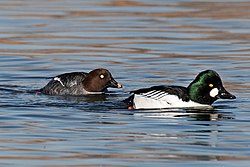
Tribe: Mergini, eiders, scoters, sawbills and other sea-ducks Common goldeneye couple, male on the right (There are 9 extant genera and some 20 living species; most of this group occur in the Northern Hemisphere, but a few [mostly extinct] mergansers in the Southern Hemisphere)
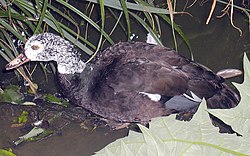
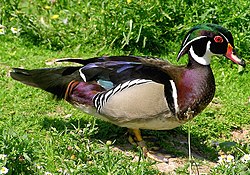
Unresolved: The largest degree of uncertainty concerns whether a number of genera are closer to the shelducks or to the dabbling ducks.The rare white-winged duck, a species of unclear affiliationWood duckAix sponsa See also the monotypic subfamilies above, and the "perching ducks"
Coscoroba, coscoroba swan – Anserinae or same subfamily as Cereopsis?
Cereopsis, Cape Barren goose – Anserinae, Tadorninae, or own subfamily?
Biziura, musk ducks (1 living species) - Oxyurini?
Malacorhynchus, pink-eared ducks (1 living species) – Tadorninae, Oxyurinae or Dendrocheninae?
Sarkidiornis, comb duck – Tadorninae or closer to dabbling ducks?
Tachyeres, steamer ducks (4 species) – Tadorninae or closer to dabbling ducks?
Cyanochen, blue-winged goose – Tadorninae or more distant clade?
Nettapus, pygmy geese (3 species) – Anatinae or part of Southern Hemisphere radiation?
Pteronetta, Hartlaub's duck – traditionally dabbling ducks, but may be closer to Cyanochen
Cairina and Asarcornis, Muscovy duck and white-winged duck, respectively (2 species) – traditionally dabbling ducks, but may be paraphyletic, with one species in Tadorninae and the other closer to diving ducks
Aix, Mandarin duck and wood duck (2 species) – dabbling ducks or Tadorninae?
Callonetta, ringed teal – dabbling ducks or Tadorninae?
Chenonetta, maned duck (1 living species) – dabbling ducks or Tadorninae? Includes Euryanas.
Marmaronetta, marbled duck – formerly dabbling ducks; actually a diving duck or a distinct subfamily
Maned duck is the only living member of the genus Chenonetta.
From subfossil bones found on Kauaʻi (Hawaiian Islands), two enigmatic waterfowl are known.[17] The living and assignable prehistoric avifauna of the archipelago contains as Anseriformes Branta geese and their descendants, and the moa-nalos as mentioned above. The following taxa, although certainly new species, cannot be assigned even to subfamily; that Kauaʻi is the oldest of the large Hawaiian Islands, meaning the species may have been evolving in isolation for nearly 10 mya (since the Late Miocene), does not help in determining their affinities:
Long-legged "shelduck", Anatidae sp. et gen. indet.
Similarly, Branta rhuax from the Big Island of Hawaiʻi, and a gigantic goose-like anatid from Oʻahu are known only from very incomplete, and in the former case much damaged, bone fragments. The former has been alleged to be a shelduck,[18] but this was generally dismissed because of the damage to the material and biogeographic considerations. The long-legged Kauaʻi bird, however, hints at the possibility of a former tadornine presence on the archipelago.
The fossil record of anatids is extensive, but many prehistoric genera cannot be unequivocally assigned to present-day subfamilies for the reasons given above. For prehistoric species of extant genera, see the respective genus accounts.
Dendrocheninae – a more advanced relative of the whistling-ducks or an ancestral relative of stifftail ducks paralleling whistling-ducks; if not extinct possibly belong in Oxyurinae (including Malacorhynchus)
Mionetta (Late Oligocene – Middle Miocene of Central Europe and Kazakhstan) – includes "Anas" blanchardi, "A." consobrina, "A." natator, "Aythya" arvernensis
Manuherikia (Bathans Early/Middle Miocene of Otago, New Zealand)
Aldabranas (Late Pleistocene of Aldabra, Indian Ocean) – anatine or tadornine* "Anas" albae (Late Miocene of Polgárdi, Hungary) – mergine? Formerly in Mergus
"Anas" eppelsheimensis (Early Pliocene of Eppelsheim, Germany) – anatine?
"Anas" isarensis (Late Miocene of Aumeister, Germany) – anatine?
"Anas" luederitzensis (Kalahari Early Miocene of Lüderitzbucht, Namibia) – anatine?
"Anas" meyerii (Middle Miocene of Öhningen, Germany) Described from a single badly crushed tarsometatarsus and phalanges. This species was named in 1867 by Milne-Edwards and then recombined in 1964 by Brodkorb to the genus Aythya. This species is currently regarded as Aves incertae sedis.[19]
"Anser" scaldii (Late Miocene of Antwerp, Belgium) – anserine or tadornine* Anatidae gen. et sp. indet. (Waite Late Miocene of Alcoota, Australia) – anatine, oxyurine?
"Anas" velox (Middle–Late? Miocene of C Europe) – anatine? May include "A." meyerii
Anatidae gen. et sp. indet. (Waite Late Miocene of Alcoota, Australia) – tadornine?
Anatidae gen. et sp. indet. MNZ S42797 (Bathans Early/Middle Miocene of Otago, New Zealand)
Anatidae gen. et sp. indet. (Middle Miocene of Nördlinger Ries, Germany) – tadornine?
Anatidae gen. et sp. indet. (Sajóvölgyi Middle Miocene of Mátraszõlõs, Hungary)[20]
"Aythya" chauvirae (Middle Miocene of Sansan, France and Credinţa, Romania) – 2 species
Caerulonettion (Early Miocene of France and the Czech Republic, Middle Miocene of Germany)
Cayaoa (Early Miocene of Argentina)
"Chenopis" nanus (Pleistocene of Australia) – at least 2 taxa, may be living species
Paranyroca (Rosebud Early Miocene of Bennett County, US) – anatid (own subfamily) or distinct family?
Eoneornis (Miocene of Argentina) – anatine? A nomen dubium
Eutelornis (Miocene of Argentina) – anatine?
The Middle Oligocene Limicorallus (from Chelkar-Teniz (Kazakhstan) was sometimes considered an anserine. It is now recognized as a primitive cormorant.[21] The middle Eocene Eonessa was formerly thought to belong to Anatidae, however reexamination of the holotype in 1978 resulted in the genus being placed as Aves incertae sedis.[1]
^ abcCarboneras, Carles (1992): Family Anatidae (Ducks, Geese and Swans). In: del Hoyo, Josep; Elliott, Andrew & Sargatal, Jordi (eds.): Handbook of Birds of the World (Volume 1: Ostrich to Ducks): 536–629. Lynx Edicions, Barcelona. ISBN84-87334-10-5
^ abcTodd, Frank S. (1991). Forshaw, Joseph (ed.). Encyclopaedia of Animals: Birds. London: Merehurst Press. pp. 81–87. ISBN1-85391-186-0.
^McKinney, Frank; Evarts, Susan (1998). "Sexual coercion in waterfowl and other birds". Ornithological Monographs. 49 (49): 165–193. doi:10.2307/40166723. JSTOR40166723.
^Briskie, James; Montgomerie, Robert (1997). "Sexual selection and the intromittent organ of birds". Journal of Avian Biology. 28 (1): 73–86. doi:10.2307/3677097. JSTOR3677097.
^Leach, William Elford (1819). "Eleventh Room". Synopsis of the Contents of the British Museum (15th ed.). London: British Museum. pp. 63–68 [67]. The name of the author is not specified in the document, Leach was the Keeper of Zoology at the time.
^Sraml, M.; Christidis, L.; Easteal, S.; Horn, P.; Collet, C. (1996). "Molecular Relationships Within Australasian Waterfowl (Anseriformes)". Australian Journal of Zoology. 44 (1): 47–58. doi:10.1071/ZO9960047.
^Terres, John K. & National Audubon Society (NAS) (1991): The Audubon Society Encyclopedia of North American Birds. Wings Books, New York. Reprint of 1980 edition. ISBN0517032880
^Collar, N. J.; Andreev, A. V.; Chan, S.; Crosby, M. J.; Subramanya, S. & Tobias, J. A. (eds.) (2001): Pink-headed DuckArchived 2007-03-11 at the Wayback Machine. In:Threatened Birds of Asia: The BirdLife International Red Data Book: 489–501. BirdLife International. ISBN0-946888-44-2
^Mlíkovský, J.; Švec, P. (1986). "Review of the Tertiary waterfowl (Aves: Anseridae) of Asia". Věstnik Čestoslovenske Spolecnosti Zoologicke. 50: 259–272.
Gonzalez, J.; Düttmann, H.; Wink, M. (2009). "Phylogenetic relationships based on two mitochondrial genes and hybridization patterns in Anatidae". Journal of Zoology. 279 (3): 310–318. doi:10.1111/j.1469-7998.2009.00622.x.
Anatidae is a diverse family of waterbirds within the order Anseriformes, encompassing ducks, geese, and swans, with approximately 174 extant species distributed across approximately 50 genera worldwide except for Antarctica.[1] These birds are highly adapted to aquatic environments, featuring webbed feet for swimming, waterproof feathers for buoyancy, and broad, flattened bills equipped with lamellae for filtering food from water.[1] Ranging in size from small ducks around 30 cm in length and 230 g in weight to large swans exceeding 180 cm and 22.5 kg, Anatidae exhibit a variety of body plans, from the elongated forms of geese and swans to the rounder bodies of diving ducks.[1]Taxonomically, the family is divided into several subfamilies, including Anatinae (true ducks), Anserinae (geese and swans), Dendrocygninae (whistling ducks), and others such as Stictonettinae and Tadorninae, reflecting evolutionary adaptations to different foraging strategies and habitats.[1] Ecologically versatile, Anatidae inhabit a broad spectrum of wetlands, from freshwater marshes and rivers to coastal bays and open oceans, with many species undertaking long-distance migrations in V-shaped formations to exploit seasonal resources.[2] Their diet varies by subfamily: dabbling ducks and geese primarily consume vegetation through grazing or surface feeding, while diving ducks target aquatic invertebrates and plants obtained by submerging.[2]Reproductively, most Anatidae species form seasonal or lifelong monogamous pairs, with females typically incubating eggs in ground nests lined with down feathers, though males' parental involvement differs—geese and swans often share duties, whereas many ducks do not.[3] Conservation challenges include habitat loss, hunting, and climate change impacts on breeding grounds, affecting population dynamics of migratory species—as of 2024, around 35 species are considered threatened with extinction—yet many remain abundant due to their adaptability and protected status in various regions.[4]
Taxonomy and Systematics
History of Classification
The classification of the Anatidae family, encompassing ducks, geese, and swans, originated in the 18th century with Carl Linnaeus's foundational work. In the 10th edition of Systema Naturae (1758), Linnaeus placed these birds within the order Anseres, a broad category that included web-footed aquatic species, and assigned most to the single genus Anas, based primarily on shared morphological traits like webbed feet and bills adapted for aquatic feeding.During the 19th century, taxonomic refinements separated these birds into more distinct groups, with George Robert Gray playing a pivotal role. In his 1840 publication A List of the Genera of Birds, Gray formally recognized the family Anatidae (originally proposed by Nicholas Vigors in 1825) and cataloged numerous genera, emphasizing anatomical differences in skeletal structure and plumage to delineate relationships. Subsequent revisions by Gray and contemporaries, such as in his 1869 Hand-list of Genera and Species of Birds, introduced key subfamily divisions, including Anatinae for typical ducks and Anserinae for geese and swans, reflecting emerging understandings of behavioral and morphological distinctions.[5]In the 20th century, Alexander Wetmore advanced the classification through comprehensive reviews incorporating fossil and osteological evidence. His 1951 revised classification of the world's birds, published in Smithsonian Miscellaneous Collections, integrated behavioral and anatomical data to refine Anatidae's internal structure, solidifying the separation of subfamilies while maintaining a morphology-driven framework. However, this system faced challenges from molecular approaches in the 1990s, as DNA-DNA hybridization studies by Charles Sibley and Jon Ahlquist revealed phylogenetic incongruities with traditional groupings, such as closer affinities among certain duck tribes than previously thought. These findings prompted reevaluations of evolutionary relationships within the family.A central debate in Anatidae classification has concerned its monophyly, particularly the status of screamers (family Anhimidae) and magpie geese (family Anseranatidae). Early broad groupings under Anseriformes sometimes included these taxa due to superficial similarities in body form, but 19th- and 20th-century anatomists increasingly excluded them based on differences in voice, locomotion, and skeletal features.[6] Molecular phylogenies from the 1990s, including mitochondrial DNA analyses, confirmed Anatidae's monophyly as a distinct clade excluding screamers and magpie geese, which form basal branches in the anseriform order, thus resolving long-standing uncertainties.[7]
Current Classification
Anatidae is a family of birds within the order Anseriformes, encompassing approximately 174 species distributed across 53 genera worldwide.[8] This diverse group includes ducks, geese, and swans, characterized by their adaptation to aquatic environments and a cosmopolitan distribution. As of IOC World Bird List version 15.1 (April 2025), with no major changes in the subsequent eBird/Clements 2025 taxonomy update (October 2025).[9][10]The current taxonomic framework recognizes four primary subfamilies: Dendrocygninae, which includes the whistling ducks (genus Dendrocygna and allies); Thalassorninae, a recently recognized subfamily comprising the white-backed duck (Thalassornis leuconotus), elevated based on molecular evidence distinguishing it from other ducks; Anatinae, the typical ducks encompassing dabbling and diving forms; and Anserinae, which contains the geese (Anser and Branta) and swans (Cygnus).[11] These divisions reflect phylogenetic relationships inferred from both morphological and genetic data, with Anatinae being the most species-rich subfamily.Key diagnostic traits at the family level include fully webbed feet adapted for propulsion in water, broad and flattened bills equipped with comb-like lamellae for straining food from water, and the presence of a well-developed uropygial gland that secretes oils to maintain feather waterproofing.[1] These features distinguish Anatidae from other anseriform families like Anhimidae (screamers) and Anseranatidae (magpie goose).Recent updates in the IOC World Bird List (version 15.1, April 2025) incorporate genetic revisions, such as the elevation of the Baikal Teal from Anas to the monotypic genus Sibirionetta based on whole-genome analyses supporting its distinct evolutionary lineage within Anatinae.[9] These changes highlight ongoing refinements driven by multilocus phylogenetic studies.[12]
Genera and Species
The family Anatidae comprises approximately 53 genera and 174 extant species, distributed across several subfamilies that reflect morphological and genetic distinctions among ducks, geese, and swans.[8] The subfamily Anatinae, encompassing typical ducks, is the most diverse with around 40 genera and over 130 species, characterized by dabbling and diving feeding strategies.[1] Anserinae includes geese and swans in roughly 7 genera totaling about 25 species, noted for larger body sizes and grazing adaptations.[13] Dendrocygninae features whistling ducks in 2 genera with 9 species, distinguished by long legs and perching habits.[2] Tribes within Anatinae, such as Mergini for sea ducks and sawbills, add specialized genera with fish-eating bills.[11]Among the key genera, Anas represents the largest group of dabbling ducks, currently encompassing 31 species such as the mallard (Anas platyrhynchos) and yellow-billed teal (Anas flavirostris), with a nearly cosmopolitan range and traits like broad bills for surface feeding.[2] The genus Branta, with 6 species including the Canada goose (Branta canadensis) and barnacle goose (Branta leucopsis), features black-necked, stout-bodied forms adapted to northern temperate zones.[14]Cygnus, comprising 7 large-bodied swan species like the mute swan (Cygnus olor) and trumpeter swan (Cygnus buccinator), is marked by elongated necks and predominantly white plumage in adults.[14]Diving adaptations distinguish genera like Aythya, which includes 9 species such as the canvasback (Aythya valisineria) and common pochard (Aythya ferina), with compact bodies, lobed feet, and bills suited for underwater foraging in deeper waters.[15] In contrast, Spatula, a genus of 9 species including the northern shoveler (Spatula clypeata) and cinnamon teal (Spatula cyanoptera), exhibits spatulate bills for dabbling in shallow waters and was recently split from Anas based on multilocus phylogenetic analyses.[16] Recent taxonomic revisions, driven by DNA studies in the 2010s and 2020s, have also elevated Amazonetta as a monotypic genus for the Brazilian teal (Amazonetta brasiliensis), separating it from Anas due to distinct genetic lineages and South American endemism.[17]
Evolutionary History
Fossil Record
The fossil record of Anatidae extends back to the early Cenozoic, with the earliest known stem-group members appearing in the Late Paleocene to Early Eocene. While crown-group Anatidae fossils appear in the Eocene, potential stem-Anseriformes like Vegavis iaai from the Late Cretaceous (~69-66 Ma) suggest earlier origins for the broader anseriform lineage. Presbyornis pervetus, a basal anseriform often regarded as a stem-anatid, is documented from numerous complete skeletons in the Green River Formation of Wyoming, North America, dating to approximately 52–53 million years ago (Ma). These fossils reveal a wader-like bird with webbed feet and a long-legged posture, suggesting colonial nesting behaviors similar to modern shorebirds, though its phylogenetic position links it closely to the origins of ducks, geese, and swans.[18] By the Late Eocene (~37 Ma), crown-group Anatidae emerge, exemplified by Romainvillia stehlini from Europe and Romainvillia kazakhstanensis from Kazakhstan, representing the earliest definitive ducks in Asia and indicating early Holarctic dispersal of the family.[19]Diversification accelerated during the Miocene (23–5 Ma), particularly in Eurasia, where small to medium-sized anatids proliferated in wetland environments. Genera such as Mionetta and Chenoanas are recorded from Early to Middle Miocene deposits across central Europe and Siberia, with Chenoanas sansaniensis showing adaptations for diving and feeding in forested lakes.[20] Anserpica, from the Late Oligocene to Early Miocene of France, represents a transitional form near the Anatidae-Anseranatidae boundary, with limb bones indicating semi-aquatic habits.[21] This period saw the radiation of dabbling and diving ducks, with fossils like Anas velox from French and Kazakh sites illustrating the establishment of modern-like body plans amid expanding lacustrine habitats.[22]Key fossil deposits provide critical windows into Anatidae evolution. The Green River Formation (Early Eocene) yields abundant Presbyornis material, including articulated skeletons that highlight early morphological diversity among proto-swan-like forms.[23] In contrast, the Pleistocene La Brea Tar Pits in California preserve over 140 bird species, including numerous Anatidae such as mallard-sized Anas and goose-like Branta, trapped in asphalt seeps around 35,000–10,000 years ago, reflecting late Ice Age community dynamics.[24]Extinct taxa illustrate adaptive extremes, including gigantism in insular and aquatic settings. Anas species from Late Miocene deposits near Lufeng, Yunnan Province, China (Shihuiba Formation, ~8–5 Ma), represent early teals adapted to subtropical wetlands, with humeri indicating dabbling behaviors akin to modern Anas.[25] Fossil swans exhibit pronounced size increase, such as Cygnus falconeri from Pleistocene Mediterranean islands (~2 Ma), which reached up to 160 cm in height and weighed over 20 kg, likely due to island gigantism and terrestrial foraging.[26] Similarly, the Miocene Annakacygna hajimei from Japan (~11–8 Ma) was a flightless, marine-adapted swan exceeding 170 cm tall, with pachyostotic bones for buoyancy and a filter-feeding bill for oceanic prey.[27]
Phylogenetic Relationships
The phylogenetic relationships within Anatidae have been elucidated through analyses of mitochondrial DNA (mtDNA), nuclear genes, and more recently, whole-genome data, revealing a basal split between the whistling ducks (subfamily Dendrocygninae) and the core Anatidae comprising Anserinae (geese and swans) and Anatinae (ducks).[28] Molecular studies using mtDNA sequences from cytochrome b and NADH dehydrogenase subunit 2, combined with nuclear introns, support Dendrocygninae as the sister group to the rest of the family, a position corroborated by hybridization patterns indicating limited gene flow with other anatids.[28] This basal divergence is estimated to have occurred around 20-30 million years ago, based on calibrated molecular clocks from these datasets.[29]Within Anatinae, the subfamily is divided into several clades, with dabbling ducks (tribe Anatini) forming a distinct group separate from diving ducks (Aythyini) and sea ducks (Mergini).[28] Phylogenetic trees derived from multi-gene analyses show Anatini as an early-diverging clade characterized by surface-feeding behaviors, while Aythyini represents a specialized lineage adapted to deeper diving, supported by shared morphological and genetic synapomorphies such as reinforced leg structures reflected in sequence divergences.[7] Mergini emerges as a more derived group within Anatinae, often sister to Aythyini in mtDNA-based phylogenies, with evidence of adaptive radiations in marine environments driving their diversification.[28] These relationships are reinforced by recent mitogenomic studies, which resolve Aythyini and Mergini as monophyletic but highlight reticulate evolution through ancient hybridization events.[30]The subfamily Anserinae is consistently recovered as monophyletic in molecular phylogenies, encompassing geese (tribes Anserini and Brantini) and swans (Cygninae).[28] However, some morphological and early molecular analyses suggest swans may be paraphyletic relative to geese, with certain swan genera (e.g., Cygnus) nesting within or sister to anserine clades based on skeletal and tracheal characters.[31] Nuclear gene data largely support monophyly for both groups, with swans diverging from a common ancestor with true geese approximately 10-15 million years ago.[29]Recent whole-genome sequencing efforts in the 2020s have further refined these relationships, particularly in resolving hybrid zones and ancient radiations within Anatidae, such as those in Australasia involving species like the Pacific black duck (Anas superciliosa) and its congeners.[32] Genome-wide data from 29 duck species reveal extensive introgression across Anatini lineages, explaining morphological ambiguities and supporting an Australasian radiation dating to the Miocene, with ongoing gene flow in hybrid zones contributing to adaptive variation.[32] These analyses also confirm the deeper structure of Anatidae, aligning with mtDNA findings while highlighting incomplete lineage sorting in basal nodes.
Morphology and Physiology
Physical Characteristics
Members of the Anatidae family display a distinctive body plan suited to semi-aquatic environments, characterized by a compact, streamlined form with a broad, rounded body, short neck in most species, and legs positioned toward the posterior for efficient propulsion in water.[1] Body size varies considerably across the family, ranging from small species measuring about 30 cm in length and weighing 230 g to large ones exceeding 180 cm and up to 22.5 kg, with representative examples including diminutive teals at the lower end and robust swans at the upper extreme.[1][11]The bill is a key morphological feature, typically broad and flattened with a soft, sensitive covering of skin; it contains transverse lamellae along the edges for straining food particles and terminates in a hardened, horny nail that aids in uprooting or grasping vegetation.[1] This structure varies slightly among subfamilies, with some exhibiting more pronounced serrations or knobs, but the lamellate design remains a unifying trait.[1]The feet are palmately webbed, featuring full interdigital webbing between the three forward-facing toes and a smaller, unwebbed hallux, which enhances paddling efficiency during swimming.[1]Leg position and length differ between taxa, with surface-feeding species often having more centrally placed legs for stability on land, while diving forms possess more posterior hindlimbs and often larger feet optimized for underwater thrust.[33]Skeletally, Anatidae possess a prominent, keel-shaped sternum that anchors large flight muscles, enabling sustained aerial travel despite their often bulky builds.[1] Hindlimbs are robust and adapted for swimming, often positioned posteriorly to enhance underwaterthrust, complementing the forelimbs specialized for flight and emphasizing aquatic and aerial locomotion over terrestrial.[34][35]
Sensory and Physiological Adaptations
Anatidae species exhibit specialized plumage adaptations that enhance waterproofing, primarily through the secretion of preen oil from the uropygial gland located at the base of the tail. During preening, birds distribute this oil across their feathers, creating a hydrophobic barrier that repels water and maintains insulation by preventing the plumage from becoming waterlogged during aquatic activities.[36] This mechanism is crucial for buoyancy and thermal retention in wetland environments. Additionally, many male Anatidae undergo a post-breeding molt into eclipse plumage, shedding their flight feathers and becoming temporarily flightless for 3–4 weeks, which synchronizes with the energy demands of feather replacement while reducing predation risk during vulnerability.[37]The visual system of Anatidae is adapted for both aerial and aquatic lifestyles, featuring high-acuity eyes with a high density of cone cells that provide sharp vision for detecting prey and predators. A key adaptation is the nictitating membrane, a translucent third eyelid that sweeps horizontally across the eye, protecting it from debris and maintaining clarity during submersion without significantly impairing sight.[38] Some species within the family possess ultraviolet (UV) sensitivity due to specialized cone photoreceptors, enabling the detection of UV-reflective patterns in feathers that play a role in mate selection by influencing perceived attractiveness and reproductive success.[39]Respiratory and diving physiology in diving Anatidae, such as those in the genera Aythya and Somateria, rely on enhanced oxygen storage to support prolonged submergence. Blood hemoglobin and muscle myoglobin concentrations are elevated, allowing efficient oxygen binding and transport; for instance, myoglobin facilitates oxygen delivery to muscles during dives, extending aerobic capacity.[40] This enables submergence durations of up to about 60 seconds in species like the long-tailed duck (Clangula hyemalis), exceeding typical 10–30 seconds for many dives in other Anatidae, while minimizing reliance on anaerobic metabolism.[41]Thermoregulation in Anatidae is particularly refined in the legs and feet, which are exposed to cold water. A counter-current heat exchange system in the vascular network of the legs minimizes heat loss by transferring warmth from arterial blood to cooler venous blood returning from the extremities, ensuring that only about 5% of total body heat is lost through the feet in species like the mallard (Anas platyrhynchos).[42] This adaptation prevents hypothermia during extended periods in icy conditions, complementing behavioral strategies like tucking legs into plumage for additional insulation.
Distribution and Habitat
Global Distribution
The Anatidae family exhibits a near-cosmopolitan distribution, occurring on all continents except Antarctica and inhabiting a wide array of aquatic environments worldwide.[1] They are notably absent from extreme deserts such as the core of the Sahara, arid interiors like central Australia, polar interiors including Antarctica, and certain remote islands lacking suitable wetlands.[43] The family demonstrates its highest species diversity in the temperate regions of the Northern Hemisphere, where environmental conditions support a greater variety of breeding and foraging opportunities compared to southern latitudes.[44]Biogeographic patterns within Anatidae reflect distinct regional assemblages across major realms. In the Holarctic region, encompassing Eurasia and North America, widespread species like the mallard (Anas platyrhynchos) dominate, breeding across temperate and subarctic zones from Alaska to Siberia and wintering in milder coastal and inland waters.[45] The Neotropical realm hosts unique perching and dabbling ducks, exemplified by the Muscovy duck (Cairina moschata), which ranges from Mexico through Central and South America in forested wetlands and riverine habitats.[46] In the Australasian realm, species such as the black swan (Cygnus atratus) are characteristic, primarily inhabiting southeastern and southwestern Australia, Tasmania, and introduced populations in New Zealand, favoring shallow lakes and estuaries.[47]Human-mediated introductions have significantly altered native ranges for some Anatidae species. Feral populations of mallards, originally introduced for hunting and ornamental purposes, have established self-sustaining groups in New Zealand, where they number around 4.5 million, and in Hawaii, where smaller feral populations hybridize with endemic ducks, thereby expanding their effective distribution beyond natural limits.[48][49]Patterns of endemism in Anatidae underscore regional specialization, highlighting evolutionary adaptations to local conditions. For instance, the Cape teal (Anas capensis) is endemic to sub-Saharan Africa, occurring in alkaline lakes and seasonal wetlands from South Africa northward to Sudan and Ethiopia.[50]
Habitat Preferences and Ecology
Anatidae species predominantly inhabit wetland environments, including marshes, rivers, lakes, and coastal estuaries, where access to water is essential for their survival and activities. Dabbling ducks, such as mallards (Anas platyrhynchos), prefer shallow waters for surface feeding, while diving species like canvasbacks (Aythya valisineria) utilize deeper aquatic habitats to forage below the surface. These preferences reflect adaptations to specific water depths and vegetation structures, with many species showing flexibility across temperate, subtropical, and tropical wetlands globally.[51][52]In their ecosystems, Anatidae play key trophic roles as herbivores that help regulate aquatic vegetation through grazing, thereby maintaining habitat balance and preventing overgrowth that could reduce open water areas. They also act as seed dispersers, transporting viable seeds of wetland plants via endozoochory in their digestive tracts or externally on feathers and feet, which aids in the colonization and regeneration of wetlands. As prey, Anatidae serve as important food sources for predators including red foxes (Vulpes vulpes) and bald eagles (Haliaeetus leucocephalus), contributing to the structure of food webs in wetland communities.[53][54]Symbiotic interactions involving Anatidae include associations with fish and invertebrates, where diving activities disturb sediments and release nutrients or small organisms, potentially benefiting co-occurring species in shared feeding grounds. Some Anatidae also host parasites that can transfer between bird and aquatic hosts, influencing parasite dynamics in wetland ecosystems. Climate influences habitat use, with many species adapted to seasonal wetlands that fluctuate with rainfall; for instance, nomadic Australian ducks exploit temporary pools in arid regions that form after irregular rains.[55][56][57]
Behavior
Foraging and Diet
Anatidae exhibit diverse foraging strategies adapted to their ecological niches, primarily divided into dabbling, diving, and grazing behaviors. Dabbling species, such as mallards (Anas platyrhynchos), feed by tipping their heads forward in shallow water to filter surface vegetation, seeds, and invertebrates from mud or water surfaces, often using a sieving action with their bills.[58] In contrast, diving species like canvasbacks (Aythya valisineria) submerge completely to pursue submerged aquatic plants, mollusks, and crustaceans in deeper waters, relying on propulsion from their feet and wings for underwater maneuvers.[58]Grazing species, including many geese (Anser spp.), forage terrestrially by grubbing for roots, tubers, and grasses in fields, using their robust bills to uproot vegetation.[59]The dietary composition of most Anatidae is largely herbivorous, consisting primarily of plant matter such as seeds, aquatic vegetation, and grasses, supplemented by invertebrates like insects and mollusks. Seasonal shifts occur, particularly during breeding periods when protein-rich animal foods, including aquatic insects and small fish, increase to support egg production and chick growth, sometimes comprising up to 99% of the diet in laying females of species like blue-winged teal (Spatula discors).[60] Diving ducks tend to consume more submerged plant material and benthic invertebrates compared to dabbling ducks, which favor surface seeds and emergent vegetation, reflecting differences in accessible resources.[61]Bill morphology in Anatidae is specialized to match these foraging modes, enhancing efficiency in prey capture and processing. Filter-feeding dabblers possess broad, flat bills with fine lamellae for straining small particles from water, supported by high densities of tactile mechanoreceptors (up to 173 per mm²) that enable detection of food in turbid environments through touch rather than sight.[62] Mergansers (Mergus spp.) feature narrow, hooked bills with serrated edges for gripping slippery fish, facilitating piscivorous diets.[59] Geese have sturdy, concave bills adapted for grubbing and shearing tough roots and stems, with larger attachment areas for jaw muscles to generate greater force.[59]To optimize energy budgets, particularly for long-distance migration, Anatidae adjust diets toward high-fat, high-energy foods like seeds and fruits in pre-migratory phases, enabling hyperphagia and fat accumulation of up to 50-60% body mass to fuel flight.[63] They also ingest small stones or grit to aid mechanical digestion in the gizzard, grinding fibrous plant material and improving nutrient extraction from tough foods.[64] These adaptations ensure efficient energy acquisition across varying seasonal demands.[63]
Social and Migratory Behavior
Anatidae exhibit varied social structures, with flocking being a prominent behavior that enhances survival through collective vigilance and resource access. In geese and swans, flocking occurs year-round, providing ongoing protection against predators via improved detection in large groups.[13] In contrast, ducks typically form flocks seasonally outside the breeding period, dispersing during reproduction to reduce competition for nesting sites.[13] These group dynamics also facilitate shared navigation and energy efficiency during movement, particularly in species like geese that maintain cohesive formations.[65]Vocalizations in Anatidae are diverse and species-specific, serving key social functions such as maintaining group cohesion and defending territories. Canada geese produce loud honking calls during flight and on the ground to coordinate flocks and signal alerts.[66] Ducks, exemplified by mallards, emit characteristic quacks that vary by sex and context, aiding in territorial announcements and social interactions.[67] Swans utilize low-frequency trumpeting or snorting sounds, often at frequencies around 720 Hz in mute swans, to assert dominance and warn intruders.[68]Migration patterns in Anatidae reflect latitudinal distributions, with Holarctic species undertaking long-distance journeys while tropical ones remain largely sedentary. Many northern populations, such as barnacle geese, undertake round-trip migrations of up to approximately 5,000 km annually from European wintering grounds to Arctic breeding areas to exploit seasonal resources.[69] These migrants often fly in V-formations, where trailing birds benefit from aerodynamic uplift, saving up to 16% of energy expenditure compared to solo flight.[70] Tropical Anatidae, however, exhibit minimal movement, staying near breeding habitats year-round or shifting only with local rainfall patterns.[71] Recent studies indicate that climate change is altering migration timing in some northern Anatidae, with earlier snowmelt allowing advanced arrival at breeding grounds, though this can lead to mismatches with food availability as of 2018.[72]Aggression and displays reinforce social hierarchies and territorial boundaries within Anatidae groups. Swans perform head-pumping motions—rapid vertical thrusts of the head and neck—as a threatgesture to intimidate rivals and protect areas.[73] Territorial males across species, including geese and ducks, frequently engage in chasing behaviors to expel intruders, maintaining spacing in flocks or at foraging sites.[74] These displays escalate from postural signals to physical pursuits, minimizing injury while establishing dominance.[75]
Reproduction
Mating and Breeding Systems
Anatidae exhibit a range of mating systems, with monogamy being prevalent across the family, though the duration and fidelity vary by subfamily and species. In most ducks and geese, pair bonds are seasonal, forming annually during the pre-breeding period and dissolving after the breeding season, allowing partners to select new mates the following year.[76] In contrast, swans typically form lifelong monogamous pairs, where bonds persist across multiple breeding seasons unless disrupted by the death of a partner.[2]Promiscuity occurs in certain species, such as ruddy ducks (Oxyura jamaicensis), where males engage in multiple matings without forming stable pairs, often through opportunistic copulations.[77]Courtship in Anatidae is elaborate and species-specific, involving a combination of visual, auditory, and physical displays to attract mates and establish pair bonds. Males often perform aerial chases, where they pursue females in flight, or ground-based rituals such as wing-flapping and head-bobbing while swimming, which signal fitness and intent.[78][79]Female choice plays a key role in pair formation, with preferences frequently directed toward males exhibiting vibrant, ornate plumage that indicates genetic quality and health.[80] These displays typically occur on water, culminating in copulation, and can involve vocal elements like whistles or grunts to coordinate interactions.[81]Alternative reproductive strategies, including polygyny and polyandry, are facilitated by extra-pair copulations (EPCs), which are common in many duckspecies and often involve forced mating attempts by non-paired males. In some populations, EPCs result in extra-pair paternity in approximately 40% of broods, allowing subordinate males to sire offspring without investing in parental care.[82] This behavior challenges strict monogamy and contributes to genetic diversity, though it imposes costs on females through physical resistance and injury risks.[83] Examples include mallards (Anas platyrhynchos), where forced EPCs occur frequently during peak breeding, driven by male competition for fertilizations.[84]Breeding timing in Anatidae shows strong latitudinal gradients, adapted to environmental cues like photoperiod, temperature, and food availability. In Arctic and high-latitude regions, species such as snow geese (Anser caerulescens) compress breeding into short summer windows of 2-3 months to exploit peak insect abundance before winter onset.[85] Temperate breeders, like many dabbling ducks, synchronize mating in spring to align with wetland flooding and invertebrate booms.[86] At equatorial latitudes, tropical Anatidae, including some African waterfowl, exhibit more flexible, year-round or rain-dependent breeding patterns, lacking the rigid seasonality of northern populations.[86]
Nesting, Incubation, and Parental Care
Nesting habits in the Anatidae family vary across subfamilies, with most ducks constructing simple ground scrapes lined with vegetation, grass, and down feathers plucked from the female's breast for insulation and camouflage. Geese and swans typically build more elaborate platform nests using sticks, reeds, and down, often placed on the ground near water or elevated in trees or cliffs for protection. Some species, such as certain whistling ducks, form colonial nests in dense reedbeds or burrows to enhance communal defense.[1][2]Females lay clutches averaging 6-12 eggs, though sizes range from 4 to 13 depending on species and environmental conditions, with one egg deposited daily until completion. Incubation begins after the last egg is laid and typically lasts 28-35 days, varying from 21 to 40 days across the family; in most ducks, including diving species like the canvasback, only the female incubates, while geese and swans exhibit biparental incubation where both sexes share duties to maintain egg temperature around 37.5°C.[2][87][88][89] During absences, the incubating parent covers the eggs with down to retain heat and conceal them from predators.[2][87][88]Hatchlings are precocial, emerging covered in waterproof down, thermoregulating soon after, and capable of following the parent to water within hours to forage independently on aquatic invertebrates and plants. In many duck species, the male deserts the brood post-hatching, leaving the female to provide sole protection, brooding the young under her wings at night, and leading them to safe feeding areas; however, in geese and swans, both parents remain involved, aggressively defending the family group until fledging at 50-70 days.[1][88][2]Intra-family brood parasitism is a notable reproductive strategy in some Anatidae, particularly ruddy ducks, where females opportunistically lay eggs in conspecific or heterospecific nests, such as those of redheads, to increase offspring numbers without full parental investment; up to 67% of ruddy duck nests may be parasitized, with parasitic eggs often larger and laid asynchronously.[90][91]
Conservation and Human Interactions
Conservation Status and Threats
The family Anatidae encompasses approximately 174 species worldwide, with the majority classified as Least Concern on the IUCN Red List. However, approximately 18% are categorized as Vulnerable or higher threat levels, including Endangered and Critically Endangered, due to ongoing population declines driven by anthropogenic pressures. Notable examples include the Madagascar pochard (Aythya innotata), listed as Critically Endangered with a global population estimated at 33–47 mature individuals in the wild as of 2025, primarily resulting from habitat degradation and invasive species on Madagascar's lakes. Similarly, the Hawaiian duck (Anas wyvilliana), assessed as Vulnerable, faces hybridization with introduced mallards and habitat loss across the Hawaiian Islands, limiting its population to under 2,000 mature individuals. These statuses highlight the vulnerability of island-endemic and wetland-dependent species within the family, with approximately 31 species recognized as globally threatened in recent assessments. In the 2025 IUCN Red List update, four Anatidae species were downlisted from threatened categories to Least Concern, including the Orinoco goose, Southern pintail, and Sunda teal, reflecting some conservation successes.[92]Habitat loss and degradation constitute the primary threat to Anatidae, through wetland drainage for agriculture and urban development, which fragments breeding and foraging grounds. Unsustainable hunting contributes to declines, particularly in migratory populations where overharvest exceeds reproductive rates in regions like Eurasia and North America. Climate change exacerbates these issues by altering wetland hydrology, shifting migration phenologies, and reducing available habitat through droughts and sea-level rise, potentially disrupting species' ranges in temperate zones. Additionally, pollution poses significant risks; lead poisoning from ingested shotgun pellets affects numerous Anatidae species, causing mortality rates of up to 20% in hunted populations in Europe and North America, while plastic ingestion has been documented in 46% of examined mallards (Anas platyrhynchos) and related coastal waterfowl, leading to digestive blockages and toxin accumulation.Global conservation efforts have yielded successes, such as the recovery of the wood duck (Aix sponsa), once near extinction in the early 20th century due to overhunting and habitat loss, but now abundant with North American populations exceeding 3 million breeding pairs as of 2025, attributed to regulated hunting, nest box programs, and wetland restoration. Initiatives by organizations like Ducks Unlimited and the IUCN Species Survival Commission focus on habitat protection, with over 20,000 hectares of wetlands restored annually in key flyways, benefiting multiple Anatidae species. Captive breeding and reintroduction programs, including for the Madagascar pochard, have released over 50 individuals since 2018, with ongoing releases including 21 in late 2024, demonstrating potential for reversing declines through targeted interventions.[93]
Relationships with Humans
Anatidae species have been domesticated for millennia, beginning with ducks derived from the mallard (Anas platyrhynchos) in China around 4000 BCE.[94] Geese were domesticated from the greylag goose (Anser anser) in Egypt approximately 3000 years ago, marking one of the earliest instances of poultrydomestication.[95] Modern breeds, such as the Pekin duck, originated in China during the Ming Dynasty (1368–1644 CE) through selective breeding for meat production and were later exported globally in the 19th century.[96]Hunting and harvesting of Anatidae are tightly regulated to ensure sustainable populations, with frameworks established by organizations like the U.S. Fish and Wildlife Service that set maximum season lengths and daily bag limits based on population data and harvest sustainability.[97] These activities contribute significantly to the global economy, particularly through meat production, where the duck and goose meat market generated approximately $19 billion in revenue in 2018, driven largely by demand in Asia.[98] Feathers and down from these birds also hold economic value as byproducts, supporting industries for insulation and apparel from the annual slaughter of millions of waterfowl.[99]In cultural contexts, swans symbolize purity, transformation, and love across various folklore traditions, notably inspiring Tchaikovsky's ballet Swan Lake (1877), which portrays swans as ethereal figures in a tale of redemption and duality.[100] Geese held sacred status in ancient Rome, where they were used in augury for divination and famously alerted the city to a Gallic invasion in 390 BCE by honking during the night, earning them honors from the goddess Juno.[101] However, some Anatidae, particularly Canada geese (Branta canadensis), are viewed as urban pests due to overabundant populations fouling parks, golf courses, and water bodies with droppings that degrade water quality and pose health risks.[102]Anatidae support ecotourism through birdwatching, which generates substantial economic benefits; in the U.S. alone, bird-related activities contribute around $90 billion annually in spending and labor income, with waterfowl hotspots attracting enthusiasts for migration viewing.[103] Organizations like Ducks Unlimited play a key role in positive management by leading wetland restoration projects, such as enhancing over 500 acres in California's San Joaquin Valley to boost habitats for ducks and geese, thereby sustaining populations for both wildlife and tourism.[104]


-20190424-RM-155436.jpg)


