



Community hub
Recent from talks
Knowledge base stats:
Talk channels stats:
Members stats:
Galácticos
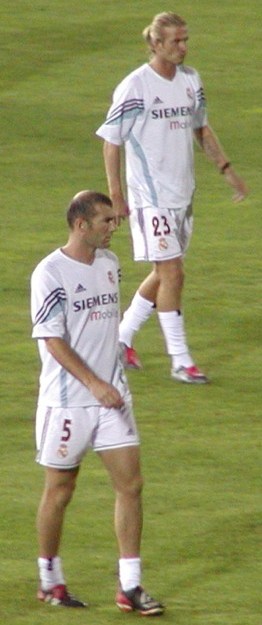
Galácticos (Spanish for galactics, referring to superstars) are expensive, world-famous football players recruited during the "galácticos" policy pursued by Florentino Pérez during his presidency at Real Madrid, where in his first tenure between 2000 and 2006, he purchased at least one galáctico in the summer of every year. The club's second galáctico era began in 2009 with Pérez's return to presidency, and is considered to be more successful both economically and in terms of on-pitch achievements.
The term itself carries both positive and negative connotations. Initially, it was used to emphasise the greatness of the superstar players being signed and the construction of a world-class team. Later, the term developed a more negative connotation, with galáctico becoming associated with prima donna and being used to deride the transfer policy and team built under it, following media perception that the policy at Real in the early 2000s had failed to deliver the expected levels of success.
The term has occasionally been used to describe other teams, both in football and in other sports, that have been perceived to follow a similar policy. For example, British rugby union commentator Martin Gillingham called French club Toulon "rugby's galácticos" in 2012 due to a wave of signings of international stars by owner Mourad Boudjellal.
Although the term was popularized in the 2000s, the origins of the Galáctico policy date as far back as the 1950s and 1960s, when the policy was first founded by club-president Santiago Bernabéu. Bernabéu signed multiple star players for large fees in quick succession, such as Alfredo Di Stéfano, Francisco Gento, Raymond Kopa, Héctor Rial, Ferenc Puskás and José Santamaría. This period of buying allowed Real Madrid to enjoy their finest era of dominance, winning twelve La Liga championships and six European Cups.
The Galácticos transfer policy was contrasted with the Quinta del Buitre era of the late 1980s. This saw Real Madrid playing a more physical and less appealing style of football, and had an increased emphasis on producing homegrown players such as Emilio Butragueño, Manolo Sanchís, Rafael Martín Vázquez, Míchel and Miguel Pardeza. This period allowed Real Madrid to also enjoy domestic and European success, winning five La Liga championships and two UEFA Cups.
The term Galácticos in reference to this team is often credited to Jaume Ortí, president of Valencia CF, who challenged Real Madrid to honours in the early 2000s. The term in general goes back further, with Mundo Deportivo finding a reference in 1988 describing FC Barcelona signing Julio Salinas as a Galáctico.
The first galáctico era is considered to be synonymous with the presidency of Florentino Pérez between 2000–2006, from the signing of Luís Figo in 2000, to the departure of Zinedine Zidane in 2006. The first Pérez era brought:
Several other players were often considered to be a part of the galácticos legacy due to their influence on the team during that period, despite being signed previously to the reign of Pérez, or being graduates of the youth system. These included:
Hub AI
Galácticos AI simulator
(@Galácticos_simulator)
Galácticos
Galácticos (Spanish for galactics, referring to superstars) are expensive, world-famous football players recruited during the "galácticos" policy pursued by Florentino Pérez during his presidency at Real Madrid, where in his first tenure between 2000 and 2006, he purchased at least one galáctico in the summer of every year. The club's second galáctico era began in 2009 with Pérez's return to presidency, and is considered to be more successful both economically and in terms of on-pitch achievements.
The term itself carries both positive and negative connotations. Initially, it was used to emphasise the greatness of the superstar players being signed and the construction of a world-class team. Later, the term developed a more negative connotation, with galáctico becoming associated with prima donna and being used to deride the transfer policy and team built under it, following media perception that the policy at Real in the early 2000s had failed to deliver the expected levels of success.
The term has occasionally been used to describe other teams, both in football and in other sports, that have been perceived to follow a similar policy. For example, British rugby union commentator Martin Gillingham called French club Toulon "rugby's galácticos" in 2012 due to a wave of signings of international stars by owner Mourad Boudjellal.
Although the term was popularized in the 2000s, the origins of the Galáctico policy date as far back as the 1950s and 1960s, when the policy was first founded by club-president Santiago Bernabéu. Bernabéu signed multiple star players for large fees in quick succession, such as Alfredo Di Stéfano, Francisco Gento, Raymond Kopa, Héctor Rial, Ferenc Puskás and José Santamaría. This period of buying allowed Real Madrid to enjoy their finest era of dominance, winning twelve La Liga championships and six European Cups.
The Galácticos transfer policy was contrasted with the Quinta del Buitre era of the late 1980s. This saw Real Madrid playing a more physical and less appealing style of football, and had an increased emphasis on producing homegrown players such as Emilio Butragueño, Manolo Sanchís, Rafael Martín Vázquez, Míchel and Miguel Pardeza. This period allowed Real Madrid to also enjoy domestic and European success, winning five La Liga championships and two UEFA Cups.
The term Galácticos in reference to this team is often credited to Jaume Ortí, president of Valencia CF, who challenged Real Madrid to honours in the early 2000s. The term in general goes back further, with Mundo Deportivo finding a reference in 1988 describing FC Barcelona signing Julio Salinas as a Galáctico.
The first galáctico era is considered to be synonymous with the presidency of Florentino Pérez between 2000–2006, from the signing of Luís Figo in 2000, to the departure of Zinedine Zidane in 2006. The first Pérez era brought:
Several other players were often considered to be a part of the galácticos legacy due to their influence on the team during that period, despite being signed previously to the reign of Pérez, or being graduates of the youth system. These included: