Hubbry Logo
OarOarMain
Open search
Oar
Community hub
Oar
logo
8 pages, 0 posts
0 subscribers
Be the first to start a discussion here.
Oar
Oar
from Wikipedia
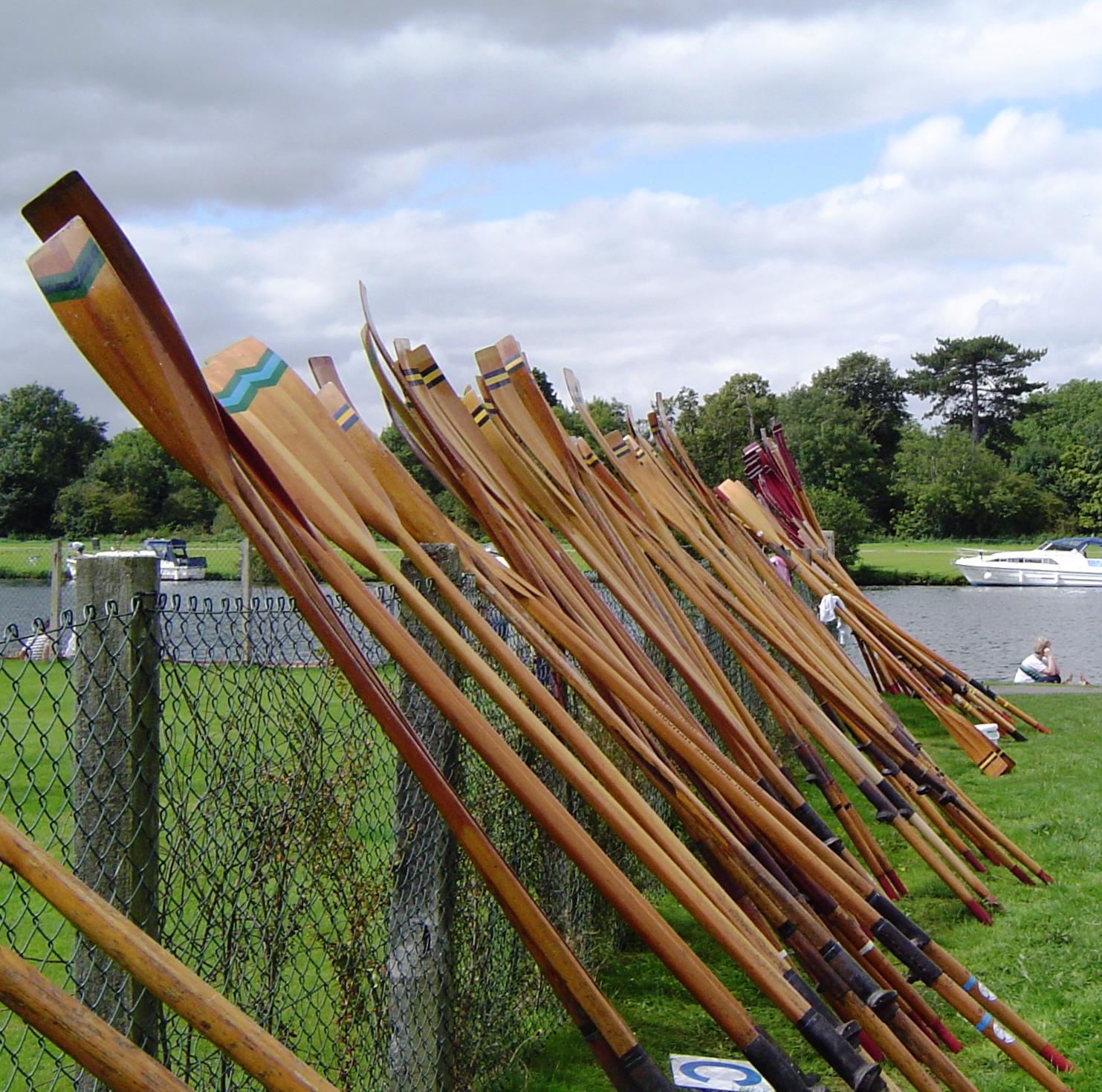
Traditional wooden oars

An oar is an implement used for water-borne propulsion. Oars have a flat blade at one end. Rowers grasp the oar at the other end.

The difference between oars and paddles is that oars are used exclusively for rowing. In rowing the oar is connected to the vessel by means of a pivot point for the oar, either an oarlock, or a thole. The oar is placed in the pivot point with a short portion inside the vessel, and a much larger portion outside. The rower pulls on the short end of the oar, while the long end is in the water. By contrast, paddles are held in both hands by the paddler, and are not attached to the vessel.

Rowers generally face the stern of the vessel, reach towards the stern, and insert the blade of their oar in the water. As they lean back, towards the vessel's bow, the blade of their oars pivots in the oarlock, and the end in the water moves towards the stern, providing forward thrust.

For thousands of years vessels were powered either by sails, or by the mechanical work of rowers, or by paddlers. It is common for an oar propelled vessel to also have the option to be powered by sail, both in antiquity (for instance the galley) and more recently.

History

[edit]

Rowing oars have been used since the early Neolithic period. Wooden oars, with canoe-shaped pottery, dating from 5000–4500 BC have been discovered in a Hemudu culture site at Yuyao, Zhejiang, in modern China.[1][2] In 1999, an oar measuring 63.4 cm (2 ft) in length, dating from 4000 BC, was unearthed in Ishikawa Prefecture, Japan.[3]

Athletes of the sport of rowing use oars to propel their racing shell.

Construction

[edit]

Oars have traditionally been made of wood. The form is a long shaft (or loom) with a flat blade on the end. Where the oar connects to the boat there is a "collar" (or button), often made of leather, which stops the oar slipping past the rowlock. Oars usually have a handle about 150mm long, which may be a material sleeve or alternatively an ovoid shape carved to fit the hands.

Physics

[edit]

Oars are levers. Which class of lever depends on the frame of reference. From the rower's perspective, the oar can be seen as a Class I lever. The oar is fixed in the oarlock, the rower pulls on the handle, and the blade moves in the opposite direction to propel the boat. The blade is further from the oarlock than the rower's hands. So, the heavy force of a short rowing motion becomes a smaller force over a greater distance.[4]

From an observer on the shore, the oar is instead a Class II lever. Here, the fulcrum is the blade, planted in the water. The rower pulls on the handle and the boat moves along with them. The "Class II" perspective is important to competitive rowing. Effective rowers learn to lever the boat past the end of the blade, rather than pulling the blade through the water.[4] The World Rowing Federation rulebook defines oars as Class II.[5]

Both the Class I and Class II perspectives can be used to calculate the forces on the rower, boat, and water, with equivalent results. The calculations are simpler for the Class I perspective. The mechanical advantage of the oar depends on the length of the oar from the oarlock to the blade, compared to the length from the oarlock to the rower's hand(s). The further away from the oarlock the blade is, the more difficult it is to row and the more distance each stroke will move.[4]

Balanced oar

[edit]

This is a normal, usually wooden oar to which weight has been added at the inboard end so that the blade end is noticeably lighter and easier for a rower to operate without fatigue. The two methods of adding weight are to either have a much larger section in the oar immediately next to the handle for a distance of about 450 millimetres (18 in) or to drill an 18-millimetre (0.71 in) hole inside the handle for a distance of about 150 millimetres (5.9 in) and add about 12 oz of lead secured by epoxy resin glue. For a 7-foot (2.1 m) oar the balance point is about 12 inches outboard of the rowlock. Often surplus wood is removed from the blade's width and thickness and at the neck between the blade and the shaft to further reduce outboard weight. As the rower is expending less energy accelerating the (now-reduced) mass of the oar back-and-forth, and will experience less fatigue constantly exerting downward force on the handle (vs. an unbalanced version) -- this type of oar is more efficient and thus preferable for long-range rowing.

Oars used for transport

[edit]

The oars used for transport come in a variety of sizes. The oars used in small dinghies or rafts can be less than 2 metres long. In classical times warships were propelled by very long oars that might have several oarsmen per oar. These oars could be more than a dozen metres long. According to Callixenus, as cited by Athenaeus, in the great ship of Ptolemy the oars of the upper tier were over 50 feet (15 m) in length with handles leaded so as to equalize the weight inboard and outboard.[6]

Oars used for competitive rowing

[edit]
A pair of carbon fibre sculling oars used for sport rowing

The oars used in competitive rowing are long (250–300 cm) poles with one flat end about 50 cm long and 25 cm wide, called the blade. The part of the oar the oarsman holds while rowing is called the handle. While rowing, the oars are supported by metal frames attached to the side of the boat called riggers, while the oar fits into the oarlocks at the ends of each rigger. Classic oars were made of wood, but modern oars are made from synthetic material, the most common being carbon fibre.

Oars used as trophies

[edit]

The sport of competitive rowing has developed a tradition of using an oar as a memento of significant race wins. A 'trophy oar' is not presented at the end of the race as a more familiar precious metal cup might be, but rather given by the club, school or university that the winning crew or rower represented.

Trophy oars of the seven founding member clubs of the Remenham Club

A trophy oar is a competition oar that has been painted in the club colours and has then had the details of the race signwritten on the face of the blade. The most common format has the coat of arms or crest of the club or school positioned in the centre, with the crew names and the race details arranged around this.

Many older universities (Oxford and Cambridge for example, as well as Yale and Harvard) and their colleges have long histories of using the trophy oar and many examples are on display in club houses around the world.

In culture

[edit]
Crossed silver oars in the coat of arms of Enonkoski

In Norway, both Fedje Municipality and Herøy Municipality both have oars in their coat of arms.

Oars have been used to describe various animals with characteristics that closely resemble the said rowing implement. The members of the Family Regalecidae, elongated deep-sea fishes, are called oarfish because their body shape is similar to that of an oar.[7] The hawksbill turtle's genus of Eretmochelys is derived from the Greek root eretmo, which roughly translates to oar. The turtle was so-named because of the oar-like shape of its front flippers.[8]

See also

[edit]

References

[edit]
[edit]
Revisions and contributorsEdit on WikipediaRead on Wikipedia
from Grokipedia
An oar is a long pole equipped with a broad, flat at one end, designed to propel or steer a through by acting as a when rowed by a operator. Unlike a paddle, which is freely held and maneuvered without attachment to the vessel, an oar is typically secured to the via an or that serves as a fulcrum, enabling greater leverage and in generating against the . This mechanical setup distinguishes oars primarily for applications in rowboats, canoes, or larger vessels, where the is repeatedly dipped and pulled to drive the craft forward. Oars represent one of humanity's earliest innovations for water navigation, with archaeological evidence indicating their use dating back to the early period in , around 7,000 years ago, and widespread adoption in ancient civilizations such as by around 3000 BCE for traversing the River. In classical antiquity, oars powered galleys in Greek and Roman navies, often manned by dozens of rowers to enable swift military and movements across the Mediterranean. Historically crafted from in one-piece constructions, In modern contexts, particularly the sport of , oars are categorized into two primary types: sweep oars, which are longer (approximately 12 feet) and used singly by each rower on one side of the boat, and scull oars, which are shorter (about 9.5 feet) and wielded in pairs, one per hand, for balanced propulsion. Contemporary oars have evolved to incorporate advanced materials such as carbon fiber shafts and composite blades, introduced in the 1970s by the Dreissigacker brothers, significantly reducing weight compared to traditional wooden models while enhancing durability and performance. These developments have optimized oars for competitive , where blade shapes—such as the "hatchet" or "spoon"—are tailored to maximize water displacement and minimize drag. Beyond sport, oars remain essential in recreational , rescue operations, and traditional crafts worldwide.

History

Origins and Early Use

The earliest archaeological evidence for oar-like tools dates to the Neolithic period in East Asia, particularly from the Hemudu culture in Zhejiang Province, China, where sites dating to approximately 5000–4500 BC have yielded remains of dugout canoes accompanied by wooden oars or paddles used for propulsion. These artifacts, unearthed alongside tools for woodworking and fishing, suggest that early communities relied on such implements to navigate inland waters and coastal areas for resource gathering and transport. The Hemudu findings represent one of the oldest confirmed instances of organized watercraft use in the region, highlighting the integration of boating into daily subsistence activities. In , evidence of early paddles and oar-like tools dates to the period, with wooden implements associated with dugouts from around 6000–4000 BC in sites such as those in and the . Similar evidence emerges from the in around 4000 BC, where excavations of coastal and lakeside settlements have uncovered wooden single-bladed paddles associated with dugout canoes, indicating propulsion methods for fishing and inter-island travel. These tools, often crafted from local hardwoods, facilitated movement across the Japanese archipelago's fragmented waterways during a time of increasing maritime adaptation among hunter-gatherer societies. In ancient Egypt, depictions from predynastic and early dynastic periods around 3000 BC illustrate rowed boats equipped with oars in scenes of riverine transport and ceremonial processions. In , evidence from around 3000 BC suggests the use of boats on the and rivers for , short-distance ferries, , and . These boats, typically simple in design with broad blades for propulsion, supported the vital role of riverine economies in sustaining urban centers like . The gradual shift from basic poles—used for punting in shallow waters—to more advanced bladed oars marked a key , enhancing propulsion efficiency by allowing greater leverage and forward thrust in deeper or faster currents. Early oars, distinct from handheld paddles, were often pivoted against the vessel's side for , enabling coordinated efforts by multiple users.

Evolution Through Maritime Eras

The evolution of oars in maritime contexts from ancient civilizations onward reflected adaptations to increasing vessel sizes and tactical demands in naval warfare and trade. Building on early Neolithic foundations where simple paddles transitioned to lever-like oars for propulsion, Greek triremes around the 5th century BC standardized oar designs to enhance coordinated rowing across large crews. These vessels featured oars up to 4.2 meters in length, arranged in three tiers (thranite, zygite, and thalamite) with one rower per oar, allowing multiple rowers per bench position to generate substantial thrust for speeds exceeding 7 knots in trials. Roman adoption of similar trireme designs in the 3rd century BC maintained this configuration, with epigraphic records confirming oar lengths of approximately 4 meters based on Attic cubit measurements. A key innovation during the Roman era was the use of leather oar-loops or collars attached to tholepins, which secured the oar while minimizing friction and preventing slippage during strokes; these were first documented in texts like Vitruvius's (late 1st century BC), influencing subsequent galley construction. By the medieval period, oars adapted to versatile longships used by from circa 800 to 1100 AD, where their primary role shifted toward enhancing maneuverability in shallow coastal and riverine waters rather than open-sea endurance. These clinker-built vessels, with shallow drafts under 1 meter, employed 16 to 30 oars per side for rapid beaching and tactical reversals, enabling raids far inland without relying solely on sails. During the Age of Sail's early transitions in the , oars persisted as essential backups in Mediterranean galleys, particularly Ottoman and Spanish designs, where calm winds or maneuvers demanded reliable human-powered . Ottoman galleys typically mounted approximately 50 oars (25 per side), each around 10 meters long and manned by two or three rowers, supporting crews of around 200 for sustained operations in the . Spanish galleys, such as the flagship La Real at Lepanto in 1571, featured similar setups with 48 to 60 oars exceeding 10 meters, often requiring three to five rowers per oar to maneuver 50- to 60-meter hulls when auxiliary sails failed. These adaptations underscored oars' enduring role in hybrid systems until full sail dominance in the .

Design and Construction

Materials and Components

Oars have traditionally been constructed from , with shafts typically made from lighter, flexible species such as or to allow for efficient energy transfer during strokes. Blades, in contrast, were crafted from harder woods like to provide durability and a strong grip on the in flat or shapes. In the , materials have shifted toward composites for enhanced . Carbon fiber, introduced in the mid-1970s by the Dreissigacker brothers, offers superior lightweight strength and rigidity, revolutionizing competitive by reducing fatigue and improving speed. provides a more affordable alternative with good durability, while hybrid designs combining wood elements with synthetic reinforcements are used in recreational settings for balanced cost and . Recent advancements as of 2024 include smart oars with embedded sensors for real-time metrics, further optimizing training and technique analysis. The primary structural components of an include the shaft, which extends from the handle to the transition; the , the inboard section that passes through the oarlock; the , featuring shapes like the curved for traditional water displacement or the flatter Macon for modern grip efficiency; and the collar, a protective ring of in traditional oars or synthetic materials in contemporary ones to prevent wear against the oarlock. Typical oar dimensions vary by application, with overall lengths ranging from 2 to 4 meters for most and uses, and handle sections approximately 150 in effective grip length to accommodate hand placement. Modern weighted designs briefly consider balance to optimize handling without altering core mechanics.

Types of Oars

Oars are categorized by their functional designs, which have evolved to suit specific contexts, from traditional fixed pivots to modern ergonomic adaptations. Historical variants include thole-pin oars, which feature a fixed pivot using paired wooden pins inserted into the , allowing the oar shaft to nestle between them for simple, low-tech propulsion in early boats like dories and skiffs. These differ from modern gated oarlocks, which incorporate a swiveling U-shaped with a spring-loaded gate to secure the oar collar, enabling smoother feathering and reduced risk of oar loss during dynamic , a development introduced in the late for racing shells and widely adopted in competitive and recreational vessels thereafter. A primary distinction lies between sculling and sweep oars, tailored to the number of oars per rower and boat configuration. oars, used in pairs by a single rower, measure approximately 2.5 to 3 meters in length, providing balanced leverage for precise control in smaller craft like single or double sculls. In contrast, sweep oars are longer, typically 3.5 to 4 meters, and employed singly per rower on one side of the boat, facilitating greater power in team events such as eights or fours. Balanced oars represent an innovation in competitive , with the inboard end weighted—often via inserts—to position the balance point near the oarlock, typically about 12-24 inches outboard from it, minimizing perceived weight and reducing rower over extended strokes. This design emerged in the mid-20th century as part of efforts to optimize in high-performance settings. For inclusive participation, adaptive oars have been developed since the , featuring shorter lengths and ergonomic elements like adjustable grips or looped aids to accommodate rowers with disabilities, enabling recreational and competitive access in fixed-seat or para- classes. These variations often incorporate material selections, such as lightweight composites, to enhance durability across specialized uses.

Physics and Mechanics

Lever Systems and Forces

An oar functions as a in the mechanical system of , with the classification depending on the observational perspective. From the rower's viewpoint within the boat's frame, the oar operates as a Class I , where the fulcrum is at the oarlock, the effort force is applied at the , and the load is the resistance encountered by the in the . Conversely, from the perspective of an observer on the riverbank, the oar acts as a Class II , with the serving as the fulcrum against the stationary , the effort applied at the , and the load at the oarlock as the boat is propelled forward. This dual interpretation highlights the relative motion between the boat and the in the propulsion . The of the oar, which determines the trade-off between amplification and , is governed by the of the lever arms. In the rower's Class I framework, the mechanical advantage for at the is given by MA=outboard [length](/page/Length)inboard [length](/page/Length)\text{MA} = \frac{\text{outboard [length](/page/Length)}}{\text{inboard [length](/page/Length)}}, where the outboard is the distance from the oarlock to the tip and the inboard is from the oarlock to the . Typical rigging configurations maintain an inboard-to-outboard of approximately 1:3, allowing the to exert greater on the relative to the rower's input at the , though this comes at the cost of reduced compared to movement. This is adjusted in practice to balance power application during the stroke. Force dynamics in the oar system involve the rower's pull at the handle generating torque around the oarlock pivot, which transfers motion to the blade immersed in water. The primary forces on the blade include hydrodynamic drag and lift from water resistance, with the oarlock providing the reaction force to constrain and redirect the oar's path. The rower's effort force EE at the handle relates to the load force LL at the blade via L=E(ab)L = E \left( \frac{a}{b} \right), where aa is the outboard length and bb is the inboard length, ensuring efficient propulsion through the stroke cycle. The recognition of oars as levers traces back to ancient , as discussed in the Mechanical Problems attributed to Aristotle's in the BCE, where the oarlock is identified as the fulcrum, the rower's as the effort, and the as the load, with longer inboard sections enhancing effectiveness for central rowers. Balance in the oar design aids in even distribution across the lever arms during application.

Efficiency and Balance

The efficiency of oar in depends on the effective transfer of the rower's power to forward boat motion, minimizing losses from oar drag, water displacement, and mechanical inefficiencies. , defined as the ratio of dissipated by boat drag to the total work performed by the rower (η = D_b / W_r, where D_b is boat drag and W_r is rower work), typically ranges from 70% to 80% in modern competitive setups, with averages around 77.6% observed in elite . An approximate model for force incorporates the rower's power input, the of the oar as a , and the boat's : F_p = (P_r × MA) / C_d, where F_p is force, P_r is rower power, MA is , and C_d is ; this highlights how optimized maximizes forward thrust while accounting for hydrodynamic losses. Oar balance, achieved through precise mass distribution along the shaft and , significantly influences overall efficiency by reducing inertial torque during the recovery phase, which allows for quicker blade extraction and faster rates without excessive rower effort. Poorly balanced oars increase energy losses due to heightened handling demands and disrupted rhythm. Key design factors affecting efficiency include blade entry angle, oarlock height, and spread (the distance between oar pivots). An optimal blade entry angle of 45-60° at the catch minimizes splash and turbulence, reducing drag and improving application during the drive. Proper oarlock height (typically 13-18 cm above the ) ensures ergonomic handle positioning to avoid undue wrist strain and optimize leverage, while an ideal spread of 44-48 inches balances load distribution for maximum without excessive gearing that reduces power transfer. Post-2000 computational models, including (CFD) simulations, have demonstrated that carbon fiber oars enhance efficiency by 10-15% over traditional wooden ones, primarily through reduced weight (up to 30% lighter) and tailored stiffness that minimizes flexural losses and improves energy storage during the stroke.

Applications

Transport and Navigation

Oars employed in transport and navigation span a range of sizes tailored to vessel scale and purpose. Short oars, typically under 2 meters in length, suit small dinghies and rafts for maneuverability in confined waters like harbors or inland lakes. In contrast, ancient warships such as Greek s and Roman galleys utilized longer oars, approximately 4.5 meters each, often handled by multiple rowers per oar in larger vessels to generate substantial thrust for open-sea or battle conditions. Historically, oars played a vital role in merchant and exploratory voyages where wind was unreliable. Roman merchant galleys, known as actuaria from the AD, combined oars with sails for efficient river navigation on waterways like the , enabling the transport of goods such as grain and timber upstream against currents. Similarly, Polynesian outrigger canoes relied on large steering paddles—broad-bladed and operated from the stern—for precise control during long-distance voyages across the Pacific, allowing navigators to maintain course amid variable winds and swells. These implements facilitated the settlement of remote islands by providing reliable propulsion in calm conditions, leveraging basic mechanics to convert human effort into forward motion. In contemporary settings, oars serve as auxiliary propulsion in sailboats and canoes, particularly as emergency backups when engines fail or winds die. Dinghies towed by larger sailboats often carry collapsible oars for short hauls to shore, ensuring self-sufficiency in remote anchorages. In motor-scarce regions like the , indigenous communities continue to rely on manual for riverine transport in dugout canoes to carry families, fish, and supplies along tributaries where fuel is costly or unavailable. Safety protocols underscore oar redundancy in maritime operations, especially following the 1912 Titanic disaster, which exposed inadequacies in life-saving equipment. The International Convention for the Safety of Life at Sea (SOLAS), established in 1914 and revised thereafter, mandates that lifeboats carry sufficient buoyant oars—along with thole pins or crutches for each—to achieve in calm , providing a manual fallback when primary propulsion fails. This requirement ensures redundancy for evacuation scenarios, reflecting lessons from Titanic's insufficient lifeboat provisions that contributed to over 1,500 fatalities.

Competitive and Recreational Rowing

Competitive rowing adheres to strict equipment standards set by World Rowing (formerly FISA) to ensure fairness and safety. For oars, lengths typically range from 288 to 298 cm, while sweep oars measure 372 to 382 cm, allowing for optimized leverage in various boat configurations (maximum lengths: 300 cm for sculls, 390 cm for sweeps per 2024 rules). Oar weights generally fall between 1.2 and 1.5 kg for sculls and up to 2 kg for sweeps in elite use, balancing power application with fatigue reduction. Riggers and swivels, integral for precise oar control, must comply with identification and design rules outlined in the World Rowing Rules of Racing (as of 2024), including limits on advertising space (e.g., max 100 sq cm for sponsor ID on sweep oars) and requirements for material integrity to prevent mechanical failures during races. Key techniques in competitive distinguish between sweep rowing, where each athlete handles one oar on alternate sides for coordinated propulsion, and , involving two oars per rower for balanced symmetry and higher maneuverability. During races, stroke rates vary from 20 to 40 per minute, starting higher (up to 45-50) for before settling into 36-40 for sustained speed in events like the men's eight or . These rates optimize power output and boat velocity over distances such as 2000 meters, with often demanding slightly higher cadences due to dual-oar coordination. Recreational emphasizes accessibility, often using durable oars in club settings for and casual participants. These oars, such as all- models weighing around 1.55 kg, provide affordability and resilience for non-competitive training and social outings. Adaptive programs, integrated into Paralympic since its debut in following post-1990s development of inclusive frameworks, incorporate modified oar lengths and grips—such as shorter shafts or added padding—to accommodate disabilities like limb differences or visual impairments. In the 2020s, modern trends include GPS-integrated training systems mounted on oars or oarlocks for real-time performance tracking, enabling data on efficiency and pace during sessions. Ergonomic oar designs, featuring adjustable and balanced , have advanced to prevent injuries like rib stress or shoulder impingement by reducing repetitive strain, as evidenced in recent biomechanical studies and optimizations. Transport oars from earlier eras served as precursors to these sport variants by establishing basic principles later refined for athletic precision.

Cultural and Symbolic Role

In Traditions and Heraldry

Oars have been incorporated into heraldic designs to symbolize maritime heritage, , and seafaring prowess, particularly in regions with strong boating traditions. For instance, the of , a historic English port town, displays four silver oars arranged in on an azure field, representing the community's long-standing role in fishing and trade across the . Similarly, in Scandinavian , oars appear in municipal arms to evoke coastal locations and historical reliance on waterborne transport. In folklore and mythology, oars often embody themes of transition, journey, and the boundary between worlds. In Greek mythology, Charon, the ferryman of the underworld, wields a long oar to transport souls across the River Acheron to Hades, a role first attested in ancient texts such as Plato's Republic and later elaborated in Virgil's Aeneid, where his grim figure underscores the inexorable passage from life to death. Norse sagas similarly depict oars as essential tools in epic sea voyages, symbolizing endurance and communal effort; in the Saga of the Volsungs and accounts of Viking explorations, rowers wielding oars propel longships through treacherous waters, reflecting the Norse valor in confronting the unknown seas. Indigenous traditions, particularly among the of , integrate carved oars into ceremonial practices that honor ancestry and spiritual connections. Hoe (paddles or oars) for waka (canoes) are often intricately carved with motifs representing ancestors, nature, and tribal identity, and are blessed during rituals such as the launching of a new vessel to invoke protection and unity; these ceremonies, rooted in pre-colonial customs, emphasize the oar's role as a link between the physical voyage and the spiritual realm. Such carvings transform the oar from a utilitarian object into a taonga (treasured possession) central to iwi (tribal) heritage. Beyond specific myths, oars serve as broader symbols of and perseverance in cultural and idioms. The English "pull together," derived from crews synchronizing their strokes to advance a boat, illustrates collective effort overcoming obstacles, much like "many hands make light work," which parallels the coordinated labor of rowers sharing the burden of . These expressions highlight the oar's metaphorical power to represent and shared endurance in human endeavors.

As Trophies and Modern Symbols

In rowing competitions, oars have long served as prestigious trophies, particularly through the tradition of painted presentation oars awarded to victors. At the , established in 1839, winners receive custom-decorated oars featuring the club's crest, the event name, and inscriptions detailing the , a practice that commemorates achievements and is preserved in club collections worldwide. In modern symbolism, oars appear in organizational emblems and natural nomenclature to evoke themes of propulsion and elegance. Similarly, the oarfish (Regalecus glesne), a deep-sea creature with elongated, oar-shaped pelvic fins, derives its common name from this resemblance, highlighting oars' influence beyond human contexts in biological descriptions. Oars feature prominently in 20th-century literature and film as metaphors for human struggle and endurance. In Ernest Hemingway's 1952 novella The Old Man and the Sea, the protagonist's repeated use of oars in his skiff underscores themes of isolation and perseverance against nature's forces. In the 1959 film Ben-Hur, the intense galley rowing scene parallels the later chariot race in rhythmic exertion, symbolizing coerced labor and redemption through synchronized effort. Post-2010s environmental movements have repurposed oars in eco-art to address . For instance, Lucy + Jorge Orta's 2011 installation Cloud - constructs a floating cloud-like structure from wooden oars and recycled water bottles, critiquing and . Concurrently, virtual oars have emerged in rowing simulations, enabling competitive indoor events; World Rowing's 2025 partnership with Ergatta advances this for the 2027 Olympic Esports Games, blending physical ergometers with digital interfaces for global participation.

References

Add your contribution
Related Hubs
User Avatar
No comments yet.