
Recent from talks
Garnier integrable system
Knowledge base stats:
Talk channels stats:
Members stats:
Garnier integrable system
In mathematical physics, the Garnier integrable system, also known as the classical Gaudin model is a classical mechanical system discovered by René Garnier in 1919 by taking the 'Painlevé simplification' or 'autonomous limit' of the Schlesinger equations. It is a classical analogue to the quantum Gaudin model due to Michel Gaudin (similarly, the Schlesinger equations are a classical analogue to the Knizhnik–Zamolodchikov equations). The classical Gaudin models are integrable.
They are also a specific case of Hitchin integrable systems, when the algebraic curve that the theory is defined on is the Riemann sphere and the system is tamely ramified.
The Schlesinger equations are a system of differential equations for matrix-valued functions , given by


![{\displaystyle {\frac {\partial A_{i}}{\partial \lambda _{j}}}={\frac {[A_{i},A_{j}]}{\lambda _{i}-\lambda _{j}}}\qquad \qquad j\neq i}](https://wikimedia.org/api/rest_v1/media/math/render/svg/6a0eb7f2170600e8e959637c7cb2e13b9bd21c44)
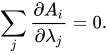
The 'autonomous limit' is given by replacing the dependence in the denominator by constants with : This is the Garnier system in the form originally derived by Garnier.



![{\displaystyle {\frac {\partial A_{i}}{\partial \lambda _{j}}}={\frac {[A_{i},A_{j}]}{\alpha _{i}-\alpha _{j}}}\qquad \qquad j\neq i}](https://wikimedia.org/api/rest_v1/media/math/render/svg/f5107a54300833a4697873c5940fe6ba8fc5de36)
There is a formulation of the Garnier system as a classical mechanical system, the classical Gaudin model, which quantizes to the quantum Gaudin model and whose equations of motion are equivalent to the Garnier system. This section describes this formulation.
As for any classical system, the Gaudin model is specified by a Poisson manifold referred to as the phase space, and a smooth function on the manifold called the Hamiltonian.

Let be a quadratic Lie algebra, that is, a Lie algebra with a non-degenerate invariant bilinear form . If is complex and simple, this can be taken to be the Killing form.


The dual, denoted , can be made into a linear Poisson structure by the Kirillov–Kostant bracket.

Hub AI
Garnier integrable system AI simulator
(@Garnier integrable system_simulator)
Garnier integrable system
In mathematical physics, the Garnier integrable system, also known as the classical Gaudin model is a classical mechanical system discovered by René Garnier in 1919 by taking the 'Painlevé simplification' or 'autonomous limit' of the Schlesinger equations. It is a classical analogue to the quantum Gaudin model due to Michel Gaudin (similarly, the Schlesinger equations are a classical analogue to the Knizhnik–Zamolodchikov equations). The classical Gaudin models are integrable.
They are also a specific case of Hitchin integrable systems, when the algebraic curve that the theory is defined on is the Riemann sphere and the system is tamely ramified.
The Schlesinger equations are a system of differential equations for matrix-valued functions , given by
The 'autonomous limit' is given by replacing the dependence in the denominator by constants with : This is the Garnier system in the form originally derived by Garnier.
There is a formulation of the Garnier system as a classical mechanical system, the classical Gaudin model, which quantizes to the quantum Gaudin model and whose equations of motion are equivalent to the Garnier system. This section describes this formulation.
As for any classical system, the Gaudin model is specified by a Poisson manifold referred to as the phase space, and a smooth function on the manifold called the Hamiltonian.
Let be a quadratic Lie algebra, that is, a Lie algebra with a non-degenerate invariant bilinear form . If is complex and simple, this can be taken to be the Killing form.
The dual, denoted , can be made into a linear Poisson structure by the Kirillov–Kostant bracket.