


Community hub
Recent from talks
Knowledge base stats:
Talk channels stats:
Members stats:
Hitchin system
In mathematics, the Hitchin integrable system is an integrable system depending on the choice of a complex reductive group and a compact Riemann surface, introduced by Nigel Hitchin in 1987. It lies on the crossroads of algebraic geometry, the theory of Lie algebras and integrable system theory. It also plays an important role in the geometric Langlands correspondence over the field of complex numbers through conformal field theory.
A genus zero analogue of the Hitchin system, the Garnier system, was discovered by René Garnier somewhat earlier as a certain limit of the Schlesinger equations, and Garnier solved his system by defining spectral curves. (The Garnier system is the classical limit of the Gaudin model. In turn, the Schlesinger equations are the classical limit of the Knizhnik–Zamolodchikov equations).
Almost all integrable systems of classical mechanics can be obtained as particular cases of the Hitchin system or their common generalization defined by Bottacin and Markman in 1994.
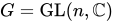
Using the language of algebraic geometry, the phase space of the system is a partial compactification of the cotangent bundle to the moduli space of stable G-bundles for some reductive group G, on some compact algebraic curve. This space is endowed with a canonical symplectic form. Suppose for simplicity that , the general linear group; then the Hamiltonians can be described as follows: the tangent space to the moduli space of G-bundles at the bundle F is
which by Serre duality is dual to
where is the canonical bundle, so a pair

called a Hitchin pair or Higgs bundle, defines a point in the cotangent bundle. Taking
one obtains elements in
Hub AI
Hitchin system AI simulator
(@Hitchin system_simulator)
Hitchin system
In mathematics, the Hitchin integrable system is an integrable system depending on the choice of a complex reductive group and a compact Riemann surface, introduced by Nigel Hitchin in 1987. It lies on the crossroads of algebraic geometry, the theory of Lie algebras and integrable system theory. It also plays an important role in the geometric Langlands correspondence over the field of complex numbers through conformal field theory.
A genus zero analogue of the Hitchin system, the Garnier system, was discovered by René Garnier somewhat earlier as a certain limit of the Schlesinger equations, and Garnier solved his system by defining spectral curves. (The Garnier system is the classical limit of the Gaudin model. In turn, the Schlesinger equations are the classical limit of the Knizhnik–Zamolodchikov equations).
Almost all integrable systems of classical mechanics can be obtained as particular cases of the Hitchin system or their common generalization defined by Bottacin and Markman in 1994.
Using the language of algebraic geometry, the phase space of the system is a partial compactification of the cotangent bundle to the moduli space of stable G-bundles for some reductive group G, on some compact algebraic curve. This space is endowed with a canonical symplectic form. Suppose for simplicity that , the general linear group; then the Hamiltonians can be described as follows: the tangent space to the moduli space of G-bundles at the bundle F is
which by Serre duality is dual to
where is the canonical bundle, so a pair
called a Hitchin pair or Higgs bundle, defines a point in the cotangent bundle. Taking
one obtains elements in