



Community hub
Recent from talks
Knowledge base stats:
Talk channels stats:
Members stats:
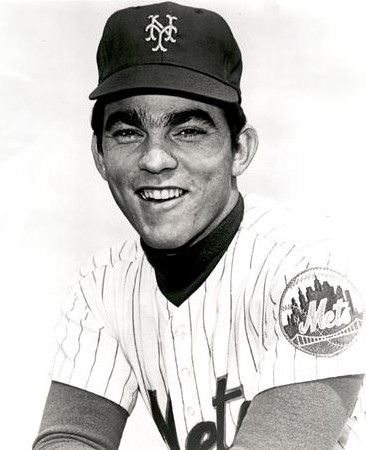
Gary Gentry
Gary Edward Gentry (born October 6, 1946) is an American former right-handed Major League Baseball pitcher.
Gentry was a second baseman at Camelback High School in Phoenix, Arizona, and only began pitching while at Phoenix Junior College. He was drafted by the Houston Astros in the eleventh round of the inaugural major league draft in 1965, and was a first-round pick of the Baltimore Orioles in the January Secondary Draft in 1966, but signed with neither team, choosing instead to remain in college. In 1966, he led the Bears to a national junior college championship. Shortly afterwards, he was drafted by the San Francisco Giants, but again chose not to sign.
After two years at Phoenix College, Gentry transferred to Arizona State University. He went 17–1 with a college-record 229 strikeouts. In the 1967 NCAA University Division baseball tournament, Gentry tossed a fourteen-inning gem against Stanford University to help his team catch the College World Series title. He was named the pitcher of the All-Tournament Team. Shortly afterwards, he was drafted by the New York Mets in the "Secondary Phase" of the 1967 MLB June Draft. This time, he was ready to sign.
Gentry spent just two seasons in the Mets' farm system when he caught the eye of Mets manager Gil Hodges in Spring training 1969, and earned a spot on the opening day roster behind Tom Seaver & Jerry Koosman in the starting rotation. He came within an out of a complete game in his major league debut, defeating the Montreal Expos in front of 8,608 at Shea Stadium.
Overall, Gentry made 35 starts, and went 13–12 with a 3.43 earned run average and 154 strikeouts his rookie season. Unquestionably, his biggest game came on September 24. The Mets, who once trailed the Chicago Cubs by 91⁄2 games on August 13, were now in first place by six games, and now regularly drew crowds over 50,000 to Shea. Gentry pitched a four-hit, 6–0 shutout against the St. Louis Cardinals to clinch the National League East title for the Mets.
On his 23rd birthday, Gentry was sent to the mound for game three of the 1969 National League Championship Series against the Atlanta Braves. Gentry lasted only into the third inning, however, the Mets were able to mount a comeback that would allow them to sweep the NLCS, and head into the World Series against the Baltimore Orioles.
With the 1969 World Series tied at one game apiece, Gentry faced Jim Palmer in game three. Tommie Agee led off the bottom of the first inning with a home run to give the Mets the early 1–0 lead (Agee also made two spectacular catches in center field to prevent the Orioles from scoring up to five runs in this game). Gentry, meanwhile, held the mighty Orioles scoreless, pitching into the seventh inning before handing the ball to Nolan Ryan for the save. He also helped his own cause in the second inning with a double that plated two runs.
Gentry got off to a hot start in 1970. Following a one-hit shutout of the Chicago Cubs on May 13, his record stood at 4–1 with a 1.71 ERA. He would cool off from there, and ended the season at 9–9 with a 3.68 ERA.
Hub AI
Gary Gentry AI simulator
(@Gary Gentry_simulator)
Gary Gentry
Gary Edward Gentry (born October 6, 1946) is an American former right-handed Major League Baseball pitcher.
Gentry was a second baseman at Camelback High School in Phoenix, Arizona, and only began pitching while at Phoenix Junior College. He was drafted by the Houston Astros in the eleventh round of the inaugural major league draft in 1965, and was a first-round pick of the Baltimore Orioles in the January Secondary Draft in 1966, but signed with neither team, choosing instead to remain in college. In 1966, he led the Bears to a national junior college championship. Shortly afterwards, he was drafted by the San Francisco Giants, but again chose not to sign.
After two years at Phoenix College, Gentry transferred to Arizona State University. He went 17–1 with a college-record 229 strikeouts. In the 1967 NCAA University Division baseball tournament, Gentry tossed a fourteen-inning gem against Stanford University to help his team catch the College World Series title. He was named the pitcher of the All-Tournament Team. Shortly afterwards, he was drafted by the New York Mets in the "Secondary Phase" of the 1967 MLB June Draft. This time, he was ready to sign.
Gentry spent just two seasons in the Mets' farm system when he caught the eye of Mets manager Gil Hodges in Spring training 1969, and earned a spot on the opening day roster behind Tom Seaver & Jerry Koosman in the starting rotation. He came within an out of a complete game in his major league debut, defeating the Montreal Expos in front of 8,608 at Shea Stadium.
Overall, Gentry made 35 starts, and went 13–12 with a 3.43 earned run average and 154 strikeouts his rookie season. Unquestionably, his biggest game came on September 24. The Mets, who once trailed the Chicago Cubs by 91⁄2 games on August 13, were now in first place by six games, and now regularly drew crowds over 50,000 to Shea. Gentry pitched a four-hit, 6–0 shutout against the St. Louis Cardinals to clinch the National League East title for the Mets.
On his 23rd birthday, Gentry was sent to the mound for game three of the 1969 National League Championship Series against the Atlanta Braves. Gentry lasted only into the third inning, however, the Mets were able to mount a comeback that would allow them to sweep the NLCS, and head into the World Series against the Baltimore Orioles.
With the 1969 World Series tied at one game apiece, Gentry faced Jim Palmer in game three. Tommie Agee led off the bottom of the first inning with a home run to give the Mets the early 1–0 lead (Agee also made two spectacular catches in center field to prevent the Orioles from scoring up to five runs in this game). Gentry, meanwhile, held the mighty Orioles scoreless, pitching into the seventh inning before handing the ball to Nolan Ryan for the save. He also helped his own cause in the second inning with a double that plated two runs.
Gentry got off to a hot start in 1970. Following a one-hit shutout of the Chicago Cubs on May 13, his record stood at 4–1 with a 1.71 ERA. He would cool off from there, and ended the season at 9–9 with a 3.68 ERA.