


Community hub
Recent from talks
Contribute something
Nothing was collected or created yet.
Garynahine
View on Wikipedia
Garynahine (Scottish Gaelic: Gearraidh na h-aibhne) is a settlement on Lewis, in the Outer Hebrides, Scotland. Garynahine is situated at a T-junction where roads from Stornoway, Uig and the west side of Lewis all meet. The roads are the A858 and the B8011.[1][2] Garynahine is within the parish of Uig.[3]
Key Information


Heritage Sites and Attractions
[edit]In the surrounding ares is the Garynahine Estate which was owned by Sir James Matheson from 1844 to 1917, before it was then sold it to Lord Leverhulme. It is currently operated as a sporting estate for hunting, shooting and fishing.[4] On the estate is Garynahine Lodge, a Category B listed building, which is a shooting lodge, since 1925, formerly the 19th century Garynahine Hotel and it may incorporate parts of the inn that existed there from at least 1720.[5][6]
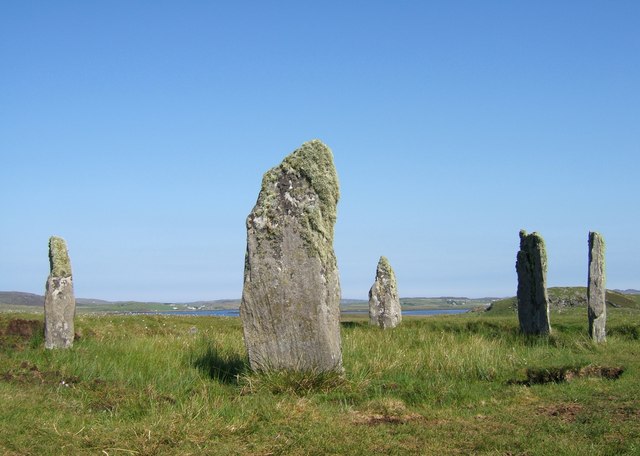
To the south of Garynahine are three scheduled monuments Cul a'Chleit, Airidh nam Bidearan and Sron a'Chail. Sron a'Chail is a circle of standing stones surrounding a burial cairn which dates to the late Neolithic or early Bronze Age. It consists of 5 upright and 1 fallen standing stone surrounding what appears to be a burial cairn.[7] It is better known as one of the outliers of the Callanish stones ('Ceann Hulavig'), specifically Callanish IV. It is also near a prehistoric quartz quarry.[8] Airidh nam Bidearan consists of three upright stone slabs and possibly to other nearby stones.[9] Cul a'Chleit is two standing stones on a rocky knoll. It is thought that the stones are probably the remains of a larger circle that was mostly destroyed by the construction of nearby shielings.[10]
Archaeology
[edit]In 2002, Mr Donald Angus Mackay, discovered a number of flat stone slabs, during annual peat cutting, that were thought to be a cist burial. However, excavations by Northamptonshire Archaeology, working for Glasgow University Archaeological Research Division (GUARD) as part of the Historic Scotland Human Remains Call Off Contract (now Historic Environment Scotland), discovered that it was in fact a pit containing what is believed to be a hazel wicker structure or basket. Analysis of the botanical remains indicated that heather and Sphagnum moss might have been incorporated into or deposited in the structure/basket. Radiocarbon dates suggesting the structure/basket was constructed and deposited during the Late Bronze Age.[11]
Images
[edit]-
 Abhainn Dhubh. The river Blackwater at Garynahine.
 -
 Callanish IV
 -
 Track to Eitshal


References
[edit]- ^ "A858". Sabre. Retrieved 23 December 2014.
- ^ "B8011". Sabre. Retrieved 23 December 2014.
- ^ "Details of Garrynahine". Scottish Places. Retrieved 23 December 2014.
- ^ "Garynahine Estate, Isle of Lewis - Tasglann nan Eilean Siar". ica-atom.tasglann.org.uk. Retrieved 29 July 2021.
- ^ Historic Environment Scotland. "Lewis, Garynahine Lodge (Site no. NB23SW 72)". Retrieved 23 June 2025.
- ^ Historic Environment Scotland. "GARRYNAHINE LODGE (LB19266)". Retrieved 29 July 2021.
- ^ Historic Environment Scotland. "Sron a'Chail,stone circle and cairn 450m SSE of Ceann Hulavig (SM5457)". Retrieved 29 July 2021.
- ^ "Vol 11 (2004): The worked quartz vein at Cnoc Dubh, Uig parish, Isles of Lewis, Western Isles: presentation and discussion of a small prehistoric quarry | Scottish Archaeological Internet Reports". journals.socantscot.org. Retrieved 27 July 2021.
- ^ Historic Environment Scotland. "Airidh nam Bidearan,standing stones N of (SM6018)". Retrieved 29 July 2021.
- ^ Historic Environment Scotland. "Cul a'Chleit,standing stones,Garynahine (SM6019)". Retrieved 29 July 2021.
- ^ "Vol 19 (2006): Excavation of a Bronze Age wicker container, Gearraidh na h'Aibhne, Isle of Lewis | Scottish Archaeological Internet Reports". journals.socantscot.org. Retrieved 28 July 2021.
External links
[edit]- Historic Environment Scotland. "Lewis, Garynahine (Site no. NB23SW 49)".
- Historic Environment Scotland. "Lewis, Garynahine, Airidh Nam Bidearan, 'Tursachan' (Site no. NB22NW 1)".
- Historic Environment Scotland. "Lewis, Garynahine, 'Tursachan' (Site no. NB23SW 4)".