Hubbry Logo
search
logo

Gate capacitance

logo
Community Hub0 Subscribers
Read side by side
from Wikipedia

In electronics, gate capacitance is the capacitance of the gate terminal of a field-effect transistor (FET). It can be expressed as the absolute capacitance of the gate of a transistor, or as the capacitance per unit area of an integrated circuit technology, or as the capacitance per unit width of minimum-length transistors in a technology.

In generations of approximately Dennard scaling of metal-oxide-semiconductor FETs (MOSFETs), the capacitance per unit area has increased inversely with device dimensions. Since the gate area has gone down by the square of device dimensions, the gate capacitance of a transistor has gone down in direct proportion with device dimensions. With Dennard scaling, the capacitance per unit of gate width has remained approximately constant; this measurement can include gate–source and gate–drain overlap capacitances. Other scalings are not uncommon; the voltages and gate oxide thicknesses have not always decreased as rapidly as device dimensions, so the gate capacitance per unit area has not increased as fast, and the capacitance per transistor width has sometimes decreased over generations.[1]

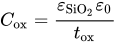
The intrinsic gate capacitance (that is, ignoring fringing fields and other details) for a silicon-dioxide-insulated gate can be calculated from thin-oxide capacitance per unit area as:

where:[2]

  • AG is the gate area
  • is the thin-oxide capacitance per unit area, where

References

[edit]
Revisions and contributorsEdit on WikipediaRead on Wikipedia
from Grokipedia
Gate capacitance refers to the electrical capacitance between the gate electrode and the underlying semiconductor channel in a metal-oxide-semiconductor field-effect transistor (MOSFET), primarily determined by the thin insulating oxide layer that separates them.[1] This capacitance, often denoted as CgC_g or CoxC_{ox}, is calculated as Cg=CoxWLC_g = C_{ox} \cdot W \cdot L, where Cox=ϵox/toxC_{ox} = \epsilon_{ox} / t_{ox} is the oxide capacitance per unit area, ϵox\epsilon_{ox} is the permittivity of the oxide, toxt_{ox} is the oxide thickness, WW is the channel width, and LL is the channel length.[2] In MOSFET operation, gate capacitance enables control of the channel conductivity through applied voltage, forming the basis for amplification and switching functions in integrated circuits.[1] The total gate capacitance comprises several components that vary with bias conditions and operating regions of the transistor. In the cutoff region, it includes gate-to-body capacitance (CGB=CoxWLeffC_{GB} = C_{ox} \cdot W \cdot L_{eff}) and overlap capacitances (CGSOC_{GSO} and CGDOC_{GDO}).[2] During linear operation, the channel capacitance splits roughly equally between gate-to-source (CGSC_{GS}) and gate-to-drain (CGDC_{GD}), each approximately 12CoxWLeff\frac{1}{2} C_{ox} \cdot W \cdot L_{eff}.[2] In saturation, CGSC_{GS} dominates as 23CoxWLeff+CoxWxd\frac{2}{3} C_{ox} \cdot W \cdot L_{eff} + C_{ox} \cdot W \cdot x_d, where xdx_d is the overlap length, while CGDC_{GD} is minimized, reducing the Miller effect that amplifies effective input capacitance in amplifiers.[2] These voltage-dependent behaviors are characterized through capacitance-voltage (C-V) measurements, where the MOS structure exhibits accumulation (high capacitance ≈ CoxC_{ox}), depletion (decreasing to a minimum), and inversion (recovering to ≈ CoxC_{ox}) regimes.[1] Gate capacitance plays a critical role in the performance of CMOS circuits by influencing switching speed, dynamic power dissipation, and overall efficiency. It contributes significantly to the total load capacitance (CLC_L) in logic gates, where delay scales linearly with CLC_L according to models like τDRCL\tau_D \approx R \cdot C_L, with RR being the effective resistance of the pull-up or pull-down network. Higher gate capacitance increases the energy required to charge and discharge the gate during transitions, elevating dynamic power consumption proportional to CV2fC V^2 f, where VV is supply voltage and ff is frequency. In nanoscale devices, reducing gate capacitance through thinner oxides or high-k dielectrics enables faster operation and lower power, though it introduces challenges like increased gate leakage.[1] Accurate modeling of these capacitances is essential for circuit simulation and optimization in VLSI design.

Fundamentals

Definition and Basic Concept

Gate capacitance refers to the capacitive coupling between the gate electrode and the underlying semiconductor in field-effect transistors (FETs), primarily arising from the gate insulator layer that separates the gate from the channel region. This capacitance enables electrostatic control of the charge carriers in the semiconductor, forming the basis for modulating the transistor's conductivity. In metal-oxide-semiconductor field-effect transistors (MOSFETs), it is modeled as the equivalent capacitance at the gate terminal, representing the ability to store charge in response to applied voltage.[3] The foundational model for gate capacitance is the simple parallel-plate capacitor approximation, where the gate electrode and the semiconductor surface act as the two plates, with the insulator serving as the dielectric. The total gate capacitance CgC_g is quantified by the formula
Cg=ϵAtox, C_g = \frac{\epsilon A}{t_{ox}},
where ϵ\epsilon is the permittivity of the insulator, AA is the effective gate area, and toxt_{ox} is the thickness of the oxide (or insulator) layer. This model provides the starting point for understanding how voltage applied to the gate induces charge in the channel, controlling current flow between source and drain. The capacitance is often expressed in farads (F) for the total device or normalized as capacitance per unit area in F/cm² to facilitate comparisons across different geometries.[3] The concept of gate capacitance emerged in the context of MOSFET development during the late 1950s and early 1960s at Bell Laboratories, where researchers Dawon Kahng and Mohamed M. Atalla fabricated the first working silicon MOSFET devices in 1960. Their work built upon earlier studies of metal-oxide-semiconductor (MOS) capacitors, which demonstrated stable silicon-silicon dioxide interfaces through thermal oxidation techniques pioneered by Atalla. This historical advancement established gate capacitance as a critical parameter for reliable FET operation, paving the way for integrated circuit scaling.[4][5]

Physical Origin in Semiconductors

Gate capacitance in semiconductors arises from the electrostatic interaction at the metal-insulator-semiconductor (MIS) interface, where an applied gate voltage modulates the charge distribution within the semiconductor substrate. In a typical MOS structure, the semiconductor (often p-type silicon) responds to the voltage by forming distinct layers near the insulator-semiconductor boundary. For negative gate voltages relative to the flat-band condition, an accumulation layer forms, where majority carriers (holes) are attracted to the interface, increasing their concentration exponentially and enabling efficient charge storage akin to a parallel-plate capacitor. As the voltage becomes positive, a depletion layer develops, repelling majority carriers and creating a region of exposed, ionized dopants that widens with increasing voltage, reducing the effective charge storage capacity. At sufficiently positive voltages, an inversion layer emerges, where minority carriers (electrons) accumulate at the surface, bending the energy bands to favor their inducement and restoring high capacitance levels. These layers result in variable charge storage, fundamentally distinguishing MOS capacitance from fixed-value capacitors.[1][6] The initial capacitance is influenced by the work function difference between the gate material and the semiconductor, which determines the flat-band voltage and aligns the Fermi levels across the structure. The work function, defined as the energy required to remove an electron from the Fermi level to vacuum, varies with material properties; for instance, n+-polysilicon gates exhibit a work function of approximately 4.05 eV, while p-type silicon's is higher due to its doping. This difference, denoted as φ_ms, shifts the energy bands even at zero bias, setting the baseline for charge inducement. Fermi level alignment ensures thermal equilibrium in the bulk but leads to potential barriers at the interface, modulated by the insulator's properties. These factors establish the starting point for voltage-induced changes, with seminal demonstrations of stable Si-SiO₂ interfaces enabling reliable capacitance control.[1][6][4] Quantum mechanical effects further shape charge inducement through the semiconductor's bandgap and density of states, which dictate available energy levels for carriers. The bandgap energy (∼1.12 eV for silicon) limits carrier excitation, while the density of states—higher in the conduction band for electrons—governs how efficiently minority carriers populate the inversion layer. Under bias, band bending occurs qualitatively at the interface: in accumulation or inversion, bands curve toward the Fermi level to increase carrier density near the surface; in depletion, they curve away, creating a potential well that depletes carriers. This bending, driven by the surface potential ψ_s, reflects the electric field's penetration into the semiconductor, altering local carrier concentrations without uniform distribution. Unlike ideal capacitors with uniform charge sheets, the non-uniform charge profile in the semiconductor—peaking sharply near the interface and decaying exponentially—necessitates defining capacitance as the differential quantity dQ/dV, representing the incremental charge response to a small voltage change and capturing the structure's voltage-dependent behavior.[1][6]

Components in Transistors

Gate Oxide Capacitance

The gate oxide capacitance, denoted as CoxC_{ox}, represents the primary capacitive element between the gate electrode and the channel in a metal-oxide-semiconductor field-effect transistor (MOSFET). It arises from the insulating dielectric layer, typically silicon dioxide (SiO2_2) in early devices, and is calculated using the parallel-plate capacitor formula:
Cox=ϵoxAtox C_{ox} = \frac{\epsilon_{ox} A}{t_{ox}}
where ϵox\epsilon_{ox} is the permittivity of the oxide, AA is the gate area, and toxt_{ox} is the physical thickness of the oxide layer. For SiO2_2, ϵox=3.9ϵ0\epsilon_{ox} = 3.9 \epsilon_0, with ϵ0=8.85×10¹²\epsilon_0 = 8.85 \times 10^{-12} F/m being the vacuum permittivity. This capacitance directly controls the amount of charge induced in the semiconductor channel by the gate voltage, thereby modulating the transistor's conductivity and enabling its switching operation.[2][1][7] In the evolution of MOSFET technology, SiO2_2 served as the gate dielectric from the 1960s through the 1990s due to its excellent electrical properties and compatibility with silicon processing. However, as device scaling progressed into the sub-100 nm regime in the early 2000s, the need for thinner oxides to maintain high CoxC_{ox} led to increased quantum mechanical tunneling currents and reliability degradation. To address this, high-k dielectrics—materials with relative permittivities greater than that of SiO2_2—were introduced, with hafnium oxide (HfO2_2) emerging as a leading candidate around 2007 for its high dielectric constant (k2025k \approx 20-25) and thermal stability. This transition allowed for physically thicker layers that preserved capacitance while reducing leakage, as implemented in Intel's 45 nm process node.[8][9][10] To compare the capacitive performance of high-k materials with traditional SiO2_2, the equivalent oxide thickness (EOT) is used, defined as:
EOT=tphys×ϵSiO2ϵhigh-k \text{EOT} = t_{\text{phys}} \times \frac{\epsilon_{\text{SiO}_2}}{\epsilon_{\text{high-k}}}
where tphyst_{\text{phys}} is the physical thickness of the high-k layer and ϵSiO2/ϵ0=3.9\epsilon_{\text{SiO}_2} / \epsilon_0 = 3.9. This metric expresses the effective thickness as if the dielectric were SiO2_2, enabling direct scaling assessments; for instance, a 3 nm HfO2_2 layer can yield an EOT of approximately 0.5 nm (using k24k \approx 24). High-k integration often involves interfacial layers to mitigate defects, but achieving sub-1 nm EOT remains challenging for continued scaling in production devices, though research has demonstrated values as low as 0.67 nm in specialized structures as of 2025.[11][12][13] Despite these advances, ultra-thin oxides below 2 nm, whether SiO2_2 or high-k equivalents, suffer from significant direct tunneling currents that increase gate leakage and degrade device reliability. These currents, dominated by electron injection through the barrier, lead to issues such as stress-induced leakage current (SILC) and time-dependent dielectric breakdown (TDDB), limiting operational lifetime under high-field conditions. Studies on 1.4-2 nm oxides have shown that while tunneling can be modeled, it imposes fundamental limits on further thinning without alternative materials or architectures.[14][15][16]

Overlap and Fringing Capacitances

In metal-oxide-semiconductor field-effect transistors (MOSFETs), overlap capacitances arise from the physical extension of the gate electrode beyond the channel edges into the source and drain regions, creating parallel-plate capacitive coupling. This extrinsic component, denoted as ColC_{ol}, is given by Col=ϵoxWLov/toxC_{ol} = \epsilon_{ox} \cdot W \cdot L_{ov} / t_{ox}, where ϵox\epsilon_{ox} is the permittivity of the gate oxide, WW is the channel width, LovL_{ov} is the overlap length on each side, and toxt_{ox} is the oxide thickness.[2] These capacitances contribute significantly to the total gate-to-source (CgsC_{gs}) and gate-to-drain (CgdC_{gd}) capacitances, particularly in short-channel devices where LovL_{ov} becomes comparable to the effective channel length.[17] Fringing capacitances, another parasitic element, originate from electric field lines that curve around the gate edges rather than passing directly through the oxide, primarily at the gate sidewalls and between the gate and source/drain extensions. These fields are not confined to the flat oxide area and are modeled as a geometry-dependent term often on the order of 0.2–0.5 fF/μm of width, though more precise formulations employ conformal mapping techniques to account for the non-uniform field distribution.[17] In advanced models like BSIM3, fringing capacitance is bias-independent for the outer component and calculated as CF=ϵoxπln(tg+toxtox)WC_F = \frac{\epsilon_{ox}}{\pi} \ln\left(\frac{t_g + t_{ox}}{t_{ox}}\right) \cdot W, where tgt_g is the gate height, highlighting its dependence on vertical dimensions.[17] Modern fabrication processes incorporate gate sidewall spacers—typically silicon nitride or low-k dielectrics deposited after gate formation—to define lightly doped drain (LDD) regions, which reduce the overlap length LovL_{ov} by controlling dopant implantation and thus minimizing short-channel effects. However, thicker or higher-k spacers can enhance fringing fields at the gate edges, partially offsetting the overlap reduction and increasing the overall parasitic capacitance.[18] This trade-off is critical in sub-100 nm nodes, where spacers enable reliable scaling but demand optimized materials to balance capacitance and reliability.[19] The total gate capacitance integrates these parasitics with the intrinsic oxide capacitance as Cg,total=Cox+2Col+CfringeC_{g,total} = C_{ox} + 2C_{ol} + C_{fringe}, where CoxC_{ox} is the channel-area component; as transistor dimensions scale, the relative contribution of 2Col+Cfringe2C_{ol} + C_{fringe} grows, potentially comprising 20–50% of Cg,totalC_{g,total} in nanoscale devices and limiting switching speeds.[2][17]

Dependence on Operating Conditions

Bias Voltage Effects

In metal-oxide-semiconductor (MOS) structures, the gate capacitance exhibits distinct variations with applied bias voltage, as characterized by capacitance-voltage (C-V) measurements. For a p-type substrate, when the gate voltage $ V_g $ is sufficiently negative relative to the flat-band voltage $ V_{fb} $, the surface enters accumulation, where majority carriers (holes) accumulate at the oxide-semiconductor interface, resulting in a capacitance $ C_{acc} $ approximately equal to the oxide capacitance $ C_{ox} = \epsilon_{ox} / t_{ox} $. As $ V_g $ increases toward positive values, the device transitions to depletion, where the capacitance decreases to a minimum due to the widening depletion region, forming a series combination with $ C_{ox} $: $ C_{dep} = \frac{C_{ox} C_{d}}{C_{ox} + C_{d}} $, with the depletion capacitance $ C_{d} = \epsilon_{si} / W_d $.[1][20] The depletion width $ W_d $ under bias is given by $ W_d = \sqrt{ \frac{2 \epsilon_{si} \phi_s }{q N_a} } $, where $ \phi_s $ is the surface potential that increases with $ V_g $, $ \epsilon_{si} $ is the permittivity of silicon, $ q $ is the elementary charge, and $ N_a $ is the acceptor doping concentration; this widening continues until the onset of inversion near the threshold voltage $ V_{th} $, where minority carriers (electrons) begin to form an inversion layer, marking the transition point for capacitance recovery. Beyond $ V_{th} $, in strong inversion, the inversion layer shields the depletion region, restoring the capacitance to approximately $ C_{inv} \approx C_{ox} $. The threshold voltage $ V_{th} $ thus defines the key transition, influencing the bias range over which capacitance varies significantly, with $ V_{th} = V_{fb} + 2\phi_f + \frac{\sqrt{4 \epsilon_{si} q N_a \phi_f }}{C_{ox}} $ for ideal p-type MOS capacitors, where $ \phi_f $ is the Fermi potential.[1][21] In the weak inversion regime, between depletion and strong inversion (typically $ V_{fb} + \phi_s < V_g < V_{th} $), partial channel formation leads to a gradual increase in capacitance as minority carrier density rises exponentially with gate overdrive, resulting in a logarithmic-like rise toward $ C_{ox} $ due to the sub-exponential response of inversion charge to bias. This region is critical for understanding low-power device behavior, where the capacitance reflects the onset of diffusion-dominated minority carrier response.[22] Hysteresis in C-V curves arises from charge trapping at the oxide-semiconductor interface or in near-interface oxide traps, causing a shift in the curve during forward and reverse voltage sweeps; this is quantified by the flat-band voltage shift $ \Delta V_{fb} $, which measures the voltage difference between upward and downward sweeps at constant capacitance, often on the order of 10-100 mV for devices with interface trap densities $ D_{it} $ exceeding $ 10^{11} $ cm2^{-2} eV1^{-1}. Interface traps, with energy levels within the bandgap, capture and emit carriers in response to bias changes, leading to slower response times and observable hysteresis, particularly under stress biases that fill traps.[23][24]

Frequency and Temperature Influences

In metal-oxide-semiconductor (MOS) structures, the gate capacitance exhibits significant frequency dependence, particularly in the inversion regime where minority carriers play a key role in charge response. At low frequencies, typically below 1 kHz, the minority carriers can fully respond to the alternating current (AC) signal, allowing the gate capacitance to approach the oxide capacitance value, $ C_{\text{low-f}} \approx C_{\text{ox}} $. This quasi-static behavior ensures that the inversion layer charge adjusts rapidly enough to maintain equilibrium.[1] At higher frequencies, exceeding 1 MHz, the finite response time of minority carriers prevents them from following the AC signal, resulting in a reduced gate capacitance, $ C_{\text{high-f}} < C_{\text{ox}} $. In this case, the measured capacitance reflects the series combination of the oxide capacitance and the semiconductor depletion capacitance, as the inversion charge lags behind. The transition from low- to high-frequency regimes occurs around a characteristic angular frequency $ \omega_c \approx 1/\tau $, where $ \tau $ represents the minority carrier lifetime, typically on the order of microseconds in silicon. This frequency-dependent behavior is critical for understanding dynamic device operation beyond static conditions.[1][25] High-frequency capacitance measurements are further complicated by series resistance effects, such as those from contacts, bulk material, and probe parasitics, which introduce additional impedance and cause an underestimation of the true capacitance value. These resistances lead to a phase shift in the AC signal, effectively rolling off the apparent capacitance, especially in structures with high leakage or thin oxides. Correction techniques, including multi-frequency analysis or conductance methods, are often required to mitigate this artifact and extract accurate parameters.[26][27] Temperature variations influence gate capacitance primarily through changes in the intrinsic carrier concentration $ n_i $, which affects the depletion region width in the semiconductor. As temperature increases, $ n_i $ rises exponentially, narrowing the depletion width and altering the effective capacitance; however, in practice for silicon devices, the overall gate capacitance exhibits only a weak temperature dependence, typically showing a slight decrease due to combined impacts on carrier statistics and dielectric properties. This effect is more pronounced in the depletion and weak inversion regimes.[28][29] In radio-frequency (RF) applications, the high-frequency gate capacitance imposes key limitations on MOSFET performance, reducing the unity-current-gain frequency $ f_T = g_m / (2\pi C_g) $ and thereby constraining maximum gain. Additionally, the frequency-dependent capacitance contributes to elevated noise figures in RF amplifiers, as induced gate noise correlates with gate-drain and gate-source components, degrading signal-to-noise ratios at gigahertz frequencies. These effects necessitate careful modeling for RF circuit design, particularly in scaled technologies.[30][31]

Measurement and Modeling

Experimental Techniques

One primary experimental technique for characterizing gate capacitance in MOSFETs is capacitance-voltage (C-V) profiling, which involves applying a DC bias sweep across the gate while superimposing a small AC signal to measure the resulting capacitance. This method typically uses semiconductor parameter analyzers such as the HP 4155 or its successor, the Keysight B1500A, to apply the bias sweep and AC perturbation, with signal amplitudes of 10-50 mV and frequencies ranging from 1 kHz to 1 MHz.[32][33] The resulting C versus V plot enables extraction of key parameters including oxide capacitance CoxC_{ox}, threshold voltage VthV_{th}, and indicators of oxide integrity such as flat-band voltage shifts.[34] To isolate intrinsic gate capacitance from extrinsic components like overlap and fringing capacitances, the split-C-V method is employed by fabricating transistors with varying gate lengths and measuring total gate capacitance as a function of gate length. By plotting the measured capacitance against gate length and extrapolating to zero length, the intrinsic capacitance is obtained, while the slope reveals extrinsic contributions.[35] This approach is particularly useful for submicron devices, where extrinsic effects dominate short-channel behavior.[36] Accurate extraction faces challenges from parasitic probe capacitances and gate leakage currents, especially in thin-oxide devices. Parasitic capacitances from probes and cabling, often on the order of picofarads, are subtracted by performing open-circuit measurements prior to device testing and deducting the baseline from the total measured capacitance.[37] For gate leakage correction in ultra-thin oxides, the conductance method is applied, where the parallel conductance GpG_p is measured as a function of angular frequency ω\omega, and the leakage is quantified via the peak value of Gp/ωG_p / \omega to adjust the apparent capacitance without significant distortion.[38][39] For high-frequency characterization up to the GHz range, non-destructive microwave C-V techniques utilize vector network analyzers to probe capacitance under RF conditions, mitigating issues like series resistance effects that plague low-frequency methods in advanced nodes. These approaches enable evaluation of frequency-dependent behaviors in operational regimes, such as inversion layer dynamics.[40][41]

Analytical and Simulation Models

Analytical models for gate capacitance in MOSFETs range from simple approximations suitable for basic digital circuit simulations to more sophisticated formulations that account for bias, frequency, and geometry effects. The Meyer model, introduced in 1971, treats gate capacitances as piecewise linear functions of terminal voltages, dividing operation into cutoff, linear, and saturation regions with fixed values such as Cgb=CoxC_{gb} = C_{ox} in cutoff and Cgs=Cox/2C_{gs} = C_{ox}/2, Cgd=Cox/2C_{gd} = C_{ox}/2 in linear mode.[42] This approach assumes constant or voltage-stepped capacitances, enabling efficient simulations in tools like SPICE but lacking detailed physical dependencies, which can lead to charge non-conservation issues in transient analyses. Advanced compact models, such as those in the BSIM family, provide bias-dependent descriptions of total gate capacitance CgC_g, incorporating intrinsic channel capacitances and extrinsic overlap components. In BSIM4, the capacitance model (controlled by parameter capMod, default 2) uses a charge-thickness approach for smooth transitions across accumulation, depletion, and inversion, with effective oxide capacitance Coxeff=Coxe/(1+CoxeXDC/ϵsi)C_{oxeff} = C_{oxe} / (1 + C_{oxe} \cdot X_{DC} / \epsilon_{si}), where XDCX_{DC} adjusts for charge layer thickness based on surface potential.[43] Bias effects are captured through voltage terms like Vgsteff,CVV_{gsteff,CV}, while overlap capacitances include gate-source/drain contributions modulated by parameters such as CKAPPAS, e.g., Qs,overlap=Wactive[CGSO+CGSL(1+(Vgs,overlapCKAPPAS)4)1/2]Q_{s,overlap} = W_{active} \cdot [CGSO + CGSL \cdot (1 + (V_{gs,overlap} - CKAPPAS)^4)^{-1/2}]. Frequency dependence is addressed via non-quasi-static (NQS) extensions in BSIM, though static models predominate for DC capacitance predictions.[43] These models enable accurate prediction of partial depletion scenarios, where CgC_g reduces from CoxC_{ox} due to incomplete channel inversion. Numerical simulations employ technology computer-aided design (TCAD) tools like Synopsys Sentaurus and Silvaco Atlas to compute gate capacitance by solving the Poisson equation (ϵϕ)=ρ\nabla \cdot (\epsilon \nabla \phi) = -\rho alongside drift-diffusion or hydrodynamic transport equations using finite element or finite volume methods. Capacitance is derived from charge-voltage characteristics (C=dQ/dVC = dQ/dV) or small-signal AC analysis, which perturbs voltages to extract admittance matrices and decompose into real (conductance) and imaginary (capacitance) parts.[44] These approaches capture 2D/3D effects like fringing fields, validating against experimental CV curves for devices down to 10 nm scales.[45] Variability in gate capacitance arises from process fluctuations, particularly oxide thickness non-uniformity, modeled statistically via Monte Carlo methods that sample distributions such as normal for toxt_{ox} with standard deviation σtox3%\sigma_{t_{ox}} \approx 3\% of the mean, propagating to capacitance variations through Cox=ϵox/toxC_{ox} = \epsilon_{ox}/t_{ox}.[46] These simulations quantify impacts on device matching and yield in scaled technologies. Validation of analytical and simulation models against measurements shows good agreement for nodes above 10 nm, but discrepancies emerge in sub-10 nm regimes due to unmodeled quantum effects like confinement and tunneling, necessitating corrections such as density-gradient models or Schrödinger-Poisson solvers to adjust effective capacitance by 10-20%.[47] For instance, quantum models reduce predicted CgC_g in inversion by accounting for charge centroid shifts away from the interface.

Applications and Implications

Role in Device Performance

Gate capacitance plays a pivotal role in determining the switching speed of metal-oxide-semiconductor field-effect transistors (MOSFETs), as it directly affects the intrinsic delay and unity-gain frequency. The intrinsic delay, defined as τ=CgVdd/Ion\tau = C_g V_{dd} / I_{on}, where CgC_g is the total gate capacitance, VddV_{dd} is the supply voltage, and IonI_{on} is the on-state drive current, quantifies the time required to charge or discharge the gate during switching; higher CgC_g increases τ\tau, thereby slowing device operation.[48] Similarly, the unity-gain frequency fTf_T, given by fT=gm/(2πCgg)f_T = g_m / (2\pi C_{gg}), where gmg_m is the transconductance and CggC_{gg} is the total gate capacitance, represents the frequency at which the current gain drops to unity; an elevated CgC_g reduces fTf_T, limiting high-frequency performance in RF applications. These relationships underscore the need to minimize CgC_g while maximizing IonI_{on} and gmg_m for faster transistors. In terms of power consumption, gate capacitance is a dominant factor in dynamic power dissipation within complementary metal-oxide-semiconductor (CMOS) circuits. The dynamic power PdynCgVdd2fP_{dyn} \propto C_g V_{dd}^2 f, where ff is the operating frequency, arises primarily from the energy required to charge and discharge the gate capacitance during switching transitions; thus, reducing CgC_g is essential for achieving low-power designs, particularly in battery-constrained systems like mobile processors.[49] This proportionality highlights capacitance as a key metric in power optimization, where even modest reductions in CgC_g can yield significant energy savings without compromising functionality. For analog devices, gate capacitance influences noise characteristics and linearity, impacting signal integrity in amplifiers and mixers. It contributes to input-referred noise by coupling thermal and flicker noise sources from the channel to the gate terminal, where larger CgC_g can amplify the effective noise voltage at the input.[50] Additionally, the voltage-dependent variation in gate capacitance leads to intermodulation distortion, as nonlinear capacitance modulates signals and generates harmonics or intermodulation products, degrading linearity metrics like the third-order intercept point in RF front-ends.[51] Advanced transistor architectures such as FinFETs and gate-all-around (GAA) structures leverage 3D geometry to enhance drive current through capacitance boosting, effectively increasing the oxide capacitance CoxC_{ox} by wrapping the gate around multiple surfaces of the channel. This multi-faceted gating improves electrostatic control, raising the effective CgC_g per footprint area and thereby boosting IonI_{on} for better performance at scaled nodes below 10 nm.

Impact on Circuit Design and Scaling

In integrated circuit design, gate capacitance imposes significant trade-offs in layout strategies to optimize performance and power efficiency. Parasitic capacitances associated with the gate, such as input capacitance (C_iss), influence layout rules that mandate minimum spacing between metal wires, typically exceeding 1 μm in high-voltage applications, to mitigate capacitive coupling and reduce overall switching losses.[52] For instance, side-by-side metal layouts can improve the figure-of-merit R_ds(on)·C_iss by up to 9.2% compared to layer-to-layer configurations by minimizing fringe effects on gate capacitance.[52] In switched-capacitor circuits, where physical capacitor sizes are constrained by process limitations, capacitance multipliers leverage the gate-to-channel capacitance of MOSFETs to emulate larger effective capacitances, enabling compact implementations of filters and converters without excessive area overhead.[53] As semiconductor nodes scale below 5 nm, traditional reductions in gate capacitance (C_g) face fundamental challenges, stalling progress aligned with Moore's Law due to increasing parasitic fringe components from tighter gate pitches.[54] High-k/metal gate stacks, initially introduced to enable equivalent oxide thickness (EOT) scaling to ~0.9 nm at the 32 nm node, have reached physical limits, with further thinning exacerbating quantum tunneling and variability.[54] To sustain performance in this regime, designers increasingly rely on the EKV model, a charge-based compact MOSFET framework that accurately captures subthreshold operation for ultra-low-power circuits, allowing optimization of drive current despite diminished C_g scaling.[55] Gate capacitance also drives reliability considerations in circuit design, particularly through time-dependent dielectric breakdown (TDDB) in thin gate oxides, where high electric fields accelerate defect generation and reduce device lifetime.[56] TDDB lifetime models, such as the 1/E model, typically express τTDDBeγ/Eox\tau_{TDDB} \propto e^{\gamma / E_{ox}}, where Eox=Vg/toxE_{ox} = V_g / t_{ox} is the oxide electric field, reflecting the field's role in anode hole injection and trap creation.[57] This necessitates voltage derating and conservative scaling of operating VgV_g to achieve 10-year lifetimes, impacting overall circuit margins and power budgets. Looking ahead, capacitance engineering in emerging devices addresses scaling limits by exploring 2D materials like MoS2_2 for transistors, where quantum capacitance effects enable tunable channel control and reduced short-channel variability.[58] Negative capacitance field-effect transistors (NCFETs), incorporating ferroelectric layers such as HfO2_2 or P(VDF-TrFE), amplify effective gate capacitance beyond classical limits by stabilizing the negative dP/dEdP/dE region in the ferroelectric, resulting in sub-60 mV/dec subthreshold swings and enhanced energy efficiency.[59] In MoS2_2-based NCFETs, this approach has demonstrated swings as low as 24.2 mV/dec, paving the way for low-power logic beyond silicon CMOS.[58]

References

User Avatar
No comments yet.