Recent from talks
Nothing was collected or created yet.
Spice
View on Wikipedia


In the culinary arts, a spice is any seed, fruit, root, bark, or other plant substance in a form primarily used for flavoring or coloring food. Spices are distinguished from herbs, which are the leaves, flowers, or stems of plants used for flavoring or as a garnish. Spices and seasoning do not mean the same thing, but spices fall under the seasoning category with herbs. Spices are sometimes used in medicine, religious rituals, cosmetics, or perfume production. They are usually classified into spices, spice seeds, and herbal categories.[1] For example, vanilla is commonly used as an ingredient in fragrance manufacturing.[2] Plant-based sweeteners such as sugar are not considered spices.
Spices can be used in various forms, including fresh, whole, dried, grated, chopped, crushed, ground, or extracted into a tincture. These processes may occur before the spice is sold, during meal preparation in the kitchen, or even at the table when serving a dish, such as grinding peppercorns as a condiment. Certain spices, like turmeric[dubious – discuss], are rarely available fresh or whole and are typically purchased in ground form. Small seeds, such as fennel and mustard, can be used either in their whole form or as a powder, depending on the culinary need.
A whole dried spice has the longest shelf life, so it can be purchased and stored in larger amounts, making it cheaper on a per-serving basis. A fresh spice, such as ginger, is usually more flavorful than its dried form, but fresh spices are more expensive and have a much shorter shelf life.
There is not enough clinical evidence to indicate that consuming spices affects human health.[3]
India contributes to 75% of global spice production.[4] This is reflected culturally through its cuisine. Historically, the spice trade developed throughout the Indian subcontinent as well as in East Asia and the Middle East. Europe's demand for spices was among the economic and cultural factors that encouraged exploration in the early modern period.
Definition
[edit]Although defining spice is difficult, varying definitions cover several common aspects. One such aspect is the biological source of spices: the Oxford English Dictionary (OED) identifies the source as vegetables, while Redgrove (1933) is more specific as to the part of the plant, specifically the root, rhizome, flower, fruit, seed and bark when they are dried, in contrast with herbaceous parts which constitute herbs. The Oxford Companion to Food challenges spices as sourced from plants being a hard rule, pointing to ambergris being often identified as a spice despite its animal origin.[5]
Another aspect is the geographical source: The OED specifies spices are sourced from the tropics, while The Oxford Companion to Food gives the example of caraway seeds as demonstrating that spices can come from temperate climes. The notion that spices have a tropical origin is historic: originally "spice" was understood as a type of merchandise from the Orient. As Europeans encountered the Americas, beginning the Columbian exchange, the meaning expanded to capture new aromatics, and the meaning later shifted again to refer to culinary use. This historic development has led to some ingredients indigenous to European cooking such as garlic and horseradish not being considered spices despite sharing many attributes.[5]
History
[edit]Early history
[edit]Archeological study of early spice use is difficult, as spices were used in small quantities, leaving few preserved remains.[6]
The spice trade developed throughout the Indian subcontinent[7] and Middle East by 2000 BCE with cinnamon and black pepper, and in East Asia with herbs and pepper. The Egyptians used herbs for cuisine and mummification. Their demand for exotic spices and herbs helped stimulate world trade.
Cloves were used in Mesopotamia by 1700 BCE.[note 1] The earliest written records of spices come from ancient Egyptian, Chinese, and Indian cultures. The Ebers Papyrus from early Egypt dating from 1550 BCE describes some eight hundred different herbal medicinal remedies and numerous medicinal procedures.[11]
By 1000 BCE, medical systems based on herbs could be found in China, Korea, and India.[12] Early uses were associated with magic, medicine, religion, tradition, and preservation.[13]
Indonesian merchants traveled around China, India, the Middle East, and the east coast of Africa. Arab merchants facilitated the routes through the Middle East and India. This resulted in the Egyptian port city of Alexandria being the main trading center for spices. The most important discovery prior to the European spice trade was the monsoon winds (40 CE). Sailing from Eastern spice cultivators to Western European consumers gradually replaced the land-locked spice routes once facilitated by the Middle East Arab caravans.[13]
Spices were prominent enough in the ancient world that they are mentioned in the Old Testament. In Genesis, Joseph was sold into slavery by his brothers to spice merchants. In Exodus, manna is described as being similar to coriander in appearance. In the Song of Solomon, the male narrator compares his beloved to many saffron, cinnamon, and other spices.[14]
Historians believe that nutmeg, which originates from the Banda Islands in Southeast Asia, was introduced to Europe in the 6th century BCE.[15] The Romans had cloves in the 1st century CE, as Pliny the Elder wrote about them.[16]
Middle Ages
[edit]
Spices were among the most demanded and expensive products available in Europe in the Middle Ages,[5] the most common being black pepper, cinnamon (and the cheaper alternative cassia), cumin, nutmeg, ginger, and cloves. Given medieval medicine's main theory of humorism, spices and herbs were indispensable to balance "humors" in food,[6] on a daily basis for good health at a time of recurrent pandemics. In addition to being desired by those using medieval medicine, the European elite also craved spices in the Middle Ages, believing spices to be from and a connection to "paradise".[17] An example of the European aristocracy's demand for spice comes from the King of Aragon, who invested substantial resources into importing spices to Spain in the 12th century. He was specifically looking for spices to put in wine and was not alone among European monarchs at the time to have such a desire for spice.[18]
Spices were all imported from plantations in Asia and Africa, which made them expensive. From the 8th until the 15th century, the Republic of Venice held a monopoly on spice trade with the Middle East, using this position to dominate the neighboring Italian maritime republics and city-states. The trade made the region rich. It has been estimated that around 1,000 tons of pepper and 1,000 tons of other common spices were imported into Western Europe each year during the Late Middle Ages. The value of these goods was the equivalent of a yearly supply of grain for 1.5 million people.[19] The most exclusive was saffron, used as much for its vivid yellow-red color as for its flavor. Spices that have now fallen into obscurity in European cuisine include grains of paradise, a relative of cardamom which mostly replaced pepper in late medieval north French cooking, along with long pepper, mace, spikenard, galangal, and cubeb.[20]
Early modern period
[edit]Voyagers from Spain and Portugal were interested in seeking new routes to trade in spices and other valuable products from Asia. The control of trade routes and the spice-producing regions were the main reasons that Portuguese navigator Vasco da Gama sailed to India in 1499.[8] When da Gama discovered the pepper market in India, he was able to secure peppers for a much lower cost than demanded by Venice.[18] At around the same time, Christopher Columbus returned from the New World. He described to investors the new spices available there.[21][a]
Another source of competition in the spice trade during the 15th and 16th centuries was the Ragusans from the maritime republic of Dubrovnik in southern Croatia.[22] The military prowess of Afonso de Albuquerque (1453–1515) allowed the Portuguese to take control of the sea routes to India. In 1506, he took the island of Socotra in the mouth of the Red Sea and, in 1507, Ormuz in the Persian Gulf. Since becoming the viceroy of the Indies, he took Goa in India in 1510, and Malacca on the Malay Peninsula in 1511. The Portuguese could now trade directly with Siam, China, and the Maluku Islands.[citation needed]
With the discovery of the New World came new spices, including allspice, chili peppers, vanilla, and chocolate. This development kept the spice trade, with the Americas as a latecomer with their new seasonings, profitable well into the 19th century.[23]
Function
[edit]
Spices are primarily used as food flavoring or to create variety.[24] They are also used to perfume cosmetics and incense. At various periods, many spices were used in herbal medicine. Finally, since they can be expensive, rare and exotic commodities, their conspicuous consumption has often been a symbol of wealth and social class.[20]
Preservative claim
[edit]The most popular explanation for the love of spices in the Middle Ages is that they were used to preserve meat from spoiling, or to cover up the taste of meat that had already gone off. This compelling but false idea constitutes something of an urban legend, a story so instinctively attractive that mere fact seems unable to wipe it out... Anyone who could afford spices could easily find meat fresher than what city dwellers today buy in their local supermarket.[20]
It is often claimed that spices were used either as food preservatives or to mask the taste of spoiled meat, especially in the European Middle Ages.[20][25] This is false.[26][27][28][20] In fact, spices are rather ineffective as preservatives as compared to salting, smoking, pickling, or drying, and are ineffective in covering the taste of spoiled meat.[20] Moreover, spices have always been comparatively expensive: in 15th century Oxford, a whole pig cost about the same as a pound of the cheapest spice, pepper.[20] There is also no evidence of such use from contemporary cookbooks: "Old cookbooks make it clear that spices weren't used as a preservative. They typically suggest adding spices toward the end of the cooking process, where they could have no preservative effect whatsoever."[29] Indeed, Cristoforo di Messisbugo suggested in the 16th century that pepper may speed up spoilage.[29]
Though some spices have antimicrobial properties in vitro,[30] pepper—by far the most common spice—is relatively ineffective, and in any case, salt, which is far cheaper, is also far more effective.[29]
Classification and types
[edit]
Culinary herbs and spices
[edit]Botanical basis
[edit]- Seeds, such as fennel, mustard, nutmeg, and black pepper
- Fruits, such as cayenne pepper and Chimayo pepper
- Arils, such as mace (part of nutmeg plant fruit)
- Barks, such as true cinnamon and cassia
- Flower buds, such as cloves
- Stigmas, such as saffron
- Roots and rhizomes, such as turmeric, ginger and galangal
- Resins, such as asafoetida
Common spice mixtures
[edit]- Advieh (Iran)
- Baharat (Arab world, and the Middle East in general)
- Berbere (Ethiopia, Eritrea and Somalia)
- Bumbu (Indonesia)
- Cajun (United States)
- Chaat masala (Indian subcontinent)
- Chili powder and crushed red pepper (Cayenne, Chipotle, Jalapeño, New Mexico, Tabasco, and other cultivars)
- Curry powder
- Five-spice powder (China)
- Garam masala (Indian subcontinent)
- Harissa (North Africa)
- Hawaij (Yemen)
- Jerk spice (Jamaica)
- Khmeli suneli (Georgia)
- Masala (a generic name for any mix used in the Indian subcontinent)
- Mixed spice (United Kingdom)
- Panch phoron (Indian subcontinent)
- Pumpkin pie spice (United States)
- Quatre épices (France)
- Ras el hanout (North Africa)
- Sharena sol (literally "colorful salt", Bulgaria)
- Shichimi tōgarashi (Japan)
- Speculaas (Belgium and Netherlands)
- Thuna Paha (Sri Lanka)
- Vegeta (Croatia) and a generic name for the staple brand in Central and Eastern Europe
- Za'atar (Middle East)
Handling
[edit]

A mortar and pestle is the classic set of tools for grinding a whole spice. Less labor-intensive tools are more common now: a microplane or fine grater can be used to grind small amounts; a coffee grinder[note 2] is useful for larger amounts. A frequently used spice such as black pepper may merit storage in its own hand grinder or mill.
The flavor of a spice is derived in part from compounds (volatile oils) that oxidize or evaporate when exposed to air. Grinding a spice greatly increases its surface area and so increases the rates of oxidation and evaporation. Thus, the flavor is maximized by storing a spice whole and grinding when needed. The shelf life of a whole dry spice is roughly two years; of a ground spice roughly six months.[31] The "flavor life" of a ground spice can be much shorter.[note 3] Ground spices are better stored away from light.[note 4]
Some flavor elements in spices are soluble in water; many are soluble in oil or fat. As a general rule, the flavors from a spice take time to infuse into the food so spices are added early in preparation. This contrasts to herbs which are usually added late in preparation.[31]
Salmonella contamination
[edit]A study by the Food and Drug Administration of shipments of spices to the United States during fiscal years 2007–2009 showed about 7% of the shipments were contaminated by Salmonella bacteria, some of it antibiotic-resistant.[32] As most spices are cooked before being served salmonella contamination often has no effect, but some spices, particularly pepper, are often eaten raw and are present at the table for convenient use. Shipments from Mexico and India, a major producer, were the most frequently contaminated.[33] Food irradiation is said to minimize this risk.[34][35]
Production
[edit]
| Rank | Country | 2010 | 2011 |
|---|---|---|---|
| 1 | India | 1,474,900 | 1,525,000 |
| 2 | Bangladesh | 128,517 | 139,775 |
| 3 | Turkey | 107,000 | 113,783 |
| 4 | China | 90,000 | 95,890 |
| 5 | Pakistan | 53,647 | 53,620 |
| 6 | Iran | 18,028 | 21,307 |
| 7 | Nepal | 20,360 | 20,905 |
| 8 | Colombia | 16,998 | 19,378 |
| 9 | Ethiopia | 27,122 | 17,905 |
| 10 | Sri Lanka | 8,293 | 8,438 |
| — | World | 1,995,523 | 2,063,472 |
| Source: UN Food & Agriculture Organization[36] | |||
Standardization
[edit]The International Organization for Standardization addresses spices and condiments, along with related food additives, as part of the International Classification for Standards 67.220 series.[37]
Gallery
[edit]-
The Gato Negro café and spice shop (Buenos Aires, Argentina)
-
A spice shop selling a variety of spices in Iran
-
Night spice shop in Casablanca, Morocco
-
A spice shop in Taliparamba, India
-
Spices sold in Taliparamba, India
-
Spice seller at a market in Kashgar, China
-
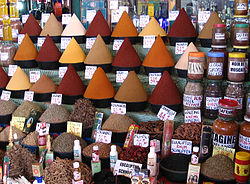
Spice market, Marrakesh, Morocco
See also
[edit]Notes
[edit]- ^ A team of archaeologists led by Giorgio Buccellati excavating the ruins of a burned-down house at the site of Terqa, in modern-day Syria, found a ceramic pot containing a handful of cloves. The house had burned down around 1720 BC and this was the first evidence of cloves being used in the west before Roman times.[8][9][10]
- ^ Other types of coffee grinders, such as a burr mill, can grind spices just as well as coffee beans.
- ^ Nutmeg, in particular, suffers from grinding and the flavor will degrade noticeably in a matter of days.
- ^ Light contributes to oxidation processes.
- ^ The word "ají" is still used in South American Spanish for chili peppers.
References
[edit]- ^ "Spice and herb | Types, Uses, & Facts | Britannica". www.britannica.com. March 8, 2024. Retrieved April 9, 2024.
- ^ Ahmad, Hafsa; Khera, Rasheed Ahmad; Hanif, Muhammad Asif; Ayub, Muhammad Adnan; Jilani, Muhammad Idrees (2020). "Vanilla". Medicinal Plants of South Asia. pp. 657–669. doi:10.1016/B978-0-08-102659-5.00048-3. ISBN 978-0-08-102659-5. S2CID 241855294.
- ^ Vázquez-Fresno, Rosa; Rosana, Albert Remus R.; Sajed, Tanvir; et al. (May 22, 2019). "Herbs and Spices - Biomarkers of Intake Based on Human Intervention Studies – A Systematic Review". Genes and Nutrition. 14 (18): 18. doi:10.1186/s12263-019-0636-8. PMC 6532192. PMID 31143299.
- ^ "Spices Board". www.indianspices.com. Retrieved July 20, 2024.
- ^ a b Davidson & Jaine (2014), spices.
- ^ Moore, Katherine M (2013). "The archaeology of food". In Albala, Ken (ed.). Routledge International Handbook of Food Studies. Oxford & New York: Routledge. ISBN 978-0-415-78264-7.
- ^ Steven E. Sidebotham (May 7, 2019). Berenike and the Ancient Maritime Spice Route. Univ of California Press. ISBN 978-0-520-30338-6. Archived from the original on June 30, 2023. Retrieved April 13, 2019.
- ^ Daniel T. Potts (1997), Mesopotamian Civilization: The Material Foundations. Archived March 26, 2023, at the Wayback Machine A&C Black publishers, p. 269
- ^ Buccellati, G., M. Kelly-Buccellati, Terqa: The First Eight Seasons, Les Annales Archeologiques Arabes Syriennes 33(2), 1983, 47–67
- ^ O'Connell, John (2016). The Book of Spice: From Anise to Zedoary. Pegasus Books. ISBN 978-1-68177-152-6.
- ^ Woodward, Penny (2003). "Herbs and Spices". In Katz (ed.). Encyclopedia of Food and Culture. Vol. 2. Charles Scribner's Sons. pp. 187–195.
- ^ Sonal Dubey (2017). "Indian Spices and their medicinal value". Indian Journal of Pharmaceutical Education and Research. 51 (3s2): s330 – s332. doi:10.5530/ijper.51.3s.41. Retrieved July 27, 2025.
By 1000 BCE, medical systems based upon herbs could be found in China, Korea, and India.
- ^ a b Murdock, Linda (2001). A Busy Cook's Guide to Spices: How to Introduce New Flavors to Everyday Meals. Bellwether Books. p. 14. ISBN 978-0-9704285-0-9.
- ^ "Bible Gateway passage: Song of Songs 4:14 - New International Version". Bible Gateway. Retrieved March 22, 2025.
- ^ Burkill, I.H. (1966). A Dictionary of the Economic Products of the Malay Peninsula. Kuala Lumpur: Ministry of Agriculture and Co-Operatives.
- ^ Duke, J.A. (2002). CRC Handbook of Medicinal Spices. CRC Press. p. 7. ISBN 978-1-4200-4048-7. Archived from the original on June 30, 2023. Retrieved May 9, 2017.
- ^ Schivelbusch, Wolfgang (1992). Tastes of paradise : a social history of spices, stimulants, and intoxicants. Pantheon Books. ISBN 0-394-57984-4. OCLC 24702170.
- ^ a b Freedman, Paul (June 5, 2015). "Health, wellness and the allure of spices in the Middle Ages". Journal of Ethnopharmacology. Potent Substances: On the Boundaries of Food and Medicine. 167: 47–53. doi:10.1016/j.jep.2014.10.065. PMID 25450779.
- ^ Adamson, Melitta Weiss (2004). Food in Medieval Times. Westport, Conn: Greenwood Press. p. 65. ISBN 978-0-313-32147-4.
- ^ a b c d e f g Paul Freedman, Out of the East: Spices and the Medieval Imagination, 2008, ISBN 9780300151350, p. 2-3
- ^ Turner, 2004, p. 11
- ^ Encyclopedia of Jewish Food, p. 453, Gil Marks, John Wiley & Sons, 2010. ISBN 978-0-470-39130-3
- ^ "Mariners Weather Log Vol. 52, No. 3, December 2008". www.vos.noaa.gov. Retrieved October 7, 2024.
- ^ Dennett, Carrie (January 26, 2017). "How a full spice cabinet can keep you healthy". The Washington Post. Archived from the original on February 8, 2023. Retrieved August 12, 2022.
- ^ Thomas, Frédéric; Daoust, Simon P.; Raymond, Michel (June 2012). "Can we understand modern humans without considering pathogens?: Human evolution and parasites". Evolutionary Applications. 5 (4): 368–379. doi:10.1111/j.1752-4571.2011.00231.x. PMC 3353360. PMID 25568057.
- ^ Paul Freedman, "Food Histories of the Middle Ages", in Kyri W. Claflin, Peter Scholliers, Writing Food History: A Global Perspective, ISBN 1847888097, p. 24
- ^ Andrew Dalby, Dangerous Tastes: The Story of Spices, 2000, ISBN 0520236742, p. 156
- ^ Andrew Jotischky, A Hermit's Cookbook: Monks, Food and Fasting in the Middle Ages, 2011, ISBN 1441159916, p. 170
- ^ a b c Michael Krondl, The Taste of Conquest: The Rise and Fall of the Three Great Cities of Spice, 2007, ISBN 9780345480835, p. 6
- ^ Shelef, L.A. (1984). "Antimicrobial Effects of Spices". Journal of Food Safety. 6 (1): 29–44. doi:10.1111/j.1745-4565.1984.tb00477.x.
- ^ a b Host: Alton Brown (January 14, 2004). "Spice Capades". Good Eats. Season 7. Episode 14. Food Network.
- ^ Van Dorena, Jane M.; Daria Kleinmeiera; Thomas S. Hammack; Ann Westerman (June 2013). "Prevalence, serotype diversity, and antimicrobial resistance of Salmonella in imported shipments of spice offered for entry to the United States, FY2007–FY2009". Food Microbiology. 34 (2): 239–251. doi:10.1016/j.fm.2012.10.002. PMID 23541190. Archived from the original on June 16, 2019. Retrieved June 16, 2019.
Shipments of imported spices offered for entry to the United States were sampled during the fiscal years 2007–2009. The mean shipment prevalence for Salmonella was 0.066 (95% CI 0.057–0.076)
- ^ Gardiner Harris (August 27, 2013). "Salmonella in Spices Prompts Changes in Farming". The New York Times. Archived from the original on August 29, 2013. Retrieved August 28, 2013.
- ^ Calucci, L.; Pinzino, C.; Zandomeneghi, M.; Capocchi, A.; Ghiringhelli, S.; Saviozzi, F.; Tozzi, S.; Galleschi, L. (2003). "Effects of gamma-irradiation on the free radical and antioxidant contents in nine aromatic herbs and spices". Journal of Agricultural and Food Chemistry. 51 (4): 927–34. Bibcode:2003JAFC...51..927C. doi:10.1021/jf020739n. PMID 12568551.
- ^ "Myths about Food Irradiation". Center for Consumer Research. June 28, 2017. Archived from the original on July 30, 2022. Retrieved July 30, 2022.
- ^ "Production of Spice by countries". UN Food & Agriculture Organization. 2011. Archived from the original on July 13, 2011. Retrieved December 20, 2013.
- ^ "67.220: Spices and condiments. Food additives". International Organization for Standardization. 2009. Archived from the original on June 6, 2011. Retrieved April 23, 2009.
Sources
[edit]- Davidson, Alan; Jaine, Tom (2014). The Oxford Companion to Food (3rd ed.). Oxford University Press. ISBN 9780191756276.
Further reading
[edit]Books
[edit]- Czarra, Fred (2009). Spices: A Global History. Reaktion Books. p. 128. ISBN 978-1-86189-426-7.
- Dalby, Andrew (2000). Dangerous Tastes: The Story of Spices. University of California Press. ISBN 978-0-520-23674-5.
- Freedman, Paul (2008). Out of the East: Spices and the Medieval Imagination. Yale University Press. ISBN 978-0-300-21131-3.
- Keay, John (2006). The Spice Route: A History. John Murray. ISBN 978-0-7195-6199-3.
- Krondl, Michael (2008). The Taste of Conquest: The Rise and Fall of the Three Great Cities of Spice. Random House. ISBN 978-0-345-50982-6.
- Miller, James Innes (1969). The spice trade of the Roman Empire, 29 B.C. to A.D. 641. Oxford: Clarendon P. ISBN 978-0-19-814264-5.
- Morton, Timothy (2006). The Poetics of Spice: Romantic Consumerism and the Exotic. Cambridge University Press. ISBN 978-0-521-02666-6.
- Seidemann, Johannes (2005). World Spice Plants: Economic Usage, Botany, Taxonomy. Springer. ISBN 978-3-540-22279-8.
- Turner, Jack (2004). Spice: The History of a Temptation. Knopf. ISBN 978-0-375-40721-5.
External links
[edit]
Media related to Spice at Wikimedia Commons
Cookbook:Spices and herbs at Wikibooks
The dictionary definition of spice at Wiktionary
Spice
View on GrokipediaHistory
Origins and Development
The development of SPICE began in the late 1960s at the University of California, Berkeley, driven by the need to simulate increasingly complex integrated circuits as transistor counts grew rapidly in semiconductor design.[7] In 1968, faculty member Ronald A. Rohrer introduced a course on computer analysis of nonlinear circuits, which laid the groundwork for advanced simulation tools to address the limitations of manual analysis and early linear approximation methods.[8] Donald O. Pederson, a professor in the Department of Electrical Engineering and Computer Sciences, oversaw the project as thesis advisor, with graduate student Laurence W. Nagel leading the implementation efforts after Rohrer's departure from Berkeley. The original name, Simulation Program with Integrated Circuit Emphasis (SPICE), reflected its focus on modeling integrated circuits, particularly emphasizing nonlinear device behaviors that earlier tools could not accurately capture.[9] Key motivations included the demand for precise nonlinear DC, transient, and small-signal analyses to go beyond the linear approximations employed in predecessors like IBM's ECAP and ECAP-II, which were insufficient for the nonlinear characteristics of diodes and transistors in modern ICs.[8] The program built on foundational semiconductor physics, incorporating Shockley diode equations and early transistor models such as the Ebers-Moll equations for bipolar junction transistors.[9] Early funding came from the National Science Foundation (NSF), supporting the academic research environment at Berkeley that enabled this innovation.[7] The project evolved from an initial program called CANCER (Computer Analysis of Nonlinear Circuits, Excluding Radiation), building on even earlier Berkeley tools like BIAS, SLIC, and TIME, and developed as a class project and publicly described in a 1971 paper by Nagel and Rohrer.[10] This precursor was released for limited use in 1971, with the first version of SPICE (SPICE1) released to limited users in fall 1971 and publicly introduced in April 1973, marking a significant milestone in accessible circuit simulation. By 1973, Nagel and Pederson formalized SPICE in a technical report, establishing it as a robust tool for integrated circuit design.[9][11]Initial Implementations and Milestones
The initial implementation of SPICE, known as SPICE1, was publicly released in 1973 by Laurence W. Nagel and Donald O. Pederson at the University of California, Berkeley. Written in Fortran, it emphasized simulation of integrated circuits through nodal analysis and supported DC operating point analysis, transient analysis, and small-signal AC analysis, with models for both MOS and bipolar transistors.[12] This version was designed to handle circuits up to 50 nodes and 25 bipolar transistors, using a fixed timestep for transient simulations on mainframe computers like the CDC 6400.[13] SPICE2, released in 1975 as part of Nagel's PhD dissertation and further developed until 1977 under the leadership of Pederson and contributions from researchers like A. Richard Newton and Sally Liu, introduced significant enhancements to address limitations in SPICE1. Key improvements included better convergence algorithms for nonlinear solvers, the addition of sensitivity analysis to evaluate circuit parameter variations, and support for behavioral modeling via subcircuit definitions, enabling hierarchical circuit representation.[14] These features expanded its utility for more complex MOS and bipolar designs, while maintaining backward compatibility with SPICE1 input formats.[15] A pivotal milestone came with the release of SPICE2G.6 in 1983, which solidified its role as a semi-official standard for circuit simulation due to refined numerical stability and broader device modeling. This version saw rapid adoption in universities for educational purposes and in industry for integrated circuit verification, forming the foundation for many commercial simulators.[14] By 1980, Berkeley had distributed thousands of copies, influencing parallel developments such as IBM's ASTAP simulator, which adopted similar nodal analysis techniques but emphasized sparse tableau formulations for larger circuits.[16] SPICE implementations tackled key technical challenges in simulating stiff differential equations arising from circuit dynamics, particularly in transient analysis. SPICE2 incorporated Gear's method, a stiffly stable backward differentiation formula that improved integration accuracy and convergence for systems with widely varying time constants, outperforming explicit methods in handling nonlinear device behaviors. From its inception, SPICE benefited from UC Berkeley's policy of releasing the software into the public domain without licensing fees, encouraging widespread academic and industrial use and fostering an ecosystem of modifications and extensions. This open approach, championed by Pederson, ensured free distribution and modification rights, accelerating its integration into global engineering workflows.[17]Successors and Implementations
Open-Source Variants
Ngspice, initiated in 1993 as a fork of the Berkeley SPICE 3f.5 release, serves as a prominent open-source mixed-signal circuit simulator that incorporates extensions from the Cider1b1 and Xspice packages for enhanced device modeling and digital simulation capabilities.[18] It supports a wide range of analyses, including transient, AC, DC, and noise simulations, while enabling mixed analog-digital workflows through XSPICE code models for behavioral extensions. Active development continues, with the latest stable release, version 45.2, issued on September 6, 2025, featuring bug fixes and improved compatibility for Windows environments.[19] Additionally, ngspice provides Python bindings via its shared library interface, allowing seamless integration into Python-based workflows for automated simulations and data analysis through libraries like PySpice.[20][21] Developed by Sandia National Laboratories starting in the early 2000s, Xyce is a SPICE-compatible simulator optimized for parallel processing on high-performance computing clusters, enabling efficient handling of large-scale circuits with millions of devices.[22] Its architecture leverages distributed-memory parallelism to reduce simulation times for complex analog and mixed-signal designs, supporting standard SPICE netlists alongside advanced analyses like harmonic balance and sensitivity.[23] First released as open-source software under the GNU General Public License in 2013, Xyce remains actively maintained by Sandia, with ongoing enhancements for scalability in scientific and engineering applications.[24][25] Qucs-S, a variant of the original Quite Universal Circuit Simulator (Qucs) project from the early 2000s, integrates open-source SPICE engines such as ngspice and Xyce within a unified graphical user interface for schematic capture and simulation.[26] Launched in its stable form around 2017, it emphasizes RF and system-level simulations, including microstrip modeling, semiconductor device analysis, and ESD effects, while maintaining compatibility with SPICE netlists for hybrid workflows.[27] The tool's backend-agnostic design allows users to select simulation kernels dynamically, facilitating advanced features like Verilog-A model support when paired with compatible engines.[26] Post-2020 developments in these variants have focused on extensibility, with ngspice introducing Verilog-A support through the OSDI/OpenVAF interface starting in version 39 (2022), enabling compact device models for more accurate behavioral simulations via community-contributed compilers.[28] Community efforts have also explored machine learning integration with ngspice for model optimization, such as using neural networks to accelerate transient analysis and genetic algorithms for analog circuit sizing, as detailed in recent research frameworks.[29] These advancements, driven by open contributions on platforms like GitHub, enhance the tools' adaptability for modern design challenges. All major open-source SPICE variants—ngspice under the modified BSD license, Xyce under the GNU GPL, and Qucs-S under GPL-2.0—promote accessibility for academic, research, and hobbyist use by allowing free distribution, modification, and integration without proprietary restrictions.[30][24][27] This licensing model fosters widespread adoption and collaborative improvement, distinguishing them from commercial tools while enabling extensions for specialized applications.Commercial Derivatives
Commercial derivatives of SPICE have evolved into proprietary simulators tailored for professional electronic design automation (EDA) workflows, offering enhanced performance, integration with design tools, and specialized analyses for industry applications. These tools, developed by major EDA vendors, provide optimized algorithms, advanced device models, and user interfaces that support complex circuit verification in semiconductor and PCB design, often under licensing models that ensure reliability and support for enterprise users. LTspice, introduced by Linear Technology in the late 1990s and maintained by Analog Devices following the 2017 acquisition, is a freeware SPICE simulator featuring an integrated schematic editor for circuit capture and a waveform viewer for results analysis. It includes fast Monte Carlo analysis capabilities to evaluate component tolerances and variations, making it a staple for analog circuit design and prototyping among engineers. Recent updates, such as those in LTspice 24 released in 2024 with further model enhancements in late 2025, have improved simulation speed and consistency while supporting behavioral modeling sources for arbitrary voltage and current expressions.[4][31][32] PSpice, originating in the 1980s from MicroSim and now part of Cadence's OrCAD suite since 1999, excels in analog and mixed-signal simulation with advanced waveform viewing tools for detailed signal inspection and support for hierarchical design entry to manage large schematics efficiently. It integrates seamlessly with PCB layout environments like OrCAD PCB Designer and Allegro, enabling simulation-driven optimization from schematic to board-level verification. These features facilitate rapid iteration in power electronics and signal integrity analysis.[33][34] Spectre, developed by Cadence starting in the late 1980s, is a high-performance circuit simulator optimized for analog, RF, and mixed-signal (AMS) designs, with extensions like SpectreRF for radio-frequency analysis and Spectre AMS Designer for system-level verification. It natively supports Verilog-AMS for behavioral modeling of mixed-signal systems, allowing co-simulation of analog and digital blocks in complex SoCs. Widely adopted in RFIC and AMS SoC verification, it delivers scalable parallel processing for large-scale designs.[35][36] HSPICE from Synopsys emphasizes precision in simulating nanometer-scale circuits, leveraging foundry-qualified models for accurate characterization of transistors and interconnects at advanced process nodes like 45 nm and below. It includes robust statistical variation analysis through Monte Carlo and variability tools to assess process-induced mismatches and yield impacts in high-volume manufacturing. This makes it essential for custom IC design where timing and power accuracy are critical.[37][38][39] These commercial SPICE derivatives dominate the semiconductor EDA landscape, with Synopsys and Cadence holding significant market shares in simulation tools amid a global EDA market projected to reach USD 19.22 billion in 2025. Licensing models typically involve annual fees scaled to usage and support levels, supporting their role in professional workflows. Recent trends include cloud-based integrations, such as AWS-compatible deployments for scalable simulation by 2023, contrasting with open-source variants that prioritize accessibility over enterprise optimization.[40]Technical Architecture
Simulation Analyses
SPICE employs modified nodal analysis to formulate circuit equations based on Kirchhoff's laws and device characteristics, enabling the solution of large systems through sparse matrix techniques. This foundation supports multiple analysis types, each addressing specific aspects of circuit performance, such as steady-state operation, time-domain responses, and frequency-domain behaviors. The core solver uses iterative numerical methods to handle nonlinearity, with convergence ensured through specialized techniques. These analyses assume prior definition of device models, which provide the nonlinear relationships between voltages, currents, and charges. DC analysis in SPICE determines the steady-state operating point of a circuit by solving a system of nonlinear algebraic equations derived from the nodal formulation. The primary equation is , where is the conductance matrix incorporating nonlinear device conductances, is the vector of node voltages, and is the vector of independent current sources. This system is solved iteratively using the Newton-Raphson method, which linearizes the nonlinear functions around the current estimate and updates the solution via , where is the Jacobian matrix of partial derivatives and is the residual vector. The process continues until the residuals fall below specified tolerances, such as RELTOL for relative error.[41][42] Transient analysis simulates the time-domain evolution of circuit variables by integrating the differential equations arising from capacitive and inductive elements in the device models. SPICE discretizes time into steps and approximates derivatives using implicit integration methods, transforming the problem into a sequence of nonlinear algebraic equations solved at each step via Newton-Raphson iteration. The default trapezoidal method models the integral of a variable as , where is the time step, providing A-stability for stiff systems but potentially introducing numerical ringing in high-Q circuits. An alternative Gear method, introduced in SPICE3, uses backward difference formulas of second or higher order for improved accuracy in oscillatory responses, with the order adaptively selected up to six based on local truncation error estimates controlled by parameters like TRTOL. Time steps are fixed or controlled automatically to balance accuracy and efficiency.[41][43][42] AC analysis evaluates the small-signal frequency response by linearizing the circuit around the DC operating point obtained from prior analysis. Nonlinear devices are replaced by their linearized equivalents, such as transconductances and capacitances, yielding a linear system solved in the frequency domain using complex phasors. For each frequency point, SPICE computes node voltages as , where is the capacitance matrix and is the angular frequency, allowing extraction of magnitudes, phases, and transfer functions like gain and impedance. This enables efficient characterization of bandwidth, resonance, and stability without simulating full transients.[41][42] Beyond core analyses, SPICE supports specialized evaluations including noise analysis, which computes equivalent input noise spectral densities by summing contributions from devices (e.g., thermal noise and flicker noise ) propagated through the small-signal model; sensitivity analysis, which calculates partial derivatives of outputs with respect to parameters using adjoint methods for design optimization; and distortion analysis, assessing harmonic and intermodulation products via small-signal nonlinear coefficients or, in extensions, harmonic balance techniques that solve multi-tone steady-state equations in the frequency domain for large-signal RF circuits.[41][42][44] Numerical instability in nonlinear iterations is mitigated by convergence enhancement techniques, such as source stepping, which gradually ramps independent sources from zero to their final values over multiple DC solutions to provide better initial guesses, and pseudo-transient methods, which introduce artificial time constants to damp oscillations and guide the solver toward the operating point. These are invoked automatically or via options when iterations exceed limits, preventing failures in circuits with floating nodes or sharp nonlinearities.[41][42]Device Models and Parameters
SPICE employs a hierarchy of mathematical models to represent the behavior of electronic components, ranging from simple linear elements to complex nonlinear devices. These models are defined through parameters that capture physical properties such as geometry, material characteristics, and operating conditions, enabling accurate simulation of circuit performance across DC, transient, and AC analyses. The models are specified using dedicated syntax in the input netlist, allowing users to select levels of complexity based on the required fidelity and computational efficiency.[45] Passive components in SPICE are modeled with straightforward equations that account for basic electrical properties and dependencies. Resistors are represented as linear elements with resistance value R, but can include voltage-dependent behavior via a polynomial expression or table lookup for nonlinear cases; temperature dependence is incorporated through coefficients TC1 and TC2 in the equation R(T) = R(T0)[1 + TC1(T - T0) + TC2(T - T0)^2], where T0 is the nominal temperature. Capacitors are defined by capacitance C, with support for initial conditions (IC) to set voltage at simulation start, and junction capacitance modeled as CAP = CJ(L - NARROW)(W - NARROW) + 2 CJSW(L + W - 2 NARROW) for area and sidewall effects in integrated structures. Inductors use inductance L, also with initial current conditions (IC), and can model coupling for transformers via mutual inductance M.[45] Diodes are simulated using the Shockley diode equation, which describes the current-voltage relationship as , where is the saturation current, is the emission coefficient, is the diode voltage, and is the thermal voltage with Boltzmann constant , temperature , and electron charge . This model includes series resistance RS, junction capacitance with parameters CJO (zero-bias capacitance), VJ (junction potential), and grading coefficient M, as well as temperature dependence through parameters like EG (bandgap energy) and XTI (temperature exponent for saturation current). Breakdown effects are captured by BV (reverse breakdown voltage) and IBV (current at breakdown).[45] Bipolar junction transistors (BJTs) in SPICE utilize the Gummel-Poon model, an integral charge control formulation that extends the Ebers-Moll model to include high-current effects, base-width modulation (Early effect), and charge storage. The model operates at levels 1 through 3, with level 1 providing basic forward and reverse current gains; key parameters include BF (ideal maximum forward current gain β_F, default 100) for low-current beta and IS (transport saturation current, default 1.0 × 10^{-16} A) that scales the exponential collector current. Additional parameters such as VAF (forward Early voltage) account for the Early effect, where output conductance increases with collector-emitter voltage, while TF and TR model forward and reverse transit times for dynamic behavior. The model supports both NPN and PNP types with quasi-saturation effects at high bias levels.[45][46] MOSFET models in SPICE progress from basic to advanced formulations to handle short-channel effects in modern technologies. The level 1 model, based on the Shichman-Hodges equations, assumes long-channel behavior and computes drain current in saturation as , where μ is carrier mobility, C_ox is gate oxide capacitance per unit area, W/L is the channel aspect ratio, V_GS is gate-source voltage, V_TH is threshold voltage, and λ is the channel-length modulation parameter. Higher levels (2 and 3) add semi-empirical corrections for mobility degradation and subthreshold conduction. For contemporary nanoscale devices, BSIM models (levels 4 and beyond, up to BSIM4 and BSIM6) provide industry-standard accuracy, incorporating short-channel effects like velocity saturation, DIBL (drain-induced barrier lowering), and pocket implants through parameters such as VTH0 (zero-bias threshold), U0 (low-field mobility), and TOX (oxide thickness); BSIM4, for instance, uses a surface-potential-based core for robust scalability across process variations.[45][47] SPICE supports behavioral modeling through arbitrary dependent sources that use mathematical expressions for voltage or current, such as B sources defined as BXXX N+ N- I=expression (e.g., I = V(1)*V(2)) or V=expression, enabling compact representation of nonlinear or table-based behaviors without detailed internal circuitry. Subcircuits extend this by defining hierarchical macros with .SUBCKT and .ENDS statements, encapsulating complex elements like amplifiers as reusable blocks with instance parameters for customization. These feed into analyses like transient simulations to predict time-domain responses.[45] Device parameters are specified via .MODEL statements, a SPICE-unique syntax that declares a model name, type (e.g., D for diode, NPN for BJT, NMOS for MOSFET), and parameter values, such as .MODEL MOD1 NMOS LEVEL=1 KP=100u VTO=0.7, where LEVEL selects the model complexity, KP is transconductance (μ C_ox), and VTO is zero-bias threshold voltage. This format allows sharing models across multiple instances while supporting temperature scaling and geometric scaling factors like SCALE for area adjustments.[45]Input Formats and Output Visualization
SPICE simulations are primarily defined through text-based netlist files, which describe the circuit topology, components, and simulation directives in a structured, human-readable format. Each line in the netlist typically specifies a component, such as a resistor named R1 connected between nodes 1 and 2 with a value of 1 kΩ, written asR1 1 2 1k. Nodes represent electrical connections, with node 0 conventionally serving as the global ground. The netlist also includes .CONTROL statements to orchestrate simulation runs, such as specifying input files or setting global parameters.[45][48]
Many modern SPICE-compatible tools integrate schematic capture interfaces to simplify circuit definition, automatically generating the underlying netlist from graphical elements. For instance, LTspice provides a built-in schematic editor where users draw components and wires, which the software converts to a SPICE netlist for simulation. Similarly, Qucs offers a graphical user interface for schematic entry, supporting SPICE netlists through its integration with simulators like ngspice, allowing users to visualize and edit circuits before generating the text-based description.[4]
Control statements direct the types of analyses performed, with common examples including .OP for DC operating point analysis, which computes steady-state node voltages and currents, and .TRAN for transient analysis, such as .TRAN 1n 1u to simulate over a time span from 0 to 1 µs with a 1 ns print interval. Output selection is managed via statements like .PROBE in variants such as ngspice, which specifies vectors (e.g., node voltages) to save from the simulation. These directives ensure focused computation and data capture without unnecessary overhead.[45][49]
Simulation results are stored in raw data files, typically with a .raw extension, available in binary or ASCII formats containing time-domain or frequency-domain vectors. Visualization occurs through post-processing tools like Nutmeg, the original interactive plotter bundled with Berkeley SPICE3, which generates waveforms, XY plots, and Bode diagrams from the .raw data. For example, Nutmeg can display voltage versus time traces from a .TRAN run or magnitude-phase plots from .AC analysis.[45][50]
Post-processing extends analysis capabilities, such as applying Fourier transforms to transient outputs via the .FOUR statement to extract harmonic content at a specified fundamental frequency, or generating statistical plots for Monte Carlo simulations by varying parameters like resistor tolerances and plotting distributions of key metrics. In AC analysis, the .raw file directly provides frequency response data for magnitude and phase visualization.[49][45]
Evolutions in open-source variants like ngspice and Xyce include enhanced output options for scripting and integration, such as exporting simulation data in structured formats like CSV or TECPLOT for further processing, though direct JSON or XML exports are facilitated through wrapper tools like PySpice, which convert .raw contents to JSON for Python-based automation. These features support advanced workflows in large-scale simulations.[51][52][21]
