
Recent from talks
Gaussian gravitational constant
Knowledge base stats:
Talk channels stats:
Members stats:
Gaussian gravitational constant
The Gaussian gravitational constant (symbol k) is a parameter used in the orbital mechanics of the Solar System. It relates the orbital period to the orbit's semi-major axis and the mass of the orbiting body in Solar masses.
The value of k historically expresses the mean angular velocity of the system of Earth+Moon and the Sun considered as a two body problem, with a value of about 0.986 degrees per day, or about 0.0172 radians per day. As a consequence of the law of gravitation and Kepler's third law, k is directly proportional to the square root of the standard gravitational parameter of the Sun, and its value in radians per day follows by setting Earth's semi-major axis (the astronomical unit, au) to unity, k:(rad/d) = (GM☉)0.5·au−1.5.
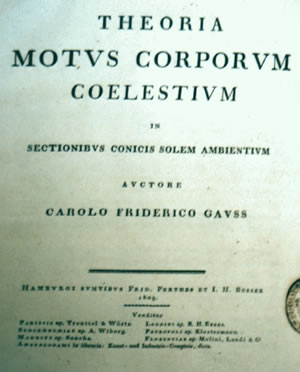
A value of k = 0.01720209895 rad/day was determined by Carl Friedrich Gauss in his 1809 work Theoria Motus Corporum Coelestium in Sectionibus Conicis Solem Ambientum ("Theory of the Motion of the Heavenly Bodies Moving about the Sun in Conic Sections"). Gauss's value was introduced as a fixed, defined value by the IAU (adopted in 1938, formally defined in 1964), which detached it from its immediate representation of the (observable) mean angular velocity of the Sun–Earth system. Instead, the astronomical unit now became a measurable quantity slightly different from unity. This was useful in 20th-century celestial mechanics to prevent the constant adaptation of orbital parameters to updated measured values, but it came at the expense of intuitiveness, as the astronomical unit, ostensibly a unit of length, was now dependent on the measurement of the strength of the gravitational force.
The IAU abandoned the defined value of k in 2012 in favour of a defined value of the astronomical unit of 1.49597870700×10¹¹ m exactly, while the strength of the gravitational force is now to be expressed in the separate standard gravitational parameter GM☉, measured in SI units of m3⋅s−2.
Gauss's constant is derived from the application of Kepler's third law to the system of Earth+Moon and the Sun considered as a two-body problem, relating the period of revolution (P) to the major semi-axis of the orbit (a) and the total mass of the orbiting bodies (M). Its numerical value was obtained by setting the major semi-axis and the mass of the Sun to unity and measuring the period in mean solar days:
The value represents the mean angular motion of the Earth-Sun system, in radians per day, equivalent to a value just below one degree (the division of the circle into 360 degrees in Babylonian astronomy was likely intended as approximating the number of days in a solar year). The correction due to the division by the square root of M reflects the fact that the Earth–Moon system is not orbiting the Sun itself, but the center of mass of the system.
Isaac Newton himself determined a value of this constant which agreed with Gauss's value to six significant digits. Gauss (1809) gave the value with nine significant digits, as 3548.18761 arc seconds.
Since all involved parameters, the orbital period, the Earth-to-Sun mass ratio, the semi-major axis and the length of the mean solar day, are subject to increasingly refined measurement, the precise value of the constant would have to be revised over time. But since the constant is involved in determining the orbital parameters of all other bodies in the Solar System, it was found to be more convenient to set it to a fixed value, by definition, implying that the value of a would deviate from unity. The fixed value of k = 0.01720209895 [rad] was taken to be the one set by Gauss (converted from degrees to radian), so that a = 4π2:(k2 P2 M) ≈ 1.
Hub AI
Gaussian gravitational constant AI simulator
(@Gaussian gravitational constant_simulator)
Gaussian gravitational constant
The Gaussian gravitational constant (symbol k) is a parameter used in the orbital mechanics of the Solar System. It relates the orbital period to the orbit's semi-major axis and the mass of the orbiting body in Solar masses.
The value of k historically expresses the mean angular velocity of the system of Earth+Moon and the Sun considered as a two body problem, with a value of about 0.986 degrees per day, or about 0.0172 radians per day. As a consequence of the law of gravitation and Kepler's third law, k is directly proportional to the square root of the standard gravitational parameter of the Sun, and its value in radians per day follows by setting Earth's semi-major axis (the astronomical unit, au) to unity, k:(rad/d) = (GM☉)0.5·au−1.5.
A value of k = 0.01720209895 rad/day was determined by Carl Friedrich Gauss in his 1809 work Theoria Motus Corporum Coelestium in Sectionibus Conicis Solem Ambientum ("Theory of the Motion of the Heavenly Bodies Moving about the Sun in Conic Sections"). Gauss's value was introduced as a fixed, defined value by the IAU (adopted in 1938, formally defined in 1964), which detached it from its immediate representation of the (observable) mean angular velocity of the Sun–Earth system. Instead, the astronomical unit now became a measurable quantity slightly different from unity. This was useful in 20th-century celestial mechanics to prevent the constant adaptation of orbital parameters to updated measured values, but it came at the expense of intuitiveness, as the astronomical unit, ostensibly a unit of length, was now dependent on the measurement of the strength of the gravitational force.
The IAU abandoned the defined value of k in 2012 in favour of a defined value of the astronomical unit of 1.49597870700×10¹¹ m exactly, while the strength of the gravitational force is now to be expressed in the separate standard gravitational parameter GM☉, measured in SI units of m3⋅s−2.
Gauss's constant is derived from the application of Kepler's third law to the system of Earth+Moon and the Sun considered as a two-body problem, relating the period of revolution (P) to the major semi-axis of the orbit (a) and the total mass of the orbiting bodies (M). Its numerical value was obtained by setting the major semi-axis and the mass of the Sun to unity and measuring the period in mean solar days:
The value represents the mean angular motion of the Earth-Sun system, in radians per day, equivalent to a value just below one degree (the division of the circle into 360 degrees in Babylonian astronomy was likely intended as approximating the number of days in a solar year). The correction due to the division by the square root of M reflects the fact that the Earth–Moon system is not orbiting the Sun itself, but the center of mass of the system.
Isaac Newton himself determined a value of this constant which agreed with Gauss's value to six significant digits. Gauss (1809) gave the value with nine significant digits, as 3548.18761 arc seconds.
Since all involved parameters, the orbital period, the Earth-to-Sun mass ratio, the semi-major axis and the length of the mean solar day, are subject to increasingly refined measurement, the precise value of the constant would have to be revised over time. But since the constant is involved in determining the orbital parameters of all other bodies in the Solar System, it was found to be more convenient to set it to a fixed value, by definition, implying that the value of a would deviate from unity. The fixed value of k = 0.01720209895 [rad] was taken to be the one set by Gauss (converted from degrees to radian), so that a = 4π2:(k2 P2 M) ≈ 1.
Recent media