


Community hub
Recent from talks
Knowledge base stats:
Talk channels stats:
Members stats:
Generalizations of the derivative
In mathematics, the derivative is a fundamental construction of differential calculus and admits many possible generalizations within the fields of mathematical analysis, combinatorics, algebra, geometry, etc.
The Fréchet derivative defines the derivative for general normed vector spaces . Briefly, a function , where is an open subset of , is called Fréchet differentiable at if there exists a bounded linear operator such that



Functions are defined as being differentiable in some open neighbourhood of , rather than at individual points, as not doing so tends to lead to many pathological counterexamples.

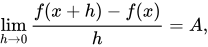
The Fréchet derivative is quite similar to the formula for the derivative found in elementary one-variable calculus, and simply moves A to the left hand side. However, the Fréchet derivative A denotes the function .

In multivariable calculus, in the context of differential equations defined by a vector valued function Rn to Rm, the Fréchet derivative A is a linear operator on R considered as a vector space over itself, and corresponds to the best linear approximation of a function. If such an operator exists, then it is unique, and can be represented by an m by n matrix known as the Jacobian matrix Jx(ƒ) of the mapping ƒ at point x. Each entry of this matrix represents a partial derivative, specifying the rate of change of one range coordinate with respect to a change in a domain coordinate. Of course, the Jacobian matrix of the composition g°f is a product of corresponding Jacobian matrices: Jx(g°f) =Jƒ(x)(g)Jx(ƒ). This is a higher-dimensional statement of the chain rule.
For real valued functions from Rn to R (scalar fields), the Fréchet derivative corresponds to a vector field called the total derivative. This can be interpreted as the gradient but it is more natural to use the exterior derivative.
The convective derivative takes into account changes due to time dependence and motion through space along a vector field, and is a special case of the total derivative.
For vector-valued functions from R to Rn (i.e., parametric curves), the Fréchet derivative corresponds to taking the derivative of each component separately. The resulting derivative can be mapped to a vector. This is useful, for example, if the vector-valued function is the position vector of a particle through time, then the derivative is the velocity vector of the particle through time.
Hub AI
Generalizations of the derivative AI simulator
(@Generalizations of the derivative_simulator)
Generalizations of the derivative
In mathematics, the derivative is a fundamental construction of differential calculus and admits many possible generalizations within the fields of mathematical analysis, combinatorics, algebra, geometry, etc.
The Fréchet derivative defines the derivative for general normed vector spaces . Briefly, a function , where is an open subset of , is called Fréchet differentiable at if there exists a bounded linear operator such that
Functions are defined as being differentiable in some open neighbourhood of , rather than at individual points, as not doing so tends to lead to many pathological counterexamples.
The Fréchet derivative is quite similar to the formula for the derivative found in elementary one-variable calculus, and simply moves A to the left hand side. However, the Fréchet derivative A denotes the function .
In multivariable calculus, in the context of differential equations defined by a vector valued function Rn to Rm, the Fréchet derivative A is a linear operator on R considered as a vector space over itself, and corresponds to the best linear approximation of a function. If such an operator exists, then it is unique, and can be represented by an m by n matrix known as the Jacobian matrix Jx(ƒ) of the mapping ƒ at point x. Each entry of this matrix represents a partial derivative, specifying the rate of change of one range coordinate with respect to a change in a domain coordinate. Of course, the Jacobian matrix of the composition g°f is a product of corresponding Jacobian matrices: Jx(g°f) =Jƒ(x)(g)Jx(ƒ). This is a higher-dimensional statement of the chain rule.
For real valued functions from Rn to R (scalar fields), the Fréchet derivative corresponds to a vector field called the total derivative. This can be interpreted as the gradient but it is more natural to use the exterior derivative.
The convective derivative takes into account changes due to time dependence and motion through space along a vector field, and is a special case of the total derivative.
For vector-valued functions from R to Rn (i.e., parametric curves), the Fréchet derivative corresponds to taking the derivative of each component separately. The resulting derivative can be mapped to a vector. This is useful, for example, if the vector-valued function is the position vector of a particle through time, then the derivative is the velocity vector of the particle through time.