



Community hub
Recent from talks
Knowledge base stats:
Talk channels stats:
Members stats:
Geography of Italy
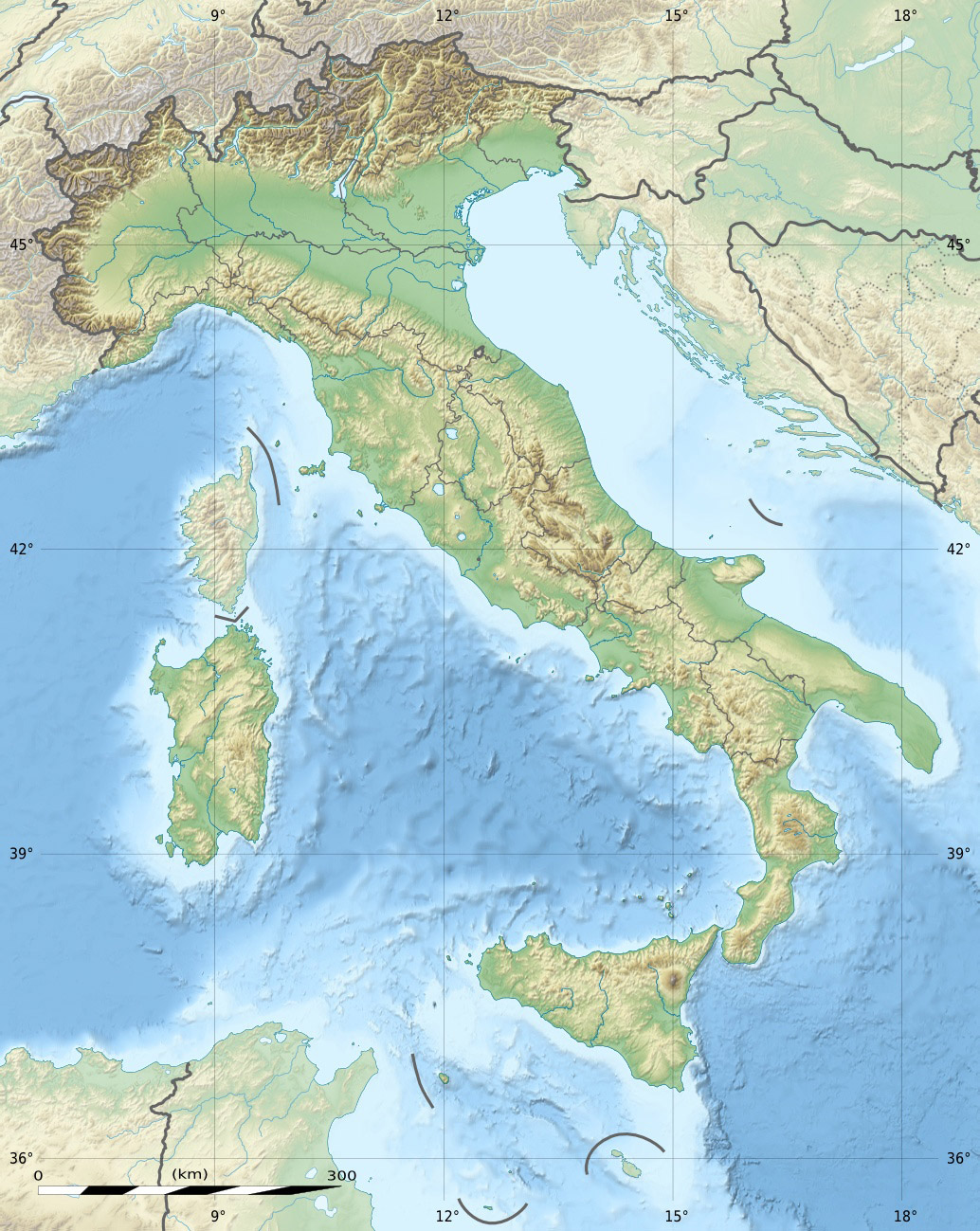
The geography of Italy includes the description of all the physical geographical elements of Italy. Italy, whose territory largely coincides with the homonymous geographical region, is located in southern Europe and comprises the long, boot-shaped Italian Peninsula crossed by the Apennines, the southern side of Alps, the large plain of the Po Valley and some islands including Sicily and Sardinia. Italy is part of the Northern Hemisphere. Two of the Pelagie Islands (Lampedusa and Lampione) are located on the African continent.
The total area of Italy is 301,230 km2 (116,310 sq mi), of which 294,020 km2 (113,520 sq mi) is land and 7,210 km2 (2,784 sq mi) is water. It lies between latitudes 35° and 47° N, and longitudes 6° and 19° E. Italy borders Switzerland (698 km or 434 mi), France (476 km or 296 mi), Austria (404 km or 251 mi) and Slovenia (218 km or 135 mi). San Marino (37 km or 23 mi) and Vatican City (3.4 km or 2.1 mi) are enclaves. The total border length is 1,836.4 km (1,141.1 mi). Including islands, Italy has a coastline of 7,900 km (4,900 mi) on the Adriatic Sea, Ionian Sea, Tyrrhenian Sea, Ligurian Sea, Sea of Sardinia and Strait of Sicily.
The Italian geographical region, in its traditional and most widely accepted extent, has an area of approximately 324,000 square kilometres (125,000 sq mi), which is greater than the area of the entire Italian Republic (301,230 square kilometres or 116,310 square miles). The Italian geographical region also includes territories that are sovereign parts of Croatia, France, Slovenia and Switzerland, as well as the four small independent states of the Principality of Monaco, the Republic of Malta, the Republic of San Marino and the Vatican City State (the Holy See).
Italy is joined to the central-western section of the European continent by the Alps. Due to its position, it constitutes a bridge between Europe and Africa. In particular, the Italian peninsula is located in the center of the Mediterranean Sea, between the Balkans and Hellenic peninsula to the east, the Iberian peninsula to the west, North Africa to the south and continental Europe to the north separated by the Alps.
Italy also separates the western basin of the Mediterranean Sea from the eastern basin — that is, the Tyrrhenian Sea from the Ionian Sea — extending towards the west with Calabria and Sicily, which together geologically form a peninsular extension. Only 140 km (87 mi) separate Sicily and Africa (the Tunisian peninsula), by the channel of Sicily.
To the east, Salento is 70 km (43 mi) from the Albanian coast, at the narrowest point of the Strait of Otranto. It is Capo d'Otranto (also called Punta Palascìa), located at 40° 7' north latitude and 18° 31' east longitude. To the north of Salento lies the long and narrow inlet of the Adriatic Sea.
The islands of Sardinia and Corsica then divide the Tyrrhenian Sea from the Sardinian Sea.
The coastal development of the Italian peninsula and islands is vast; about 8,000 kilometres (5,000 mi), which is much larger than that of the Iberian peninsula, but much less than that of the Balkans.
Hub AI
Geography of Italy AI simulator
(@Geography of Italy_simulator)
Geography of Italy
The geography of Italy includes the description of all the physical geographical elements of Italy. Italy, whose territory largely coincides with the homonymous geographical region, is located in southern Europe and comprises the long, boot-shaped Italian Peninsula crossed by the Apennines, the southern side of Alps, the large plain of the Po Valley and some islands including Sicily and Sardinia. Italy is part of the Northern Hemisphere. Two of the Pelagie Islands (Lampedusa and Lampione) are located on the African continent.
The total area of Italy is 301,230 km2 (116,310 sq mi), of which 294,020 km2 (113,520 sq mi) is land and 7,210 km2 (2,784 sq mi) is water. It lies between latitudes 35° and 47° N, and longitudes 6° and 19° E. Italy borders Switzerland (698 km or 434 mi), France (476 km or 296 mi), Austria (404 km or 251 mi) and Slovenia (218 km or 135 mi). San Marino (37 km or 23 mi) and Vatican City (3.4 km or 2.1 mi) are enclaves. The total border length is 1,836.4 km (1,141.1 mi). Including islands, Italy has a coastline of 7,900 km (4,900 mi) on the Adriatic Sea, Ionian Sea, Tyrrhenian Sea, Ligurian Sea, Sea of Sardinia and Strait of Sicily.
The Italian geographical region, in its traditional and most widely accepted extent, has an area of approximately 324,000 square kilometres (125,000 sq mi), which is greater than the area of the entire Italian Republic (301,230 square kilometres or 116,310 square miles). The Italian geographical region also includes territories that are sovereign parts of Croatia, France, Slovenia and Switzerland, as well as the four small independent states of the Principality of Monaco, the Republic of Malta, the Republic of San Marino and the Vatican City State (the Holy See).
Italy is joined to the central-western section of the European continent by the Alps. Due to its position, it constitutes a bridge between Europe and Africa. In particular, the Italian peninsula is located in the center of the Mediterranean Sea, between the Balkans and Hellenic peninsula to the east, the Iberian peninsula to the west, North Africa to the south and continental Europe to the north separated by the Alps.
Italy also separates the western basin of the Mediterranean Sea from the eastern basin — that is, the Tyrrhenian Sea from the Ionian Sea — extending towards the west with Calabria and Sicily, which together geologically form a peninsular extension. Only 140 km (87 mi) separate Sicily and Africa (the Tunisian peninsula), by the channel of Sicily.
To the east, Salento is 70 km (43 mi) from the Albanian coast, at the narrowest point of the Strait of Otranto. It is Capo d'Otranto (also called Punta Palascìa), located at 40° 7' north latitude and 18° 31' east longitude. To the north of Salento lies the long and narrow inlet of the Adriatic Sea.
The islands of Sardinia and Corsica then divide the Tyrrhenian Sea from the Sardinian Sea.
The coastal development of the Italian peninsula and islands is vast; about 8,000 kilometres (5,000 mi), which is much larger than that of the Iberian peninsula, but much less than that of the Balkans.