Hubbry Logo
Geometric standard deviationGeometric standard deviationMain
Open search
Geometric standard deviation
Community hub
Geometric standard deviation
logo
7 pages, 0 posts
0 subscribers
Be the first to start a discussion here.
Geometric standard deviation
from Wikipedia

In probability theory and statistics, the geometric standard deviation (GSD) describes how spread out are a set of numbers whose preferred average is the geometric mean. For such data, it may be preferred to the more usual standard deviation. Note that unlike the usual arithmetic standard deviation, the geometric standard deviation is a multiplicative factor, and thus is dimensionless, rather than having the same dimension as the input values. Thus, the geometric standard deviation may be more appropriately called geometric SD factor.[1][2] When using geometric SD factor in conjunction with geometric mean, it should be described as "the range from (the geometric mean divided by the geometric SD factor) to (the geometric mean multiplied by the geometric SD factor), and one cannot add/subtract "geometric SD factor" to/from geometric mean.[3]

Definition

[edit]

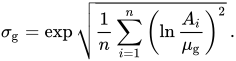
If the geometric mean of a set of numbers is denoted as , then the geometric standard deviation is

Derivation

[edit]

If the geometric mean is

then taking the natural logarithm of both sides results in

The logarithm of a product is a sum of logarithms (assuming is positive for all ), so

It can now be seen that is the arithmetic mean of the set , therefore the arithmetic standard deviation of this same set should be

This simplifies to

Geometric standard score

[edit]

The geometric version of the standard score is

If the geometric mean, standard deviation, and z-score of a datum are known, then the raw score can be reconstructed by

Relationship to log-normal distribution

[edit]

The geometric standard deviation is used as a measure of log-normal dispersion analogously to the geometric mean.[3] As the log-transform of a log-normal distribution results in a normal distribution, we see that the geometric standard deviation is the exponentiated value of the standard deviation of the log-transformed values, i.e. .

As such, the geometric mean and the geometric standard deviation of a sample of data from a log-normally distributed population may be used to find the bounds of confidence intervals analogously to the way the arithmetic mean and standard deviation are used to bound confidence intervals for a normal distribution. See discussion in log-normal distribution for details.

References

[edit]
Revisions and contributorsEdit on WikipediaRead on Wikipedia
from Grokipedia
The geometric standard deviation (GSD) is a measure of for , serving as the multiplicative analog to the arithmetic standard deviation when the is the appropriate , especially for lognormally distributed data. It quantifies variability by exponentiating the standard deviation of the natural logarithms of the data, yielding a unitless factor greater than or equal to 1 that describes how much the data spreads multiplicatively around the geometric mean—for instance, a GSD of 1.2 indicates that approximately 68% of the values lie between the geometric mean divided by 1.2 and multiplied by 1.2 in lognormal distributions. Introduced by biostatistician T.B.L. Kirkwood in to address limitations of arithmetic measures for skewed, ratio-based data, the GSD transforms the dataset via logarithms to normalize it before applying standard deviation calculations, then back-transforms the result to preserve the original scale's multiplicative nature. The formal definition for a sample x1,x2,,xn>0x_1, x_2, \dots, x_n > 0 involves computing the sample standard deviation ss of yi=ln(xi)y_i = \ln(x_i), followed by GSD=es\text{GSD} = e^s, where the natural logarithm ensures the measure is invariant to proportional scaling of the data. This approach contrasts with the arithmetic standard deviation, which is additive and suited to normal distributions, as the GSD cannot be added or subtracted but instead multiplies or divides the to form confidence-like intervals. Key properties of the GSD include its dimensionless quality and minimum value of 1 (achieved when all data are identical), making it ideal for expressing relative variability in percentages via the geometric coefficient of variation, defined as 100(GSD1)%100(\text{GSD} - 1)\%. In practice, software implementations like SAS, , and compute it directly from log-transformed data, often adjusting for in sample estimates. The measure assumes lognormality for optimal interpretability, where it captures about two-thirds of the data within the factor bounds, but it can be applied more broadly to positive skewed datasets with caution. Applications of the GSD span fields requiring analysis of multiplicative processes, such as environmental science for pollutant concentrations (e.g., reporting geometric means for radionuclides like 210Pb^{210}\text{Pb} at 0.52 mBq m3^{-3}), aerosol engineering for particle size distributions in pharmaceuticals (where GSD = d84/d50d_{84}/d_{50} or similar percentiles define spread), and finance for modeling investment returns or compounded growth rates. In biomedical research, it evaluates assay variability and bioequivalence, such as inter-laboratory differences in drug potency, while in demography, it assesses population growth fluctuations over time. These uses highlight its utility in summarizing data where ratios or percentages dominate, ensuring interpretations remain proportional rather than absolute.

Core Concepts

Definition

The geometric standard deviation (GSD) is a measure of dispersion applicable to sets of , especially those exhibiting multiplicative variability or following a . It quantifies the spread of data on a multiplicative scale by taking the exponential of the standard deviation of the natural logarithms of the data values, thereby transforming the additive spread in the logarithmic domain back to the original scale. For a sample of nn positive values x1,x2,,xn>0x_1, x_2, \dots, x_n > 0, the GSD is calculated as σg=exp(1n1i=1n(lnxiμg)2),\sigma_g = \exp\left( \sqrt{\frac{1}{n-1} \sum_{i=1}^n (\ln x_i - \mu_g)^2} \right),
Add your contribution
Related Hubs
User Avatar
No comments yet.