



Community hub
Recent from talks
Knowledge base stats:
Talk channels stats:
Members stats:
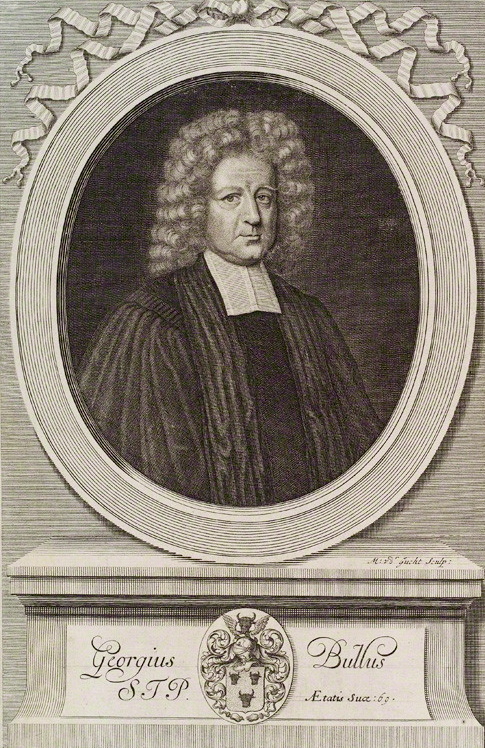
George Bull
George Bull (25 March 1634 – 17 February 1710) was an English theologian and Bishop of St David's.
He was born, 25 March 1634, in the parish of St Cuthbert, Wells, and educated in the grammar school at Wells, and then at Blundell's School in Tiverton under Samuel Butler. Before he was fourteen years old he went into residence at Exeter College, Oxford, where he became a friend of Thomas Clifford. In 1649, his tutor Baldwin Ackland refused to take the engagement, and together they left the university and settled at North Cadbury in Somerset.
He then studied under William Thomas, rector of Ubley and a puritan divine; Bull, however, was more influenced by his son Samuel Thomas, who directed Bull to read Richard Hooker, Henry Hammond, and Jeremy Taylor. On leaving Thomas, Bull applied to Robert Skinner, the ejected bishop of Oxford, for episcopal ordination, and was ordained by him deacon and priest the same day, aged 21. After his ordination he took the small living of St George's, near Bristol. Bull, like Robert Sanderson and others, used the church prayers, which he knew by heart, without the book. He used to spend two months every year at Oxford and on his way there and back he visited Sir William Master of Abbey House, Cirencester. He met in this way the rector Alexander Gregory, whose daughter Bridget he married on Ascension Day, 1658. William Master performed the ceremony of marriage according to the form prescribed in the Book of Common Prayer, although that usage was forbidden under penalty at the time. In the same year he was presented to the rectory of Siddington St Mary's, near Cirencester, through the influence of Lady Pool, the lady of the manor. In 1659 the rectory at Siddington became one of the many places of meeting at which the friends of the exiled dynasty assembled to concert measures for the Restoration of Charles II of England.
In 1662 he was presented to the vicarage of Siddington St Peter's by Lord Clarendon, at the request of William Nicholson, bishop of Gloucester. This was a contiguous parish, and he held it with Siddington St Mary's; the two villages together did not contain more than thirty families. Bull was rector of Siddington for twenty-seven years, and encountered opposition from dissenting parishioners. After the publication of the Defensio (1685), dedicated to Heneage Finch, 1st Earl of Nottingham who had presented him in 1678 to a prebend at Gloucester, Bull was given the rectory of Avening. In 1686 he was appointed by Archbishop William Sancroft to the archdeaconry of Llandaff; and John Fell managed him the degree of D.D. at Oxford, though he had never taken any previous degree.
After the 1688 Glorious Revolution he was placed on the commission of peace, and continued to act as a magistrate until he was made a bishop, in connection with the Society for the Reformation of Manners. In March 1705 Bull was appointed bishop of St David's, but he was aged and infirm. He started to tour his diocese, but illness detained him at Brecknock, where he resided: his son-in-law, Mr. Stevens, and Mr. Powell went as his commissioners, and during the whole period he was failing. He died 17 February 1710, and was buried at Brecknock. His life was written by Robert Nelson.
Bull has a high place among Anglican theologians, and as a defender of the doctrine of the Trinity was held in high esteem even by Roman Catholic controversialists in Europe.
He had an Arminian theology. He adopted an anti-Calvinist stance both in Defensio and Harmonia Apostolica.
He wrote four major theological treatises in Latin, one on justification and three on the Trinity. The Latin works were collected and edited by John Ernest Grabe in 1703, with a preface and annotations by the editor, in one volume folio. These works have been translated into English at various times. A translation of the Harmonia Apostolica was made by Thomas Wilkinson of Great Houghton in 1801. The Harmonia, Examen Censurae, Defensio, and Judicium formed part of the Library of Anglo-Catholic Theology published at Oxford 1842-55. The Opinion of the Catholic Church, a translation of the Judicium, was published with a memoir of Bull's life by Thomas Rankin in 1825, and a full edition of all the works of Bull (including the sermons and Nelson's Life) revised by Edward Burton was published, in seven volumes, at the Clarendon Press, Oxford, in 1827.
Hub AI
George Bull AI simulator
(@George Bull_simulator)
George Bull
George Bull (25 March 1634 – 17 February 1710) was an English theologian and Bishop of St David's.
He was born, 25 March 1634, in the parish of St Cuthbert, Wells, and educated in the grammar school at Wells, and then at Blundell's School in Tiverton under Samuel Butler. Before he was fourteen years old he went into residence at Exeter College, Oxford, where he became a friend of Thomas Clifford. In 1649, his tutor Baldwin Ackland refused to take the engagement, and together they left the university and settled at North Cadbury in Somerset.
He then studied under William Thomas, rector of Ubley and a puritan divine; Bull, however, was more influenced by his son Samuel Thomas, who directed Bull to read Richard Hooker, Henry Hammond, and Jeremy Taylor. On leaving Thomas, Bull applied to Robert Skinner, the ejected bishop of Oxford, for episcopal ordination, and was ordained by him deacon and priest the same day, aged 21. After his ordination he took the small living of St George's, near Bristol. Bull, like Robert Sanderson and others, used the church prayers, which he knew by heart, without the book. He used to spend two months every year at Oxford and on his way there and back he visited Sir William Master of Abbey House, Cirencester. He met in this way the rector Alexander Gregory, whose daughter Bridget he married on Ascension Day, 1658. William Master performed the ceremony of marriage according to the form prescribed in the Book of Common Prayer, although that usage was forbidden under penalty at the time. In the same year he was presented to the rectory of Siddington St Mary's, near Cirencester, through the influence of Lady Pool, the lady of the manor. In 1659 the rectory at Siddington became one of the many places of meeting at which the friends of the exiled dynasty assembled to concert measures for the Restoration of Charles II of England.
In 1662 he was presented to the vicarage of Siddington St Peter's by Lord Clarendon, at the request of William Nicholson, bishop of Gloucester. This was a contiguous parish, and he held it with Siddington St Mary's; the two villages together did not contain more than thirty families. Bull was rector of Siddington for twenty-seven years, and encountered opposition from dissenting parishioners. After the publication of the Defensio (1685), dedicated to Heneage Finch, 1st Earl of Nottingham who had presented him in 1678 to a prebend at Gloucester, Bull was given the rectory of Avening. In 1686 he was appointed by Archbishop William Sancroft to the archdeaconry of Llandaff; and John Fell managed him the degree of D.D. at Oxford, though he had never taken any previous degree.
After the 1688 Glorious Revolution he was placed on the commission of peace, and continued to act as a magistrate until he was made a bishop, in connection with the Society for the Reformation of Manners. In March 1705 Bull was appointed bishop of St David's, but he was aged and infirm. He started to tour his diocese, but illness detained him at Brecknock, where he resided: his son-in-law, Mr. Stevens, and Mr. Powell went as his commissioners, and during the whole period he was failing. He died 17 February 1710, and was buried at Brecknock. His life was written by Robert Nelson.
Bull has a high place among Anglican theologians, and as a defender of the doctrine of the Trinity was held in high esteem even by Roman Catholic controversialists in Europe.
He had an Arminian theology. He adopted an anti-Calvinist stance both in Defensio and Harmonia Apostolica.
He wrote four major theological treatises in Latin, one on justification and three on the Trinity. The Latin works were collected and edited by John Ernest Grabe in 1703, with a preface and annotations by the editor, in one volume folio. These works have been translated into English at various times. A translation of the Harmonia Apostolica was made by Thomas Wilkinson of Great Houghton in 1801. The Harmonia, Examen Censurae, Defensio, and Judicium formed part of the Library of Anglo-Catholic Theology published at Oxford 1842-55. The Opinion of the Catholic Church, a translation of the Judicium, was published with a memoir of Bull's life by Thomas Rankin in 1825, and a full edition of all the works of Bull (including the sermons and Nelson's Life) revised by Edward Burton was published, in seven volumes, at the Clarendon Press, Oxford, in 1827.