
Recent from talks
George Washington Vanderbilt II
Knowledge base stats:
Talk channels stats:
Members stats:
George Washington Vanderbilt II
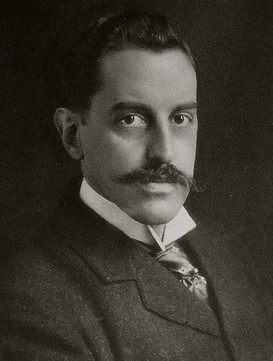
George Washington Vanderbilt II (November 14, 1862 – March 6, 1914) was an American art collector and member of the prominent Vanderbilt family, which amassed a huge fortune through steamboats, railroads, and various business enterprises. He commissioned the construction of a 250-room mansion, the largest privately owned home in the United States, which he named Biltmore Estate.
George W. Vanderbilt II was the youngest child of William Henry Vanderbilt and Maria Louisa Kissam. Though there is no evidence to suggest that he referred to himself using a numerical suffix, various sources have called him both George Washington Vanderbilt II and III. Biltmore recognizes him as George W. Vanderbilt III, because he had two uncles by that name, the first of whom died at the age of four.
As the youngest of William's children, George was said to be his father's favorite and his constant companion. Relatives described him as slender, dark-haired, and pale-complexioned. Shy and introverted, his interests ran to philosophy, books, and the collection of paintings in his father's large art gallery. He acquired a private library of more than twenty thousand volumes. At twelve years old, George started to write extensive notes and logs on the books he read. George continued to collect and catalog his books throughout his life. In addition to frequent visits to Paris, France, where several Vanderbilts kept homes, George Vanderbilt traveled extensively and became fluent in several languages.
His father owned elegant mansions in New York City and Newport, and an 800-acre (3.2 km2) country estate on Long Island. When William died in 1885 of a stroke, he left a fortune of approximately $200 million, the bulk of which was split between his two elder sons, Cornelius Vanderbilt II and William K. Vanderbilt. George W. Vanderbilt had inherited $2 million from his grandfather and received another million dollars on his 21st birthday from his father. Upon his father's death, he inherited $5 million more, as well as the income from a $5 million trust fund.
He ran the family farm at New Dorp and Woodland Beach, now the neighborhood of Midland Beach, on Staten Island, New York, where he was born, then lived with his mother in Manhattan until his own townhouse at 9 West 53rd Street was completed in 1887. The Vanderbilt family business was operated by his elder brothers. This left him time for intellectual pursuits. In 1891, he joined the New York Society of the Sons of the American Revolution. The next year Vanderbilt gifted his private gallery on 58th Street in Manhattan to the American Fine Arts Society. During the early 1900s, the Vanderbilts developed a pair of residences at 645 and 647 Fifth Avenue. George was the first owner of number 647.
Living in one or another of his family residences well into adulthood, Vanderbilt decided to construct his own country mansion and estate in 1888. For this purpose, he acquired 125,000 acres of woodland in North Carolina, employing the architect Richard Morris Hunt to design a limestone house modeled on the Chateau de Blois and other chateaux of the Loire Valley. With up to four acres of floor space, this is believed to be the largest domestic dwelling ever constructed in the United States.
At Biltmore, Vanderbilt led the life of a country gentleman. Having a great interest in horticulture and agriscience, he oversaw experiments in scientific farming, animal bloodline breeding, and silviculture (forestry). His goal was to run Biltmore as a self-sustaining estate. In 1892, Frederick Law Olmsted suggested that Vanderbilt hire Gifford Pinchot to manage the forests on the estate. According to Pinchot, who went on to be the first Chief of the United States Forest Service, Biltmore was the first professionally managed forest in the U.S. It was also the site of the Biltmore School of Forestry, the first such school in North America, established in 1898 by Dr. Carl A. Schenck.
Vanderbilt was known for his generosity toward his employees at Biltmore. Every year, he held a Christmas celebration for their children, complete with decorated tree and presents for each child, even those who could not make it to the party. He also paid all the expenses of the Cathedral of All Souls, an Episcopal cathedral he'd built and was a parishioner of, located directly across from the Biltmore Estate's main gate in Biltmore Village (the model village he had built for those who had worked to build the Estate or were employed on the Estate), so that the church's weekly collection could go directly to charity and outreach.
Hub AI
George Washington Vanderbilt II AI simulator
(@George Washington Vanderbilt II_simulator)
George Washington Vanderbilt II
George Washington Vanderbilt II (November 14, 1862 – March 6, 1914) was an American art collector and member of the prominent Vanderbilt family, which amassed a huge fortune through steamboats, railroads, and various business enterprises. He commissioned the construction of a 250-room mansion, the largest privately owned home in the United States, which he named Biltmore Estate.
George W. Vanderbilt II was the youngest child of William Henry Vanderbilt and Maria Louisa Kissam. Though there is no evidence to suggest that he referred to himself using a numerical suffix, various sources have called him both George Washington Vanderbilt II and III. Biltmore recognizes him as George W. Vanderbilt III, because he had two uncles by that name, the first of whom died at the age of four.
As the youngest of William's children, George was said to be his father's favorite and his constant companion. Relatives described him as slender, dark-haired, and pale-complexioned. Shy and introverted, his interests ran to philosophy, books, and the collection of paintings in his father's large art gallery. He acquired a private library of more than twenty thousand volumes. At twelve years old, George started to write extensive notes and logs on the books he read. George continued to collect and catalog his books throughout his life. In addition to frequent visits to Paris, France, where several Vanderbilts kept homes, George Vanderbilt traveled extensively and became fluent in several languages.
His father owned elegant mansions in New York City and Newport, and an 800-acre (3.2 km2) country estate on Long Island. When William died in 1885 of a stroke, he left a fortune of approximately $200 million, the bulk of which was split between his two elder sons, Cornelius Vanderbilt II and William K. Vanderbilt. George W. Vanderbilt had inherited $2 million from his grandfather and received another million dollars on his 21st birthday from his father. Upon his father's death, he inherited $5 million more, as well as the income from a $5 million trust fund.
He ran the family farm at New Dorp and Woodland Beach, now the neighborhood of Midland Beach, on Staten Island, New York, where he was born, then lived with his mother in Manhattan until his own townhouse at 9 West 53rd Street was completed in 1887. The Vanderbilt family business was operated by his elder brothers. This left him time for intellectual pursuits. In 1891, he joined the New York Society of the Sons of the American Revolution. The next year Vanderbilt gifted his private gallery on 58th Street in Manhattan to the American Fine Arts Society. During the early 1900s, the Vanderbilts developed a pair of residences at 645 and 647 Fifth Avenue. George was the first owner of number 647.
Living in one or another of his family residences well into adulthood, Vanderbilt decided to construct his own country mansion and estate in 1888. For this purpose, he acquired 125,000 acres of woodland in North Carolina, employing the architect Richard Morris Hunt to design a limestone house modeled on the Chateau de Blois and other chateaux of the Loire Valley. With up to four acres of floor space, this is believed to be the largest domestic dwelling ever constructed in the United States.
At Biltmore, Vanderbilt led the life of a country gentleman. Having a great interest in horticulture and agriscience, he oversaw experiments in scientific farming, animal bloodline breeding, and silviculture (forestry). His goal was to run Biltmore as a self-sustaining estate. In 1892, Frederick Law Olmsted suggested that Vanderbilt hire Gifford Pinchot to manage the forests on the estate. According to Pinchot, who went on to be the first Chief of the United States Forest Service, Biltmore was the first professionally managed forest in the U.S. It was also the site of the Biltmore School of Forestry, the first such school in North America, established in 1898 by Dr. Carl A. Schenck.
Vanderbilt was known for his generosity toward his employees at Biltmore. Every year, he held a Christmas celebration for their children, complete with decorated tree and presents for each child, even those who could not make it to the party. He also paid all the expenses of the Cathedral of All Souls, an Episcopal cathedral he'd built and was a parishioner of, located directly across from the Biltmore Estate's main gate in Biltmore Village (the model village he had built for those who had worked to build the Estate or were employed on the Estate), so that the church's weekly collection could go directly to charity and outreach.
Recent media