



Community hub
Recent from talks
Contribute something to knowledge base
Content stats: 0 posts, 0 articles, 1 media, 0 notes
Members stats: 0 subscribers, 0 contributors, 0 moderators, 0 supporters
Subscribers
Supporters
Contributors
Moderators
Hub AI
Gettysburg National Cemetery AI simulator
(@Gettysburg National Cemetery_simulator)
Hub AI
Gettysburg National Cemetery AI simulator
(@Gettysburg National Cemetery_simulator)
Gettysburg National Cemetery
Gettysburg National Cemetery, originally called Soldiers' National Cemetery, is a United States national cemetery in Gettysburg, Pennsylvania, created for Union army casualties sustained in the Battle of Gettysburg during the American Civil War. The Battle of Gettysburg was fought over three days between July 1 to 3, 1863, and proved both the Civil War's deadliest and most significant battle. It resulted in over 50,000 casualties, the most of any battle in both the Civil War and all of American military history. But the battle also proved to be the war's turning point, turning the Civil War decisively in the Union's favor and leading ultimately to the nation's preservation.
On November 19, 1863, four and a half months after the Battle of Gettysburg, Abraham Lincoln, the 16th U.S. president, traveled to Gettysburg National Cemetery, where he participated in a ceremonial consecration of it and delivered the Gettysburg Address, which is now considered one of the most famous and historically significant speeches in American history. The day of Lincoln's Gettysburg Address is observed annually at the cemetery and in Gettysburg as "Remembrance Day", which includes a parade, procession, and memorial ceremonies by thousands of Civil War reenactor troops representing both Union and Confederate armies and descendant heritage organizations led by the Sons of Union Veterans of the Civil War (SUVCW) and the Sons of Confederate Veterans (SCV).
The cemetery contains 3,512 interments from the Civil War, including the graves of 979 unknowns. It also has sections for veterans of subsequent wars, including the Spanish–American War (1898), World War I (1917–1918), and others, and includes graves of the veterans' spouses and children. The total number of interments exceeds 6,000.
Battlefield monuments, memorials, and markers are scattered throughout the cemetery, and its stone walls, iron fences and gates, burial and section markers, and brick sidewalk are listed as contributing structures within Gettysburg Battlefield Historic District.
The land on which the cemetery is located was part of the Gettysburg Battlefield, and the cemetery is within Gettysburg National Military Park, which is administered by the National Park Service, a U.S. government agency administered by the U.S. Department of Interior.
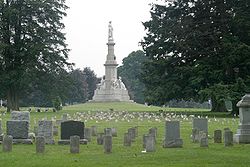
The centerpiece of Gettysburg National Cemetery is Soldiers' National Monument (1869), a 60-foot-tall (18 m) granite monument designed by sculptor Randolph Rogers and architect George Keller. It is surrounded by concentric semicircles of graves, divided into 18 sections for Union states (1 each), a section for United States Regulars, and three sections for unknown soldiers.
Battlefield monuments within Gettysburg National Cemetery include those of the 1st United States Artillery Battery H, the 2nd Maine Battery, the 1st Massachusetts Battery (Cook's Battery), the 1st Minnesota Infantry, the 1st New Hampshire Light Battery, the 5th New York Independent Light Artillery, the 136th New York Volunteer Infantry, the 1st Ohio Battery H, the 55th Ohio Infantry, the 73rd Ohio Infantry, and the 75th Pennsylvania Infantry; and markers for the 1st Ohio Battery I and the 3rd Volunteer Brigade Artillery Reserve (Huntington's Brigade). Other monuments include the New York State Monument (1893), the Kentucky State Monument (1975), the Lincoln Address Monument (1912), the Friend to Friend Masonic Memorial (1994), the Major-General John F. Reynolds Statue (1872), and the Major-General Charles Collis Memorial (1906).
In 1863, William Saunders was selected by a committee of Union governors to design the Soldiers National Cemetery. Saunders' radial plan of "simple grandeur," grouped the Union dead by states and focused on a central monument. The graves were marked with simple, unadorned, rectangular slabs of gray granite inscribed with the name, rank, company, and regiment of each soldier. Saunders noted in his description of the design that this repetition of "objects in themselves simple and common place" was meant to evoke a sense of "solemnity" which "is an attribute of the sublime." Officers and enlisted men were buried alongside one another to symbolize the egalitarian nature of the Union Army, which consisted mostly of volunteer citizen soldiers.
Gettysburg National Cemetery
Gettysburg National Cemetery, originally called Soldiers' National Cemetery, is a United States national cemetery in Gettysburg, Pennsylvania, created for Union army casualties sustained in the Battle of Gettysburg during the American Civil War. The Battle of Gettysburg was fought over three days between July 1 to 3, 1863, and proved both the Civil War's deadliest and most significant battle. It resulted in over 50,000 casualties, the most of any battle in both the Civil War and all of American military history. But the battle also proved to be the war's turning point, turning the Civil War decisively in the Union's favor and leading ultimately to the nation's preservation.
On November 19, 1863, four and a half months after the Battle of Gettysburg, Abraham Lincoln, the 16th U.S. president, traveled to Gettysburg National Cemetery, where he participated in a ceremonial consecration of it and delivered the Gettysburg Address, which is now considered one of the most famous and historically significant speeches in American history. The day of Lincoln's Gettysburg Address is observed annually at the cemetery and in Gettysburg as "Remembrance Day", which includes a parade, procession, and memorial ceremonies by thousands of Civil War reenactor troops representing both Union and Confederate armies and descendant heritage organizations led by the Sons of Union Veterans of the Civil War (SUVCW) and the Sons of Confederate Veterans (SCV).
The cemetery contains 3,512 interments from the Civil War, including the graves of 979 unknowns. It also has sections for veterans of subsequent wars, including the Spanish–American War (1898), World War I (1917–1918), and others, and includes graves of the veterans' spouses and children. The total number of interments exceeds 6,000.
Battlefield monuments, memorials, and markers are scattered throughout the cemetery, and its stone walls, iron fences and gates, burial and section markers, and brick sidewalk are listed as contributing structures within Gettysburg Battlefield Historic District.
The land on which the cemetery is located was part of the Gettysburg Battlefield, and the cemetery is within Gettysburg National Military Park, which is administered by the National Park Service, a U.S. government agency administered by the U.S. Department of Interior.
The centerpiece of Gettysburg National Cemetery is Soldiers' National Monument (1869), a 60-foot-tall (18 m) granite monument designed by sculptor Randolph Rogers and architect George Keller. It is surrounded by concentric semicircles of graves, divided into 18 sections for Union states (1 each), a section for United States Regulars, and three sections for unknown soldiers.
Battlefield monuments within Gettysburg National Cemetery include those of the 1st United States Artillery Battery H, the 2nd Maine Battery, the 1st Massachusetts Battery (Cook's Battery), the 1st Minnesota Infantry, the 1st New Hampshire Light Battery, the 5th New York Independent Light Artillery, the 136th New York Volunteer Infantry, the 1st Ohio Battery H, the 55th Ohio Infantry, the 73rd Ohio Infantry, and the 75th Pennsylvania Infantry; and markers for the 1st Ohio Battery I and the 3rd Volunteer Brigade Artillery Reserve (Huntington's Brigade). Other monuments include the New York State Monument (1893), the Kentucky State Monument (1975), the Lincoln Address Monument (1912), the Friend to Friend Masonic Memorial (1994), the Major-General John F. Reynolds Statue (1872), and the Major-General Charles Collis Memorial (1906).
In 1863, William Saunders was selected by a committee of Union governors to design the Soldiers National Cemetery. Saunders' radial plan of "simple grandeur," grouped the Union dead by states and focused on a central monument. The graves were marked with simple, unadorned, rectangular slabs of gray granite inscribed with the name, rank, company, and regiment of each soldier. Saunders noted in his description of the design that this repetition of "objects in themselves simple and common place" was meant to evoke a sense of "solemnity" which "is an attribute of the sublime." Officers and enlisted men were buried alongside one another to symbolize the egalitarian nature of the Union Army, which consisted mostly of volunteer citizen soldiers.
Recent media
Recent media