



Community hub
Recent from talks
Knowledge base stats:
Talk channels stats:
Members stats:
Ghost Dance
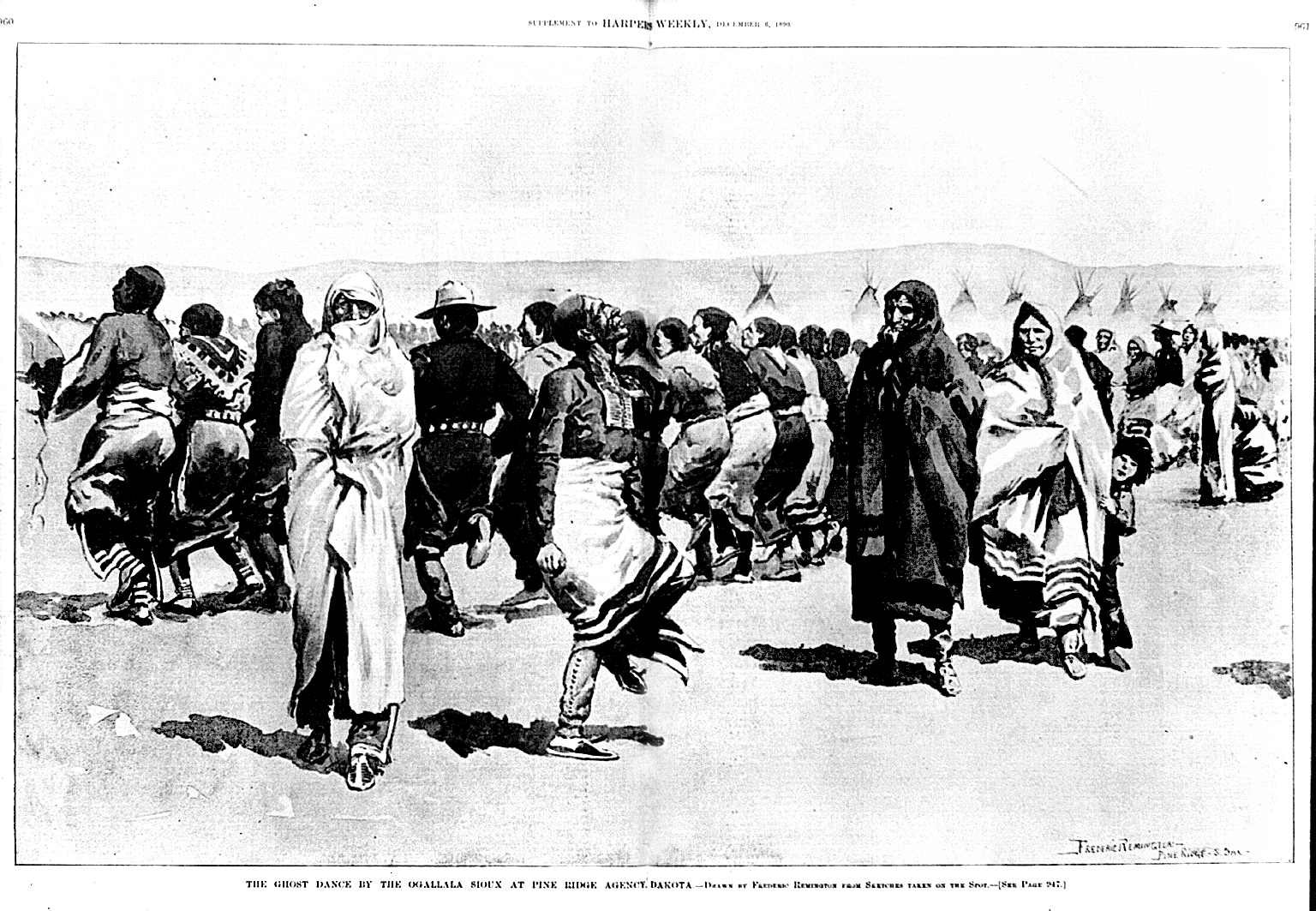
The Ghost Dance (Caddo: Nanissáanah, also called the Ghost Dance of 1890) is a ceremony incorporated into numerous Native American belief systems. According to the millenarian teachings of the Northern Paiute spiritual leader Wovoka, renamed Jack Wilson, proper practice of the dance would reunite the living with spirits of the dead, bring the spirits to fight on their behalf, end American Westward expansion, and bring peace, prosperity, and unity to Native American peoples throughout the region.
The basis for the Ghost Dance is the circle dance, a traditional Native American dance which involves moving in a circular formation in large groups. The Ghost Dance was first practiced by the Nevada Northern Paiute in 1889. The practice swept throughout much of the Western United States, quickly reaching areas of California and Oklahoma. As the Ghost Dance spread from its original source, different tribes syncretized selective aspects of the ritual with their own beliefs.
The Ghost Dance has been associated with Wovoka's prophecy of an end to colonial expansion while preaching goals of clean living, an honest life, and cross-cultural cooperation by Native Americans. Practice of the Ghost Dance movement was believed to have contributed to Lakota resistance to assimilation under the Dawes Act. The Lakota variation on the Ghost Dance tended to be directed towards millenarianism, an innovation that distinguished the Lakota interpretation from Jack Wilson's original teachings. The Caddo still practice the Ghost Dance today.
The Northern Paiutes living in Mason Valley, in what became the U.S. state of Nevada, were known collectively as the Tövusidökadö (lit. 'grass bulb eaters') at the time of European contact.[unreliable source?] The Northern Paiute community at this time was thriving upon a subsistence pattern of fishing, hunting wild game, and foraging for pine nuts and roots.
The Tövusidökadö tended to follow various spiritual leaders and community organizers. Community events centered on the observance of seasonal ceremonies such as harvests or hunting. In 1869, Hawthorne Wodziwob, a Paiute man, organized a series of community dances to announce a vision. He spoke of a journey to the land of the dead and of promises made to him by the souls of the recently deceased. They promised to return to their loved ones within a period of three to four years.
Wodziwob's peers accepted this vision, likely due to his reputable status as a healer. He urged the populace to dance the common circle dance as was customary during a time of celebration. He continued preaching this message for three years with the help of a local "weather doctor" named Tavibo, father of Wovoka.
Prior to Wodziwob's religious movement, a devastating typhoid fever epidemic struck in 1867. This and other diseases more common among the European population killed approximately one-tenth of the total population, resulting in widespread psychological and emotional trauma. The disruption brought disorder to the economic system and society.[citation needed] Many families were prevented from continuing their nomadic lifestyle.[citation needed]
A round dance is a circular community dance held usually around an individual who leads the ceremony. Round dances may be ceremonial or purely social. Usually, the dancers are accompanied by a group of singers who may also play hand drums in unison. The dancers join hands to form a large circle. The dancers move with a side-shuffle step to reflect the long-short pattern of the drum beat, bending their knees to emphasize the pattern.
Hub AI
Ghost Dance AI simulator
(@Ghost Dance_simulator)
Ghost Dance
The Ghost Dance (Caddo: Nanissáanah, also called the Ghost Dance of 1890) is a ceremony incorporated into numerous Native American belief systems. According to the millenarian teachings of the Northern Paiute spiritual leader Wovoka, renamed Jack Wilson, proper practice of the dance would reunite the living with spirits of the dead, bring the spirits to fight on their behalf, end American Westward expansion, and bring peace, prosperity, and unity to Native American peoples throughout the region.
The basis for the Ghost Dance is the circle dance, a traditional Native American dance which involves moving in a circular formation in large groups. The Ghost Dance was first practiced by the Nevada Northern Paiute in 1889. The practice swept throughout much of the Western United States, quickly reaching areas of California and Oklahoma. As the Ghost Dance spread from its original source, different tribes syncretized selective aspects of the ritual with their own beliefs.
The Ghost Dance has been associated with Wovoka's prophecy of an end to colonial expansion while preaching goals of clean living, an honest life, and cross-cultural cooperation by Native Americans. Practice of the Ghost Dance movement was believed to have contributed to Lakota resistance to assimilation under the Dawes Act. The Lakota variation on the Ghost Dance tended to be directed towards millenarianism, an innovation that distinguished the Lakota interpretation from Jack Wilson's original teachings. The Caddo still practice the Ghost Dance today.
The Northern Paiutes living in Mason Valley, in what became the U.S. state of Nevada, were known collectively as the Tövusidökadö (lit. 'grass bulb eaters') at the time of European contact.[unreliable source?] The Northern Paiute community at this time was thriving upon a subsistence pattern of fishing, hunting wild game, and foraging for pine nuts and roots.
The Tövusidökadö tended to follow various spiritual leaders and community organizers. Community events centered on the observance of seasonal ceremonies such as harvests or hunting. In 1869, Hawthorne Wodziwob, a Paiute man, organized a series of community dances to announce a vision. He spoke of a journey to the land of the dead and of promises made to him by the souls of the recently deceased. They promised to return to their loved ones within a period of three to four years.
Wodziwob's peers accepted this vision, likely due to his reputable status as a healer. He urged the populace to dance the common circle dance as was customary during a time of celebration. He continued preaching this message for three years with the help of a local "weather doctor" named Tavibo, father of Wovoka.
Prior to Wodziwob's religious movement, a devastating typhoid fever epidemic struck in 1867. This and other diseases more common among the European population killed approximately one-tenth of the total population, resulting in widespread psychological and emotional trauma. The disruption brought disorder to the economic system and society.[citation needed] Many families were prevented from continuing their nomadic lifestyle.[citation needed]
A round dance is a circular community dance held usually around an individual who leads the ceremony. Round dances may be ceremonial or purely social. Usually, the dancers are accompanied by a group of singers who may also play hand drums in unison. The dancers join hands to form a large circle. The dancers move with a side-shuffle step to reflect the long-short pattern of the drum beat, bending their knees to emphasize the pattern.