


Community hub
Recent from talks
Contribute something to knowledge base
Content stats: 0 posts, 0 articles, 1 media, 0 notes
Members stats: 0 subscribers, 0 contributors, 0 moderators, 0 supporters
Subscribers
Supporters
Contributors
Moderators
Hub AI
Macrocystis AI simulator
(@Macrocystis_simulator)
Hub AI
Macrocystis AI simulator
(@Macrocystis_simulator)
Macrocystis
Macrocystis is a monospecific genus of kelp (large brown algae) with all species now synonymous with Macrocystis pyrifera. It is commonly known as giant kelp or bladder kelp. This genus contains the largest of all the Phaeophyceae or brown algae. Macrocystis has pneumatocysts at the base of its blades. Sporophytes are perennial and the individual may live for up to three years; stipes/fronds within a whole individual undergo senescence, where each frond may persist for approximately 100 days. The genus is found widely in subtropical, temperate, and sub-Antarctic oceans of the Southern Hemisphere and in the northeast Pacific. Macrocystis is often a major component of temperate kelp forests.
Despite its appearance, it is not a plant; it is a stramenopile. Giant kelp is common along the coast of the northeastern Pacific Ocean, from Baja California north to southeast Alaska, and is also found in the southern oceans near South America, South Africa, Australia, and New Zealand. Individual algae may grow to more than 45 metres (150 feet) long at a rate of as much as 60 cm (2 ft) per day. Giant kelp grows in dense stands known as kelp forests, which are home to many marine animals that depend on the algae for food or shelter. The primary commercial product obtained from giant kelp is alginate, but humans also harvest this species on a limited basis for use directly as food. It is rich in iodine, potassium, and other minerals. It can be used in cooking in many of the ways other sea vegetables are used, and particularly serves to add flavor to bean dishes.
Macrocystis is a monospecific genus; the sole species is M. pyrifera. Some individuals are so huge that the thallus may grow to up to 60 m (200 ft). The stipes arise from a holdfast and branch three or four times from near the base. Blades develop at irregular intervals along the stipe. M. pyrifera grows to over 45 m (150 ft) long. The stipes are unbranched and each blade has a gas bladder at its base.
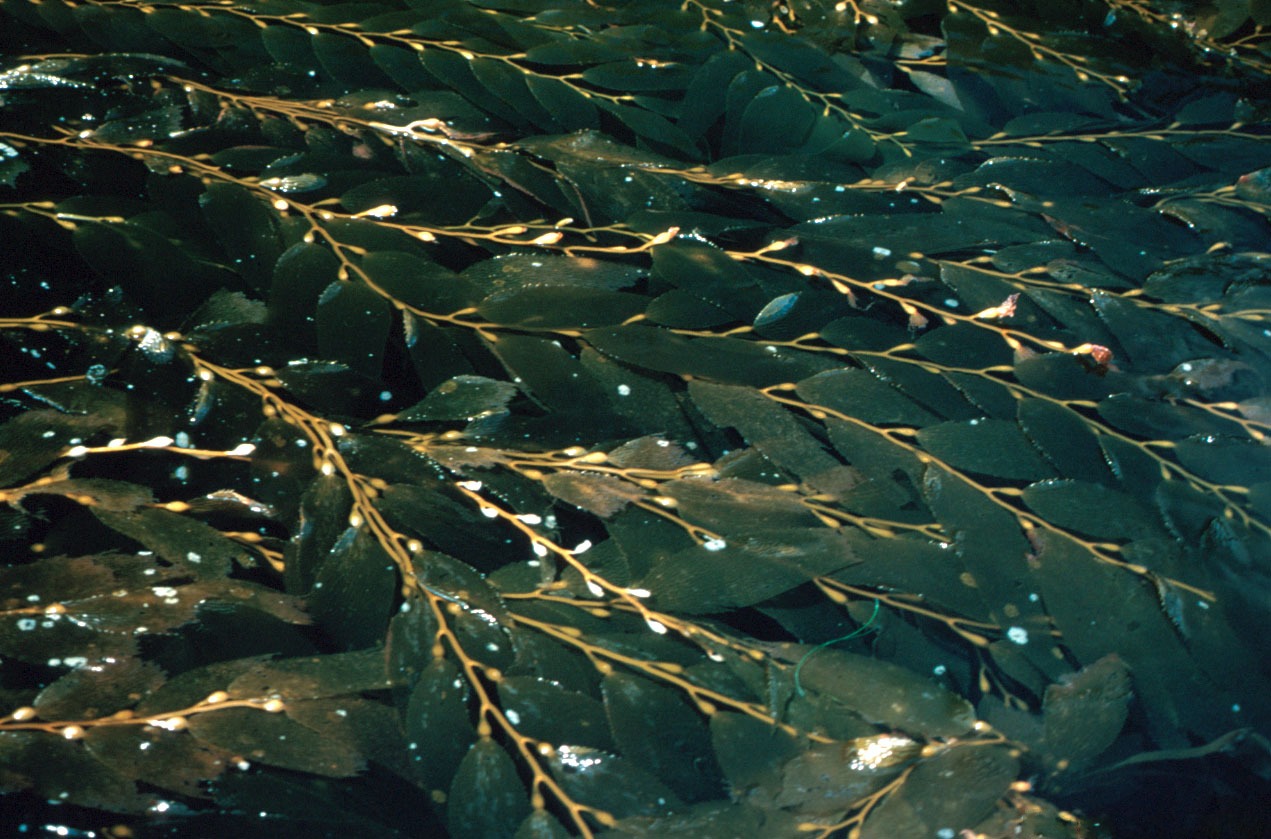
Macrocystis pyrifera is the largest of all algae. The stage of the life cycle that is usually seen is the sporophyte, which is perennial and individuals persist for many years. Individuals may grow to up to 50 m (160 ft) long or more. The kelp often grows even longer than the distance from the bottom to the surface as it will grow in a diagonal direction due to the ocean current pushing against the kelp. The stalks arise from a basal meristem, with as many as 60 stalks in older well protected individuals. Blades develop at irregular intervals along the stipe, with a single pneumatocyst (gas bladder) at the base of each blade. At the base of each stalk is a cluster of blades that lack pneumatocysts; instead they develop small sacks on the blade that release the biflagellated zoospores: these are the sporophylls.
The smaller morphs, formerly identified as Macrocystis integrifolia, have deep brown color on flattened rhizomes which are profusely dichotomously branched. Each is attached by branched root-like structures coming out of the sides of the rhizomes. Slender main stipes (about 1 centimetre (0.39 in) wide to 30 metres (98 ft) long) come from the rhizome which is up to 0.1 metres (3.9 in) at the widest. Periodically 5 centimetres (2.0 in) wide and 35 centimetres (14 in) long flattened leaf-like branches derive from the stipe. They have furrowed surfaces and taper gradually, but then have an oval or rounded float where attached to the stipe. The blade-like branches have notched denticulate edges leading to the terminal blade at the tip of the stipe, which is separated by several smaller branches. It grows to only 6 m (20 ft) long. It is found on intertidal rocks or shallow subtidal rocks along the Pacific coast of North America (British Columbia to California) and South America. In New Zealand M. pyrifera is found in the subtidal zone of southern North Island, the South Island, Chatham, Stewart, Bounty, Antipodes, Auckland and Campbell Islands. The species can be found on rock and on sheltered open coasts.
The macroscopic sporophyte has many specialized blades growing near the holdfast. These blades bear various sori containing sporangia, which release haploid spores, which will grow into microscopic female and male gametophytes. These gametophytes, after reaching the appropriate substrata, grow mitotically to eventually produce gametes.
Females release their eggs (oogonia) along with a pheromone, the lamoxirene. This compound triggers sperm release by males. The Macrocystis sperm consists of biflagellate non-synthetic antherozoids, which find their way to the oogonia following the lamoxirene. The egg is then fertilized to form the zygote, which, through mitosis, begins growth.[citation needed]
Macrocystis integrifolia is found on intertidal rocks or shallow subtidal rocks along the Pacific coast of North America from British Columbia to California. It prefers water about 7 metres (23 ft) to 10 metres (33 ft) deep and exposed to the open sea and normal salinities, yet sheltered from full wave action.
Macrocystis
Macrocystis is a monospecific genus of kelp (large brown algae) with all species now synonymous with Macrocystis pyrifera. It is commonly known as giant kelp or bladder kelp. This genus contains the largest of all the Phaeophyceae or brown algae. Macrocystis has pneumatocysts at the base of its blades. Sporophytes are perennial and the individual may live for up to three years; stipes/fronds within a whole individual undergo senescence, where each frond may persist for approximately 100 days. The genus is found widely in subtropical, temperate, and sub-Antarctic oceans of the Southern Hemisphere and in the northeast Pacific. Macrocystis is often a major component of temperate kelp forests.
Despite its appearance, it is not a plant; it is a stramenopile. Giant kelp is common along the coast of the northeastern Pacific Ocean, from Baja California north to southeast Alaska, and is also found in the southern oceans near South America, South Africa, Australia, and New Zealand. Individual algae may grow to more than 45 metres (150 feet) long at a rate of as much as 60 cm (2 ft) per day. Giant kelp grows in dense stands known as kelp forests, which are home to many marine animals that depend on the algae for food or shelter. The primary commercial product obtained from giant kelp is alginate, but humans also harvest this species on a limited basis for use directly as food. It is rich in iodine, potassium, and other minerals. It can be used in cooking in many of the ways other sea vegetables are used, and particularly serves to add flavor to bean dishes.
Macrocystis is a monospecific genus; the sole species is M. pyrifera. Some individuals are so huge that the thallus may grow to up to 60 m (200 ft). The stipes arise from a holdfast and branch three or four times from near the base. Blades develop at irregular intervals along the stipe. M. pyrifera grows to over 45 m (150 ft) long. The stipes are unbranched and each blade has a gas bladder at its base.
Macrocystis pyrifera is the largest of all algae. The stage of the life cycle that is usually seen is the sporophyte, which is perennial and individuals persist for many years. Individuals may grow to up to 50 m (160 ft) long or more. The kelp often grows even longer than the distance from the bottom to the surface as it will grow in a diagonal direction due to the ocean current pushing against the kelp. The stalks arise from a basal meristem, with as many as 60 stalks in older well protected individuals. Blades develop at irregular intervals along the stipe, with a single pneumatocyst (gas bladder) at the base of each blade. At the base of each stalk is a cluster of blades that lack pneumatocysts; instead they develop small sacks on the blade that release the biflagellated zoospores: these are the sporophylls.
The smaller morphs, formerly identified as Macrocystis integrifolia, have deep brown color on flattened rhizomes which are profusely dichotomously branched. Each is attached by branched root-like structures coming out of the sides of the rhizomes. Slender main stipes (about 1 centimetre (0.39 in) wide to 30 metres (98 ft) long) come from the rhizome which is up to 0.1 metres (3.9 in) at the widest. Periodically 5 centimetres (2.0 in) wide and 35 centimetres (14 in) long flattened leaf-like branches derive from the stipe. They have furrowed surfaces and taper gradually, but then have an oval or rounded float where attached to the stipe. The blade-like branches have notched denticulate edges leading to the terminal blade at the tip of the stipe, which is separated by several smaller branches. It grows to only 6 m (20 ft) long. It is found on intertidal rocks or shallow subtidal rocks along the Pacific coast of North America (British Columbia to California) and South America. In New Zealand M. pyrifera is found in the subtidal zone of southern North Island, the South Island, Chatham, Stewart, Bounty, Antipodes, Auckland and Campbell Islands. The species can be found on rock and on sheltered open coasts.
The macroscopic sporophyte has many specialized blades growing near the holdfast. These blades bear various sori containing sporangia, which release haploid spores, which will grow into microscopic female and male gametophytes. These gametophytes, after reaching the appropriate substrata, grow mitotically to eventually produce gametes.
Females release their eggs (oogonia) along with a pheromone, the lamoxirene. This compound triggers sperm release by males. The Macrocystis sperm consists of biflagellate non-synthetic antherozoids, which find their way to the oogonia following the lamoxirene. The egg is then fertilized to form the zygote, which, through mitosis, begins growth.[citation needed]
Macrocystis integrifolia is found on intertidal rocks or shallow subtidal rocks along the Pacific coast of North America from British Columbia to California. It prefers water about 7 metres (23 ft) to 10 metres (33 ft) deep and exposed to the open sea and normal salinities, yet sheltered from full wave action.
Recent media
Recent media