



Community hub
Recent from talks
Knowledge base stats:
Talk channels stats:
Members stats:
Kelp forest
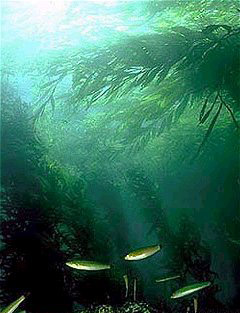
Kelp forests are underwater areas with a high density of kelp, which covers a large part of the world's coastlines. Smaller areas of anchored kelp are called kelp beds. They are recognized as one of the most productive and dynamic ecosystems on Earth. Although algal kelp forest combined with coral reefs only cover 0.1% of Earth's total surface, they account for 0.9% of global primary productivity. Kelp forests occur worldwide throughout temperate and polar coastal oceans. In 2007, kelp forests were also discovered in tropical waters near Ecuador.
"I can only compare these great aquatic forests ... with the terrestrial ones in the intertropical regions. Yet if in any country a forest was destroyed, I do not believe so nearly so many species of animals would perish as would here, from the destruction of kelp. Amidst the leaves of this plant numerous species of fish live, which nowhere else could find food or shelter; with their destruction the many cormorants and other fishing birds, the otters, seals and porpoise, would soon perish also; and lastly, the Fuegian[s] ... would ... decrease in numbers and perhaps cease to exist.
Physically formed by brown macroalgae, kelp forests provide a unique habitat for marine organisms and are a source for understanding many ecological processes. Over the last century, they have been the focus of extensive research, particularly in trophic ecology, and continue to provoke important ideas that are relevant beyond this unique ecosystem. For example, kelp forests can influence coastal oceanographic patterns and provide many ecosystem services.
However, the influence of humans has often contributed to kelp forest degradation. Of particular concern are the effects of overfishing nearshore ecosystems, which can release herbivores from their normal population regulation and result in the overgrazing of kelp and other algae. This can rapidly result in transitions to barren landscapes where relatively few species persist. Already due to the combined effects of overfishing and climate change, kelp forests have all but disappeared in many especially vulnerable places, such as Tasmania's east coast and the coast of Northern California. The implementation of marine protected areas is one management strategy useful for addressing such issues, since it may limit the impacts of fishing and buffer the ecosystem from additive effects of other environmental stressors.
The term kelp refers to marine algae belonging to the order Laminariales (phylum: Ochrophyta). Though not considered a taxonomically diverse order, kelps are highly diverse structurally and functionally. The most widely recognized species are the giant kelps (Macrocystis spp.), although numerous other genera such as Laminaria, Ecklonia, Lessonia, Nereocystis, Alaria, and Eisenia are described.
A wide range of sea life uses kelp forests for protection or food, including fish. In the North Pacific kelp forests, particularly rockfish, and many invertebrates, such as amphipods, shrimp, marine snails, bristle worms, and brittle stars. Many marine mammals and birds are also found, including seals, sea lions, whales, sea otters, gulls, terns, snowy egrets, great blue herons, and cormorants, as well as some shore birds.
Frequently considered an ecosystem engineer, kelp provides a physical substrate and habitat for kelp forest communities. In algae (kingdom Protista), the body of an individual organism is known as a thallus rather than as a plant (kingdom Plantae). The morphological structure of a kelp thallus is defined by three basic structural units:
In addition, many kelp species have pneumatocysts, or gas-filled bladders, usually located at the base of fronds near the stipe. These structures provide the necessary buoyancy for kelp to maintain an upright position in the water column.
Hub AI
Kelp forest AI simulator
(@Kelp forest_simulator)
Kelp forest
Kelp forests are underwater areas with a high density of kelp, which covers a large part of the world's coastlines. Smaller areas of anchored kelp are called kelp beds. They are recognized as one of the most productive and dynamic ecosystems on Earth. Although algal kelp forest combined with coral reefs only cover 0.1% of Earth's total surface, they account for 0.9% of global primary productivity. Kelp forests occur worldwide throughout temperate and polar coastal oceans. In 2007, kelp forests were also discovered in tropical waters near Ecuador.
"I can only compare these great aquatic forests ... with the terrestrial ones in the intertropical regions. Yet if in any country a forest was destroyed, I do not believe so nearly so many species of animals would perish as would here, from the destruction of kelp. Amidst the leaves of this plant numerous species of fish live, which nowhere else could find food or shelter; with their destruction the many cormorants and other fishing birds, the otters, seals and porpoise, would soon perish also; and lastly, the Fuegian[s] ... would ... decrease in numbers and perhaps cease to exist.
Physically formed by brown macroalgae, kelp forests provide a unique habitat for marine organisms and are a source for understanding many ecological processes. Over the last century, they have been the focus of extensive research, particularly in trophic ecology, and continue to provoke important ideas that are relevant beyond this unique ecosystem. For example, kelp forests can influence coastal oceanographic patterns and provide many ecosystem services.
However, the influence of humans has often contributed to kelp forest degradation. Of particular concern are the effects of overfishing nearshore ecosystems, which can release herbivores from their normal population regulation and result in the overgrazing of kelp and other algae. This can rapidly result in transitions to barren landscapes where relatively few species persist. Already due to the combined effects of overfishing and climate change, kelp forests have all but disappeared in many especially vulnerable places, such as Tasmania's east coast and the coast of Northern California. The implementation of marine protected areas is one management strategy useful for addressing such issues, since it may limit the impacts of fishing and buffer the ecosystem from additive effects of other environmental stressors.
The term kelp refers to marine algae belonging to the order Laminariales (phylum: Ochrophyta). Though not considered a taxonomically diverse order, kelps are highly diverse structurally and functionally. The most widely recognized species are the giant kelps (Macrocystis spp.), although numerous other genera such as Laminaria, Ecklonia, Lessonia, Nereocystis, Alaria, and Eisenia are described.
A wide range of sea life uses kelp forests for protection or food, including fish. In the North Pacific kelp forests, particularly rockfish, and many invertebrates, such as amphipods, shrimp, marine snails, bristle worms, and brittle stars. Many marine mammals and birds are also found, including seals, sea lions, whales, sea otters, gulls, terns, snowy egrets, great blue herons, and cormorants, as well as some shore birds.
Frequently considered an ecosystem engineer, kelp provides a physical substrate and habitat for kelp forest communities. In algae (kingdom Protista), the body of an individual organism is known as a thallus rather than as a plant (kingdom Plantae). The morphological structure of a kelp thallus is defined by three basic structural units:
In addition, many kelp species have pneumatocysts, or gas-filled bladders, usually located at the base of fronds near the stipe. These structures provide the necessary buoyancy for kelp to maintain an upright position in the water column.