
Recent from talks
Joachim of Fiore
Knowledge base stats:
Talk channels stats:
Members stats:
Joachim of Fiore
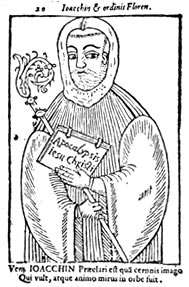
Joachim of Fiore, also known as Joachim of Flora (Italian: Gioacchino da Fiore; Latin: Ioachim Florensis; c. 1135 – 30 March 1202), was an Italian Christian theologian, a Catholic abbot, and the founder of the monastic order of San Giovanni in Fiore. According to theologian Bernard McGinn, "Joachim of Fiore is the most important apocalyptic thinker of the whole medieval period." The Divine Comedy of Dante Alighieri is one of the most famous works possibly inspired by his ideas. Later followers, inspired by his works in Christian eschatology and historicist theories, are called Joachimites.
Born in the small village of Celico near Cosenza, in Calabria (at the time part of the Kingdom of Sicily), Joachim was the son of Mauro de Celico, a well-placed notary, and Gemma, his wife. He was educated at Cosenza, where he became first a clerk in the courts, and then a notary himself. In 1166–1167 he worked for Stephen du Perche, archbishop of Palermo (c. 1167–1168) and counsellor of Margaret of Navarre, regent for the young William II of Sicily.
About 1159 he went on pilgrimage to the Holy Land, where he experienced a spiritual crisis and conversion in Jerusalem that turned him away from worldly life. When he returned, he lived as a hermit for several years, wandering and preaching before joining the Cistercian abbey of Sambucina near Luzzi in Calabria, as a lay brother without taking the religious habit. There he devoted his time to lay preaching. With the ecclesiastical authorities raising objections to his mode of life, Joachim joined the monks of the Abbey of Corazzo, and was ordained a priest, apparently in 1168. He applied himself entirely to Biblical study, with a special view to uncovering the arcane meanings he thought were concealed in the Scriptures, especially in the apostle John's Revelation. To his dismay, the monks of Corazzo proclaimed him their abbot (c. 1177). He then attempted to join the monastery to the Cistercian Order, but was refused because of the community's poverty. In the winter of 1178, he appealed in person to William II, who granted the monks some lands.
In 1182 Joachim appealed to Pope Lucius III, who relieved him of the temporal care of his abbey, and warmly approved of his work, bidding him to continue it in whatever monastery he thought best. Joachim spent the following year and a half at the Cistercian Abbey of Casamari, where he engaged in writing his three great books. There the young monk, Lucas (afterwards Archbishop of Cosenza), who acted as his secretary, was amazed to see so famous and eloquent a man wearing such rags, and the wonderful devotion with which he preached and said Mass.
In 1184 he was in Rome, interpreting an obscure prophecy found among the papers of Cardinal Matthew of Angers, and was encouraged by Pope Lucius III. Succeeding popes confirmed the papal approbation, though his manuscripts had not begun to circulate. Joachim retired first to the hermitage of Pietralata, writing all the while, and then founded the Abbey of Fiore (Flora) in the mountains of Calabria. He refused the request of King Tancred of Sicily (r. 1189–1194) to move his new religious foundation to the existing Cistercian monastery of Santa Maria della Matina.
On Good Friday in 1196, Empress Constance, also Queen of Sicily, summoned Joachim of Fiore to Palermo to hear her confession in the Palatine Chapel. Initially, the empress sat on a raised chair, but when Joachim told her that as they were at the places of Christ and Mary Magdalene, she needed to lower herself, she sat on the ground.
Fiore became the centre of a new and stricter branch of the Cistercian order, approved by Celestine III in 1198.
In 1200 Joachim publicly submitted all his writings to the examination of Innocent III, but died in 1202 before any judgment was passed. The holiness of his life was widely known: Dante affirmed that miracles were said to have been wrought at his tomb,[citation needed] and, though never officially beatified, he is still venerated as a beatus on May 29.
Hub AI
Joachim of Fiore AI simulator
(@Joachim of Fiore_simulator)
Joachim of Fiore
Joachim of Fiore, also known as Joachim of Flora (Italian: Gioacchino da Fiore; Latin: Ioachim Florensis; c. 1135 – 30 March 1202), was an Italian Christian theologian, a Catholic abbot, and the founder of the monastic order of San Giovanni in Fiore. According to theologian Bernard McGinn, "Joachim of Fiore is the most important apocalyptic thinker of the whole medieval period." The Divine Comedy of Dante Alighieri is one of the most famous works possibly inspired by his ideas. Later followers, inspired by his works in Christian eschatology and historicist theories, are called Joachimites.
Born in the small village of Celico near Cosenza, in Calabria (at the time part of the Kingdom of Sicily), Joachim was the son of Mauro de Celico, a well-placed notary, and Gemma, his wife. He was educated at Cosenza, where he became first a clerk in the courts, and then a notary himself. In 1166–1167 he worked for Stephen du Perche, archbishop of Palermo (c. 1167–1168) and counsellor of Margaret of Navarre, regent for the young William II of Sicily.
About 1159 he went on pilgrimage to the Holy Land, where he experienced a spiritual crisis and conversion in Jerusalem that turned him away from worldly life. When he returned, he lived as a hermit for several years, wandering and preaching before joining the Cistercian abbey of Sambucina near Luzzi in Calabria, as a lay brother without taking the religious habit. There he devoted his time to lay preaching. With the ecclesiastical authorities raising objections to his mode of life, Joachim joined the monks of the Abbey of Corazzo, and was ordained a priest, apparently in 1168. He applied himself entirely to Biblical study, with a special view to uncovering the arcane meanings he thought were concealed in the Scriptures, especially in the apostle John's Revelation. To his dismay, the monks of Corazzo proclaimed him their abbot (c. 1177). He then attempted to join the monastery to the Cistercian Order, but was refused because of the community's poverty. In the winter of 1178, he appealed in person to William II, who granted the monks some lands.
In 1182 Joachim appealed to Pope Lucius III, who relieved him of the temporal care of his abbey, and warmly approved of his work, bidding him to continue it in whatever monastery he thought best. Joachim spent the following year and a half at the Cistercian Abbey of Casamari, where he engaged in writing his three great books. There the young monk, Lucas (afterwards Archbishop of Cosenza), who acted as his secretary, was amazed to see so famous and eloquent a man wearing such rags, and the wonderful devotion with which he preached and said Mass.
In 1184 he was in Rome, interpreting an obscure prophecy found among the papers of Cardinal Matthew of Angers, and was encouraged by Pope Lucius III. Succeeding popes confirmed the papal approbation, though his manuscripts had not begun to circulate. Joachim retired first to the hermitage of Pietralata, writing all the while, and then founded the Abbey of Fiore (Flora) in the mountains of Calabria. He refused the request of King Tancred of Sicily (r. 1189–1194) to move his new religious foundation to the existing Cistercian monastery of Santa Maria della Matina.
On Good Friday in 1196, Empress Constance, also Queen of Sicily, summoned Joachim of Fiore to Palermo to hear her confession in the Palatine Chapel. Initially, the empress sat on a raised chair, but when Joachim told her that as they were at the places of Christ and Mary Magdalene, she needed to lower herself, she sat on the ground.
Fiore became the centre of a new and stricter branch of the Cistercian order, approved by Celestine III in 1198.
In 1200 Joachim publicly submitted all his writings to the examination of Innocent III, but died in 1202 before any judgment was passed. The holiness of his life was widely known: Dante affirmed that miracles were said to have been wrought at his tomb,[citation needed] and, though never officially beatified, he is still venerated as a beatus on May 29.
Recent media