


Community hub
Recent from talks
Contribute something to knowledge base
Content stats: 0 posts, 0 articles, 1 media, 0 notes
Members stats: 0 subscribers, 0 contributors, 0 moderators, 0 supporters
Subscribers
Supporters
Contributors
Moderators
Hub AI
Giovanni Alfonso Borelli AI simulator
(@Giovanni Alfonso Borelli_simulator)
Hub AI
Giovanni Alfonso Borelli AI simulator
(@Giovanni Alfonso Borelli_simulator)
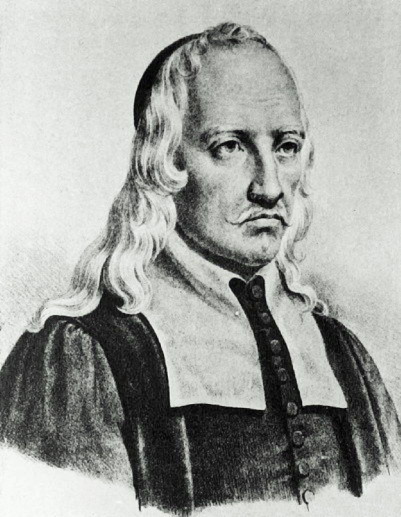
Giovanni Alfonso Borelli
Giovanni Alfonso Borelli (Italian: [dʒoˈvanni alˈfɔnso boˈrɛlli]; 28 January 1608 – 31 December 1679) was a Renaissance Italian physiologist, physicist, and mathematician who is often described as the father of biomechanics. He contributed to the modern principle of scientific investigation by continuing Galileo's practice of testing hypotheses against observation. Trained in mathematics, Borelli also made extensive studies of Jupiter's moons, the mechanics of animal locomotion and, in microscopy, of the constituents of blood. He also used microscopy to investigate the stomatal movement of plants, and undertook studies in medicine and geology. During his career, he enjoyed the patronage of Queen Christina of Sweden. He was the first scientist to explain that animal and human bodily movements are caused by muscular contractions.
Giovanni Borelli was born on 28 January 1608 in the district of Castel Nuovo, in Naples. He was the first-born son of Spanish infantryman Miguel Alfonso and a local woman named Laura Porello (alternately Porelli or Borelli.) Borelli had five siblings.
Borelli eventually travelled to Rome where he studied under Benedetto Castelli, matriculating in mathematics at Sapienza University of Rome. From 1635 to 1656 he served as a Professor of Mathematics in Messina, Sicily. In 1635, the Senate of Messina offered him a membership in the prestigious Accademia della Fucina, which was an intellectual society of scientists devoted to studying and publishing largely on physical and natural sciences under the supervision and protection of the Senate. Borelli was designated to investigate "the causes of the malignant fever that lashed a large part of Italy in 1647. He attributed the cause to an airborne infection and contested the prevailing opinion that the illness was due to excessive heat, humidity, or astrological influences." He even devised a treatment for the disease. While Borelli worked on studying the disease he also continued to study mathematics. In 1658 he published a revised version of Euclid’s Elements called, Euclides Restitutus (Euclid Restored). Euclid was an ancient Greek mathematician whose book had been one of the most important mathematical texts for centuries. Borelli also revised Apollonius of Perga: Conics, a treatise on mathematics that examined parabolas and ellipses. Apollonius of Perga was an ancient Greek astronomer and mathematician.
Around 1655, Borelli was invited to the University of Pisa by Ferdinando De' Medici Grand Duke of Tuscany. Earlier Galileo rejected a recommendation by Benedetto Castelli to nominate Borelli as head of mathematics at the University of Pisa when he left the post himself. Borelli would attain this post in 1656. It was there that he first met the Italian anatomist Marcello Malpighi.
Borelli and Malpighi were both founder-members of the short-lived Accademia del Cimento, an Italian scientific academy founded in 1657. It was here that Borelli, piqued by Malpighi's own studies, began his first investigations into the science of animal movement, or biomechanics. This began an interest that would continue for the rest of his life, eventually earning him the title of the Father of Biomechanics. Borelli's involvement in the Accademia was temporary and the organization itself disbanded shortly after he left.
From 1664 to 1665, Borelli tracked the path of a comet. He took measurements of the comet and concluded that it was moving in an elliptical curved orbit around the sun. These conclusions went against the accepted scientific theory of the day (that was supported and imposed by the Catholic church), which asserted that Earth was the center of the universe. It was dangerous to oppose the theories of the church, so Borelli published his findings under the pseudonym Pier Maria Mutoli. In a treatise titled, Del Movimento della Cometa Apparasa il mese di Dicembre (Of the Movement of the Comet that Appears in the Month of December), Borelli suggested that planets and comets orbit the sun.
Borelli returned to Messina in 1668 in the midst of a political uprising that was growing against the Spanish in Italy. Borelli joined the anti-Spanish forces despite his familial ties to Spain through his father. He changed his surname from his father's name to a variation of his mother's name, likely to hide his ties to the Spanish.
In 1674 Borelli was exiled from Messina to Rome for suspected involvement in the political conspiracy to free Sicily from Spanish rule. Here he first became acquainted with ex-Queen Christina of Sweden who had been forced to give up her crown and exiled to Rome two decades prior as a punishment for converting to Catholicism. In 1672 he served as her personal physician and scientific consultant.
Giovanni Alfonso Borelli
Giovanni Alfonso Borelli (Italian: [dʒoˈvanni alˈfɔnso boˈrɛlli]; 28 January 1608 – 31 December 1679) was a Renaissance Italian physiologist, physicist, and mathematician who is often described as the father of biomechanics. He contributed to the modern principle of scientific investigation by continuing Galileo's practice of testing hypotheses against observation. Trained in mathematics, Borelli also made extensive studies of Jupiter's moons, the mechanics of animal locomotion and, in microscopy, of the constituents of blood. He also used microscopy to investigate the stomatal movement of plants, and undertook studies in medicine and geology. During his career, he enjoyed the patronage of Queen Christina of Sweden. He was the first scientist to explain that animal and human bodily movements are caused by muscular contractions.
Giovanni Borelli was born on 28 January 1608 in the district of Castel Nuovo, in Naples. He was the first-born son of Spanish infantryman Miguel Alfonso and a local woman named Laura Porello (alternately Porelli or Borelli.) Borelli had five siblings.
Borelli eventually travelled to Rome where he studied under Benedetto Castelli, matriculating in mathematics at Sapienza University of Rome. From 1635 to 1656 he served as a Professor of Mathematics in Messina, Sicily. In 1635, the Senate of Messina offered him a membership in the prestigious Accademia della Fucina, which was an intellectual society of scientists devoted to studying and publishing largely on physical and natural sciences under the supervision and protection of the Senate. Borelli was designated to investigate "the causes of the malignant fever that lashed a large part of Italy in 1647. He attributed the cause to an airborne infection and contested the prevailing opinion that the illness was due to excessive heat, humidity, or astrological influences." He even devised a treatment for the disease. While Borelli worked on studying the disease he also continued to study mathematics. In 1658 he published a revised version of Euclid’s Elements called, Euclides Restitutus (Euclid Restored). Euclid was an ancient Greek mathematician whose book had been one of the most important mathematical texts for centuries. Borelli also revised Apollonius of Perga: Conics, a treatise on mathematics that examined parabolas and ellipses. Apollonius of Perga was an ancient Greek astronomer and mathematician.
Around 1655, Borelli was invited to the University of Pisa by Ferdinando De' Medici Grand Duke of Tuscany. Earlier Galileo rejected a recommendation by Benedetto Castelli to nominate Borelli as head of mathematics at the University of Pisa when he left the post himself. Borelli would attain this post in 1656. It was there that he first met the Italian anatomist Marcello Malpighi.
Borelli and Malpighi were both founder-members of the short-lived Accademia del Cimento, an Italian scientific academy founded in 1657. It was here that Borelli, piqued by Malpighi's own studies, began his first investigations into the science of animal movement, or biomechanics. This began an interest that would continue for the rest of his life, eventually earning him the title of the Father of Biomechanics. Borelli's involvement in the Accademia was temporary and the organization itself disbanded shortly after he left.
From 1664 to 1665, Borelli tracked the path of a comet. He took measurements of the comet and concluded that it was moving in an elliptical curved orbit around the sun. These conclusions went against the accepted scientific theory of the day (that was supported and imposed by the Catholic church), which asserted that Earth was the center of the universe. It was dangerous to oppose the theories of the church, so Borelli published his findings under the pseudonym Pier Maria Mutoli. In a treatise titled, Del Movimento della Cometa Apparasa il mese di Dicembre (Of the Movement of the Comet that Appears in the Month of December), Borelli suggested that planets and comets orbit the sun.
Borelli returned to Messina in 1668 in the midst of a political uprising that was growing against the Spanish in Italy. Borelli joined the anti-Spanish forces despite his familial ties to Spain through his father. He changed his surname from his father's name to a variation of his mother's name, likely to hide his ties to the Spanish.
In 1674 Borelli was exiled from Messina to Rome for suspected involvement in the political conspiracy to free Sicily from Spanish rule. Here he first became acquainted with ex-Queen Christina of Sweden who had been forced to give up her crown and exiled to Rome two decades prior as a punishment for converting to Catholicism. In 1672 he served as her personal physician and scientific consultant.
Recent media
Recent media