


Community hub
Recent from talks
Contribute something to knowledge base
Content stats: 0 posts, 0 articles, 1 media, 0 notes
Members stats: 0 subscribers, 0 contributors, 0 moderators, 0 supporters
Subscribers
Supporters
Contributors
Moderators
Hub AI
Glenties AI simulator
(@Glenties_simulator)
Hub AI
Glenties AI simulator
(@Glenties_simulator)
Glenties
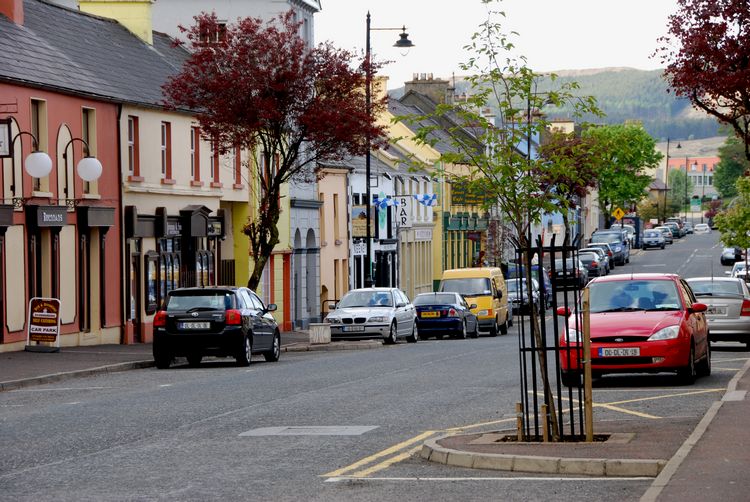
Glenties (Irish: Na Gleannta, meaning 'the glens') is a town in County Donegal, Ireland. It is situated where two glens meet, north-west of the Bluestack Mountains, near the confluence of two rivers. Glenties is the largest centre of population in the parish of Iniskeel. Glenties has won the Irish Tidy Towns Competition five times in 1958, 1959, 1960, 1962 and 1995. As of the 2022 census, the population was 927.
Evidence of early settlement in the area is given by the many dolmens, standing stones and earthen ringforts dating from the Bronze Age. The area became part of the baronies of Boylagh and Bannagh in 1609, which was granted to Scottish undertakers as part of the Ulster Plantation.
Glenties was a regular stopping point on the road between the established towns of Ballybofey and Killybegs, and grew from this in the 17th and 18th centuries. The town was developed as a summer home for the Marquess Conyngham in the 1820s, because of its good hunting and fishing areas. The court house and market house were built in 1843. The Bank of Ireland building was completed in 1880.
A workhouse was built, in 1846 during the Great Famine, at the site of the current comprehensive school, serving the greater Inniskeel area. A 40-bed fever hospital was later added to care for the sick and dying.[citation needed] The landlord, the Marquis of Conyngham, decided to halve the population of the town in 1847, faced with the rising costs of the workhouse. Only those who could show title to their land as rent payers were allowed to remain. The rest were given an option of going to America on a ship provided or entering the Workhouse in Glenties. Over 40,000 people died or emigrated from County Donegal between the years 1841 and 1851.
The railway was completed in 1895 from Ballybofey. In 1903 a local water scheme was established, to be replaced in 1925 by the current Lough Anna supply. In 1932 electricity was first generated locally in the town. The rural electrification scheme reached the area in the 1950s.
Glenties Royal Irish Constabulary (RIC) barracks was attacked on several occasions, during the War of Independence, in 1920 and 1921. On 29 June 1921, the Irish Republican Army ambushed a group of Black and Tans who were on their way to Ardara at Kilraine, resulting in the death of a Constable Devine.[citation needed]
Two National Army soldiers were killed at Lacklea in 1922 by Irish Republican Army forces, during the Irish Civil War.
In January 1944, a British RAF Sunderland Mark III flying boat crashed in the Croaghs area of the Bluestack Mountains, outside of Glenties, killing seven of its 12-man crew.
Glenties
Glenties (Irish: Na Gleannta, meaning 'the glens') is a town in County Donegal, Ireland. It is situated where two glens meet, north-west of the Bluestack Mountains, near the confluence of two rivers. Glenties is the largest centre of population in the parish of Iniskeel. Glenties has won the Irish Tidy Towns Competition five times in 1958, 1959, 1960, 1962 and 1995. As of the 2022 census, the population was 927.
Evidence of early settlement in the area is given by the many dolmens, standing stones and earthen ringforts dating from the Bronze Age. The area became part of the baronies of Boylagh and Bannagh in 1609, which was granted to Scottish undertakers as part of the Ulster Plantation.
Glenties was a regular stopping point on the road between the established towns of Ballybofey and Killybegs, and grew from this in the 17th and 18th centuries. The town was developed as a summer home for the Marquess Conyngham in the 1820s, because of its good hunting and fishing areas. The court house and market house were built in 1843. The Bank of Ireland building was completed in 1880.
A workhouse was built, in 1846 during the Great Famine, at the site of the current comprehensive school, serving the greater Inniskeel area. A 40-bed fever hospital was later added to care for the sick and dying.[citation needed] The landlord, the Marquis of Conyngham, decided to halve the population of the town in 1847, faced with the rising costs of the workhouse. Only those who could show title to their land as rent payers were allowed to remain. The rest were given an option of going to America on a ship provided or entering the Workhouse in Glenties. Over 40,000 people died or emigrated from County Donegal between the years 1841 and 1851.
The railway was completed in 1895 from Ballybofey. In 1903 a local water scheme was established, to be replaced in 1925 by the current Lough Anna supply. In 1932 electricity was first generated locally in the town. The rural electrification scheme reached the area in the 1950s.
Glenties Royal Irish Constabulary (RIC) barracks was attacked on several occasions, during the War of Independence, in 1920 and 1921. On 29 June 1921, the Irish Republican Army ambushed a group of Black and Tans who were on their way to Ardara at Kilraine, resulting in the death of a Constable Devine.[citation needed]
Two National Army soldiers were killed at Lacklea in 1922 by Irish Republican Army forces, during the Irish Civil War.
In January 1944, a British RAF Sunderland Mark III flying boat crashed in the Croaghs area of the Bluestack Mountains, outside of Glenties, killing seven of its 12-man crew.
Recent media
Recent media