


Community hub
Recent from talks
Contribute something
Nothing was collected or created yet.
Killybegs
View on Wikipedia
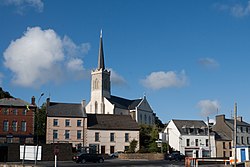
Killybegs (Irish: Na Cealla Beaga)[2] is a town in County Donegal, Ireland. It is the largest fishing port in the country and on the island of Ireland. It is located on the south coast of the county, north of Donegal Bay, near Donegal Town. Its Irish name Na Cealla Beaga means 'little cells', a reference to early monastic settlements.[2] The town is situated at the head of a scenic harbour and at the base of a vast mountainous tract extending northward.[3] In the summer, there is a street festival celebrating the fish catches and incorporating the traditional "Blessing of the Boats". As of 2022[update], the population was 1,258.[1]
Key Information


History
[edit]
There are at least six Court Cairns dating from the Neolithic period located in the Killybegs area. Two of the largest are Shalwy (130 feet long) and Croagh Beg (120 feet long).[4] In 1588, Killybegs was the last port of call for the Spanish vessel La Girona, which had dropped anchor in the harbour when the Spanish Armada fetched up on the Irish coast during Spain's war with England. With the assistance of a Killybegs chieftain, MacSweeney Bannagh, the Girona's personnel were fed, her rudder repaired, and she set sail for Scotland, but was wrecked off the Antrim coast with the loss of nearly 1,300 lives.[5]
In 1893 a railway station opened in the town, connecting it to Donegal town, but the line closed in 1960.
Bridge Street in the town centre was flooded during Storm Bert in November 2024.[6]
Fishing industry
[edit] |
Killybegs is a natural deepwater harbour with a depth of 12 metres at low water spring tide at the new €50 million pier completed in 2004. The harbour is home to all the largest Irish midwater pelagic trawlers and a modest whitefish fleet, but it handles many other types of shipping as well. These include passenger cruise liners and mixed specialist cargoes. In recent years Killybegs has become the favoured port for the importation of wind turbines and is a service port for the offshore gas/oil drilling rigs.
The town is the centre of the Irish pelagic fishing and processing industries, as it specialises in the processing and freezing of species such as mackerel, herring, scad, and blue whiting. The finished processed fish is exported to markets in Africa, the Middle East and Europe by freezer ships. However, due to blanket enforcement of EU fishing regulations on Irish vessels by the Irish Department of the Marine, starting in 2005, and mackerel shoals remaining longer in Norwegian waters, there has been a downturn in the fishing industry in the town. This has led to redundancies in the fish processing industry, in which the fish factory workers have been the hardest hit.[citation needed]

Education
[edit]The first national school, known as 'Killybegs National School', and later as the 'Commons National School', opened in 1834 on a site originally provided by the Plantation Commissioners in the reign of King James I[7] There are three national schools[8][9][10] and one second-level school in Killybegs[11] as well as a third level institution Tourism College Killybegs, the only dedicated tourism institute in Ireland, offering courses in hospitality, tourism and culinary skills.[12][13] The college was academically integrated with Letterkenny Institute of Technology since 2001, and ATU Donegal since 2022.[13][14]
St Catherine's Vocational School is a non-denominational, co-educational second-level school.[11][15] There are twenty-six teaching staff, five special needs assistants and three support staff. The student population is 385 and the male-to-female student ratio is approximately 50:50.[11] The present two-storey building opened in 1987 provides facilities for students, teachers and members of the community.[15] St Catherine's has a range of extracurricular activities, the school has had success in English, Irish and science debates. The arts are well provided for with an art and music department, the music department has staged a number of musical productions,[16] and students are taught a variety of instruments. Sport is also an important aspect of school life students participate in teams representing the school in soccer,[17] Gaelic football,[18] athletics,[19] basketball[20] and rugby.[21]
Transport
[edit]Road
[edit]Killybegs is on the R263 road, joining the N56 road 3 km to the north.[22]
Bus
[edit]The town is on several bus routes with many buses each day.
Local Link route 293,[23] and Bus Éireann routes 490 and 492 operate to and from Donegal town and other local places.[24][25] McGeehan Coaches operates a route 991 to/from Letterkenny and other local places.[26]
Rail
[edit]There is no longer a rail service to Killybegs. A railway line opened on 18 October 1893 on the Donegal Railway Company (DR) line from Donegal town to Killybegs. The Donegal town to Killybegs branch of the DR terminated at the harbour and some of the remains can still be seen to this day. The railway was closed on 1 January 1960.[27]
Fintra Beach
[edit]Fintra Beach (Irish: Fionntrá), a registered blue flag beach, is located on the outskirts of Killybegs town.[28][29] It consists entirely of fine golden sand and receives large numbers of day-trippers during the peak of the tourist season. It is lifeguarded throughout the bathing season.[29]
Donegal Carpets
[edit] |
Killybegs is famous for its tapestries and carpets, some of which were produced on the biggest carpet loom in the world at the "Donegal Carpet Factory". The carpets, known as Donegals, are hand-knotted in the Turkish style. The carpets have adorned many important buildings in Ireland such as Dublin Castle, the Royal Hospital Kilmainham, Áras an Uachtaráin and internationally the Vatican, The White House, Buckingham Palace, 10 Downing Street and most state buildings around the world. The factory in Killybegs closed in 2003 and has been open since 2006 as the Maritime & Heritage Centre. The Centre provides information on carpet making and the fishing industry. Tours are conducted daily and visitors can watch smaller carpets being made and try making a knot.
Sport
[edit]The local GAA club is Na Cealla Beaga. They play their home games at Eamon Byrne Memorial Park.[30]
The local association football club, St Catherine's, was founded in 1896.[31] They play their home games at Emerald Park.[32]
Killybegs Rowing Club can often be seen training in the harbour during the summer months and hold an annual regatta on the last weekend of July.[33] The club row the Donegal Skiff, the traditional skiff of the county.
Killybegs in literature
[edit] |

Killybegs Authors: John C. Ward: An Teagasg Criostaidhe fa Choinne Dioghoise Ratha Bhota 1891; Turas na croiche agus an Choróin Mhuire maille le dántaibh diadha 1892; Na hEipistil agus na soisgéil do na Domhnaigh agus na laetha saoire arna dtarraingt go Gaeilge 1904; An Cruinneolaí 1906; Leabhar filíochta fa choinne na scoil 1909 (with Padraig O'Beirne).
Thomas Colin MacGinley ('Kinnfaela'): The Cliff Scenery of South-Western Donegal 1867 (Reprinted by the Four Masters Press 2000); General Biology 1874.
Very Reverend James Stephens, P.P.: Illustrated Handbook of The Scenery and Antiquities of South-Western Donegal 1872.
Charles Conaghan: History and Antiquities of Killybegs 1975.
Dr Donald Martin: Killybegs Then and Now 1998; Killybegs-Down Memory Lane 2011.
Pat Conaghan: Bygones 1989; The Great Famine in South-West Donegal 1845–1850 1997; The Zulu Fishermen 2003; Steamed Fish (The Phoenix No 2, Winter 1991/2); Stranorlar, Not San Francisco (The Phoenix No 3, Spring 1992).
Bella McGee (poet) James Conwell (poet) Padraig O'Beirne (poet) e.g.: Mo Phiopa Gairid Donn (n.d).
In 2011, French novelist Sorj Chalandon published "fr:Retour à Killybegs" ("Return to Killybegs") whose main character, Tyrone Meehan, is a native of Killybegs.[34]
People
[edit]- Manus Boyle (born 1966) - Gaelic footballer[35][36]
- Brian Brady (1903-1949) - Fianna Fáil politician[37]
- Séamus Coleman (born 1988) - professional footballer whom captains both Premier League club Everton and the Republic of Ireland national team.[38]
- Barry Cunningham (born 1965) - Gaelic footballer[35]
- Paddy McClafferty (born 2004) – international footballer with Gibraltar.[39]
- Hugh McFadden (born 1994) - Gaelic footballer[40]
- Barry McGowan (born 1967) - Gaelic footballer[35]
- Thomas Pringle (born 1967) - Independent TD[41]
- Kevin Sharkey (born 1961) - artist and musician[42]
- Noelle Vial (1959-2003) - poet[43]
- Peter J. Ward (1891-1970) - Sinn Féin politician[37]
Gallery
[edit]


See also
[edit]References
[edit]- ^ a b "Census Interactive Map – Towns: Killybegs". Census 2022. Central Statistics Office. Retrieved 26 November 2024.
- ^ a b "Na Cealla Beaga/Killybegs". Placenames Database of Ireland (logainm.ie). Department of Culture, Heritage and the Gaeltacht and Dublin City University. Archived from the original on 26 May 2021. Retrieved 29 May 2020.
- ^ Samuel Lewis (1858), A Topographical Dictionary of Ireland, p. 158, archived from the original on 1 January 2014, retrieved 23 July 2011
- ^ Meehan, Cary (2004). Sacred Ireland. Somerset: Gothic Image Publications. p. 115. ISBN 0-906362-43-1.
- ^ "La Girona" (PDF). Annual Report of the Advisory Committee on Historic Wrecks, 2005. Advisory Committee on Historic Wreck Sites. pp. 35 pp. Archived (PDF) from the original on 14 January 2007. Retrieved 1 November 2008.
- ^ Foley, Alan (23 November 2024). "'It is heartbreaking to witness the extent of the flooding this morning'". Donegal Live. Retrieved 23 November 2024.
- ^ Bygones-New horizons on the history of Killybegs Killybegs: Pat Conaghan, Aghyeevoge (1989) OCLC 22529769
- ^ "KILLYBEGS COMMON N S". www.gov.ie. 7 July 2021. Retrieved 15 April 2024.
- ^ "S N FHIONNTRA". www.gov.ie. 7 July 2021. Retrieved 15 April 2024.
- ^ "S N NEILL MOR". www.gov.ie. 7 July 2021. Retrieved 15 April 2024.
- ^ a b c "ST. CATHERINE'S VOCATIONAL SCHOOL". www.gov.ie. 7 July 2021. Retrieved 15 April 2024.
- ^ McLaughlin, Rachel (1 October 2018). "Chef shortage: 'It is not a desirable career any more'". The Irish Times. Archived from the original on 15 April 2024. Retrieved 15 April 2024.
Established in 1969, Killybegs is Ireland's oldest dedicated tourism and catering college outside Dublin. The school is renowned for turning out skilled chefs including McDermott, Adrian Martin and Gary O'Hanlon.
- ^ a b "ATU Donegal Killybegs | ATU - Atlantic Technological University". www.atu.ie. 10 March 2022. Retrieved 15 April 2024.
- ^ "Killybegs Marine Cluster will bring new business development and internationalisation to the North-West | ATU - Atlantic Technological University". www.atu.ie. 19 April 2022. Retrieved 15 April 2024.
Minister for Agriculture, Food & the Marine, Charlie McConalogue TD, officially launched the Killybegs Marine Cluster this week (Monday 11 April) in the Killybegs campus of the newly formed Atlantic Technological University (ATU).
- ^ a b "St. Catherine's Vocational School – Donegal ETB". Donegal ETB. Retrieved 15 April 2024.
- ^ Maguire, Stephen (12 August 2018). "School's out for Ultan at the Balor". Donegal Daily. Retrieved 15 April 2024.
He knew the actors from the St. Catherine's Vocational School production of 'All Shook Up', which he co-directed, and from Big Fish, which he founded while a student at St. Catherine's.
- ^ Doherty, Cillian (9 January 2024). "Pobalscoil Ghaoth Dobhair lift Junior B Girls Ulster Schools title". www.donegallive.ie. Retrieved 15 April 2024.
Hat-tricks from Maria Ní hFídhinn and Maria Ní Ghallachóir helped Pobalscoil Ghaoth Dobhair to a comfortable 6-0 win over St Catherine's Vocational School, Killybegs, in the Ulster Junior B Girls final on Tuesday.
- ^ Daly, Michael (18 October 2016). "Abbey Vocational School News". www.donegallive.ie. Retrieved 15 April 2024.
- ^ Maguire, Stephen (22 October 2014). "ATHLETICS NEWS: TIR CHONAILL AC ATHLETE PAUL WARD CONTINUES HIS IMPRESSIVE FORM". Donegal Daily. Retrieved 15 April 2024.
Congratulations to local schools athletes from St Catherine's, Killybegs and the Abbey Voc School who travelled in large numbers and from results [see attached] had numerous fine individual and team results.
- ^ "Passing of Anna Ward, Bruckless". www.donegallive.ie. 4 February 2014. Retrieved 15 April 2024.
A very well known and popular woman, Mrs Ward was a former teacher of science and maths at St Catherine's Vocational School, where she also founded and coached the basketball team.
- ^ "A first for Killybegs school - an U-16 rugby team". www.donegallive.ie. 28 March 2013. Retrieved 15 April 2024.
- ^ McNamara, Siobhán (19 December 2022). "Proposed N56 improvement works are vital for the future of the region". DonegalLive.ie. Retrieved 17 April 2025.
- ^ "Timetable: Glencolmcille to Donegal Town & Return" (PDF). Local Link Donegal Sligo Leitrim. Retrieved 24 November 2024.
- ^ "Route 490". Bus Éireann. Retrieved 24 November 2024.
- ^ "Route 492". Bus Éireann. Retrieved 24 November 2024.
- ^ "991 - Killybegs - Letterkenny". bustimes.org. Retrieved 24 November 2024.
- ^ "Killybegs station" (PDF). Railscot - Irish Railways. Archived (PDF) from the original on 2 March 2011. Retrieved 27 April 2012.
- ^ "Fintragh Blue Flag Beach". Killybegs Tourism and Visitor Information. Retrieved 15 April 2024.
- ^ a b "Fintra Blue Flag Beach". Go Visit Donegal. Retrieved 15 April 2024.
- ^ "Club History - Killybegs Gaa Club". killybegs.gaa.ie. Archived from the original on 12 April 2016. Retrieved 15 April 2024.
- ^ Foley, Alan (25 June 2015). "Hugh McFadden takes scenic route to Donegal set-up". Irish Examiner. Archived from the original on 3 March 2016. Retrieved 15 April 2024.
McFadden is from the fishing town in south-west Donegal, a place where there's an understanding between the local GAA club Killybegs and the soccer equivalent, St Catherine's FC.
- ^ Craig, Frank (3 May 2023). "Old Saints still marching on at Emerald Park". www.donegallive.ie. Retrieved 15 April 2024.
- ^ "Busy weekend on water in Killybegs". www.donegallive.ie. 7 August 2014. Retrieved 15 April 2024.
- ^ Chalandon, Sorj (2011). Retour à Killybegs [Return to Killybegs] (in French). Grasset. ISBN 9782246785699.
- ^ a b c Duggan, Keith (13 June 2009). "Medals do not put bread on tables". The Irish Times. Archived from the original on 15 April 2024. Retrieved 15 April 2024.
Barry McGowan, man-of-the-match Manus Boyle and substitute midfielder Barry Cunningham were from Killybegs.
- ^ "Where are they now?". Irish Independent. 23 September 2012. Retrieved 15 April 2024.
Boyle's background is in fishing not sport. He lives in Killybegs, his mother comes from Ringsend in Dublin and his father hails from Rutland Island.
- ^ a b McHugh, Michael (June 2023). "McHugh's Miscellany - Donegal TDs whose IRA pension applications are now online". www.donegallive.ie. Retrieved 15 April 2024.
Deputy Brian Brady TD and Deputy P.J. Ward were both Killybegs men
- ^ Farrell, Sean (28 June 2013). "If Seamus Coleman played GAA, he'd be a star with Donegal -- McGuinness". The 42. Retrieved 15 April 2024.
Everton's Seamus Coleman is Killybegs born and bred.
- ^ "Former St Catherine's star Patrick McClafferty earns senior Gibraltar call-up". 8 March 2025.
- ^ Campbell, Peter (16 March 2023). "I'm vocal because I care - Hugh McFadden". www.donegallive.ie. Retrieved 15 April 2024.
"Growing up in Killybegs we were absolutely blessed with people who loved soccer and Gaelic and gave us a love and desire and a really enjoyable experience playing sport."
- ^ O'Donnell, Ciaran (8 August 2017). "Donegal Deputy Thomas Pringle thanks public for get well messages". www.donegallive.ie. Retrieved 15 April 2024.
In a message posted on his facebook page on Tuesday night, the Killybegs-based Dáil Deputy commented: "Not dying anyway folks! All going well here, have the phone for 20 minutes. Can't reply to all the messages but they are greatly appreciated. Thanks for all your best wishes. See ya soon."
- ^ "Balbriggan bid for Áras". Irish Independent. 3 August 2018. Retrieved 15 April 2024.
Defining that relationship, he said: 'You have to remember that I was born in 1961 in Dublin. 'My mother was Irish and I was brought up in Killybegs. 'In Killybegs in 1961, I was the only black kid there but what I found as a child, growing up in Killybegs and in rural Ireland, was that instead of being held apart, instead of being ridiculed, instead of being made to feel unwelcome, the community really, really embraced me.
- ^ "Untimely death of local poet". Marine Times. Archived from the original on 19 November 2007. Retrieved 17 March 2022.
External links
[edit]
| International | |
|---|---|
| National | |
| Other | |

Killybegs
View on GrokipediaGeography and Demographics
Location and Physical Features
Killybegs is situated in County Donegal, Republic of Ireland, on the northern shore of Donegal Bay in the northwest of the country.[7] The town lies approximately 21 kilometers southwest of Donegal Town at coordinates 54°38′05″N 08°27′17″W.[8] [7] Its position on the southern coastal fringe of Donegal places it amid the rugged topography characteristic of the region, with elevations averaging around 22 meters above sea level.[9] The town's core physical feature is Killybegs Harbour, a sheltered inlet extending from McSwyne's Bay, which provides natural protection for maritime activities against Atlantic swells.[7] Surrounding the harbor, the landscape rises into hills and mountains that shield the settlement, contributing to its role as a safe haven for vessels navigating the North Atlantic.[10] The townland encompassing Killybegs covers an area of 1.3645 square kilometers, featuring a mix of coastal terrain and inland slopes typical of western Ireland's glaciated geology.[11] Nearby physical landmarks include rocky shorelines and beaches such as Fintragh, which exemplify the area's dramatic coastal features shaped by erosion and tidal forces.[12] The broader environs reflect Donegal's mountainous backbone, with elevations increasing inland toward peaks that influence local microclimates and drainage patterns.[10]Climate and Environment
Killybegs features a temperate oceanic climate typical of Ireland's northwest coast, with mild temperatures year-round, high humidity, and frequent precipitation influenced by Atlantic weather systems. Average high temperatures range from 8°C (46°F) in winter to 15–16°C (59–61°F) in summer, while lows rarely drop below freezing.[13] Annual rainfall totals approximately 1,477 mm (58 inches), with December being the wettest month at around 112 mm (4.4 inches) and the highest number of rainy days occurring in autumn and winter.[14] Winds are often moderate to fresh, predominantly from the west or southwest, contributing to a perception of cooler, damper conditions despite moderate temperatures.[13] The local environment encompasses rugged coastal landscapes, including beaches like Fintragh and sheltered bays that support diverse marine habitats along the Donegal coast. This area forms part of a biodiversity hotspot for seabirds and marine species, with colonies of national importance in nearby sites such as Donegal Bay Special Protection Area, hosting species like gulls, auks, and migratory waterfowl.[15] Intertidal zones and offshore waters provide ecosystems for shellfish, fish stocks, and occasional marine mammals, sustained by nutrient-rich upwellings from the Atlantic.[16] Environmental pressures arise primarily from the fishing and processing industries, including potential water discharges and odour emissions from fish plants, managed through wastewater treatment plants and odour control plans.[17][18] The Killybegs Fishermen's Organisation promotes sustainability via fishery improvement projects, gear recycling, and reduced bycatch to mitigate impacts on marine ecosystems.[19] Coastal litter surveys indicate low pollution levels, with Killybegs beaches ranking clean in national assessments.[20] Harbour policies emphasize minimizing emissions and waste, aligning with EU directives for protected habitats.[21]Population and Demographics
As of the 2022 Irish census, Killybegs recorded a population of 1,258, reflecting a modest annual growth rate of 0.30% from the 1,236 residents enumerated in the 2016 census.[3] [22] This recent uptick contrasts with longer-term stagnation, as the town's population had declined from peaks in the early 1980s—driven by fishing sector expansion that boosted numbers from 1,634 in 1971 to approximately 2,280 by 1981—before leveling off amid economic shifts.[23] [24] The urban area covers 1.4 km², resulting in a density of 898.6 persons per km².[3] Demographically, Killybegs exhibits a balanced sex distribution, with males at 49.7% and females at 50.3%.[3] The age profile skews older than the national norm, with 21.1% of residents aged 65 or above compared to Ireland's 18.8%.[3] Specific breakdowns include higher concentrations in senior cohorts: 176 residents aged 70-79 and another 176 aged 60-69, alongside 60 individuals over 80.[3] Data on ethnicity and nationality remain limited at the town level, though the surrounding County Donegal context indicates a predominantly White Irish composition with minimal non-EU migrant presence typical of rural western Ireland.[25]| Census Year | Population | Change from Prior Census |
|---|---|---|
| 2016 | 1,236 | - |
| 2022 | 1,258 | +22 (+1.8%) |