



Community hub
Recent from talks
Knowledge base stats:
Talk channels stats:
Members stats:
Gobero
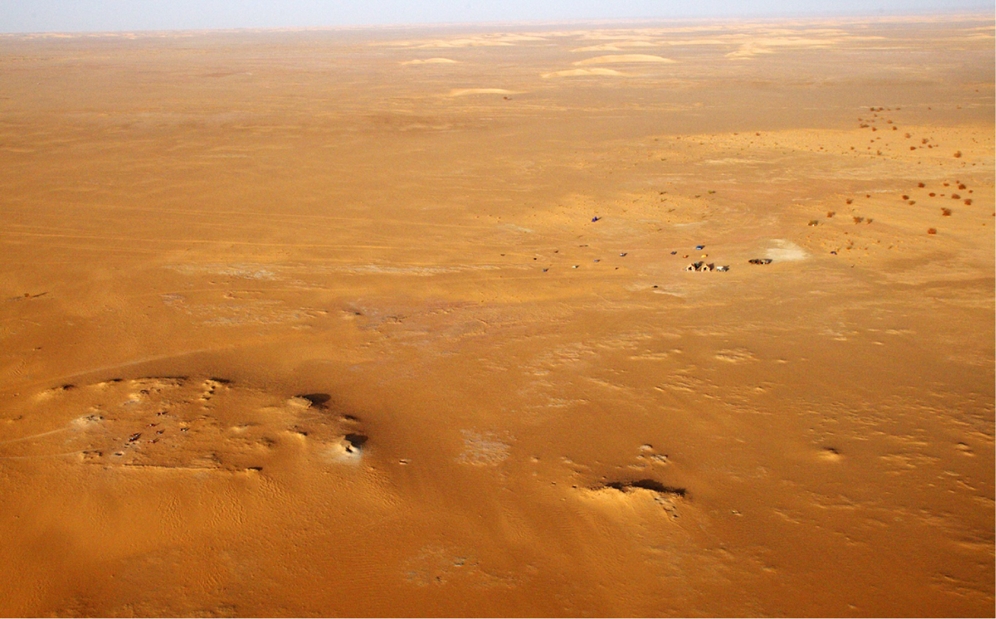
The Gobero archaeological site, dating to around 8000 BCE, is the oldest known cemetery in the Sahara Desert. The site contains important information for archaeologists on how early humans adapted to a constantly changing environment. Gobero is located in the Ténéré desert of Niger, and is named after the Tuareg name for the region. It is the type site of the Holocene era Kiffian culture and Tenerian culture.
The area was once the location of a freshwater lake named Lake Gobero, around 3 km in diameter and 3 m in depth. There are eight sites that make up Gobero: G1, G2, G3, G4, G5, G6, G7, and G8, five of which (G1, G2, G3, G5, and G8) have funerary and habitation remains.
Site G1 is a dune that rises from the lake basin to an elevation of 56.035 metres (183.84 ft) above sea level and extends from east to west. It contains 19 excavated burials, 20 individuals in total. Site G2 is a hill between Site G1 and 3 that contains four burials. G3 is 300 metres (980 ft) northwest of G1 and contains 48 burials with 51 individuals total. Site G8 is 6.5 kilometres (4.0 mi) west of G3 and contains some human burials as well as lithic artifacts and pottery. The time frame of the site has been divided into four phases: Phase I dates from around 14,000-7700 BCE and is characterized by weakening monsoons and the aridification of the area, which created the earliest paleodunes at the site. Phase II dates from 7700-6200 BCE and is characterized by a wet climate and the first evidence of occupation by a fisher-gatherer group known as the Kiffians. The next phase is an interruption in the occupation of the site from 6200–5200 BCE due to the return of dry and arid conditions making the site uninhabitable. Phase III dates from 5200 BCE to 2200 BCE and is characterized by the second main occupation of the site at Gobero by a group known as the Tenerians. The final Phase, Phase IV, dates from 2500 BCE to 300 BCE and is the period in which the Sahara dries out once more, ending any occupation.
A wealth of lithic artifacts were recovered from sites G1 and G3, though most came from the surface. A total of 4,685 artifacts came from G1 and 11,503 came from G3. These included cores, blanks, endscrapers, perforators, burins, backed tools, notches, denticulates, truncations, geometric tools, sidescrapers, arrowheads, tenerian disks, bifacial tools, axes and adzes, grinding stones and polished axes and other retouched tools.
4,646 potsherds were collected during excavations in 2005-2006, all from G1 and G3. Vessel shapes were open and closed bowls and jars. Types of decorative techniques for the pots included rocker stamping, mainly found at site G1, decorations with cord-wrapped tools, and decorations made with combs. Some decoration styles included plain zigzags, straight zigzags, curved zigzags, zigzags that form fishnet patterns, and dotted zigzags.
The site was discovered by photographer Mike Hettwer on 13 October 2000, part of a team led by University of Chicago paleontologist and geologist Paul Sereno. His previous expeditions to the region had uncovered numerous fossils, including those of the formerly unknown dinosaur Nigersaurus and the crocodylomorph Sarcosuchus.
The sheer size and scope of the find, including traces of pottery, human remains, and quantities of aquatic-environment animal bones, suggested the site dated to the early- to mid-Holocene, or "Green Sahara" period (7500–3500 BCE).
In 2005, Sereno organized an international team of archaeologists to explore the site. These archaeologists discovered that Gobero had been almost continually inhabited for 5,000 years, beginning around 8000 BCE onwards when the area fronted a large lake. The 2007 and 2008 expeditions had to be canceled due to hostilities between Nigerian government forces and Tuareg tribesmen. The first comprehensive report on Gobero was published by Sereno in August 2008, and he returned again to the region in 2011.
Hub AI
Gobero AI simulator
(@Gobero_simulator)
Gobero
The Gobero archaeological site, dating to around 8000 BCE, is the oldest known cemetery in the Sahara Desert. The site contains important information for archaeologists on how early humans adapted to a constantly changing environment. Gobero is located in the Ténéré desert of Niger, and is named after the Tuareg name for the region. It is the type site of the Holocene era Kiffian culture and Tenerian culture.
The area was once the location of a freshwater lake named Lake Gobero, around 3 km in diameter and 3 m in depth. There are eight sites that make up Gobero: G1, G2, G3, G4, G5, G6, G7, and G8, five of which (G1, G2, G3, G5, and G8) have funerary and habitation remains.
Site G1 is a dune that rises from the lake basin to an elevation of 56.035 metres (183.84 ft) above sea level and extends from east to west. It contains 19 excavated burials, 20 individuals in total. Site G2 is a hill between Site G1 and 3 that contains four burials. G3 is 300 metres (980 ft) northwest of G1 and contains 48 burials with 51 individuals total. Site G8 is 6.5 kilometres (4.0 mi) west of G3 and contains some human burials as well as lithic artifacts and pottery. The time frame of the site has been divided into four phases: Phase I dates from around 14,000-7700 BCE and is characterized by weakening monsoons and the aridification of the area, which created the earliest paleodunes at the site. Phase II dates from 7700-6200 BCE and is characterized by a wet climate and the first evidence of occupation by a fisher-gatherer group known as the Kiffians. The next phase is an interruption in the occupation of the site from 6200–5200 BCE due to the return of dry and arid conditions making the site uninhabitable. Phase III dates from 5200 BCE to 2200 BCE and is characterized by the second main occupation of the site at Gobero by a group known as the Tenerians. The final Phase, Phase IV, dates from 2500 BCE to 300 BCE and is the period in which the Sahara dries out once more, ending any occupation.
A wealth of lithic artifacts were recovered from sites G1 and G3, though most came from the surface. A total of 4,685 artifacts came from G1 and 11,503 came from G3. These included cores, blanks, endscrapers, perforators, burins, backed tools, notches, denticulates, truncations, geometric tools, sidescrapers, arrowheads, tenerian disks, bifacial tools, axes and adzes, grinding stones and polished axes and other retouched tools.
4,646 potsherds were collected during excavations in 2005-2006, all from G1 and G3. Vessel shapes were open and closed bowls and jars. Types of decorative techniques for the pots included rocker stamping, mainly found at site G1, decorations with cord-wrapped tools, and decorations made with combs. Some decoration styles included plain zigzags, straight zigzags, curved zigzags, zigzags that form fishnet patterns, and dotted zigzags.
The site was discovered by photographer Mike Hettwer on 13 October 2000, part of a team led by University of Chicago paleontologist and geologist Paul Sereno. His previous expeditions to the region had uncovered numerous fossils, including those of the formerly unknown dinosaur Nigersaurus and the crocodylomorph Sarcosuchus.
The sheer size and scope of the find, including traces of pottery, human remains, and quantities of aquatic-environment animal bones, suggested the site dated to the early- to mid-Holocene, or "Green Sahara" period (7500–3500 BCE).
In 2005, Sereno organized an international team of archaeologists to explore the site. These archaeologists discovered that Gobero had been almost continually inhabited for 5,000 years, beginning around 8000 BCE onwards when the area fronted a large lake. The 2007 and 2008 expeditions had to be canceled due to hostilities between Nigerian government forces and Tuareg tribesmen. The first comprehensive report on Gobero was published by Sereno in August 2008, and he returned again to the region in 2011.