
Recent from talks
Nigersaurus
Knowledge base stats:
Talk channels stats:
Members stats:
Nigersaurus
Nigersaurus (/niːˈʒɛərsɔːrəs, ˈnaɪdʒərsɔːrəs/) is a genus of rebbachisaurid sauropod dinosaur that lived during the middle Cretaceous period, about 115 to 105 million years ago. It was discovered in the Elrhaz Formation in an area called Gadoufaoua, in Niger. Fossils of this dinosaur were first described in 1976, but it was only named Nigersaurus taqueti in 1999 after further and more complete remains were found and described. The genus name means "Niger reptile", and the specific name honours the palaeontologist Philippe Taquet, who discovered the first remains.
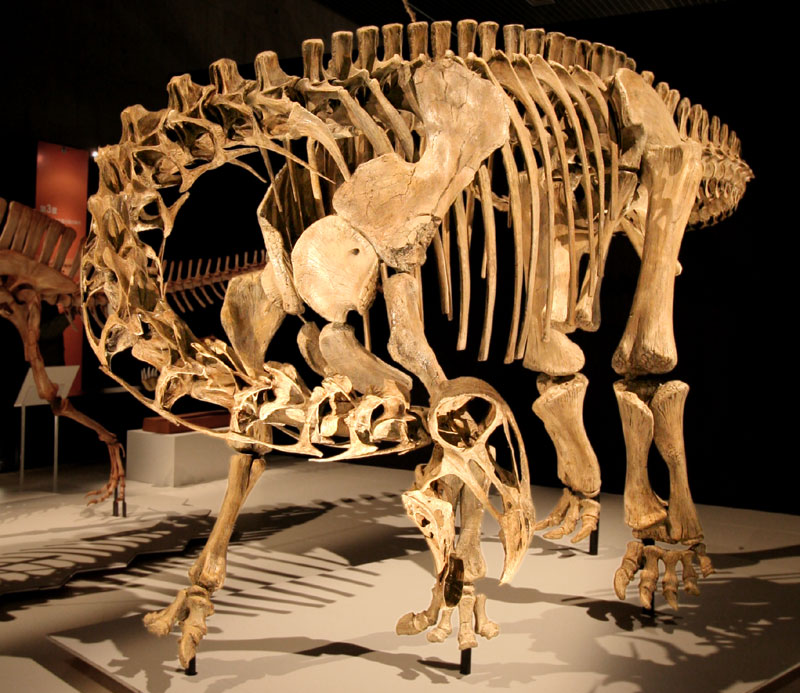
Small for a sauropod, Nigersaurus was about 9–14.1 m (30–46 ft) long, and had a short neck. It weighed around 1.9–4 t (2.1–4.4 short tons), comparable to a modern elephant. Its skull was very specialised for feeding, with large fenestrae and thin bones. It had a wide muzzle filled with more than 500 teeth, which were replaced at a rapid rate: around every 14 days. The jaws may have borne a keratinous sheath. Unlike other tetrapods, the tooth-bearing bones of its jaws were rotated transversely relative to the rest of the skull, so that all of its teeth were located far to the front. Its skeleton was highly pneumatised (filled with air spaces connected to air sacs), but the limbs were robustly built.
Nigersaurus and its closest relatives are grouped within the subfamily Rebbachisaurinae (formerly thought to be grouped in the eponymous Nigersaurinae) of the family Rebbachisauridae, which is part of the sauropod superfamily Diplodocoidea. Nigersaurus was probably a browser, and fed with its head close to the ground. The region of its brain that detected smell was underdeveloped, although its brain size was comparable to that of other dinosaurs. There has been debate on whether its head was habitually held downwards, or horizontally like other sauropods. It lived in a riparian habitat, and its diet probably consisted of soft plants, such as ferns, horsetails, and angiosperms. It is one of the most common fossil vertebrates found in the area, and shared its habitat with other dinosaurian megaherbivores, as well as large theropods and crocodylomorphs.
Remains thought to belong to Nigersaurus were first discovered during a 1965–1972 expedition to the Republic of Niger led by French paleontologist Philippe Taquet, and first mentioned in a paper published in 1976. Although a common genus, the dinosaur had been poorly known until more material of other individuals was discovered during expeditions led by American palaeontologist Paul Sereno in 1997 and 2000. The limited understanding of the genus was the result of poor preservation of its remains, which arises from the delicate and highly pneumatic construction (filled with air spaces connected to air sacs) of the skull and skeleton, in turn causing disarticulation of the fossils. Some of the skull fossils were so thin that a strong light beam was visible through them. Therefore, no intact skulls or articulated skeletons have been found, and these specimens represent the most complete known rebbachisaurid remains.
Nigersaurus was named and described in more detail by Sereno and colleagues only in 1999, based on remains of newly found individuals. The same article also named Jobaria, another sauropod from Niger. The genus name Nigersaurus ("Niger reptile") is a reference to the country where it was discovered, and the specific name taqueti honours Taquet, who was the first to organise large-scale palaeontological expeditions to Niger. The holotype specimen (MNN GAD512) consists of a partial skull and neck. Limb material and a scapula (shoulder blade) found nearby were also referred to the same specimen. These fossils are housed at the National Museum of Niger.
Sereno and the American palaeontologist Jeffrey A. Wilson provided the first detailed description of the skull and feeding adaptations in 2005. In 2007, a more detailed description of the skeleton was published by Sereno ad colleagues, based on a specimen discovered ten years earlier. The fossils, along with a reconstructed skeleton mount and a plastic model of the head and neck, were subsequently presented at the National Geographic Society in Washington. Nigersaurus was dubbed a "Mesozoic cow" in the press, and Sereno stressed that it was the most unusual dinosaur he had ever seen. He likened its physical appearance to Darth Vader and a vacuum cleaner, and compared its tooth shear with a conveyor belt and sharpened piano keys.
Numerous Nigersaurus specimens collected by French and American expeditions remain to be described. Teeth similar to those of Nigersaurus have been found on the Isle of Wight and in Brazil, but it is unknown whether they belonged to relatives of this taxon, or to titanosaurs, whose remains have been found in the vicinity. A lower jaw assigned to the titanosaur Antarctosaurus is likewise similar to that of Nigersaurus, but may have evolved convergently.
Like all sauropods, Nigersaurus was a quadruped with a small head, thick hind legs, and a prominent tail. Among that clade, Nigersaurus was fairly small, with a body length of only 9–14.1 m (30–46 ft) and a femur reaching only 1 m (3 ft 3 in); it may have weighed around 1.9–4 t (2.1–4.4 short tons), comparable to a modern elephant. It had a short neck for a sauropod, with thirteen cervical vertebrae. Nearly all rebbachisaurids had relatively short necks and a length of 10 m (33 ft) or less. The only members of the family that reached the size of larger sauropods were Rebbachisaurus and Maraapunisaurus.
Hub AI
Nigersaurus AI simulator
(@Nigersaurus_simulator)
Nigersaurus
Nigersaurus (/niːˈʒɛərsɔːrəs, ˈnaɪdʒərsɔːrəs/) is a genus of rebbachisaurid sauropod dinosaur that lived during the middle Cretaceous period, about 115 to 105 million years ago. It was discovered in the Elrhaz Formation in an area called Gadoufaoua, in Niger. Fossils of this dinosaur were first described in 1976, but it was only named Nigersaurus taqueti in 1999 after further and more complete remains were found and described. The genus name means "Niger reptile", and the specific name honours the palaeontologist Philippe Taquet, who discovered the first remains.
Small for a sauropod, Nigersaurus was about 9–14.1 m (30–46 ft) long, and had a short neck. It weighed around 1.9–4 t (2.1–4.4 short tons), comparable to a modern elephant. Its skull was very specialised for feeding, with large fenestrae and thin bones. It had a wide muzzle filled with more than 500 teeth, which were replaced at a rapid rate: around every 14 days. The jaws may have borne a keratinous sheath. Unlike other tetrapods, the tooth-bearing bones of its jaws were rotated transversely relative to the rest of the skull, so that all of its teeth were located far to the front. Its skeleton was highly pneumatised (filled with air spaces connected to air sacs), but the limbs were robustly built.
Nigersaurus and its closest relatives are grouped within the subfamily Rebbachisaurinae (formerly thought to be grouped in the eponymous Nigersaurinae) of the family Rebbachisauridae, which is part of the sauropod superfamily Diplodocoidea. Nigersaurus was probably a browser, and fed with its head close to the ground. The region of its brain that detected smell was underdeveloped, although its brain size was comparable to that of other dinosaurs. There has been debate on whether its head was habitually held downwards, or horizontally like other sauropods. It lived in a riparian habitat, and its diet probably consisted of soft plants, such as ferns, horsetails, and angiosperms. It is one of the most common fossil vertebrates found in the area, and shared its habitat with other dinosaurian megaherbivores, as well as large theropods and crocodylomorphs.
Remains thought to belong to Nigersaurus were first discovered during a 1965–1972 expedition to the Republic of Niger led by French paleontologist Philippe Taquet, and first mentioned in a paper published in 1976. Although a common genus, the dinosaur had been poorly known until more material of other individuals was discovered during expeditions led by American palaeontologist Paul Sereno in 1997 and 2000. The limited understanding of the genus was the result of poor preservation of its remains, which arises from the delicate and highly pneumatic construction (filled with air spaces connected to air sacs) of the skull and skeleton, in turn causing disarticulation of the fossils. Some of the skull fossils were so thin that a strong light beam was visible through them. Therefore, no intact skulls or articulated skeletons have been found, and these specimens represent the most complete known rebbachisaurid remains.
Nigersaurus was named and described in more detail by Sereno and colleagues only in 1999, based on remains of newly found individuals. The same article also named Jobaria, another sauropod from Niger. The genus name Nigersaurus ("Niger reptile") is a reference to the country where it was discovered, and the specific name taqueti honours Taquet, who was the first to organise large-scale palaeontological expeditions to Niger. The holotype specimen (MNN GAD512) consists of a partial skull and neck. Limb material and a scapula (shoulder blade) found nearby were also referred to the same specimen. These fossils are housed at the National Museum of Niger.
Sereno and the American palaeontologist Jeffrey A. Wilson provided the first detailed description of the skull and feeding adaptations in 2005. In 2007, a more detailed description of the skeleton was published by Sereno ad colleagues, based on a specimen discovered ten years earlier. The fossils, along with a reconstructed skeleton mount and a plastic model of the head and neck, were subsequently presented at the National Geographic Society in Washington. Nigersaurus was dubbed a "Mesozoic cow" in the press, and Sereno stressed that it was the most unusual dinosaur he had ever seen. He likened its physical appearance to Darth Vader and a vacuum cleaner, and compared its tooth shear with a conveyor belt and sharpened piano keys.
Numerous Nigersaurus specimens collected by French and American expeditions remain to be described. Teeth similar to those of Nigersaurus have been found on the Isle of Wight and in Brazil, but it is unknown whether they belonged to relatives of this taxon, or to titanosaurs, whose remains have been found in the vicinity. A lower jaw assigned to the titanosaur Antarctosaurus is likewise similar to that of Nigersaurus, but may have evolved convergently.
Like all sauropods, Nigersaurus was a quadruped with a small head, thick hind legs, and a prominent tail. Among that clade, Nigersaurus was fairly small, with a body length of only 9–14.1 m (30–46 ft) and a femur reaching only 1 m (3 ft 3 in); it may have weighed around 1.9–4 t (2.1–4.4 short tons), comparable to a modern elephant. It had a short neck for a sauropod, with thirteen cervical vertebrae. Nearly all rebbachisaurids had relatively short necks and a length of 10 m (33 ft) or less. The only members of the family that reached the size of larger sauropods were Rebbachisaurus and Maraapunisaurus.
Recent media