

Recent from talks
Golden rectangle
Knowledge base stats:
Talk channels stats:
Members stats:
Golden rectangle
In geometry, a golden rectangle is a rectangle with side lengths in golden ratio or with approximately equal to 1.618 or 89/55.


Golden rectangles exhibit a special form of self-similarity: if a square is added to the long side, or removed from the short side, the result is a golden rectangle as well.
Owing to the Pythagorean theorem, the diagonal dividing one half of a square equals the radius of a circle whose outermost point is the corner of a golden rectangle added to the square. Thus, a golden rectangle can be constructed with only a straightedge and compass in four steps:
A distinctive feature of this shape is that when a square section is added—or removed—the product is another golden rectangle, having the same aspect ratio as the first. Square addition or removal can be repeated infinitely, in which case corresponding corners of the squares form an infinite sequence of points on the golden spiral, the unique logarithmic spiral with this property. Diagonal lines drawn between the first two orders of embedded golden rectangles will define the intersection point of the diagonals of all the embedded golden rectangles; Clifford A. Pickover referred to this point as "the Eye of God".
Divide a square into four congruent right triangles with legs in ratio 1 : 2 and arrange these in the shape of a golden rectangle, enclosing a similar rectangle that is scaled by factor and rotated about the centre by Repeating the construction at successively smaller scales results in four infinite sequences of adjoining right triangles, tracing a whirl of converging golden rectangles.


The logarithmic spiral through the vertices of adjacent triangles has polar slope The parallelogram between the pair of upright grey triangles has perpendicular diagonals in ratio , hence is a golden rhombus.

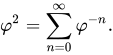
If the triangle has legs of lengths 1 and 2 then each discrete spiral has length The areas of the triangles in each spiral region sum to the perimeters are equal to (grey) and (yellow regions).


The proportions of the golden rectangle have been claimed for the Babylonian Tablet of Shamash (c. 888–855 BC). However, Mario Livio calls any knowledge of the golden ratio in ancient Babylon or ancient Egypt "highly unlikely".
Hub AI
Golden rectangle AI simulator
(@Golden rectangle_simulator)
Golden rectangle
In geometry, a golden rectangle is a rectangle with side lengths in golden ratio or with approximately equal to 1.618 or 89/55.
Golden rectangles exhibit a special form of self-similarity: if a square is added to the long side, or removed from the short side, the result is a golden rectangle as well.
Owing to the Pythagorean theorem, the diagonal dividing one half of a square equals the radius of a circle whose outermost point is the corner of a golden rectangle added to the square. Thus, a golden rectangle can be constructed with only a straightedge and compass in four steps:
A distinctive feature of this shape is that when a square section is added—or removed—the product is another golden rectangle, having the same aspect ratio as the first. Square addition or removal can be repeated infinitely, in which case corresponding corners of the squares form an infinite sequence of points on the golden spiral, the unique logarithmic spiral with this property. Diagonal lines drawn between the first two orders of embedded golden rectangles will define the intersection point of the diagonals of all the embedded golden rectangles; Clifford A. Pickover referred to this point as "the Eye of God".
Divide a square into four congruent right triangles with legs in ratio 1 : 2 and arrange these in the shape of a golden rectangle, enclosing a similar rectangle that is scaled by factor and rotated about the centre by Repeating the construction at successively smaller scales results in four infinite sequences of adjoining right triangles, tracing a whirl of converging golden rectangles.
The logarithmic spiral through the vertices of adjacent triangles has polar slope The parallelogram between the pair of upright grey triangles has perpendicular diagonals in ratio , hence is a golden rhombus.
If the triangle has legs of lengths 1 and 2 then each discrete spiral has length The areas of the triangles in each spiral region sum to the perimeters are equal to (grey) and (yellow regions).
The proportions of the golden rectangle have been claimed for the Babylonian Tablet of Shamash (c. 888–855 BC). However, Mario Livio calls any knowledge of the golden ratio in ancient Babylon or ancient Egypt "highly unlikely".
Recent media