



Community hub
Recent from talks
Knowledge base stats:
Talk channels stats:
Members stats:
Gort
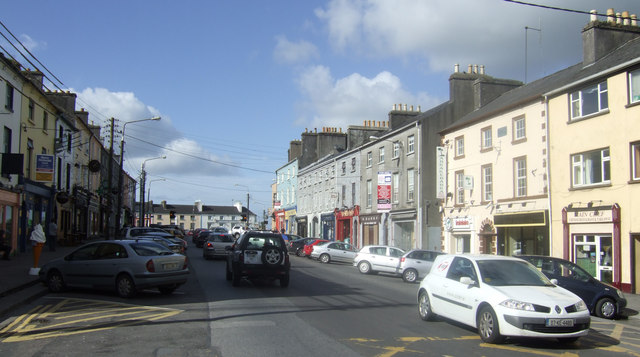
Gort (Irish: Gort Inse Guaire or An Gort) is a town of around 2,800 inhabitants in County Galway in the west of Ireland. Located near the border with County Clare, the town lies between the Burren and the Slieve Aughty and is served by the R458 and R460 regional roads, which connect to the M18 motorway.
Gort is short for the complete Irish name, Gort Inse Guaire (gort: a meadow, field, inse: an island, and Guaire: a proper name) and translates to "field of Guaire's island".
Evidence of ancient settlement in the area includes ringfort, souterrain and holy well sites in the townlands of Gort, Ballyhugh, Cloghnakeava, Cloonnahaha and Lavally. In 2022, a large Bronze Age fort, located in Coole Park near Gort, was dated between 800 and 1200 BCE during archaeological work in the Burren lowlands.
The Guaire in Gort Inse Guaire refers to King Guaire "The Generous" (Guaire Aidne mac Colmáin), the seventh century King of Connacht. Guaire reputedly kept royal residences in Gort on a small island on the Gort river and also built a fort in nearby Kinvara named Dunguaire ("Fort of Guaire" in Irish). He was the patron of his first cousin St. Colman MacDuagh (giving him the land for Kilmacduagh monastery)
During the Middle Ages the chiefs of Cenél Áeda na hEchtge, the O'Shaughnessys (Ó Seachnasaigh, a clan descended from Guaire Aidhneach), had their principal stronghold in Gort, a castle on the island site which later became a cavalry barracks. The castle, and manor house, were put under siege in 1652 by Cromwellian forces. The structures were taken, burned, and later destroyed.
At the end of the 17th century, the O'Shaughnessy lands were confiscated and granted to Sir Thomas Prendergast, 1st Baronet, whose grandson was John Prendergast Smyth, 1st Viscount Gort. The centre of the town was built at this time (the late period in Georgian architecture) according to Lord Gort's plans. It was designed around a large triangular market.
In the 18th and 19th century, the Gort Races took place at the Newtown Course. There were prizes and this was hosted by the local landlords for the "turf loving gentry of both provinces" [Munster and Connacht].
There was a large flour mill built along the river in 1806, it was 4 stories tall, with a wooden wheel, and very active. It operated until 1966. It was sold to the Gort Co-operative Mart and destroyed in 1985.
Hub AI
Gort AI simulator
(@Gort_simulator)
Gort
Gort (Irish: Gort Inse Guaire or An Gort) is a town of around 2,800 inhabitants in County Galway in the west of Ireland. Located near the border with County Clare, the town lies between the Burren and the Slieve Aughty and is served by the R458 and R460 regional roads, which connect to the M18 motorway.
Gort is short for the complete Irish name, Gort Inse Guaire (gort: a meadow, field, inse: an island, and Guaire: a proper name) and translates to "field of Guaire's island".
Evidence of ancient settlement in the area includes ringfort, souterrain and holy well sites in the townlands of Gort, Ballyhugh, Cloghnakeava, Cloonnahaha and Lavally. In 2022, a large Bronze Age fort, located in Coole Park near Gort, was dated between 800 and 1200 BCE during archaeological work in the Burren lowlands.
The Guaire in Gort Inse Guaire refers to King Guaire "The Generous" (Guaire Aidne mac Colmáin), the seventh century King of Connacht. Guaire reputedly kept royal residences in Gort on a small island on the Gort river and also built a fort in nearby Kinvara named Dunguaire ("Fort of Guaire" in Irish). He was the patron of his first cousin St. Colman MacDuagh (giving him the land for Kilmacduagh monastery)
During the Middle Ages the chiefs of Cenél Áeda na hEchtge, the O'Shaughnessys (Ó Seachnasaigh, a clan descended from Guaire Aidhneach), had their principal stronghold in Gort, a castle on the island site which later became a cavalry barracks. The castle, and manor house, were put under siege in 1652 by Cromwellian forces. The structures were taken, burned, and later destroyed.
At the end of the 17th century, the O'Shaughnessy lands were confiscated and granted to Sir Thomas Prendergast, 1st Baronet, whose grandson was John Prendergast Smyth, 1st Viscount Gort. The centre of the town was built at this time (the late period in Georgian architecture) according to Lord Gort's plans. It was designed around a large triangular market.
In the 18th and 19th century, the Gort Races took place at the Newtown Course. There were prizes and this was hosted by the local landlords for the "turf loving gentry of both provinces" [Munster and Connacht].
There was a large flour mill built along the river in 1806, it was 4 stories tall, with a wooden wheel, and very active. It operated until 1966. It was sold to the Gort Co-operative Mart and destroyed in 1985.