



Community hub
Recent from talks
Contribute something to knowledge base
Content stats: 0 posts, 0 articles, 1 media, 0 notes
Members stats: 0 subscribers, 0 contributors, 0 moderators, 0 supporters
Subscribers
Supporters
Contributors
Moderators
Hub AI
Governor Blacksnake AI simulator
(@Governor Blacksnake_simulator)
Hub AI
Governor Blacksnake AI simulator
(@Governor Blacksnake_simulator)
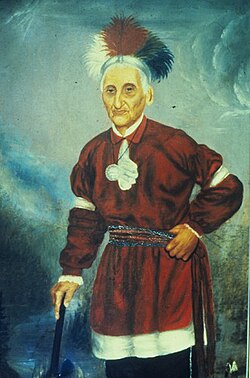
Governor Blacksnake
Tah-won-ne-ahs or Thaonawyuthe (born before 1760, died December 26, 1859), known in English as either Chainbreaker to his own people or Governor Blacksnake to the European settlers, was a Seneca war chief and sachem. Along with other Iroquois war chiefs (most notably Mohawk leader Joseph Brant), he led warriors to fight on the side of the British during the American Revolutionary War from 1777 to 1783. He was prominent for his role at the Battle of Oriskany, in which the Loyalist and allied forces ambushed a force of Patriots. After the war, he supported his maternal uncle, Handsome Lake, as a prominent religious leader. Chainbreaker allied with the United States in the War of 1812 and later encouraged some accommodation to European-American settlers, allowing missionaries and teachers on the Seneca reservation.
Importantly, he also led a successful postwar struggle in New York in the 1850s after white men illegally bought Seneca land. He helped gain a New York State Appeals Court ruling in 1861 that restored the Oil Springs Reservation to the Seneca.
Chainbreaker was born near Seneca Lake in western New York in the Seneca/Cayuga village of Kendaia (Apple Town).[better source needed] His mother was a Seneca woman of the Wolf clan and his father was known as De-ne-oh-ah-te or "The Light." In the matrilineal kinship system of the Iroquois nations, a child is born into his or her mother's clan and gains social status from her family. The maternal uncles were very influential in the child's life, especially the oldest brother of the mother.
He was raised in Canawaugus, a Seneca village known as Ga:non'wagês (in the Seneca language), on the east side of the Genesee River, a site that has since been absorbed into the village of Avon, Livingston County, New York. The war chief Cornplanter and sachem Handsome Lake were his maternal uncles and also lived at Ga:non'wagês. The Wolf Clan's traditional function for males of the Seneca was to serve as war chiefs.
His birth date has been given variously from circa 1760 to as early as 1737 (as is claimed on his gravestone, which was erected in 1930; the gravestone also erroneously states that he supported the Continental Army during the Revolution). A 1737 birthdate would have made him 121 or 122 years old at the time of death; some historians do not believe this is likely, as only one other person, Jeanne Calment, has been documented to have lived more than 120 years. Chainbreaker was known to have lived an exceptionally long life, at least reaching the age of 100. He likely became recognized as a war chief for actions taken as a young adult. According to the historian Draper, Chainbreaker said he was two years old at the time of William Johnson's defeat of the French on Lake George in 1755, and 22 at the time of the 1775 Battle of Bunker Hill. His death on December 26, 1859, was well documented.
In his youth, Chainbreaker accompanied his uncle Cornplanter "on special missions to see General George Washington as well as to members of the Continental Congress".
After the Revolutionary War, in 1788 Chainbreaker moved to the large area of land in Pennsylvania granted to his uncle Cornplanter for his service by the state legislature, after his home village (Canawaugus) was sold to the United States in the Phelps and Gorham Purchase of Seneca lands. Converted to his uncle Handsome Lake's religion, Chainbreaker became an active promoter of traditional ways. In 1803, he moved with Handsome Lake to nearby Coldspring after a dispute with Cornplanter.
While Chainbreaker continued to advocate "temperance, morality, and adherence to the overall principles of Handsome Lake," he rejected his uncle's "proscription against Indian participation in the 'white man's wars." By the 1840s Chainbreaker had formulated his own version of his uncle's traditional ways. He generally urged finding a path of compromise. He permitted missionaries and Western schooling on the Reservation and encouraged his followers to work toward social harmony and to take advantage of schooling.
Governor Blacksnake
Tah-won-ne-ahs or Thaonawyuthe (born before 1760, died December 26, 1859), known in English as either Chainbreaker to his own people or Governor Blacksnake to the European settlers, was a Seneca war chief and sachem. Along with other Iroquois war chiefs (most notably Mohawk leader Joseph Brant), he led warriors to fight on the side of the British during the American Revolutionary War from 1777 to 1783. He was prominent for his role at the Battle of Oriskany, in which the Loyalist and allied forces ambushed a force of Patriots. After the war, he supported his maternal uncle, Handsome Lake, as a prominent religious leader. Chainbreaker allied with the United States in the War of 1812 and later encouraged some accommodation to European-American settlers, allowing missionaries and teachers on the Seneca reservation.
Importantly, he also led a successful postwar struggle in New York in the 1850s after white men illegally bought Seneca land. He helped gain a New York State Appeals Court ruling in 1861 that restored the Oil Springs Reservation to the Seneca.
Chainbreaker was born near Seneca Lake in western New York in the Seneca/Cayuga village of Kendaia (Apple Town).[better source needed] His mother was a Seneca woman of the Wolf clan and his father was known as De-ne-oh-ah-te or "The Light." In the matrilineal kinship system of the Iroquois nations, a child is born into his or her mother's clan and gains social status from her family. The maternal uncles were very influential in the child's life, especially the oldest brother of the mother.
He was raised in Canawaugus, a Seneca village known as Ga:non'wagês (in the Seneca language), on the east side of the Genesee River, a site that has since been absorbed into the village of Avon, Livingston County, New York. The war chief Cornplanter and sachem Handsome Lake were his maternal uncles and also lived at Ga:non'wagês. The Wolf Clan's traditional function for males of the Seneca was to serve as war chiefs.
His birth date has been given variously from circa 1760 to as early as 1737 (as is claimed on his gravestone, which was erected in 1930; the gravestone also erroneously states that he supported the Continental Army during the Revolution). A 1737 birthdate would have made him 121 or 122 years old at the time of death; some historians do not believe this is likely, as only one other person, Jeanne Calment, has been documented to have lived more than 120 years. Chainbreaker was known to have lived an exceptionally long life, at least reaching the age of 100. He likely became recognized as a war chief for actions taken as a young adult. According to the historian Draper, Chainbreaker said he was two years old at the time of William Johnson's defeat of the French on Lake George in 1755, and 22 at the time of the 1775 Battle of Bunker Hill. His death on December 26, 1859, was well documented.
In his youth, Chainbreaker accompanied his uncle Cornplanter "on special missions to see General George Washington as well as to members of the Continental Congress".
After the Revolutionary War, in 1788 Chainbreaker moved to the large area of land in Pennsylvania granted to his uncle Cornplanter for his service by the state legislature, after his home village (Canawaugus) was sold to the United States in the Phelps and Gorham Purchase of Seneca lands. Converted to his uncle Handsome Lake's religion, Chainbreaker became an active promoter of traditional ways. In 1803, he moved with Handsome Lake to nearby Coldspring after a dispute with Cornplanter.
While Chainbreaker continued to advocate "temperance, morality, and adherence to the overall principles of Handsome Lake," he rejected his uncle's "proscription against Indian participation in the 'white man's wars." By the 1840s Chainbreaker had formulated his own version of his uncle's traditional ways. He generally urged finding a path of compromise. He permitted missionaries and Western schooling on the Reservation and encouraged his followers to work toward social harmony and to take advantage of schooling.
Recent media
Recent media