


Community hub
Recent from talks
Contribute something to knowledge base
Content stats: 0 posts, 0 articles, 1 media, 0 notes
Members stats: 0 subscribers, 0 contributors, 0 moderators, 0 supporters
Subscribers
Supporters
Contributors
Moderators
Hub AI
Greco-Bactrian Kingdom AI simulator
(@Greco-Bactrian Kingdom_simulator)
Hub AI
Greco-Bactrian Kingdom AI simulator
(@Greco-Bactrian Kingdom_simulator)
Greco-Bactrian Kingdom
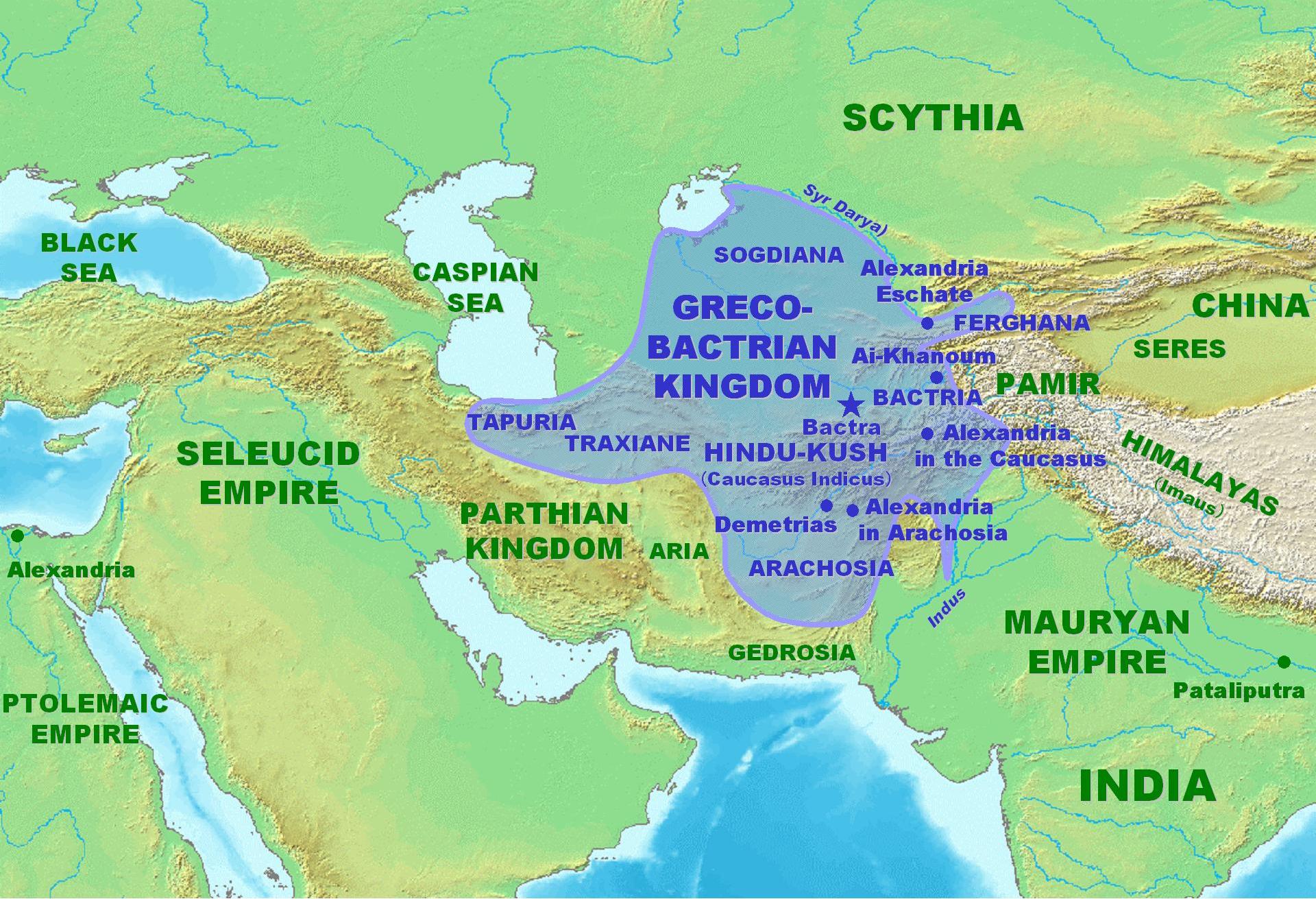
The Greco-Bactrian Kingdom (Greek: Βασιλεία τῆς Βακτριανῆς, romanized: Basileía tês Baktrianês, lit. 'Kingdom of Bactria') was a Greek state of the Hellenistic period located in Central-South Asia. The kingdom was founded by the Seleucid satrap Diodotus I Soter in about 256 BC, and continued to dominate Central Asia until its fall around 120 BC. At its peak the kingdom consisted of present-day Afghanistan, Tajikistan, Uzbekistan and Turkmenistan, and for a short time, small parts of Kazakhstan, Pakistan and Iran. An extension further east, with military campaigns and settlements, may have reached the borders of the Qin State in China by about 230 BC.
Although a Greek population was already present in Bactria by the 5th century BC, Alexander the Great conquered the region by 327 BC and founded many cities, most of them named Alexandria, and further settled with Macedonians and other Greeks. After the death of Alexander, control of Bactria passed on to his general Seleucus I Nicator. The fertility and the prosperity of the land by the early 3rd century BC led to the creation of the Greco-Bactrian kingdom by Diodotus as a successor state of the Seleucid empire. The Bactrian Greeks grew increasingly more powerful and invaded north-western India between 190 and 180 BC under king Demetrius, the son of Euthydemus. This invasion led to the creation of the Indo-Greek kingdom, as a successor state of the Greco-Bactrian kingdom, and was subsequently ruled by kings Pantaleon and Apollodotus I. Historical records indicate that many rich and prosperous cities were present in the kingdom, but only a few such cities have been excavated, such as Ai-Khanoum and Bactra. The city of Ai-Khanoum, in north-eastern Afghanistan, had all the hallmarks of a true Hellenistic city with a Greek theater, gymnasium and some houses with colonnaded courtyards.
The kingdom reached its peak under Eucratides the Great, who seems to have seized power through a coup around 171 BC and created his own dynasty. Eucratides also invaded India and successfully fought against the Indo-Greek kings. However, soon the kingdom began to decline. The Parthians and nomadic tribes such as Sakas and Yuezhi became a major threat. Eucratides was killed by his own son in about 145 BC, which may have further destabilised the kingdom. Heliocles was the last Greek king to rule in Bactria.
Even after the fall of the Greco-Bactrian kingdom, their rich Hellenistic influence remained strong for many more centuries. The Yuezhi invaders settled in Bactria and became Hellenized. They subsequently founded the Kushan empire around 30 AD, and adopted the Greek alphabet to write their language and added Greek deities to their pantheon. The Greco-Bactrian city of Ai-Khanoum was at the doorstep of India and known for its high level of Hellenistic sophistication. Greek art travelled from Bactria with the Indo-Greeks and influenced Indian art, religion and culture, leading to new syncretic art called Greco-Buddhist art.
Bactria was inhabited by Greek settlers since the time of Darius I, when the majority of the population of Barca, in Cyrenaica, was deported to the region for refusing to surrender assassins. Greek influence increased under Xerxes I, after the descendants of Greek priests who had once lived near Didyma (western Asia Minor) were forcibly relocated in Bactria, and later on with other exiled Greeks, most of them prisoners of war. Greek communities and language were already common in the area by the time that Alexander the Great conquered Bactria in 328 BC.
Diodotus, the satrap of Bactria (and probably the surrounding provinces) founded the Greco-Bactrian Kingdom when he seceded from the Seleucid Empire around 250 BC and became Basileus, or king Diodotus I of Bactria. The preserved ancient sources (see below) are somewhat contradictory, and the exact date of Bactrian independence has not been settled. Somewhat simplified, there is a high chronology (c. 255 BC) and a low chronology (c. 246 BC) for Diodotus' secession. The high chronology has the advantage of explaining why the Seleucid king Antiochus II issued very few coins in Bactria, as Diodotus would have become independent there early in Antiochus' reign.[page needed] On the other hand, the low chronology, from the mid-240s BC, has the advantage of connecting the secession of Diodotus I with the Third Syrian War, a catastrophic conflict for the Seleucid Empire.
Diodotus, the governor of the thousand cities of Bactria (Latin: Theodotus, mille urbium Bactrianarum praefectus), defected and proclaimed himself king; all the other people of the Orient followed his example and seceded from the Macedonians.
The new kingdom, highly urbanized and considered one of the richest of the Orient (opulentissimum illud mille urbium Bactrianum imperium "The extremely prosperous Bactrian empire of the thousand cities", according to the historian Justin), was to further grow in power and engage in territorial expansion to the east and the west:
Greco-Bactrian Kingdom
The Greco-Bactrian Kingdom (Greek: Βασιλεία τῆς Βακτριανῆς, romanized: Basileía tês Baktrianês, lit. 'Kingdom of Bactria') was a Greek state of the Hellenistic period located in Central-South Asia. The kingdom was founded by the Seleucid satrap Diodotus I Soter in about 256 BC, and continued to dominate Central Asia until its fall around 120 BC. At its peak the kingdom consisted of present-day Afghanistan, Tajikistan, Uzbekistan and Turkmenistan, and for a short time, small parts of Kazakhstan, Pakistan and Iran. An extension further east, with military campaigns and settlements, may have reached the borders of the Qin State in China by about 230 BC.
Although a Greek population was already present in Bactria by the 5th century BC, Alexander the Great conquered the region by 327 BC and founded many cities, most of them named Alexandria, and further settled with Macedonians and other Greeks. After the death of Alexander, control of Bactria passed on to his general Seleucus I Nicator. The fertility and the prosperity of the land by the early 3rd century BC led to the creation of the Greco-Bactrian kingdom by Diodotus as a successor state of the Seleucid empire. The Bactrian Greeks grew increasingly more powerful and invaded north-western India between 190 and 180 BC under king Demetrius, the son of Euthydemus. This invasion led to the creation of the Indo-Greek kingdom, as a successor state of the Greco-Bactrian kingdom, and was subsequently ruled by kings Pantaleon and Apollodotus I. Historical records indicate that many rich and prosperous cities were present in the kingdom, but only a few such cities have been excavated, such as Ai-Khanoum and Bactra. The city of Ai-Khanoum, in north-eastern Afghanistan, had all the hallmarks of a true Hellenistic city with a Greek theater, gymnasium and some houses with colonnaded courtyards.
The kingdom reached its peak under Eucratides the Great, who seems to have seized power through a coup around 171 BC and created his own dynasty. Eucratides also invaded India and successfully fought against the Indo-Greek kings. However, soon the kingdom began to decline. The Parthians and nomadic tribes such as Sakas and Yuezhi became a major threat. Eucratides was killed by his own son in about 145 BC, which may have further destabilised the kingdom. Heliocles was the last Greek king to rule in Bactria.
Even after the fall of the Greco-Bactrian kingdom, their rich Hellenistic influence remained strong for many more centuries. The Yuezhi invaders settled in Bactria and became Hellenized. They subsequently founded the Kushan empire around 30 AD, and adopted the Greek alphabet to write their language and added Greek deities to their pantheon. The Greco-Bactrian city of Ai-Khanoum was at the doorstep of India and known for its high level of Hellenistic sophistication. Greek art travelled from Bactria with the Indo-Greeks and influenced Indian art, religion and culture, leading to new syncretic art called Greco-Buddhist art.
Bactria was inhabited by Greek settlers since the time of Darius I, when the majority of the population of Barca, in Cyrenaica, was deported to the region for refusing to surrender assassins. Greek influence increased under Xerxes I, after the descendants of Greek priests who had once lived near Didyma (western Asia Minor) were forcibly relocated in Bactria, and later on with other exiled Greeks, most of them prisoners of war. Greek communities and language were already common in the area by the time that Alexander the Great conquered Bactria in 328 BC.
Diodotus, the satrap of Bactria (and probably the surrounding provinces) founded the Greco-Bactrian Kingdom when he seceded from the Seleucid Empire around 250 BC and became Basileus, or king Diodotus I of Bactria. The preserved ancient sources (see below) are somewhat contradictory, and the exact date of Bactrian independence has not been settled. Somewhat simplified, there is a high chronology (c. 255 BC) and a low chronology (c. 246 BC) for Diodotus' secession. The high chronology has the advantage of explaining why the Seleucid king Antiochus II issued very few coins in Bactria, as Diodotus would have become independent there early in Antiochus' reign.[page needed] On the other hand, the low chronology, from the mid-240s BC, has the advantage of connecting the secession of Diodotus I with the Third Syrian War, a catastrophic conflict for the Seleucid Empire.
Diodotus, the governor of the thousand cities of Bactria (Latin: Theodotus, mille urbium Bactrianarum praefectus), defected and proclaimed himself king; all the other people of the Orient followed his example and seceded from the Macedonians.
The new kingdom, highly urbanized and considered one of the richest of the Orient (opulentissimum illud mille urbium Bactrianum imperium "The extremely prosperous Bactrian empire of the thousand cities", according to the historian Justin), was to further grow in power and engage in territorial expansion to the east and the west:
Recent media
Recent media