


Community hub
Recent from talks
Contribute something
Nothing was collected or created yet.
Graham Maby
View on Wikipedia
Key Information


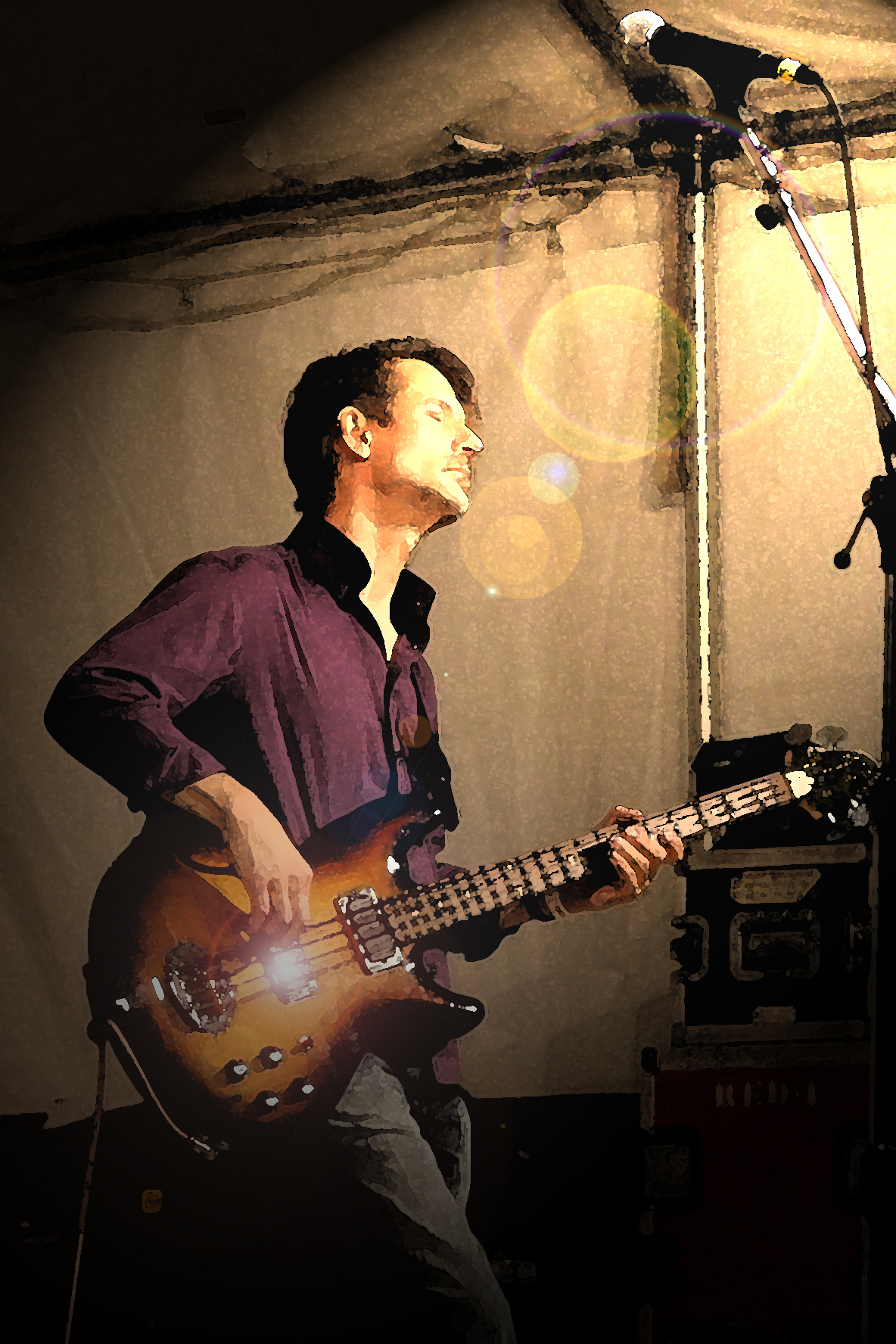
Graham Maby (born 1 September 1952) is an English bass guitar player. He has recorded and toured with Joe Jackson since his first album, appearing on most of Jackson's albums and tours.[1]
Maby was born and raised in the central south coast town of Gosport. Working exclusively with Joe Jackson since the late 1970s, in the mid 1980s he began working live and in the studio with Marshall Crenshaw. In the early 1990s he toured with Graham Parker, Garland Jeffreys, the Silos, and Darden Smith. In 1996, Maby joined They Might Be Giants, and from 1998 until 2002, he recorded and toured with Natalie Merchant. Maby has also recorded and toured with Joan Baez, Freedy Johnston, Henry Lee Summer, Ian Hunter, Regina Spektor, Chris Stamey, Shivaree, and Dar Williams.[2][3]
Along with playing bass, Maby also produced several tracks on Johnston's 1992 album, Can You Fly.[4] He appeared in the 1986 movie Peggy Sue Got Married as a member of Marshall Crenshaw's band, and very briefly in the 2019 Todd Phillips movie Joker as a member of the "Murray Franklin Show" band.[citation needed]
His first-born son Christopher, a musician and actor, died in 1998.[5][6][7]
Discography
[edit] | This section may require cleanup to meet Wikipedia's quality standards. The specific problem is: Formatting, non-use of wikitable(s), laundry list appearance, unreferenced. (March 2016) |
With Joe Jackson:
- Look Sharp! (1979)
- I'm the Man (1979)
- Beat Crazy (1980)
- Jumpin' Jive (1981)
- Night and Day (1982)
- Mike's Murder (1983)
- Body and Soul (1984)
- Live 1980/86 (1988)
- Blaze of Glory (1989)
- Laughter & Lust (1991)
- Night Music (1994)
- Summer in the City: Live in New York (2000)
- Night and Day II (2000)
- Volume 4 (2003)
- Afterlife (2004)
- Rain (2008)
- Live Music - Europe 2010 (2011)
- Live at Rockpalast (2012)
- Fast Forward ("New York" section) (2015)
- Fool (2019)
With They Might Be Giants:
- John Henry
- Why Does The Sun Shine? (EP)
- Back To Skull
- Factory Showroom
- Severe Tire Damage
- Long Tall Weekend
- Working Undercover For The Man
With Natalie Merchant:
- Ophelia
- Live in New York City
- Motherland
- The House Carpenter's Daughter
With Freedy Johnston:
- Can You Fly
- Unlucky
- This Perfect World (Elektra, 1994)
- Never Home
- Right Between the Promises
With Marshall Crenshaw:
With Ian Hunter:
With Joan Baez:
With Dar Williams:
With Regina Spektor:
With Chris Stamey:
- It's Alright
- Fireworks
With Darden Smith:
- Little Victories
- Deep Fantastic Blue
With Henry Lee Summer:
- Henry Lee Summer
- I've Got Everything
With Nina Hagen:
- Volksbeat (2011)
See also
[edit]References
[edit]- ^ "The Joe Jackson Archive: Graham Maby". Jj-archive.net. 22 September 2008. Retrieved 17 July 2011.
- ^ Prato, Greg (26 September 2002). "Graham Maby". AllMusic. Retrieved 17 July 2011.
- ^ "Graham Maby - Joe Jackson Band (BGM Issue 29)". Bassguitarmagazine.com. Retrieved 17 July 2011.
- ^ [1] Archived July 15, 2007, at the Wayback Machine
- ^ A Cure for Gravity, autobiography, Joe Jackson, Da Capo Press, 2000, ISBN 978-0306810015
- ^ Rachel Woods; Julie Maby; Carol Hilwyn (26 October 2007). "Family life | Life and style". The Guardian. London. Retrieved 17 July 2011.
- ^ "Christopher Maby - Biographical Summaries of Notable People". MyHeritage.com. 1 September 1952. Retrieved 13 March 2016.
External links
[edit]- Graham Maby discography at Discogs

| International | |
|---|---|
| National | |
| Artists | |
| People | |
Graham Maby
View on GrokipediaEarly life
Childhood in Gosport
Graham Maby was born on September 1, 1952, in Gosport, Hampshire, England.[2] Gosport, a small town on England's south coast adjacent to Portsmouth, was historically a major naval hub with a strong working-class character shaped by its military and maritime heritage.[5] The town's economy and community revolved around the Royal Navy, including bases like HMS Dolphin and Haslar Hospital, fostering a resilient, community-oriented environment amid post-World War II recovery.[6] Maby's family background immersed him in music from an early age, despite his parents being frustrated amateur musicians rather than professionals. His mother had sung in her teens in London's East End, while his father, an avid music enthusiast, improvised rhythms using household items like spoons, forks, a harmonica, or a kazoo. The couple met during World War II while serving in the army, bonding over their shared admiration for Frank Sinatra and harmonizing together; family gatherings often featured group singing, creating a lively, musical household atmosphere.[7] From infancy, Maby showed an instinctive response to music, reportedly rocking in his high chair to broadcasts on BBC radio, which provided a constant soundtrack in the home. This early auditory environment in Gosport's modest, naval-influenced setting likely contributed to his developing sensitivity and rhythmic awareness, even as his childhood involved typical play and community life in a tight-knit coastal town.[2]Musical beginnings
Maby's early exposure to music came through the radio in his family home, where at age ten he first heard the Beatles' "Love Me Do," sparking an initial interest in the sounds of popular music. This fascination deepened during his adolescence in Gosport, where the local music scene emphasized straightforward rock and emerging styles, influencing his instrument choice. At age 16, Maby experienced a pivotal "lightning-bolt moment" when he purchased an Eko bass guitar, an event that ignited his passion for the instrument.[8][2] He immediately isolated himself with the bass for several months, immersing in practice and exploration.[2] Opting for bass over guitar suited the foundational role it played in local rock bands of the late 1960s, providing rhythmic support without the lead focus.[8] Entirely self-taught, Maby honed his skills by ear, focusing on groove and song support rather than formal lessons or sheet music.[2] His initial playing experiences involved solitary experimentation at home, gradually building technique through repetition and intuition before joining any group.[8] During this early period, Maby was influenced by bassists such as Paul McCartney, Jack Bruce, John Paul Jones, and Roger Waters, drawn from 1960s rock records and shaping his emerging style with an emphasis on versatility and groove.[8][2]Career
Collaboration with Joe Jackson
Graham Maby first met Joe Jackson in 1974 when the 19-year-old Jackson visited Maby's home in Gosport, England, and invited him to join his newly formed pub rock band Arms & Legs.[2][9] The band, which also featured guitarist Dave Cairns and drummer Bruce Farthing, signed to MAM Records and released singles like "Janie" in 1976, but disbanded after commercial failure, paving the way for Jackson's pivot to new wave.[2] In 1978, Jackson recruited Maby, along with guitarist Gary Sanford and drummer David Houghton, to form the Joe Jackson Band, recording demos that led to the breakthrough debut album Look Sharp! in 1979.[9][2] Maby's bass work on Look Sharp! established the duo's symbiotic partnership, with his prominent, melodic lines providing rhythmic drive and counterpoint to Jackson's piano and vocals across genres from new wave to jazz-inflected pop.[2][9] For instance, on the hit "Is She Really Going Out with Him?," Maby's bass line opens with sliding roots and fifths, evolves into simple root-note verses with stepwise resolutions, and builds to fuller, reggae-tinged choruses featuring octaves and ninths, emphasizing the song's ironic tension.[9] This approach carried through subsequent albums like I'm the Man (1979), Night and Day (1982), Body and Soul (1984), Volume 4 (2003), Fast Forward (2015), and Fool (2019), where Maby contributed versatile playing, including fretless bass and slap techniques tailored to Jackson's evolving styles.[2] Their collaboration extended into the 2020s with Maby on bass for Jackson's upcoming album Hope and Fury, set for release in April 2026.[10] Over more than four decades, Maby and Jackson toured extensively worldwide, performing in various formats from the original quartet to trios and quartets, with reunions like the 2003 Volume 4 tour reviving the classic lineup's raw energy.[2] Band dynamics emphasized mutual trust, as Jackson noted Maby's "conviction" in every note, allowing the bassist to lead grooves while supporting the song's narrative.[2] This enduring partnership, spanning over 18 albums and countless live shows, highlights Maby's role as a foundational element in Jackson's career, adapting to punk urgency, sophisticated arrangements, and introspective rock without overshadowing the frontman's vision.[9][2]Work with other artists
In the mid-1980s, Maby collaborated with rock musician Marshall Crenshaw, providing bass on the 1987 album Mary Jean & 9, where his rhythmic foundation complemented Crenshaw's melodic guitar work and the production by Don Dixon.[11] He also joined Crenshaw for live performances during this period, contributing to the band's power-pop sound.[12] Maby's involvement with alternative rock band They Might Be Giants came in 1996, when he served as their touring and recording bassist for the album Factory Showroom, delivering punchy, supportive lines on tracks like "S-E-X-X-Y" and "How Can I Sing Like a Girl?" that enhanced the duo's quirky, energetic style.[13] His tenure with the group lasted about a year, including contributions to the live album Severe Tire Damage.[14] From 1998 to 2002, Maby was a key member of Natalie Merchant's band, recording bass on her solo albums Ophelia (1998) and Motherland (2001), including the title track of Ophelia with its introspective folk-rock arrangements, and touring extensively to support these releases.[15][3] This period highlighted Maby's adaptability to Merchant's literate, orchestral pop, blending his precise technique with subtle emotional depth. Beyond these extended partnerships, Maby made notable session and touring contributions across genres. In the early 1990s, he toured with new wave artist Graham Parker as part of the Small Clubs band, providing a solid low-end drive for Parker's sharp, socially observant songwriting.[3] He also supported reggae-influenced rocker Garland Jeffreys on a 1992 European tour, adding groove to live sets.[16] Maby recorded with folk icon Joan Baez on her 2005 live album Bowery Songs and toured with her, offering understated bass that underscored Baez's timeless voice.[3] His work with singer-songwriter Freedy Johnston spanned multiple projects, including bass on the 1992 debut Can You Fly, the 1997 album Never Home, and 2001's Right Between the Promises, where Maby's melodic lines elevated Johnston's narrative-driven indie rock. Maby toured and recorded with Mott the Hoople frontman Ian Hunter from 2004 to 2005, contributing to the 2005 album Shrunken Heads with its classic rock flair.[3] In 2004, he played bass on two tracks of Regina Spektor's Soviet Kitsch, enhancing her piano-led indie pop with subtle texture.[3] Additionally, Maby provided bass for Dar Williams' 2000 album The Green World, supporting her folk introspection on songs like "Calling the Moon."[17] In 2025, Maby continued touring with Freedy Johnston and provided occasional bass support for The Smithereens, while performing live with Joe Jackson.[18][19] These diverse engagements showcase Maby's versatility, from power-pop and alternative rock to folk and indie, often bridging his sharp, economical style developed in earlier collaborations.Production and film roles
In addition to his performing career, Graham Maby has taken on production roles, notably co-producing several tracks on Freedy Johnston's 1992 album Can You Fly. He handled production duties for tracks 3 ("Tearing Down This Place"), 4 ("Remember Me"), 5 ("Wheels"), 8 ("The Furies"), 9 ("Sincere"), 10 ("Outlaw Song"), 12 ("California Thing"), and 13 ("He Wasn't Murdered"), collaborating with Knut Bøhn on the overall project.[20] Maby has also made on-screen appearances in films, often tied to his musical background. In the 1986 Francis Ford Coppola film Peggy Sue Got Married, he appeared as a bassist in the reunion band led by Marshall Crenshaw, performing during key scenes. More recently, in Todd Phillips' 2019 film Joker, Maby had a brief uncredited role as a member of the Murray Franklin Show Band.[21] His screen presence extends to music-related documentaries and specials. Maby featured in the 2014 documentary The Front Man, providing insights as a longtime collaborator in the music industry, alongside figures like Joe Jackson and Elvis Costello.[22] He also appeared in the 1979 music video Joe Jackson: I'm the Man, capturing early band dynamics during a recording session.Musical style
Bass technique and influences
Graham Maby's bass technique is characterized by a philosophy centered on "serving the song," where he prioritizes musical taste and instinct over technical flash or showmanship. This approach involves listening intently to the melody's rhythm and harmony to craft supportive lines that enhance the overall composition, rather than dominating it. Maby has emphasized that effective bass playing requires locking in with the drummer through intuitive feel, avoiding overanalysis to maintain a natural groove, as seen in classic rhythm sections.[2] His commitment to humility and openness further underscores this ethos, allowing him to adapt suggestions while staying true to the track's needs.[2] Maby's lines are notably melodic and supportive, drawing heavily from the energetic drive of punk and new wave, which infused his early work with a sense of urgency and propulsion. Influenced by bassists like Paul McCartney, James Jamerson, and Colin Moulding, he favors fluid, tuneful phrasing that colors the harmony without overwhelming it, often filling spaces dynamically to propel the music forward.[8][2] This style shines in his precise fingerstyle technique, which delivers spot-on rhythmic accuracy and allows for subtle dissonances or step-outs that add depth, as exemplified in tracks like "Big Black Cloud" where simple lines build to clashing outros.[8] In live settings, Maby employs a wide dynamic range to mirror the song's emotional arc, transitioning seamlessly from restrained support to emphatic fills.[4] Over his career, Maby's technique evolved from the high-energy, space-filling drive of power pop and punk—evident in his youthful exuberance on early recordings—to a more subtle, nuanced approach suited to folk and Americana collaborations. This progression reflects his ability to tailor bass lines across genres, from the tumbao patterns honed in Latin-influenced works to the walking lines adapted for swing and big band styles, always maintaining melodic integrity.[8][2] His long-term partnership with Joe Jackson, spanning over four decades, played a pivotal role in shaping this versatility, granting him freedom to experiment while emphasizing conviction in every note.[4]Equipment and tone
Graham Maby has primarily relied on Fender Precision and Jazz basses throughout his career, establishing them as cornerstones of his setup since the late 1970s. He used a 1979 Fender Precision Bass for Joe Jackson's Night and Day album, contributing to its sophisticated sound, while a 1966 Fender Jazz Bass and a 1974 Fender Mustang Bass remain part of his current collection for varied tonal needs.[2][8] For amplification, Maby favors setups that deliver a warm yet punchy tone, beginning with a Fender Bassman 135 head during the recording of Jackson's early albums Look Sharp! and I'm the Man, where he cranked the treble for a distinctive, aggressive edge. In more recent years, including tours in the 2010s and 2020s, he has adopted the Wayne Jones Audio WJBP Stereo Valve Bass Guitar Preamp paired with two WJ1x10 Stereo/Mono Bass Cabinets, which provide a rich, valve-driven warmth suitable for both studio and live applications.[2][8][23] Maby employs a minimalist approach to effects, prioritizing a clean signal path to preserve the natural character of his bass tone, with only occasional use of pedals such as the Electro-Harmonix Big Muff π for subtle distortion when needed. This setup emphasizes directness and clarity, avoiding heavy processing to maintain punch and definition in his lines.[8][24] His gear has evolved significantly from his beginnings, starting with a budget Eko bass purchased at age 16 in the early 1970s, which sparked his interest in the instrument, to a 1977 Ibanez Silver Series Jazz Bass copy used for initial Look Sharp! demos. By the 1980s, he transitioned to higher-end options like Spector NS-5 models (from 1988 onward), which became his go-to for tours and recordings into the 2020s, alongside strings like Rotosound black nylon flatwounds for a smooth, pick-driven attack in early work and D’Addario coated nickel rounds for modern versatility. This progression reflects adaptations to diverse musical demands while retaining a focus on reliable, tone-focused hardware.[2][8][24]Personal life
Family and loss
Graham Maby has been married three times. He resides on Long Island with his third wife, Maureen, as of September 2025.[25][1] Maby is a father to two adult children, Claire and Pierce, from his second marriage to Mary Beth Maby, who died in 2012.[26] His first-born son, Christopher, an aspiring musician and actor, died tragically in 1998 at the age of 21.[27] Christopher's mother, Julie Maby, recounted in a 2007 personal essay that his death left her in profound grief, taking years to process memories of his life, including shared moments singing Everly Brothers songs; she described music as a vital source of healing during this period.[28] No further public details on Maby's personal reflections about the loss have been widely shared.Other interests
Beyond his longstanding career as a bassist, Graham Maby has developed a keen interest in writing, particularly through his ongoing work on a personal memoir. Titled Call Me Maby: A Bass Odyssey, the book draws from his experiences in the music industry, with excerpts revealing detailed reflections on early collaborations and pivotal moments in his professional journey. Maby has described the process as rewarding, often advancing the project during periods of travel or downtime away from performances.[4][29][30] This literary pursuit underscores Maby's broader engagement with writing and storytelling, offering a creative outlet that complements his musical endeavors without overlapping them. He has tied this interest to a deliberate approach to life balance, noting the value of lessons accumulated over more than four decades in sustaining equilibrium between intensive touring and quieter, introspective activities at home.[2] As Maby has observed, "Central for me after all these years is to keep applying the valuable lessons I’ve learned about balancing life and music. Because there is life beyond music."[2] This mindset allows him to maintain a multifaceted existence, where non-musical creative work provides essential respite from the demands of the road.Discography
With Joe Jackson
Graham Maby joined Joe Jackson's band early in his career, providing bass on the debut album Look Sharp! in 1979 and continuing as a core collaborator through numerous studio recordings, live releases, and tours over the next four decades.[3] His contributions span punk-inflected new wave, sophisticated pop, and jazz-tinged explorations, appearing on 18 Joe Jackson releases in total.[3] The following table lists Maby's credited appearances on Joe Jackson's albums in chronological order, focusing on studio and select live efforts:| Year | Album Title | Credit |
|---|---|---|
| 1979 | Look Sharp! | Bass, backing vocals |
| 1979 | I'm the Man | Bass, backing vocals |
| 1980 | Beat Crazy | Bass, backing vocals |
| 1981 | Jumpin' Jive | Bass |
| 1982 | Night and Day | Bass |
| 1983 | Mike's Murder (soundtrack) | Bass |
| 1984 | Body and Soul | Bass, backing vocals |
| 1988 | Live 1980-86 (live) | Bass |
| 1989 | Blaze of Glory | Bass |
| 1991 | Laughter & Lust | Bass |
| 1994 | Night Music | Bass |
| 2000 | Summer in the City: Live in New York (live) | Bass, backing vocals |
| 2000 | Night and Day II | Bass |
| 2003 | Volume 4 | Bass, backing vocals |
| 2004 | Afterlife | Bass, backing vocals |
| 2008 | Rain | Bass |
| 2015 | Fast Forward | Bass, vocals |
| 2019 | Fool | Bass, vocals |