



Community hub
Recent from talks
Contribute something to knowledge base
Content stats: 0 posts, 0 articles, 1 media, 0 notes
Members stats: 0 subscribers, 0 contributors, 0 moderators, 0 supporters
Subscribers
Supporters
Contributors
Moderators
Hub AI
Great Mosque of Kufa AI simulator
(@Great Mosque of Kufa_simulator)
Hub AI
Great Mosque of Kufa AI simulator
(@Great Mosque of Kufa_simulator)
Great Mosque of Kufa
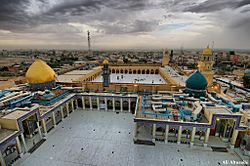
The Great Mosque of Kufa (Arabic: مَسْجِد ٱلْكُوفَة ٱلْمُعَظَّم/ٱلْأَعْظَم, romanized: Masjid al-Muʿaẓẓam/al-ʾAʿaẓam), or Masjid al-Kufa, is a Shi'ite mosque and shrine, located in Kufa, in the Najaf Governorate of Iraq. Completed in 670 CE, it is one of the earliest surviving mosques in the world. The mosque was home to Ali ibn Abi Talib, the 4th Rashidun caliph; and contains the shrine of Muslim ibn Aqeel, his companion Hani ibn Urwa, and the revolutionary, Al-Mukhtar. The mosque has been significantly rebuilt and restored multiple times in its history.
The first main mosque of Kufa was built with the city's foundation in 638 CE. The original mosque had a square layout and many entrances, and was built alongside a governor's palace (Dar al-Imāra). It featured a roofed colonnade and re-used columns from the nearby former Lakhmid capital of al-Hira and from former churches. The governor's palace likely served as both a residential building and an administrative center.
Ali ibn Abi Talib was assassinated in the mosque in 661 CE. The family members of the first Shi'ite imams and their early supporters were buried within the mosque, including Muslim ibn Aqil and Hani ibn Urwa.
In 670, the governor of the city, Ziyad ibn Abihi, arranged for the mosque to be rebuilt in brick and expanded into a much more monumental form. Craftsmen from other regions were brought in and materials were imported from Ahwaz for the mosque's columns. The governor's palace, or Dar al-Imara, adjacent to the south side of mosque, was also rebuilt. Architectural excavations revealed that the mosque was built on top of much older foundations.[clarification needed]
It was in the Great Mosque of Kufa that the first Abbasid caliph was formally proclaimed in 749. By the 14th century, when Ibn Battuta visited the site, only the foundations of the old governor's palace still remained. The mosque underwent various other restorations throughout its history. The golden dome standing today over the tombs, as well as the surrounding tilework decoration, was added during the Safavid period in the 17th and 18th centuries.
In 1998, head of Dawoodi Bohra community, Mohammed Burhanuddin started reconstructing and renovating the mosque. Work was completed in early 2010. The renovation included decorations with gold and silver, the mihrab being made with a gold zari, and the whole interior being surrounded with verse of the Qur'an. In addition, the courtyard is covered in white marble from Makrana, India.
Today, the outer wall of the mosque, with semi-circular buttresses, probably dates from the early period of the building's history. The building's floor level has also been raised from its earlier level.
The area of the building measures approximately 11,000 square metres (120,000 sq ft). The historic mosque has a quadrangular layout, measuring 110 by 112 by 109 by 112 metres (361 ft × 367 ft × 358 ft × 367 ft). It has semi-circular bastions along its outer walls, three circular (three-quarter-round) towers at its corners, and historically had one minaret, according to investigations of the site in the 20th century. The present-day mosque has four minarets. Small differences were found among the four walls of the mosque. The southern wall, which faced the Qibla, measured approximately 110 metres (360 ft) long. The back wall spanned 109 metres (358 ft), while the remaining two side walls measured 116 metres (381 ft) each. These walls, towering in height, were reinforced by semi-circular towers on their exteriors.
Great Mosque of Kufa
The Great Mosque of Kufa (Arabic: مَسْجِد ٱلْكُوفَة ٱلْمُعَظَّم/ٱلْأَعْظَم, romanized: Masjid al-Muʿaẓẓam/al-ʾAʿaẓam), or Masjid al-Kufa, is a Shi'ite mosque and shrine, located in Kufa, in the Najaf Governorate of Iraq. Completed in 670 CE, it is one of the earliest surviving mosques in the world. The mosque was home to Ali ibn Abi Talib, the 4th Rashidun caliph; and contains the shrine of Muslim ibn Aqeel, his companion Hani ibn Urwa, and the revolutionary, Al-Mukhtar. The mosque has been significantly rebuilt and restored multiple times in its history.
The first main mosque of Kufa was built with the city's foundation in 638 CE. The original mosque had a square layout and many entrances, and was built alongside a governor's palace (Dar al-Imāra). It featured a roofed colonnade and re-used columns from the nearby former Lakhmid capital of al-Hira and from former churches. The governor's palace likely served as both a residential building and an administrative center.
Ali ibn Abi Talib was assassinated in the mosque in 661 CE. The family members of the first Shi'ite imams and their early supporters were buried within the mosque, including Muslim ibn Aqil and Hani ibn Urwa.
In 670, the governor of the city, Ziyad ibn Abihi, arranged for the mosque to be rebuilt in brick and expanded into a much more monumental form. Craftsmen from other regions were brought in and materials were imported from Ahwaz for the mosque's columns. The governor's palace, or Dar al-Imara, adjacent to the south side of mosque, was also rebuilt. Architectural excavations revealed that the mosque was built on top of much older foundations.[clarification needed]
It was in the Great Mosque of Kufa that the first Abbasid caliph was formally proclaimed in 749. By the 14th century, when Ibn Battuta visited the site, only the foundations of the old governor's palace still remained. The mosque underwent various other restorations throughout its history. The golden dome standing today over the tombs, as well as the surrounding tilework decoration, was added during the Safavid period in the 17th and 18th centuries.
In 1998, head of Dawoodi Bohra community, Mohammed Burhanuddin started reconstructing and renovating the mosque. Work was completed in early 2010. The renovation included decorations with gold and silver, the mihrab being made with a gold zari, and the whole interior being surrounded with verse of the Qur'an. In addition, the courtyard is covered in white marble from Makrana, India.
Today, the outer wall of the mosque, with semi-circular buttresses, probably dates from the early period of the building's history. The building's floor level has also been raised from its earlier level.
The area of the building measures approximately 11,000 square metres (120,000 sq ft). The historic mosque has a quadrangular layout, measuring 110 by 112 by 109 by 112 metres (361 ft × 367 ft × 358 ft × 367 ft). It has semi-circular bastions along its outer walls, three circular (three-quarter-round) towers at its corners, and historically had one minaret, according to investigations of the site in the 20th century. The present-day mosque has four minarets. Small differences were found among the four walls of the mosque. The southern wall, which faced the Qibla, measured approximately 110 metres (360 ft) long. The back wall spanned 109 metres (358 ft), while the remaining two side walls measured 116 metres (381 ft) each. These walls, towering in height, were reinforced by semi-circular towers on their exteriors.
Recent media
Recent media