
Recent from talks
Sparta
Knowledge base stats:
Talk channels stats:
Members stats:
Sparta
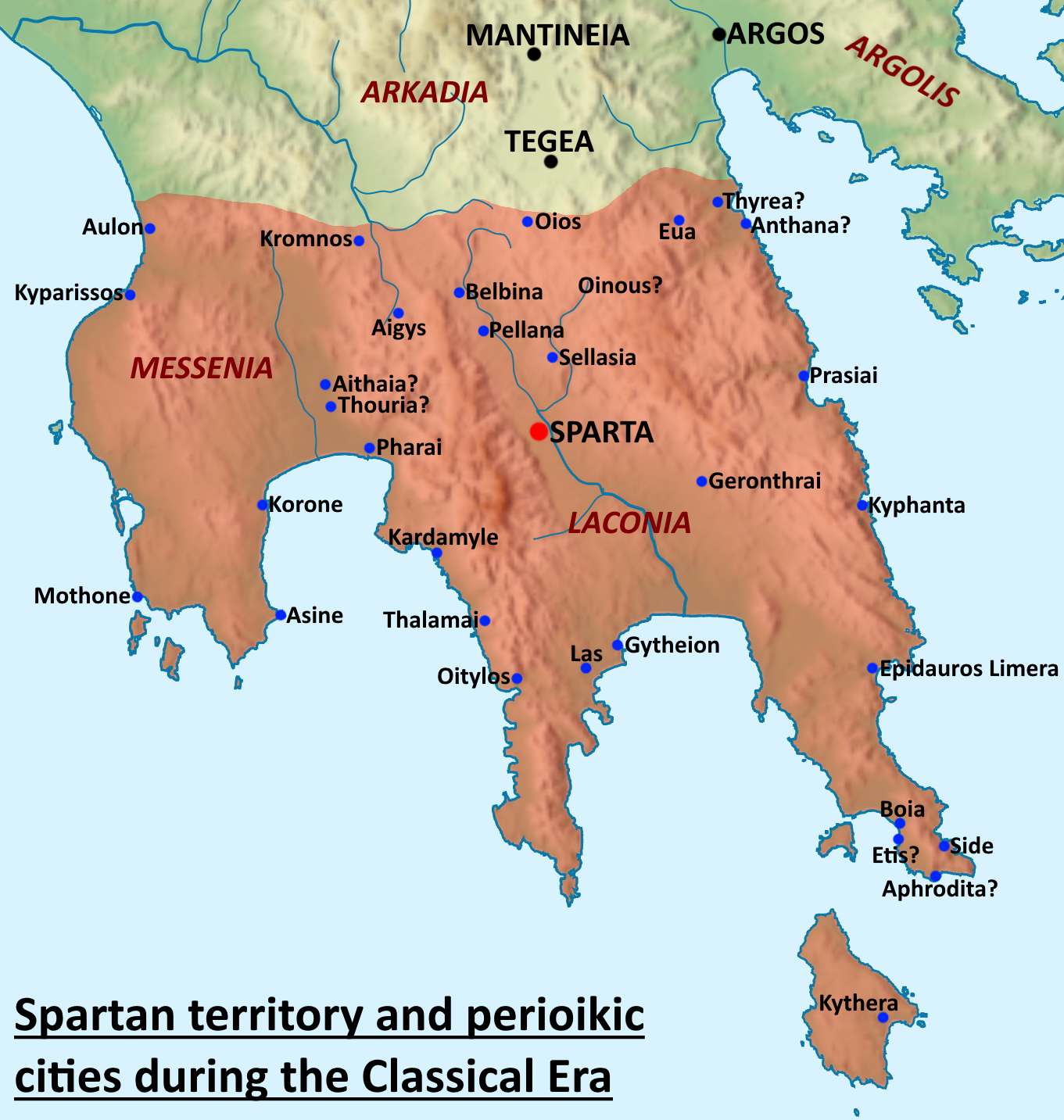
Sparta was a prominent city-state in Laconia in ancient Greece. In antiquity, the state was known as Lacedaemon (Λακεδαίμων, Lakedaímōn), while "Sparta" referred to its capital, a group of villages in the valley of the Evrotas River in Laconia, in southeastern Peloponnese. Around 650 BC, it rose to become one of the major military powers in Greece, a status it retained until 371 BC.
Sparta was recognized as the leading force of the unified Greek military during the Greco-Persian Wars, in rivalry with the rising naval power of Athens. Sparta was the principal enemy of Athens during the Peloponnesian War (431–404 BC), from which it emerged victorious after the Battle of Aegospotami. Thebes' victory over Sparta at the Battle of Leuctra in 371 BC ended Spartan hegemony and freed Messenia from Spartan rule; the loss of the slave labor this region provided sent the city into terminal decline as a military power, though it retained its independence until its forcible integration into the Achaean League in 192 BC. The city recovered some autonomy after the Roman conquest of Greece in 146 BC and became a tourist destination during the Roman era, restoring some measure of prosperity. However, Sparta was sacked in 396 AD by the Visigothic king Alaric, and underwent a long period of decline into the medieval period, when much of its population relocated to Mystras. Modern Sparta is a provincial town and the seat of the Laconia regional administration.
Sparta was unique in ancient Greece for its social system and constitution, which were supposedly introduced by the semi-mythical lawgiver Lycurgus. Spartan society was exceptionally militarized, focusing the entire attention of the Spartiate class on military training and physical development to the point of legally barring them from productive economic activity. The inhabitants of Sparta were rigidly stratified into Spartiates (citizens with full rights), mothakes and perioikoi (free non-citizens), and helots (state-owned enslaved non-Spartan locals), with helots making up the vast majority of the population; social mobility was nearly nonexistent. Spartiate men underwent the harsh agoge training regimen, and Spartan phalanx units were widely considered to be among the best in battle, though this was as much a matter of propaganda as battlefield prowess. Free Spartiate women enjoyed somewhat greater legal rights than elsewhere in classical antiquity, though helots suffered exceptionally harsh treatment at the hands of the Spartiates (particularly the Crypteia), causing repeated revolts. Sparta was a subject of fascination in its own day, as well as in later Western culture following the revival of classical learning. The admiration of Sparta is known as Laconophilia.
The ancient Greeks used one of three words to refer to the Spartan city-state and its location. First, "Sparta" refers primarily to the main cluster of settlements in the valley of the Eurotas River. The second word, "Lacedaemon" (Λακεδαίμων), was often used as an adjective and is the name referenced in the works of Homer and the historians Herodotus and Thucydides. The third term, "Laconice" (Λακωνική), referred to the immediate area around the town of Sparta, the plateau east of the Taygetos mountains, and sometimes to all the regions under direct Spartan control, including Messenia.
The earliest attested term referring to Lacedaemon is the Mycenaean Greek 𐀨𐀐𐀅𐀖𐀛𐀍, ra-ke-da-mi-ni-jo, "Lakedaimonian", written in Linear B syllabic script, the equivalent of the later Greek Λακεδαιμόνιος, Lakedaimonios (Latin: Lacedaemonius).
Herodotus seems to use "Lacedaemon" for the Mycenaean Greek citadel at Therapne, in contrast to the lower town of Sparta. This term could be used synonymously with Sparta, but typically it denoted the region in which the city was located. In Homer it is typically combined with epithets of the countryside: wide, lovely, shining and most often hollow and broken (full of ravines), suggesting the Eurotas Valley. "Sparta" on the other hand is described as "the country of lovely women", an epithet for people.
The residents of Sparta were often called Lacedaemonians. This epithet utilized the plural of the adjective Lacedaemonius (Greek: Λακεδαιμόνιοι; Latin: Lacedaemonii, but also Lacedaemones). The ancients sometimes used a back-formation, referring to the land of Lacedaemon as Lacedaemonian country. As most words for "country" were feminine, the adjective was in the feminine: Lacedaemonia (Λακεδαιμονία, Lakedaimonia). Eventually, the adjective came to be used alone.
"Lacedaemonia" was not in general use during the classical period and before. It does occur in Greek as an equivalent of Laconia and Messenia during the Roman and early Byzantine periods, mostly in ethnographers and lexica of place names. For example, Hesychius of Alexandria's Lexicon (5th century AD) defines Agiadae as a "place in Lacedaemonia" named after Agis. The actual transition may be captured by Isidore of Seville's Etymologiae (7th century AD), an etymological dictionary. Isidore relied heavily on Orosius' Historiarum Adversum Paganos (5th century AD) and Eusebius of Caesarea's Chronicon (early 5th century AD), as did Orosius. The latter defines Sparta to be Lacedaemonia Civitas, but Isidore defines Lacedaemonia as founded by Lacedaemon, son of Semele, which is consistent with Eusebius' explanation. There is a rare use, perhaps the earliest of "Lacedaemonia", in Diodorus Siculus' The Library of History, but probably with Χώρα (chōra, "country") suppressed.
Hub AI
Sparta AI simulator
(@Sparta_simulator)
Sparta
Sparta was a prominent city-state in Laconia in ancient Greece. In antiquity, the state was known as Lacedaemon (Λακεδαίμων, Lakedaímōn), while "Sparta" referred to its capital, a group of villages in the valley of the Evrotas River in Laconia, in southeastern Peloponnese. Around 650 BC, it rose to become one of the major military powers in Greece, a status it retained until 371 BC.
Sparta was recognized as the leading force of the unified Greek military during the Greco-Persian Wars, in rivalry with the rising naval power of Athens. Sparta was the principal enemy of Athens during the Peloponnesian War (431–404 BC), from which it emerged victorious after the Battle of Aegospotami. Thebes' victory over Sparta at the Battle of Leuctra in 371 BC ended Spartan hegemony and freed Messenia from Spartan rule; the loss of the slave labor this region provided sent the city into terminal decline as a military power, though it retained its independence until its forcible integration into the Achaean League in 192 BC. The city recovered some autonomy after the Roman conquest of Greece in 146 BC and became a tourist destination during the Roman era, restoring some measure of prosperity. However, Sparta was sacked in 396 AD by the Visigothic king Alaric, and underwent a long period of decline into the medieval period, when much of its population relocated to Mystras. Modern Sparta is a provincial town and the seat of the Laconia regional administration.
Sparta was unique in ancient Greece for its social system and constitution, which were supposedly introduced by the semi-mythical lawgiver Lycurgus. Spartan society was exceptionally militarized, focusing the entire attention of the Spartiate class on military training and physical development to the point of legally barring them from productive economic activity. The inhabitants of Sparta were rigidly stratified into Spartiates (citizens with full rights), mothakes and perioikoi (free non-citizens), and helots (state-owned enslaved non-Spartan locals), with helots making up the vast majority of the population; social mobility was nearly nonexistent. Spartiate men underwent the harsh agoge training regimen, and Spartan phalanx units were widely considered to be among the best in battle, though this was as much a matter of propaganda as battlefield prowess. Free Spartiate women enjoyed somewhat greater legal rights than elsewhere in classical antiquity, though helots suffered exceptionally harsh treatment at the hands of the Spartiates (particularly the Crypteia), causing repeated revolts. Sparta was a subject of fascination in its own day, as well as in later Western culture following the revival of classical learning. The admiration of Sparta is known as Laconophilia.
The ancient Greeks used one of three words to refer to the Spartan city-state and its location. First, "Sparta" refers primarily to the main cluster of settlements in the valley of the Eurotas River. The second word, "Lacedaemon" (Λακεδαίμων), was often used as an adjective and is the name referenced in the works of Homer and the historians Herodotus and Thucydides. The third term, "Laconice" (Λακωνική), referred to the immediate area around the town of Sparta, the plateau east of the Taygetos mountains, and sometimes to all the regions under direct Spartan control, including Messenia.
The earliest attested term referring to Lacedaemon is the Mycenaean Greek 𐀨𐀐𐀅𐀖𐀛𐀍, ra-ke-da-mi-ni-jo, "Lakedaimonian", written in Linear B syllabic script, the equivalent of the later Greek Λακεδαιμόνιος, Lakedaimonios (Latin: Lacedaemonius).
Herodotus seems to use "Lacedaemon" for the Mycenaean Greek citadel at Therapne, in contrast to the lower town of Sparta. This term could be used synonymously with Sparta, but typically it denoted the region in which the city was located. In Homer it is typically combined with epithets of the countryside: wide, lovely, shining and most often hollow and broken (full of ravines), suggesting the Eurotas Valley. "Sparta" on the other hand is described as "the country of lovely women", an epithet for people.
The residents of Sparta were often called Lacedaemonians. This epithet utilized the plural of the adjective Lacedaemonius (Greek: Λακεδαιμόνιοι; Latin: Lacedaemonii, but also Lacedaemones). The ancients sometimes used a back-formation, referring to the land of Lacedaemon as Lacedaemonian country. As most words for "country" were feminine, the adjective was in the feminine: Lacedaemonia (Λακεδαιμονία, Lakedaimonia). Eventually, the adjective came to be used alone.
"Lacedaemonia" was not in general use during the classical period and before. It does occur in Greek as an equivalent of Laconia and Messenia during the Roman and early Byzantine periods, mostly in ethnographers and lexica of place names. For example, Hesychius of Alexandria's Lexicon (5th century AD) defines Agiadae as a "place in Lacedaemonia" named after Agis. The actual transition may be captured by Isidore of Seville's Etymologiae (7th century AD), an etymological dictionary. Isidore relied heavily on Orosius' Historiarum Adversum Paganos (5th century AD) and Eusebius of Caesarea's Chronicon (early 5th century AD), as did Orosius. The latter defines Sparta to be Lacedaemonia Civitas, but Isidore defines Lacedaemonia as founded by Lacedaemon, son of Semele, which is consistent with Eusebius' explanation. There is a rare use, perhaps the earliest of "Lacedaemonia", in Diodorus Siculus' The Library of History, but probably with Χώρα (chōra, "country") suppressed.
Recent media