



Community hub
Greek language
View on Wikipedia
| Greek | |
|---|---|
| ελληνικά elliniká | |
| Pronunciation | [eliniˈka] ⓘ |
| Native to |
|
| Ethnicity | Greeks |
Native speakers | 13.5 million (2012)[1] |
Indo-European
| |
Early form | |
| Dialects | |
| Greek alphabet | |
| Official status | |
Official language in | |
Recognised minority language in | |
| Language codes | |
| ISO 639-1 | el |
| ISO 639-2 | gre (B) ell (T) |
| ISO 639-3 | Variously:ell – Modern Greekgrc – Ancient Greekcpg – Cappadocian Greekgmy – Mycenaean Greekpnt – Pontictsd – Tsakonianyej – Yevanic |
| Glottolog | gree1276 |
| Linguasphere |
|
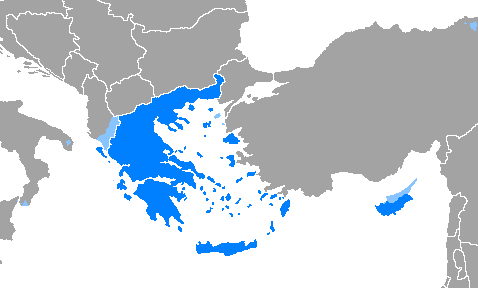
 Areas where Modern Greek is spoken (Dark blue represents areas where it is the official language.)[note 1] | |
Greek (Modern Greek: ελληνικά, romanized: elliniká [eliniˈka] ⓘ; Ancient Greek: ἑλληνική, romanized: hellēnikḗ [helːɛːnikɛ́ː]) is an Indo-European language, constituting an independent Hellenic branch within the Indo-European language family. It is native to Greece, Cyprus, Italy (in Calabria and Salento), southern Albania, and other regions of the Balkans, Caucasus, the Black Sea coast, Asia Minor, and the Eastern Mediterranean. It has the longest documented history of any Indo-European language, spanning at least 3,400 years of written records.[10] Its writing system is the Greek alphabet, which has been used for approximately 2,800 years;[11][12] previously, Greek was recorded in writing systems such as Linear B and the Cypriot syllabary.[13]
The Greek language holds a very important place in the history of the Western world. Beginning with the epics of Homer, ancient Greek literature includes many works of lasting importance in the European canon. Greek is also the language in which many of the foundational texts in science and philosophy were originally composed. The New Testament of the Christian Bible was also originally written in Greek.[14][15] Together with the Latin texts and traditions of the Roman world, the Greek texts and Greek societies of antiquity constitute the objects of study of the discipline of Classics.
During antiquity, Greek was by far the most widely spoken lingua franca in the Mediterranean world.[16] It eventually became the official language of the Byzantine Empire and developed into Medieval Greek.[17] In its modern form, Greek is the official language of Greece and Cyprus and one of the 24 official languages of the European Union. It is spoken by at least 13.5 million people today in Greece, Cyprus, Italy, Albania, Turkey, and the many other countries of the Greek diaspora.
Greek roots have been widely used for centuries and continue to be widely used to coin new words in other languages; Greek and Latin are highly-influential on the English language and remain the predominant sources of international scientific vocabulary.

History
[edit]Greek has been spoken in the Balkan peninsula since around the 3rd millennium BC,[18] or possibly earlier.[19] The earliest written evidence is a Linear B clay tablet found in Messenia that dates to between 1450 and 1350 BC,[20] making Greek the world's oldest recorded living language.[21] Among the Indo-European languages, its date of earliest written attestation is matched only by the now-extinct Anatolian languages.
Periods
[edit]
The Greek language is conventionally divided into the following periods:
- Proto-Greek: the unrecorded but assumed last ancestor of all known varieties of Greek. The unity of Proto-Greek would have ended as Hellenic migrants entered the Greek peninsula sometime in the Neolithic era or the Bronze Age.[note 2]
- Mycenaean Greek: the language of the Mycenaean civilisation. It is recorded in the Linear B script on tablets dating from the 15th century BC onwards.
- Ancient Greek: in its various dialects, the language of the Archaic and Classical periods of the ancient Greek civilisation. It was widely known throughout the Roman Empire. Ancient Greek fell into disuse in Western Europe in the Middle Ages but remained officially in use in the Byzantine world and was reintroduced to the rest of Europe with the Fall of Constantinople and Greek migration to western Europe.
- Koine Greek (also known as Hellenistic Greek): The fusion of Ionian with Attic, the dialect of Athens, began the process that resulted in the creation of the first common Greek dialect, which became a lingua franca across the Eastern Mediterranean and Near East. Koine Greek can be initially traced within the armies and conquered territories of Alexander the Great; after the Hellenistic colonisation of the known world, it was spoken from Egypt to the fringes of India. Due to the widespread use of the Greek language during this period, a set of rules had to be established for the proper dissemination of the language. It is at this point that the term Hellenism (Ἑλληνισμός) first appears. Hellenism was used by the grammarians and Strabo to denote "correct Greek".[24] After the Roman conquest of Greece, an unofficial bilingualism of Greek and Latin was established in the city of Rome and Koine Greek became the first or second language in the Roman Empire. In the eastern parts of the Roman Empire, Rome refrained from imposing the use of Latin and instead communicated with its subjects in Greek, even in regions where Greek was not the predominant spoken language.[25] The origin of Christianity can also be traced through Koine Greek because the Apostles used this form of the language to spread Christianity. Because it was the original language of the New Testament, and the Old Testament was translated into it as the Septuagint, that variety of Koine Greek may be referred to as New Testament Greek or sometimes Biblical Greek.

- Medieval Greek (also known as Byzantine Greek): the continuation of Koine Greek up to the demise of the Byzantine Empire in the 15th century. Medieval Greek is a cover phrase for a whole continuum of different speech and writing styles, ranging from vernacular continuations of spoken Koine that were already approaching Modern Greek in many respects, to highly learned forms imitating classical Attic. Much of the written Greek that was used as the official language of the Byzantine Empire was an eclectic middle-ground variety based on the tradition of written Koine.
- Modern Greek (also known as Neo-Hellenic):[27] Stemming from Medieval Greek, Modern Greek usages can be traced in the Byzantine period, as early as the 11th century. It is the language used by the modern Greeks, and, apart from Standard Modern Greek, there are several dialects of it.
Diglossia
[edit]In the modern era, the Greek language entered a state of diglossia: the coexistence of vernacular and archaising written forms of the language. What came to be known as the Greek language question was a polarisation between two competing varieties of Modern Greek: Dimotiki, the vernacular form of Modern Greek proper, and Katharevousa, meaning 'purified', a compromise between Dimotiki and Ancient Greek developed in the early 19th century that was used for literary and official purposes in the newly formed Greek state. In 1976, Dimotiki was declared the official language of Greece, after having incorporated features of Katharevousa and thus giving birth to Standard Modern Greek, used today for all official purposes and in education.[28]
Historical unity
[edit]
The historical unity and continuing identity between the various stages of the Greek language are often emphasised. Although Greek has undergone morphological and phonological changes comparable to those seen in other languages, never since classical antiquity has its cultural, literary, and orthographic tradition been interrupted to the extent that one can speak of a new language emerging. Greek speakers today still tend to regard literary works of ancient Greek as part of their own rather than a foreign language.[29] It is also often stated that the historical changes have been relatively slight compared with some other languages. According to one estimation, "Homeric Greek is probably closer to Demotic than 12-century Middle English is to modern spoken English".[30]
Geographic distribution
[edit].svg)
Greek is spoken today by at least 13 million people, principally in Greece and Cyprus along with a sizable Greek-speaking minority in Albania near the Greek-Albanian border.[27] A significant percentage of Albania's population has knowledge of the Greek language due in part to the Albanian wave of immigration to Greece in the 1980s and '90s and the Greek community in the country. Prior to the Greco-Turkish War and the resulting population exchange in 1923 a very large population of Greek-speakers also existed in Turkey, though very few remain today.[10] A small Greek-speaking community is also found in Bulgaria near the Greek-Bulgarian border. Greek is also spoken worldwide by the sizeable Greek diaspora which has notable communities in the United States, Australia, Canada, South Africa, Chile, Brazil, Argentina, Russia, Ukraine, the United Kingdom, and throughout the European Union, especially in Germany.
Historically, significant Greek-speaking communities and regions were found throughout the Eastern Mediterranean, in what are today Southern Italy, Turkey, Cyprus, Syria, Lebanon, Israel, Palestine, Egypt, and Libya; in the area of the Black Sea, in what are today Turkey, Bulgaria, Romania, Ukraine, Russia, Georgia, Armenia, and Azerbaijan; and, to a lesser extent, in the Western Mediterranean in and around colonies such as Massalia, Monoikos, and Mainake. It was also used as the official language of government and religion in the Christian Nubian kingdoms, for most of their history.[31]
Official status
[edit]Greek, in its modern form, is the official language of Greece, where it is spoken by almost the entire population.[32] It is also the official language of Cyprus (alongside Turkish) and the British Overseas Territory of Akrotiri and Dhekelia (alongside English).[33] Because of the membership of Greece and Cyprus in the European Union, Greek is one of the organization's 24 official languages.[34] Greek is recognized as a minority language in Albania, and used co-officially in some of its municipalities, in the districts of Gjirokastër and Sarandë.[35] It is also an official minority language in the regions of Apulia and Calabria in Italy. In the framework of the European Charter for Regional or Minority Languages, Greek is protected and promoted officially as a regional and minority language in Armenia, Hungary, Romania, and Ukraine.[36] It is recognized as a minority language and protected in Turkey by the 1923 Treaty of Lausanne.[4][5][6][7]
Characteristics
[edit]The phonology, morphology, syntax, and vocabulary of the language show both conservative and innovative tendencies across the entire attestation of the language from the ancient to the modern period. The division into conventional periods is, as with all such periodizations, relatively arbitrary, especially because, in all periods, Ancient Greek has enjoyed high prestige, and the literate borrowed heavily from it.
Phonology
[edit]Across its history, the syllabic structure of Greek has varied little: Greek shows a mixed syllable structure, permitting complex syllabic onsets but very restricted codas. It has only oral vowels and a fairly stable set of consonantal contrasts. The main phonological changes occurred during the Hellenistic and Roman period (see Koine Greek phonology for details):
- replacement of the pitch accent with a stress accent.
- simplification of the system of vowels and diphthongs: loss of vowel length distinction, monophthongisation of most diphthongs and several steps in a chain shift of vowels towards /i/ (iotacism).
- development of the voiceless aspirated plosives /pʰ/ and /tʰ/ to the voiceless fricatives /f/ and /θ/, respectively; the similar development of /kʰ/ to /x/ may have taken place later (the phonological changes are not reflected in the orthography, and both earlier and later phonemes are written with φ, θ, and χ).
- development of the voiced plosives /b/, /d/, and /ɡ/ to their voiced fricative counterparts /β/ (later /v/), /ð/, and /ɣ/.
Morphology
[edit]In all its stages, the morphology of Greek shows an extensive set of productive derivational affixes, a limited but productive system of compounding[37] and a rich inflectional system. Although its morphological categories have been fairly stable over time, morphological changes are present throughout, particularly in the nominal and verbal systems. The major change in the nominal morphology since the classical stage was the disuse of the dative case (its functions being largely taken over by the genitive). The verbal system has lost the infinitive, the synthetically-formed future, and perfect tenses and the optative mood. Many have been replaced by periphrastic (analytical) forms.
Nouns and adjectives
[edit]Pronouns show distinctions in person (1st, 2nd, and 3rd), number (singular, dual, and plural in the ancient language; singular and plural alone in later stages), and gender (masculine, feminine, and neuter), and decline for case (from six cases in the earliest forms attested to four in the modern language).[note 3] Nouns, articles, and adjectives show all the distinctions except for a person. Both attributive and predicative adjectives agree with the noun.
Verbs
[edit]The inflectional categories of the Greek verb have likewise remained largely the same over the course of the language's history but with significant changes in the number of distinctions within each category and their morphological expression. Greek verbs have synthetic inflectional forms for:
| Ancient Greek | Modern Greek | |
|---|---|---|
| Person | first, second and third | also second person formal |
| Number | singular, dual and plural | singular and plural |
| tense | present, past and future | past and non-past (future is expressed by a periphrastic construction) |
| aspect | imperfective, perfective (traditionally called aorist) and perfect (sometimes also called perfective; see note about terminology) | imperfective and perfective/aorist (perfect is expressed by a periphrastic construction) |
| mood | indicative, subjunctive, imperative and optative | indicative, subjunctive,[note 4] and imperative (other modal functions are expressed by periphrastic constructions) |
| Voice | active, medio-passive, and passive | active and medio-passive |
Syntax
[edit]Many aspects of the syntax of Greek have remained constant: verbs agree with their subject only, the use of the surviving cases is largely intact (nominative for subjects and predicates, accusative for objects of most verbs and many prepositions, genitive for possessors), articles precede nouns, adpositions are largely prepositional, relative clauses follow the noun they modify and relative pronouns are clause-initial. However, the morphological changes also have their counterparts in the syntax, and there are also significant differences between the syntax of the ancient and that of the modern form of the language. Ancient Greek made great use of participial constructions and of constructions involving the infinitive, and the modern variety lacks the infinitive entirely (employing a raft of new periphrastic constructions instead) and uses participles more restrictively. The loss of the dative led to a rise of prepositional indirect objects (and the use of the genitive to directly mark these as well). Ancient Greek tended to be verb-final, but neutral word order in the modern language is verb–subject–object or subject–verb–object.
Vocabulary
[edit]Modern Greek inherits most of its vocabulary from Ancient Greek, which in turn is an Indo-European language, but also includes a number of borrowings from the languages of the populations that inhabited Greece before the arrival of Proto-Greeks,[38] some documented in Mycenaean texts; they include a large number of Greek toponyms. The form and meaning of many words have changed. Loanwords (words of foreign origin) have entered the language, mainly from Latin, Venetian, Ottoman Turkish and Semitic languages.[39] During the older periods of Greek, loanwords into Greek acquired Greek inflections, thus leaving only a foreign root word. Modern borrowings (from the 20th century on), especially from French and English, are typically not inflected; other modern borrowings are derived from Slavic languages, Albanian and Eastern Romance languages (Romanian and Aromanian).[40]
Loanwords in other languages
[edit]Greek words have been widely borrowed into other languages, including English. Example words include: mathematics, physics, astronomy, democracy, philosophy, athletics, theatre, rhetoric, baptism, evangelist, etc. Moreover, Greek words and word elements continue to be productive as a basis for coinages (neologisms): anthropology, photography, telephony, isomer, biomechanics, cinematography, etc. Together with Latin words, they form the foundation of international scientific and technical vocabulary; for example, all words ending in -logy ('discourse'). There are many English words of Greek origin.[41][42]
Classification
[edit]Greek is an independent branch of the Indo-European language family. The ancient language most closely related to it may be Ancient Macedonian, which, by most accounts, was a distinct dialect of Greek itself, related to the Northwest Doric group.[43][44][45][46][47] Aside from Ancient Macedonian, current consensus regards Phrygian as the closest relative of Greek, since they share a number of phonological, morphological and lexical isoglosses, with some being exclusive between them.[43][48][49][50] Scholars have proposed a Graeco-Phrygian subgroup out of which Greek and Phrygian originated.[43][51][52][53]
Among living languages, some Indo-Europeanists suggest that Greek may be most closely related to Armenian (see Graeco-Armenian) or the Indo-Iranian languages (see Graeco-Aryan), but little definitive evidence has been found.[54][55] In addition, Albanian has also been considered somewhat related to Greek and Armenian, and it has been proposed that they all form a higher-order subgroup along with other extinct languages of the ancient Balkans; this higher-order subgroup is usually termed Palaeo-Balkan, and Greek has a central position in it.[56][57]
Writing system
[edit] | ||||||||||||||||||||||||||||||||||||||||||||||||
| Greek alphabet | ||||||||||||||||||||||||||||||||||||||||||||||||
|---|---|---|---|---|---|---|---|---|---|---|---|---|---|---|---|---|---|---|---|---|---|---|---|---|---|---|---|---|---|---|---|---|---|---|---|---|---|---|---|---|---|---|---|---|---|---|---|---|
|
||||||||||||||||||||||||||||||||||||||||||||||||
| History | ||||||||||||||||||||||||||||||||||||||||||||||||
|
||||||||||||||||||||||||||||||||||||||||||||||||
| Diacritics and other symbols | ||||||||||||||||||||||||||||||||||||||||||||||||
| Related topics | ||||||||||||||||||||||||||||||||||||||||||||||||

Linear B
[edit]
Linear B, attested as early as the late 15th century BC, was the first script used to write Greek.[58] It is basically a syllabary, which was finally deciphered by Michael Ventris and John Chadwick in the 1950s (its precursor, Linear A, has not been deciphered and most likely encodes a non-Greek language).[58] The language of the Linear B texts, Mycenaean Greek, is the earliest known form of Greek.[58]
Cypriot syllabary
[edit]
Another similar system used to write the Greek language was the Cypriot syllabary (also a descendant of Linear A via the intermediate Cypro-Minoan syllabary), which is closely related to Linear B but uses somewhat different syllabic conventions to represent phoneme sequences. The Cypriot syllabary is attested in Cyprus from the 11th century BC until its gradual abandonment in the late Classical period, in favor of the standard Greek alphabet.[59]
Greek alphabet
[edit]
Greek has been written in the Greek alphabet since approximately the 9th century BC. It was created by modifying the Phoenician alphabet, with the innovation of adopting certain letters to represent the vowels. The variant of the alphabet in use today is essentially the late Ionic variant, introduced for writing classical Attic in 403 BC. In classical Greek, as in classical Latin, only upper-case letters existed. The lower-case Greek letters were developed much later by medieval scribes to permit a faster, more convenient cursive writing style with the use of ink and quill.
The Greek alphabet consists of 24 letters, each with an uppercase (majuscule) and lowercase (minuscule) form. The letter sigma has an additional lowercase form (ς) used in the final position of a word:
| upper case | ||||||||||||||||||||||||||||||||
|---|---|---|---|---|---|---|---|---|---|---|---|---|---|---|---|---|---|---|---|---|---|---|---|---|---|---|---|---|---|---|---|---|
| Α | Β | Γ | Δ | Ε | Ζ | Η | Θ | Ι | Κ | Λ | Μ | Ν | Ξ | Ο | Π | Ρ | Σ | Τ | Υ | Φ | Χ | Ψ | Ω | |||||||||
| lower case | ||||||||||||||||||||||||||||||||
| α | β | γ | δ | ε | ζ | η | θ | ι | κ | λ | μ | ν | ξ | ο | π | ρ | σ ς |
τ | υ | φ | χ | ψ | ω | |||||||||
Diacritics
[edit]In addition to the letters, the Greek alphabet features a number of diacritical signs: three different accent marks (acute, grave, and circumflex), originally denoting different shapes of pitch accent on the stressed vowel; the so-called breathing marks (rough and smooth breathing), originally used to signal presence or absence of word-initial /h/; and the diaeresis, used to mark the full syllabic value of a vowel that would otherwise be read as part of a diphthong. These marks were introduced during the course of the Hellenistic period. Actual usage of the grave in handwriting saw a rapid decline in favor of uniform usage of the acute during the late 20th century, and it has only been retained in typography.
After the writing reform of 1982, most diacritics are no longer used. Since then, Greek has been written mostly in the simplified monotonic orthography (or monotonic system), which employs only the acute accent and the diaeresis. The traditional system, now called the polytonic orthography (or polytonic system), is still used internationally for the writing of Ancient Greek.
Punctuation
[edit]In Greek, the question mark is written as the English semicolon, while the functions of the colon and semicolon are performed by a raised point (•), known as the ano teleia (άνω τελεία). In Greek the comma also functions as a silent letter in a handful of Greek words, principally distinguishing ό,τι (ó,ti, 'whatever') from ότι (óti, 'that').[60]
Ancient Greek texts often used scriptio continua ('continuous writing'), which means that ancient authors and scribes would write word after word with no spaces or punctuation between words to differentiate or mark boundaries.[61] Boustrophedon, or bi-directional text, was also used in Ancient Greek.
Latin alphabet
[edit]Greek has occasionally been written in the Latin script, especially in areas under Venetian rule or by Greek Catholics. The term Frankolevantinika / Φραγκολεβαντίνικα applies when the Latin script is used to write Greek in the cultural ambit of Catholicism (because Frankos / Φράγκος is an older Greek term for West-European dating to when most of (Roman Catholic Christian) West Europe was under the control of the Frankish Empire). Frankochiotika / Φραγκοχιώτικα (meaning 'Catholic Chiot') alludes to the significant presence of Catholic missionaries based on the island of Chios. Additionally, the term Greeklish is often used when the Greek language is written in a Latin script in online communications.[62]
The Latin script is nowadays used by the Greek-speaking communities of Southern Italy.
Hebrew alphabet
[edit]The Yevanic dialect was written by Romaniote and Constantinopolitan Karaite Jews using the Hebrew Alphabet.[63]
Arabic alphabet
[edit]In a tradition, that in modern time, has come to be known as Greek Aljamiado, some Greek Muslims from Crete wrote their Cretan Greek in the Arabic alphabet. The same happened among Epirote Muslims in Ioannina. This also happened among Arabic-speaking Byzantine rite Christians in the Levant (Lebanon, Palestine, Syria and Jordan).[64] This usage is sometimes called aljamiado, as when Romance languages are written in the Arabic alphabet.[65]
Example text
[edit]Article 1 of the Universal Declaration of Human Rights in Greek:
- Όλοι οι άνθρωποι γεννιούνται ελεύθεροι και ίσοι στην αξιοπρέπεια και τα δικαιώματα. Είναι προικισμένοι με λογική και συνείδηση, και οφείλουν να συμπεριφέρονται μεταξύ τους με πνεύμα αδελφοσύνης.[66]
Transcription of the example text into Latin alphabet:
- Óloi oi ánthropoi gennioúntai eléftheroi kai ísoi stin axioprépeia kai ta dikaiómata. Eínai proikisménoi me logikí kai syneídisi, kai ofeíloun na symperiférontai metaxý tous me pnévma adelfosýnis.
Article 1 of the Universal Declaration of Human Rights in English:
- "All human beings are born free and equal in dignity and rights. They are endowed with reason and conscience and should act towards one another in a spirit of brotherhood."[67]
See also
[edit]Notes
[edit]- ^ The map does not indicate where the language is majority or minority.
- ^ A comprehensive overview in J.T. Hooker's Mycenaean Greece;[22] for a different hypothesis excluding massive migrations and favoring an autochthonous scenario, see Colin Renfrew's "Problems in the General Correlation of Archaeological and Linguistic Strata in Prehistoric Greece: The Model of Autochthonous Origin"[23] in Bronze Age Migrations by R.A. Crossland and A. Birchall, eds. (1973).
- ^ The four cases that are found in all stages of Greek are the nominative, genitive, accusative, and vocative. The dative/locative of Ancient Greek disappeared in the late Hellenistic period, and the instrumental case of Mycenaean Greek disappeared in the Archaic period.
- ^ There is no particular morphological form that can be identified as 'subjunctive' in the modern language, but the term is sometimes encountered in descriptions even if the most complete modern grammar (Holton et al. 1997) does not use it and calls certain traditionally-'subjunctive' forms 'dependent'. Most Greek linguists advocate abandoning the traditional terminology (Anna Roussou and Tasos Tsangalidis 2009, in Meletes gia tin Elliniki Glossa, Thessaloniki, Anastasia Giannakidou 2009 "Temporal semantics and polarity: The dependency of the subjunctive revisited", Lingua); see Modern Greek grammar for explanation.
Footnotes
[edit]- ^ Greek at Ethnologue (18th ed., 2015) (subscription required)
Ancient Greek at Ethnologue (18th ed., 2015) (subscription required)
Cappadocian Greek at Ethnologue (18th ed., 2015) (subscription required)
Mycenaean Greek at Ethnologue (18th ed., 2015) (subscription required)
Pontic at Ethnologue (18th ed., 2015) (subscription required)
Tsakonian at Ethnologue (18th ed., 2015) (subscription required)
(Additional references under 'Language codes' in the information box) - ^ 2006 Census Table: Language Spoken at Home by Sex – Time Series Statistics (1996, 2001, 2006 Census Years)
- ^ Αυστραλία: Τηλεδιάσκεψη «Μιλάμε Ελληνικά τον Μάρτιο»
- ^ a b Tsitselikis 2013, pp. 287–288.
- ^ a b Toktaş, Şule (2006). "EU enlargement conditions and minority protection : a reflection on Turkey's non-Muslim minorities". East European Quarterly. 40 (4): 489–519. ISSN 0012-8449. Archived from the original on 11 October 2023. Retrieved 12 October 2023. p. 514:
This implies that Turkey grants educational right in minority languages only to the recognized minorities covered by the Lausanne who are the Armenians, Greeks and the Jews.
- ^ a b Bayır, Derya (2013). Minorities and nationalism in Turkish law. Cultural Diversity and Law. Farnham: Ashgate Publishing. pp. 89–90. ISBN 978-1-4094-7254-4. Archived from the original on 14 October 2023.
Oran farther points out that the rights set out for the four categories are stated to be the 'fundamental law' of the land, so that no legislation or official action shall conflict or interfere with these stipulations or prevail over them (article 37). [...] According to the Turkish state, only Greek, Armenian and Jewish non-Muslims were granted minority protection by the Lausanne Treaty. [...] Except for non-Muslim populations – that is, Greeks, Jews and Armenians – none of the other minority groups' language rights have been de jure protected by the legal system in Turkey.
- ^ a b Questions and Answers: Freedom of Expression and Language Rights in Turkey. New York: Human Rights Watch. 19 April 2002. Archived from the original on 20 October 2023.
The Turkish government accepts the language rights of the Jewish, Greek and Armenian minorities as being guaranteed by the 1923 Treaty of Lausanne.
- ^ "Language Use in the United States: 2011" (PDF). United States Census. Retrieved 17 October 2015.
- ^ "gree1276". Council of Europe. Retrieved 8 December 2008.
- ^ a b "Greek language". Encyclopædia Britannica. Encyclopædia Britannica, Inc. Retrieved 29 April 2014.
- ^ Haviland, William A.; Prins, Harald E. L.; Walrath, Dana; McBride, Bunny (2013). "Chapter 15: Language and Communication". Anthropology: The Human Challenge. Cengage Learning. p. 394. ISBN 978-1-285-67758-3.
Most of the alphabets used today descended from the Phoenician one. The Greeks adopted it about 2,800 years ago, modifying the characters to suit sounds in their own language.
- ^ Comrie, Bernard (1987). The World's Major Languages. Routledge (published 2018). ISBN 978-1-317-29049-0.
... the Greek alphabet has served the Greek language well for some 2,800 years since its introduction into Greece in the tenth or ninth century BC.
- ^ Adrados, Francisco Rodríguez (2005). A history of the Greek language : from its origins to the present. Leiden: Brill. ISBN 978-90-04-12835-4. OCLC 59712402.
- ^ Kurt Aland, Barbara Aland The text of the New Testament: an introduction to the critical 1995 p. 52.
- ^ Archibald Macbride Hunter Introducing the New Testament 1972 p. 9.
- ^ Malkin, Irad (2011). A small Greek world : networks in the Ancient Mediterranean. Oxford University Press. doi:10.1093/acprof:oso/9780199734818.001.0001. ISBN 9780199918553.
- ^ Manuel, Germaine Catherine (1989). A study of the preservation of the classical tradition in the education, language, and literature of the Byzantine Empire. HVD ALEPH.
{{cite book}}: CS1 maint: location missing publisher (link) - ^ Renfrew 2003, p. 35; Georgiev 1981, p. 192.
- ^ Gray & Atkinson 2003, pp. 437–438; Atkinson & Gray 2006, p. 102.
- ^ "Ancient Tablet Found: Oldest Readable Writing in Europe". Culture. 1 April 2011. Archived from the original on 25 July 2021. Retrieved 20 January 2022.
- ^ Tulloch, A. (2017). Understanding English Homonyms: Their Origins and Usage. Hong Kong University Press. p. 153. ISBN 978-988-8390-64-9. Retrieved 30 November 2023.
Greek is the world's oldest recorded living language.
- ^ Hooker 1976, Chapter 2: "Before the Mycenaean Age", pp. 11–33 and passim
- ^ Renfrew 1973, pp. 263–276, especially p. 267
- ^ Zacharia, Katerina, ed. (2008). Hellenisms: culture, identity, and ethnicity from antiquity to modernity. Aldershot, England ; Burlington, VT: Ashgate. p. 1. ISBN 978-0-7546-6525-0. OCLC 192048201.
- ^ Cotton, Hannah M. (2022). "Language Gaps in Roman Palestine and the Roman Near East". In Pogorelsky, Ofer (ed.). Roman Rule and Jewish Life: Collected Papers. De Gruyter. p. 202. doi:10.1515/9783110770438-012. ISBN 978-3-11-077043-8. Retrieved 20 June 2025.
- ^ Dawkins & Halliday 1916.
- ^ a b "Greek". Ethnologue. Retrieved 12 April 2020.
- ^ Peter, Mackridge (1985). The modern Greek language : a descriptive analysis of standard modern Greek. Oxford [Oxfordshire]: Oxford University Press. ISBN 978-0-19-815770-0. OCLC 11134463.
- ^ Browning 1983, pp. vii–viii.
- ^ Alexiou 1982, p. 161.
- ^ Burstein, Stanley (2 November 2020). "When Greek was an African Language". Center for Hellenic Studies.
The revelation of the place of Greek cultural elements in the lives of these kingdoms has been gradual and is still ongoing, but already it is clear that Greek was the official language of government and religion for most of their history. ... Greek remained the official language of Nubian Christianity right to the end of its long and remarkable history. ... But these three factors do suggest how Greek and Christianity could have become so intimately intertwined and so entrenched in Nubian life and culture by the seventh century AD that Greek could resist both Coptic and Arabic and survive for almost another millennium before both disappeared with the conversion of Nubia to Islam in the sixteenth century AD.
- ^ "Greece". The World Factbook. Central Intelligence Agency. Retrieved 23 January 2010.
- ^ "The Constitution of Cyprus, App. D., Part 1, Art. 3". Archived from the original on 7 April 2012. states that The official languages of the Republic are Greek and Turkish. However, the official status of Turkish is only nominal in the Greek-dominated Republic of Cyprus; in practice, outside Turkish-dominated Northern Cyprus, Turkish is little used; see A. Arvaniti (2006): Erasure as a Means of Maintaining Diglossia in Cyprus, San Diego Linguistics Papers 2: pp. 25–38 [27].
- ^ "The EU at a Glance – Languages in the EU". Europa. European Union. Archived from the original on 21 June 2013. Retrieved 30 July 2010.
- ^ Bytyçi, Enver (2022). In the Shadows of Albania-China Relations (1960–1978). Cambridge Scholars Publishing. p. 20. ISBN 978-1-5275-7909-5.
Albania's official language is Albanian, but in municipalities where minorities reside, the languages of these minorities are also used, including Greek in several municipalities in Gjirokastra and Saranda, and Macedonian in a municipality in the East of the country.
- ^ "List of Declarations Made with Respect to Treaty No. 148". Council of Europe. Archived from the original on 10 April 2020. Retrieved 8 December 2008.
- ^ Ralli 2001, pp. 164–203.
- ^ Beekes 2009.
- ^ Blomqvist, Jerker. "Review of Frühe Semitiche Lehnwörter im Griechischen". Bryn Mawr Classical Review. Retrieved 4 October 2025.
- ^ Ahmadi, Sina (18 March 2019). "Foreign loanwords in Modern Greek". Retrieved 4 October 2025.
- ^ Scheler 1977.
- ^ "Πόσο "ελληνικές" είναι οι ξένες γλώσσες". NewsIt. 18 November 2019.
- ^ a b c Olander 2022, pp. 12, 14; van Beek 2022, pp. 190–191, 193
- ^ Crespo, Emilio (2018). "The Softening of Obstruent Consonants in the Macedonian Dialect". In Giannakis, Georgios K.; Crespo, Emilio; Filos, Panagiotis (eds.). Studies in Ancient Greek Dialects: From Central Greece to the Black Sea. Walter de Gruyter. p. 329. ISBN 978-3-11-053081-0.
- ^ Brixhe, Claude (2018). "Macedonian". In Klein, Jared; Joseph, Brian; Fritz, Matthias (eds.). Handbook of Comparative and Historical Indo-European Linguistics. Vol. 3. De Gruyter. pp. 1862–1867. ISBN 978-3-11-054243-1.
- ^ Hatzopoulos, Miltiades B. (2018). "Recent Research in the Ancient Macedonian Dialect: Consolidation and New Perspectives". In Giannakis, Georgios K.; Crespo, Emilio; Filos, Panagiotis (eds.). Studies in Ancient Greek Dialects: From Central Greece to the Black Sea. Walter de Gruyter. p. 299. ISBN 978-3-11-053081-0.
- ^ Babiniotis 1992, pp. 29–40; Dosuna 2012, pp. 65–78
- ^ Brixhe, Claude (2008). "Phrygian". In Woodard, Roger D (ed.). The Ancient Languages of Asia Minor. Cambridge University Press. p. 72. ISBN 978-0-521-68496-5. "Unquestionably, however, Phrygian is most closely linked with Greek."
- ^ Woodhouse 2009, p. 171: "This question is of course only just separable from the question of which languages within Indo-European are most closely related to Phrygian, which has also been hotly debated. A turning point in this debate was Kortlandt's (1988) demonstration on the basis of shared sound changes that Thraco-Armenian had separated from Phrygian and other originally Balkan languages at an early stage. The consensus has now returned to regarding Greek as the closest relative."
- ^ Obrador-Cursach 2020, pp. 238–239: "To the best of our current knowledge, Phrygian was closely related to Greek. This affirmation is consistent with the vision offered by Neumann (1988: 23), Brixhe (2006) and Ligorio and Lubotsky (2018: 1816) and with many observations given by ancient authors. Both languages share 34 of the 36 features considered in this paper, some of them of great significance: ... The available data suggest that Phrygian and Greek coexisted broadly from pre-historic to historic times, and both belong to a common linguistic area (Brixhe 2006: 39–44)."
- ^ Obrador-Cursach 2020, p. 243: "With the current state of our knowledge, we can affirm that Phrygian is closely related to Greek. This is not a surprising conclusion: ancient sources and modern scholars agree that Phrygians did not live far from Greece in pre-historic times. Moreover, the last half century of scientific study of Phrygian has approached both languages and developed the hypothesis of a Proto-Greco-Phrygian language, to the detriment to other theories like Phrygio-Armenian or Thraco-Phrygian."
- ^ Ligorio & Lubotsky 2018, pp. 1816–1817: "Phrygian is most closely related to Greek. The two languages share a few unique innovations, ... It is therefore very likely that both languages emerged from a single language, which was spoken in the Balkans at the end of the third millennium BCE."
- ^ Hammarström, Harald; Forkel, Robert; Haspelmath, Martin, eds. (2017). "Graeco-Phrygian". Glottolog 3.0. Jena, Germany: Max Planck Institute for the Science of Human History.
- ^ van Beek 2022, pp. 193–197
- ^ Renfrew 1990; Gamkrelidze & Ivanov 1990, pp. 110–116; Renfrew 2003, pp. 17–48; Gray & Atkinson 2003, pp. 435–439
- ^ Olsen & Thorsø 2022, pp. 209–217; Hyllested & Joseph 2022, pp. 225–226, 228–229, 231–241
- ^ Holm 2008, pp. 634–635
- ^ a b c Hooker, J. T. (1980). Linear B : an introduction. Bristol: Bristol Classical Press. ISBN 978-0-906515-69-3. OCLC 7326206.
- ^ "Cypriot syllabary". Britannica Academic. Retrieved 1 August 2017.
- ^ Nicolas, Nick (2005). "Greek Unicode Issues: Punctuation". Archived from the original on 6 August 2012. Retrieved 7 October 2014.
- ^ Hugoe, Matthews Peter (March 2014). The concise Oxford dictionary of linguistics. Oxford University Press. (Third ed.). Oxford: Oxford University Press. ISBN 978-0-19-967512-8. OCLC 881847972.
- ^ Androutsopoulos 2009, pp. 221–249.
- ^ "Yevanic alphabet, pronunciation and language". Omniglot. Retrieved 18 April 2020.
- ^ HMML Hill Museum & Manuscript Library (27 July 2024). This month, "Greek Aljamiado" (i.e., Greek written in Arabic script) became one of the more than 90 languages identified in HMML's online Reading Room (vhmml.org). Greek Aljamiado was a common phenomenon among Byzantine-rite Christians in Arabic-speaking communities, but has been little studied. So far, 84 examples of Greek Aljamiado have been identified in HMML's collections of Christian manuscripts digitized in Lebanon, Palestine, and Syria. Cataloging by HMML staff and associates makes these manuscripts easier to find, and supports scholars in their research of the extent and purposes of Greek Aljamiado usage. Pictured: Greek Aljamiado is written on the left page of this manuscript, in the collection of the Ordre Basilien Alepin in Jūniyah, Lebanon. View in Reading Room (OBA 00256): www.vhmml.org/readingRoom/view/120512 [Image attached] [Story update]. Facebook. [1]
- ^ Kotzageorgis, Phokion (2010). Gruber, Christiane J.; Colby, Frederick Stephen (eds.). The Prophet's Ascension: Cross-cultural Encounters with the Islamic Mi'rāj Tales. Indiana University Press. p. 297. ISBN 978-0-253-35361-0.
The element that makes this text a unicum is that it is written in Greek script. In the Ottoman Empire, the primary criterion for the selection of an alphabet in which to write was religion. Thus, people who did not speak—or even know—the official language of their religion used to write their religious texts in the languages that they knew, though in the alphabet where the sacred texts of that religion were written. Thus, the Grecophone Catholics of Chios wrote using the Latin alphabet, but in the Greek language (frangochiotika); the Turcophone Orthodox Christians of Cappadocia wrote their Turkish texts using the Greek alphabet (karamanlidika); and the Grecophone Muslims of the Greek peninsula wrote in Greek language using the Arabic alphabet (tourkogianniotika, tourkokretika). Our case is much stranger, since it is a quite early example for that kind of literature and because it is largely concerned with religious themes."; p. 306. The audience for the Greek Mi'rājnāma was most certainly Greek-speaking Muslims, in particular the so-called Tourkogianniotes (literally, the Turks of Jannina). Although few examples have been discovered as yet, it seems that these people developed a religious literature mainly composed in verse form. This literary form constituted the mainstream of Greek Aljamiado literature from the middle of the seventeenth century until the population exchange between Greece and Turkey in 1923. Tourkogianniotes were probably of Christian origin and were Islamized sometime during the seventeenth century. They did not speak any language other than Greek. Thus, even their frequency in attending mosque services did not provide them with the necessary knowledge about their faith. Given their low level of literacy, one important way that they could learn about their faith was to listen to religiously edifying texts such as the Greek Mi'rājnāma.
- ^ "Universal Declaration of Human Rights". ohchr.org.
- ^ "Universal Declaration of Human Rights". United Nations.
References
[edit]- Alexiou, Margaret (1982). "Diglossia in Greece". In Haas, William (ed.). Standard Languages: Spoken and Written. Manchester: Manchester University Press. pp. 156–192. ISBN 978-0-389-20291-2.
- Androutsopoulos, Jannis (2009). "'Greeklish': Transliteration Practice and Discourse in a Setting of Computer-Mediated Digraphia" (PDF). In Georgakopoulou, Alexandra; Silk, Michael (eds.). Standard Languages and Language Standards: Greek, Past and Present. Aldershot: Ashgate Publishing Limited. pp. 221–249.[permanent dead link]
- Atkinson, Quentin D.; Gray, Russel D. (2006). "Chapter 8: How Old is the Indo-European Language Family? Illumination or More Moths to the Flame?". In Forster, Peter; Renfrew, Colin (eds.). Phylogenetic Methods and the Prehistory of Languages. Cambridge, England: McDonald Institute for Archaeological Research. pp. 91–109. ISBN 978-1-902937-33-5.
- Babiniotis, George (1992). "The Question of Mediae in Ancient Macedonian Greek Reconsidered". In Brogyanyi, Bela; Lipp, Reiner (eds.). Historical Philology: Greek, Latin and Romance. Amsterdam and Philadelphia: John Benjamins Publishing Company. pp. 29–40. ISBN 9789027277473.
- Beekes, Robert Stephen Paul (2009). Etymological Dictionary of Greek. Leiden and Boston: Brill. ISBN 978-90-04-17418-4.
- Browning, Robert (1983) [1969]. Medieval and Modern Greek. Cambridge, UK: Cambridge University Press. ISBN 978-0-521-23488-7.
- Dawkins, Richard McGillivray; Halliday, William Reginald (1916). Modern Greek in Asia Minor: A Study of Dialect of Silly, Cappadocia and Pharasa with Grammar, Texts, Translations and Glossary. Cambridge, England: Cambridge University Press.
- Dosuna, Julián Víctor Méndez (2012). "Ancient Macedonian as a Greek Dialect: A Critical Survey on Recent Work". In Giannakis, Georgios K. (ed.). Ancient Macedonia: Language, History and Culture (in Greek). Thessaloniki: Centre for the Greek Language. pp. 65–78 – via Academia.edu.
- Gamkrelidze, Tamaz V.; Ivanov, Vyacheslav (March 1990). "The Early History of Indo-European Languages". Scientific American. 262 (3): 110–116. Bibcode:1990SciAm.262c.110G. doi:10.1038/scientificamerican0390-110. ISSN 0036-8733. Archived from the original on 6 January 2014 – via rbedrosian.com.
- Georgiev, Vladimir Ivanov (1981). Introduction to the History of the Indo-European Languages. Sofia: Bulgarian Academy of Sciences. ISBN 9789535172611.
- Gray, Russel D.; Atkinson, Quentin D. (2003). "Language-tree Divergence Times Support the Anatolian Theory of Indo-European Origin". Nature. 426 (6965): 435–439. Bibcode:2003Natur.426..435G. doi:10.1038/nature02029. PMID 14647380. S2CID 42340 – via Oxford University Research Archive.
- Holm, Hans J. (2008). "The Distribution of Data in Word Lists and its Impact on the Subgrouping of Languages". In Preisach, Christine; Burkhardt, Hans; Schmidt-Thieme, Lars; Decker, Reinhold (eds.). Data Analysis, Machine Learning, and Applications. Proceedings of the 31st Annual Conference of the Gesellschaft für Klassifikation e.V., Albert-Ludwigs-Universität Freiburg, March 7–9, 2007. Berlin-Heidelberg: Springer-Verlag. pp. 628–636. ISBN 978-3-540-78246-9.
- Hooker, J.T. (1976). Mycenaean Greece. London: Routledge & Kegan Paul. ISBN 9780710083791.
- Jeffries, Ian (2002). Eastern Europe at the Turn of the Twenty-First Century: A Guide to the Economies in Transition. London and New York: Routledge (Taylor & Francis). ISBN 978-0-415-23671-3.
- Ligorio, Orsat; Lubotsky, Alexander (2018). "Phrygian". In Klein, Jared; Joseph, Brian; Fritz, Matthias; Wenthe, Mark (eds.). Handbook of Comparative and Historical Indo-European Linguistics. Vol. 3. De Gruyter Mouton. pp. 1816–1831. doi:10.1515/9783110542431-022. hdl:1887/63481. ISBN 978-3-11-054243-1. S2CID 242082908.
- Obrador-Cursach, Bartomeu (9 April 2020). "On the place of Phrygian among the Indo-European languages". Journal of Language Relationship. 17 (3–4): 233–245. doi:10.31826/jlr-2019-173-407. S2CID 215769896.
- Olander, Thomas, ed. (2022). The Indo-European Language Family: A Phylogenetic Perspective. Cambridge University Press. doi:10.1017/9781108758666. ISBN 978-1-108-49979-8. S2CID 161016819.
- van Beek, Lucien. "Chapter 11: Greek". In Olander (2022).
- Olsen, Birgit Anette; Thorsø, Rasmus. "Chapter 12: Armenian". In Olander (2022).
- Hyllested, Adam; Joseph, Brian D. "Chapter 13: Albanian". In Olander (2022).
- Ralli, Angeliki (2001). Μορφολογία [Morphology] (in Greek). Athens: Ekdoseis Pataki.
- Renfrew, Colin (1973). "Problems in the General Correlation of Archaeological and Linguistic Strata in Prehistoric Greece: The Model of Autochthonous Origin". In Crossland, R. A.; Birchall, Ann (eds.). Bronze Age Migrations in the Aegean; Archaeological and Linguistic Problems in Greek Prehistory: Proceedings of the first International Colloquium on Aegean Prehistory, Sheffield. London: Gerald Duckworth and Company Limited. pp. 263–276. ISBN 978-0-7156-0580-6.
- Renfrew, Colin (2003). "Time Depth, Convergence Theory, and Innovation in Proto-Indo-European: 'Old Europe' as a PIE Linguistic Area". In Bammesberger, Alfred; Vennemann, Theo (eds.). Languages in Prehistoric Europe. Heidelberg: Universitätsverlag Winter GmBH. pp. 17–48. ISBN 978-3-8253-1449-1.
- Renfrew, Colin (1990) [1987]. Archaeology and Language: The Puzzle of Indo-European Origins. Cambridge: Cambridge University Press. ISBN 978-0-521-38675-3.
- Scheler, Manfred (1977). Der englische Wortschatz [English Vocabulary] (in German). Berlin: E. Schmidt. ISBN 978-3-503-01250-3.
- Tsitselikis, Konstantinos (2013). "A Surviving Treaty: The Lausanne Minority Protection in Greece and Turkey". In Henrard, Kristin (ed.). The Interrelation between the Right to Identity of Minorities and their Socio-economic Participation. Leiden and Boston: Martinus Nijhoff Publishers. pp. 287–315. ISBN 9789004244740.
- Woodhouse, Robert (2009). "An overview of research on Phrygian from the nineteenth century to the present day". Studia Linguistica Universitatis Iagellonicae Cracoviensis. 126 (1): 167–188. doi:10.2478/v10148-010-0013-x. ISSN 2083-4624.
Further reading
[edit]- Allen, W. Sidney (1968). Vox Graeca – A Guide to the Pronunciation of Classical Greek. Cambridge, England: Cambridge University Press. ISBN 978-0-521-20626-6.
- Crosby, Henry Lamar; Schaeffer, John Nevin (1928). An Introduction to Greek. Boston, MA; New York, NY: Allyn and Bacon, Inc.
- Dionysius of Thrace. Bibliotheca Augustana Τέχνη Γραμματική [Art of Grammar] (in Greek).
- Holton, David; Mackridge, Peter; Philippaki-Warburton, Irene (1997). Greek: A Comprehensive Grammar of the Modern Language. London and New York: Routledge. ISBN 978-0-415-10002-1.
- Horrocks, Geoffrey (1997). Greek: A History of the Language and Its Speakers. London and New York: Longman Linguistics Library (Addison Wesley Longman Limited). ISBN 978-0-582-30709-4.
- Krill, Richard M. (1990). Greek and Latin in English Today. Wauconda, IL: Bolchazy-Carducci Publishers. ISBN 978-0-86516-241-9.
- Mallory, James P. (1997). "Greek Language". In Mallory, James P.; Adams, Douglas Q. (eds.). Encyclopedia of Indo-European Culture. Chicago, IL: Fitzroy Dearborn Publishers. pp. 240–246. ISBN 9781884964985.
- Newton, Brian (1972). The Generative Interpretation of Dialect: A Study of Modern Greek Phonology. Cambridge, England: Cambridge University Press. ISBN 978-0-521-08497-0.
- Sihler, Andrew L. (1995). New Comparative Grammar of Greek and Latin. New York, NY: Oxford University Press. ISBN 978-0-19-508345-3.
- Smyth, Herbert Weir; Messing, Gordon (1956) [1920]. Greek Grammar. Cambridge, MA: Harvard University Press. ISBN 978-0-674-36250-5.
{{cite book}}: ISBN / Date incompatibility (help)
External links
[edit]


General background
- Greek Language, Columbia Electronic Encyclopedia.
- The Greek Language and Linguistics Gateway, useful information on the history of the Greek language, application of modern Linguistics to the study of Greek, and tools for learning Greek.
- Aristotle University of Thessaloniki, The Greek Language Portal, a portal for Greek language and linguistic education.
- The Perseus Project has many useful pages for the study of classical languages and literatures, including dictionaries.
- Ancient Greek Tutorials, Berkeley Language Center of the University of California, Berkeley
Language learning

- Hellenistic Greek Lessons Greek-Language.com provides a free online grammar of Hellenistic Greek.
- komvos.edu.gr, a website for the support of people who are being taught the Greek language.
- New Testament Greek Archived 6 February 2009 at the Wayback Machine Three graduated courses designed to help students learn to read the Greek New Testament
- Books on Greek language that are taught at schools in Greece Archived 9 February 2010 at the Wayback Machine (in Greek)
- Greek Swadesh list of basic vocabulary words (from Wiktionary's Swadesh list appendix)
- USA Foreign Service Institute Modern Greek basic course
- Aversa, Alan. "Greek Inflector". Identifies the grammatical functions of all the words in sentences entered, using Perseus.
Dictionaries
- Greek Lexical Aids, descriptions of both online lexicons (with appropriate links) and Greek Lexicons in Print.
- The Greek Language Portal, dictionaries of all forms of Greek (Ancient, Hellenistic, Medieval, Modern)
- scanned images from S. C. Woodhouse's English–Greek dictionary, 1910
Literature
- Center for Neo-Hellenic Studies, a non-profit organization that promotes modern Greek literature and culture
- Research lab of modern Greek philosophy, a large e-library of modern Greek texts/books
| Official language | |
|---|---|
| Greek varieties | |
| Sign languages | |
| Other languages | |
| Official languages | |
|---|---|
| Semiofficial language | |
| Vernacular languages | |
| Minority languages | |
| Sign languages | |

| Official language | |||||
|---|---|---|---|---|---|
| Minority languages |
| ||||
| Immigrant languages | |||||
| Main foreign languages | |||||
| Sign languages | |||||
| Whistle languages | |||||

| |||||||||||||||||||||||

Greece topics | |||||||||||||||||||||||||||
|---|---|---|---|---|---|---|---|---|---|---|---|---|---|---|---|---|---|---|---|---|---|---|---|---|---|---|---|
| |||||||||||||||||||||||||||
| |||||||||||||||||||||||||||
| |||||||||||||||||||||||||||
| |||||||||||||||||||||||||||
| |||||||||||||||||||||||||||


Greek language
View on GrokipediaHistorical Origins
Proto-Greek and Indo-European Roots
Proto-Greek represents the reconstructed ancestral stage of the Greek language, emerging as a distinct branch from Proto-Indo-European (PIE), the hypothetical common ancestor of the Indo-European language family spoken approximately 4500–2500 BCE in the Pontic-Caspian steppe region.[8] Linguistic reconstruction via the comparative method identifies Proto-Greek as the last unified variety before diversification into dialects like Mycenaean Greek, marked by shared innovations such as the development of the augment (a prefix *e- for past tenses) and specific phonological shifts, including the merger of PIE laryngeals after coloring vowels.[9] These features distinguish Greek from other IE branches, with Proto-Greek estimated to have been spoken around 2200–1600 BCE, shortly before the attestation of Mycenaean Greek in Linear B script from circa 1450 BCE.[2] The separation of the Greek branch from PIE likely occurred after the divergence of Anatolian languages but before the major IE expansions, with Proto-Greek forming through innovations like the preservation of labiovelars (*kʷ, *gʷ > p, b, ph, etc., as in *kʷid > tis "who") and the loss of word-initial *y- (as in *yugóm > zugón "yoke").[10] Evidence for Proto-Greek derives from comparative linguistics applied to attested Greek dialects, revealing a continuum of closely related varieties rather than a monolithic proto-language, with core vocabulary retaining PIE roots (e.g., *ph₂tḗr > patḗr "father").[11] Archaeological correlations suggest Indo-European speakers, including proto-Greeks, arrived in the Aegean during the Early Bronze Age transition around 2200 BCE, coinciding with cultural shifts at the end of Early Helladic II-III periods, though direct linguistic-archaeological linkage remains inferential due to the absence of pre-Mycenaean writing.[12] A significant non-Indo-European substrate influences Proto-Greek, evident in loanwords and toponyms (e.g., Athens from *Aθānā, Parnassus) comprising up to 20-30% of basic vocabulary, likely from pre-existing Balkan or Aegean languages spoken before IE migrations, highlighting a process of linguistic convergence rather than wholesale replacement.[13] This substrate underscores the hybrid origins of Greek, with PIE superstrate elements overlaying indigenous terms, particularly in flora, topography, and technology, as reconstructed from systematic deviations in Greek etymologies that defy standard IE sound laws.[14] While reconstructions lack direct attestation and rely on probabilistic comparative models, the consistency across Greek dialects in retaining these innovations supports the coherence of Proto-Greek as a historical entity.[15]Mycenaean Greek and Linear B
Mycenaean Greek constitutes the oldest documented stage of the Greek language, attested through inscriptions dating from approximately 1450 to 1200 BCE during the Late Bronze Age Mycenaean civilization, which spanned roughly 1700 to 1100 BCE overall.[16][17] These records originate primarily from administrative clay tablets unearthed at palatial sites such as Knossos on Crete, Pylos, Mycenae, and Thebes on the Greek mainland, reflecting a centralized bureaucratic system focused on economic management, including inventories of goods, personnel lists, and land allocations.[18][19] The script employed for Mycenaean Greek, known as Linear B, is a syllabic writing system comprising about 90 signs representing syllables and ideograms, adapted by Mycenaean Greeks from the undeciphered Minoan Linear A script around 1450 BCE after their influence extended to Crete following the decline of Minoan palace society.[20] Linear B's syllabary inadequately captures certain Greek phonemes, such as distinguishing vowel length or aspirated consonants, leading to ambiguities resolved through contextual analysis of inflected forms and recurring terms.[21] The tablets, baked hard by accidental fires that destroyed the palaces, preserve predominantly prosaic content rather than literary or narrative works, underscoring the script's utilitarian role in palace administration rather than broader literary expression.[22] Decipherment of Linear B occurred in 1952 through the efforts of English architect and amateur linguist Michael Ventris, building on prior statistical analyses of sign frequencies and inflections by scholars like Alice Kober and Emmett Bennett; Ventris's breakthrough confirmed the script encoded an archaic dialect of Greek via patterns matching known Greek roots, such as a-to-ro-qo for anthrōqoi ("men") and divine names like di-we (Zeus) and po-se-da-o (Poseidon).[20][23] This revelation established Mycenaean Greek as an Indo-European language with proto-Greek traits, including dual number in nouns, athematic verbs, and dative plurals in -ewesi, while exhibiting innovations like the loss of labiovelars (qw > p before e/i) absent in Anatolian branches but aligned with later Greek developments.[24][18] Linguistically, Mycenaean Greek bridges reconstructed Proto-Greek and later dialects, featuring vocabulary and morphology continuous with Homeric and Classical Greek—such as terms for chariot (a-ka-to) and wheel (a-mo)—but also archaisms like genitive singulars in -oio and evidence of dialectal variation between "normal" and "special" forms, possibly reflecting east-west divides in the Mycenaean world.[21][23] The corpus, exceeding 5,000 tablets, reveals a society with hierarchical titles (wanax for king, lawagetas for leader of the people) and religious terminology, yet lacks epic poetry, suggesting oral traditions preceded widespread writing.[25] Its abrupt discontinuation around 1200 BCE coincides with the Mycenaean collapse, ushering in a "Dark Age" until the adoption of the alphabet circa 800 BCE.[26]Ancient and Classical Development
Archaic and Classical Dialects
The Archaic period (c. 800–480 BCE) and Classical period (480–323 BCE) of ancient Greek witnessed the flourishing of distinct regional dialects, reflecting the linguistic diversity among Greek-speaking poleis and colonies following the Bronze Age collapse.[27] These dialects are classified into four primary groups: Aeolic, Arcado-Cypriot, Doric (including Northwest Greek), and East Greek (Ionic and Attic).[28] Each group exhibited phonological, morphological, and lexical variations stemming from Proto-Greek divergences, with mutual intelligibility varying by proximity but generally allowing communication across dialects due to shared core vocabulary and grammar.[29] In the Archaic era, the introduction of the Phoenician-derived alphabet around 800 BCE enabled the recording of dialects in inscriptions and early literature.[30] Homeric epics, attributed to a poet active c. 750 BCE, employed an epic dialect primarily Ionic with Aeolic admixtures, used for oral-formulaic composition across Ionian and Aeolian regions.[30] Lyric poets like Sappho and Alcaeus (late 7th–early 6th century BCE) composed in Aeolic, spoken in Lesbos, Thessaly, and Boeotia, characterized by metathesis (e.g., kósmos as kósmos but with shifts like walos for hau-lós) and retention of certain Indo-European vowels.[30] Doric, prevalent in the Peloponnese (e.g., Sparta, Corinth), Crete, and western colonies like Sicily, featured in choral lyric by Alcman (7th century BCE) and Theocritus later, with traits like retention of rough breathing (/h/) and labialized velars as /b/ or /p/.[30] Arcado-Cypriot, the most archaic, persisted in isolated Arcadia and Cyprus, preserving Mycenaean features such as labiovelars (e.g., ti-ri-se-ro-e for triptolemos) and attested in Cypriot syllabary inscriptions up to the 4th century BCE.[18] During the Classical period, Attic— a dialect of the Ionic branch spoken in Attica—emerged as the prestige variety due to Athens' hegemony after the Persian Wars (490–479 BCE), underpinning drama (Aeschylus c. 525–456 BCE, Sophocles c. 496–406 BCE), historiography (Herodotus in Ionic, but Thucydides c. 460–400 BCE in Attic), and philosophy (Plato c. 428–348 BCE).[30] Attic innovations included psilosis (loss of word-initial /h/, e.g., hós > os) and contraction of vowels, distinguishing it from Doric's conservatism in aspiration and from Aeolic's quantitative metathesis.[29] Ionic proper, used by Herodotus (c. 484–425 BCE) and in eastern Aegean contexts, shared Attic's smoother aspiration but differed in epic traditions. Doric remained robust in non-Attic regions, evident in Sicilian inscriptions and comedy, while Aeolic waned in literary prominence but survived in northern inscriptions.[30] Arcado-Cypriot's isolation preserved archaisms like dative plural -oisi, linking it closer to Linear B texts (c. 1450–1200 BCE).[18] Dialectal boundaries, informed by ethnic migrations (Dorian invasion c. 1100 BCE), shaped political identities, with pan-Hellenic sanctuaries like Delphi accommodating multiple forms.[29]Koine Greek and Hellenistic Spread
Koine Greek, meaning "common" Greek, emerged in the late 4th century BC as a simplified dialect blending Attic Greek with elements from Ionic and other regional varieties, facilitating communication across diverse populations.[31] This evolution coincided with the conquests of Alexander the Great (336–323 BC), whose campaigns extended Macedonian and Greek influence from Greece to Egypt, Persia, and India, establishing Greek as the administrative and cultural medium in newly founded cities like Alexandria.[32] By the early 3rd century BC, Koine had supplanted more localized dialects in urban centers, serving as the lingua franca for trade, governance, and scholarship throughout the Hellenistic world.[30] The Hellenistic kingdoms succeeding Alexander—such as the Ptolemaic dynasty in Egypt (305–30 BC) and the Seleucid Empire in Syria and Mesopotamia (312–63 BC)—institutionalized Koine Greek in bureaucracy and education, promoting its adoption among elites and settlers while limiting deeper penetration among native masses in rural areas.[33] In Ptolemaic Alexandria, for instance, Koine enabled the translation of the Hebrew Bible into Greek, known as the Septuagint, commissioned around 250 BC for Jewish communities and later influencing early Christian texts.[34] This linguistic unification fostered Hellenistic cultural fusion, with Koine texts preserving works by authors like Euclid and Aristarchus, though its phonetic simplifications, such as vowel mergers, marked a departure from Classical Attic purity.[30] Koine's spread extended its role into religious and literary domains, forming the basis for the New Testament writings composed between approximately 50 and 100 AD, which drew on everyday Hellenistic usage rather than elevated literary styles.[35] By the 1st century BC, as Roman influence grew, Koine persisted as the dominant vernacular in the eastern Mediterranean, bridging Greek heritage with emerging imperial structures until gradual shifts toward Byzantine forms in the 4th century AD.[33] Its durability stemmed from pragmatic adaptations, including reduced grammatical complexity, which enhanced accessibility amid multicultural exchanges.[31]Medieval and Byzantine Phases
Byzantine Greek Evolution
Byzantine Greek, spanning from the establishment of the Byzantine Empire in 330 CE to the fall of Constantinople in 1453 CE, evolved as the direct continuation of Koine Greek, serving as the administrative, literary, and liturgical language of the empire.[36][11] This period marked a transition toward greater vernacular influence in spoken forms, while written registers often retained archaizing elements mimicking Classical or Koine structures to maintain continuity with ancient heritage.[37] The language reflected the empire's Christian orientation, incorporating terms from theological texts like the New Testament and Septuagint, alongside administrative vocabulary.[36] Phonological developments included the completion of iotacism by the 5th–6th centuries CE, merging diphthongs and long vowels such as ει, η, ι, οι, and υ into a single /i/ sound, alongside the simplification of the vowel system to five basic qualities (a, e, i, o, u) and the loss of vowel length distinctions.[37] The pitch accent of Koine yielded to a dynamic stress accent, altering prosody and facilitating easier oral transmission. Consonant shifts progressed, with voiced stops fricativizing (e.g., β from /b/ to /v/, γ from /g/ to a palatal /j/ or /ɣ/), and aspirates like φ, θ, χ evolving into fricatives /f/, /θ/, /x/ by late antiquity.[37] These changes, evident in papyri and inscriptions from Egypt and elsewhere, bridged Koine pronunciation to that of early Modern Greek.[37] Morphological and syntactic simplification accelerated, with the infinitive largely disappearing in favor of finite verbs, subordinate clauses with ἵνα, or articular infinitives in higher registers.[36][37] The dative case waned, its functions absorbed by genitive or prepositional phrases with εἰς + accusative; optatives faded, replaced by subjunctives; and periphrastic constructions (e.g., for futures and perfects) proliferated, reducing synthetic complexity.[37] Syntax shifted toward analytic patterns, favoring parataxis over hypotaxis, fixed subject-verb-object word order, and increased use of particles for subordination, as seen in vernacular texts like the 12th-century epic Digenis Akritas.[37] Learned works, such as Anna Komnene's Alexiad (c. 1148 CE), blended these innovations with conservative morphology, including occasional dual forms and middle voices.[36][37] Lexical expansion drew minimally from Latin and Slavic contacts—intensifying after the Fourth Crusade (1204 CE)—but primarily internalized Koine roots, adding ecclesiastical neologisms and administrative terms.[36] Scribal practices introduced minuscule script around the 8th–9th centuries CE for efficiency in codex production, laying groundwork for modern orthography.[38] By 1453, spoken Byzantine Greek closely resembled emerging Modern Greek vernaculars, though diglossia persisted between elevated literary styles and popular usage.[11][37]Christian Influence on Usage
The advent of Christianity elevated Koine Greek as the primary medium for sacred texts, with the New Testament composed in this dialect between approximately 50 and 100 CE, incorporating Semitic influences from Hebrew and Aramaic that subtly altered idiomatic expressions and vocabulary in religious contexts.[39] This usage standardized Koine features, such as simplified verb forms and periphrastic constructions, while embedding theological reinterpretations of common words, like hamartia shifting from "missing the mark" in archery to denoting sin, a change rooted in Septuagint precedents and amplified in Christian writings.[40] In the Byzantine era, Church Fathers and councils further molded Greek through doctrinal innovation, coining or refining terms for abstract concepts absent in pagan philosophy; for instance, the Cappadocian theologians Basil of Caesarea, Gregory of Nyssa, and Gregory of Nazianzus (circa 330–390 CE) distinguished ousia (essence or substance) from hypostasis (person or subsistence) to articulate Trinitarian relations, influencing subsequent patristic and conciliar language.[41] The Nicene Creed of 325 CE introduced homoousios (of the same substance) to affirm Christ's divinity against Arianism, a neologism that permeated liturgical and dogmatic texts, reinforcing Greek's role as the empire's theological lingua franca.[42] Ecclesiastical usage preserved archaic elements in liturgy and hagiography, countering vernacular drift; the Divine Liturgy attributed to John Chrysostom (circa 390–407 CE) retained Biblical syntax, including genitive absolutes and aorist tenses, fostering a diglossic split where high-register Greek for worship and theology conserved classical morphology amid spoken simplifications like loss of the dative case.[43] Christian institutions, including monasteries, sustained scribal practices that copied patristic works, ensuring Greek's administrative and literary dominance in the Eastern Roman Empire until 1453 CE, even as Slavic missions adapted it for translations.[44] This religious monopoly marginalized pagan lexicon, repurposing terms like martys (witness) exclusively for Christian martyrs and kyrios (lord) for Christ, embedding a Christocentric semantic layer in medieval Greek discourse.[40]Modern Standardization
Ottoman Vernacular and Early Modern Forms
During the Ottoman Empire's domination of Greek-speaking regions, initiated by the fall of Constantinople on May 29, 1453, the Greek vernacular—spoken primarily by the populace—evolved into early modern forms distinct from the conservative registers employed in Orthodox liturgy and scholarly works. This period, extending to the early 19th century, witnessed the vernacular's adaptation to everyday administrative, commercial, and social interactions under Ottoman governance, fostering phonological, morphological, and lexical shifts that distanced it from Byzantine precedents.[11] The Orthodox Church served as the primary institution preserving higher registers of Greek, using them in education, religious texts, and community records to sustain cultural and linguistic continuity amid foreign rule; however, the vernacular diverged through oral traditions and informal writing, incorporating simplifications such as reduced inflectional endings and vowel mergers inherited from late medieval developments.[45] [46] Ottoman Turkish exerted significant lexical influence, introducing over 300 loanwords into the vernacular, particularly in domains like bureaucracy (e.g., yiousouf for judge), cuisine (tzatziki from cacık), and household items, with initial entries documented in 15th-century post-conquest histories as place names and expanding to broader usage by the 17th century.[47] [48] [49] From the 17th century onward, vernacularization accelerated, with literate applications of the spoken form appearing in folk poetry, epic ballads, and local chronicles across mainland Greece, the islands, and Anatolian communities, reflecting a broader Ottoman imperial trend toward non-classical languages in prose and documentation.[50] [51] Regional variations persisted, with insular and Anatolian dialects retaining archaic features while mainland forms absorbed more Turkish elements; this vernacular base, unstandardized until post-independence reforms, underpinned the demotic speech that challenged purist standards in the 19th century.[52]The Language Question: Katharevousa vs. Demotic
The Greek Language Question, spanning the 19th and 20th centuries, centered on the choice of a standard form for Modern Greek following independence from Ottoman rule in 1821, pitting Katharevousa—a constructed, archaizing variety—against Demotic (Dimotiki), the naturally evolved vernacular spoken by the populace.[53] Katharevousa, developed in the late 18th century by scholars like Adamantios Korais, aimed to purge foreign (e.g., Turkish, Slavic) influences while drawing on ancient Greek morphology and syntax to forge a "purified" national tongue suitable for state administration, education, and literature, reflecting a romantic nationalist drive to link modern Greeks directly to classical heritage.[54] In contrast, Demotic represented the organic speech of everyday Greeks, incorporating regional dialects and post-classical evolutions, which proponents argued better served literacy and communication among the masses rather than an elite minority.[55] The debate intensified due to diglossia, where Katharevousa dominated official domains—constitutions, laws, newspapers, and schools—while Demotic prevailed in oral use and folk literature, creating educational barriers as children struggled with Katharevousa's archaic grammar (e.g., dual number, optative mood) and vocabulary unfamiliar to spoken norms.[53] Supporters of Katharevousa, including early state builders, viewed Demotic as corrupted and insufficient for embodying Hellenic identity, fearing it diluted continuity with antiquity amid Balkan linguistic influences.[56] Demotic advocates, such as linguist Ioannis Psycharis in his 1888 work My Journey, countered that language must evolve naturally like other European vernaculars (e.g., from Latin to Romance languages), decrying Katharevousa as artificial and elitist, which stifled popular access to knowledge and perpetuated class divides.[57] Key flashpoints underscored the tensions: in November 1901, the "Gospel Riots" erupted in Athens when an newspaper serialized a Demotic translation of the Gospels, sparking protests by Katharevousa partisans who deemed it sacrilegious and vulgar, resulting in eight deaths and martial law.[53] Brief reforms, like the 1911 introduction of Demotic in primary schools under Prime Minister Eleftherios Venizelos, faced backlash and reversal by 1914 amid conservative opposition.[55] Regimes like Ioannis Metaxas's dictatorship (1936–1941) and the 1967–1974 military junta reinforced Katharevousa as official, associating Demotic with leftist or subversive elements.[58] Resolution came post-junta with democracy's 1974 restoration; in 1976, legislation under Prime Minister Konstantinos Karamanlis mandated Demotic as the language of education, administration, and the constitution, training civil servants in its use to democratize access and align writing with speech, though Katharevousa elements lingered in legal phrasing until full standardization.[53][59] This shift, driven by practical needs for mass literacy—evidenced by persistent low comprehension rates under diglossia—prioritized empirical usability over ideological purity, ending a century-long conflict that had polarized society without altering Greek's core Indo-European structure.[60]Post-1976 Demotic Adoption and Reforms
In January 1976, the government of Prime Minister Konstantinos Karamanlis issued a decree establishing Demotic Greek (Dimotiki) as the official language of the Greek state, supplanting Katharevousa for administrative, legal, educational, and literary purposes.[59] This marked the resolution of the long-standing Greek Language Question, which had pitted the vernacular Demotic against the archaizing Katharevousa since the 19th century, with the reform aimed at aligning public language use with the spoken vernacular to enhance accessibility and national cohesion.[53] Implementation followed swiftly: school textbooks were rewritten in Demotic by September 1976, compulsory Ancient Greek instruction was reduced in secondary education, and civil servants underwent training to adopt the new standard.[60][53] The adoption facilitated a gradual standardization of Demotic into what is now termed Standard Modern Greek (Koiní Neoellinikí), incorporating select Katharevousa lexical and syntactic elements for precision in formal contexts while prioritizing the phonological and morphological features of the spoken language.[54] This hybrid form addressed criticisms of pure Demotic as overly colloquial or inconsistent for official documentation, drawing on empirical usage patterns from literature and media where Demotic had already predominated since the mid-20th century.[53] By the early 1980s, the reform had permeated state institutions, with newspapers and broadcasts transitioning fully, though pockets of resistance persisted among conservative academics and clergy favoring Katharevousa's perceived continuity with classical heritage. A key subsequent reform occurred in 1982 under the PASOK government of Andreas Papandreou, which enacted Law 1268/1982 mandating the monotonic orthography (monotonikó systíma) for all official and educational texts.[61] This simplification retained only the acute accent (tonos) for stress indication and eliminated the rough/smooth breathings (daseia/psefli) and circumflex/grave accents from the polytonic system, reducing diacritics from three to one per vowel and aligning script more closely with Modern Greek phonology, where pitch distinction had eroded.[62] The change, justified by efficiency in typing, printing, and learning—evidenced by pilot programs showing improved literacy rates—faced initial opposition from traditionalists but achieved near-universal adoption by the mid-1990s, with polytonic restricted to academic editions of ancient texts.[61] These measures solidified Demotic's role, fostering a unified national language spoken by over 13 million in Greece and contributing to its recognition as the basis for contemporary Greek identity.[58]Dialects and Varieties
Mainland and Island Dialects
Modern Greek dialects spoken on the mainland and Aegean islands, excluding Tsakonian and Cypriot varieties, form a continuum exhibiting phonological and lexical variations from the Koine base, with isoglosses separating northern from southern forms.[63] Northern mainland dialects, extending from Macedonia through Thessaly and into northern Euboea, are marked by high vowel syncope, where unstressed /i/ and /u/ are deleted, as in Thessaloniki pronunciation of "Thessaloniki" as /θisaluˈnik/.[64] This feature diminishes southward, giving way to dialects closer to Standard Modern Greek in central and Peloponnesian areas, such as those in Western Epirus, the Ionian islands like Corfu and Zakynthos, and the Peloponnese, which lack extreme syncope but may show minor palatalizations.[63] Southern mainland pockets, like the Mani peninsula, feature /u/ reflexes for ancient upsilon (υ) and velar palatalization, where velars like /k/ become affricates such as [tɕ] before front vowels.[64] Similarly, relic Old Athenian dialects around Athens, Megara, and Aegina preserved /u/ for υ and tsitakismos, a fronting of /k/ to /ts/, though these have largely yielded to standardization by the 20th century.[63] Island dialects in the Aegean display greater diversity, with southern varieties like Cretan showing velar palatalization akin to Mani but extending to geminate consonants and retention of final /n/ in some southeastern isles such as Rhodes and Kos.[64] Cycladic subgroups vary: northern Cyclades (e.g., Andros, Tinos) exhibit tsitakismos; central ones (e.g., Naxos) add geminates and final /n/; while eastern Aegean islands like Chios retain geminates without strong palatalization.[63] These features, mapped via early 20th-century surveys, reflect historical isolations and substrate influences, though urbanization has leveled many differences since the 1950s.[64]Cypriot and Tsakonian Distinctives
Cypriot Greek, the primary dialect spoken by over 700,000 individuals in Cyprus and several hundred thousand abroad, retains archaic features from Ancient and Koine Greek while incorporating influences from periods of isolation, such as Arab attacks from the 7th to 10th centuries AD and Crusader rule after 1191.[65] Phonologically, it features a richer consonant inventory, including geminate consonants like σσ and ρρ, palato-alveolar consonants such as σ and ζ, and a more complex vowel system with distinctions in length and quality absent in Standard Modern Greek (SMG).[65] Specific phonetic shifts include the replacement of /k/ with /t͡ʃ/ or /d͡ʒ/ in certain contexts, as in τζαι for και ("and"), and preservation of double consonants, exemplified by ποττέ for ποτέ ("never").[66] Grammatically, Cypriot Greek diverges in verb and noun formations, such as adding the suffix -ν to nouns and verbs (τραπέζιν for τραπέζι "table"; πιαίνουμεν for πηγαίνουμε "we go"), placing pronouns after verbs (είπεν μου for μου είπε "he told me"), and employing double negatives for emphasis (εν τζαι είδα τον for δεν τον είδα "I didn't see him").[66] It forms the future tense with έν(ν)α plus the verb (έν να πάμεν for "we will go"), contrasting with SMG's θα, and uses a unique past tense suffix -ε- not found in SMG.[66][65] Lexically, it includes distinct terms like ίντα for τι ("what") and ένι for είναι ("is"), alongside idiomatic expressions and cultural proverbs, with some Ottoman Turkish loanwords reflecting historical contact.[66][65] Tsakonian Greek, confined to the Tsakonia region in the eastern Peloponnese and spoken by an estimated 1,500 to 2,000 people primarily among older generations, represents the only extant descendant of ancient Doric Greek, the dialect associated with Sparta and spoken over 2,000 years ago.[67] Unlike other Modern Greek varieties, which evolved from the Attic-Ionic branch through Koine Greek, Tsakonian's Doric origins—preserved by geographic isolation in hilly terrain—result in significant divergence, including low mutual intelligibility with SMG due to distinct phonetics, morphology, and verb conjugations.[67][68] It employs the Greek alphabet with special diacritics and retains archaic phonological traits, such as the regular preservation of original /a/ sounds across positions where other dialects shifted to /e/.[67] Morphologically, Tsakonian preserves Doric-derived verb forms differing from Demotic Greek, contributing to its oral tradition and cultural expressions tied to ancient Spartan laconicism, as echoed in phrases like "Molon lave" from the Battle of Thermopylae in 480 BC.[68] Classified as severely or critically endangered by UNESCO, Tsakonian faces decline from historical stigma as a "peasant language" and assimilation pressures, prompting preservation initiatives like community-led digital lexicons and recordings of fluent speakers since the 2010s.[68][67]Distribution and Demographics
Global Speaker Base
Modern Greek is spoken natively by approximately 13.5 million people worldwide as of recent estimates.[69] This figure encompasses speakers in core regions and diaspora communities, with the vast majority concentrated in Greece and Cyprus.[5] Native proficiency remains strong in homeland populations but varies in diaspora settings due to intergenerational language shift.[70] In Greece, Greek serves as the first language for nearly the entire population of about 10.4 million, reflecting its status as the dominant and official tongue since antiquity.[5] Cyprus hosts around 1.21 million native speakers, primarily Greek Cypriots, who use a distinct variety but mutually intelligible with Standard Modern Greek.[5] These two nations account for over 90% of global native speakers, underscoring the language's geographic core in the eastern Mediterranean.[71] Diaspora populations, stemming from 20th-century migrations, add several hundred thousand native or heritage speakers across Western countries. In Australia, census data from 2021 records over 200,000 Greek speakers, including 129,000 Australian-born individuals maintaining the language.[70] The United States reports 264,000 native speakers, largely in urban enclaves like New York and Chicago.[5] Germany, host to a sizable Greek migrant community since the 1960s, sustains around 100,000 proficient speakers, though exact native figures are lower due to assimilation pressures.[72] Smaller native-speaking pockets persist in historical areas outside official borders, such as southern Italy (Griko speakers, fewer than 20,000), Albania (Arvanitika-influenced communities), and Turkey (Pontic remnants, under 5,000 fluent).[5] These groups face endangerment from dominant local languages, with speaker bases declining absent institutional support. Overall, second-language acquisition remains modest globally, limited to academic, religious, or EU contexts, without significantly inflating total figures beyond 14 million proficient users.[73]| Country/Territory | Estimated Native Speakers |
|---|---|
| Greece | 10,400,000 |
| Cyprus | 1,210,000 |
| United States | 264,000 |
| Australia | 230,000 |
| Germany | ~100,000 |
Official and Institutional Roles
Greek serves as the official language of the Hellenic Republic, underpinning all legislative, administrative, and judicial functions, with constitutional and statutory texts drafted exclusively in it.[74][75] In the Republic of Cyprus, Greek is one of two official languages alongside Turkish, mandating its use in government operations, education, and public services within Greek Cypriot areas, as enshrined in Article 4 of the relevant constitutional provisions.[76] This bilingual framework reflects Cyprus's demographic divisions, with Greek predominant in the internationally recognized southern administration controlling approximately 59% of the island's territory as of 2023 data from EU reports.[77] Within the European Union, Greek has held official status since Greece's accession on January 1, 1981, entitling it to full parity in treaty translations, parliamentary debates, and institutional documentation among the bloc's 24 working languages; Cyprus's EU membership in 2004 reinforced this without extending Turkish to EU level.[78][71] EU regulations require all 24 languages for legal acts, imposing logistical demands on Greek, which comprises about 0.9% of the multilingual corpus processed annually by EU translation services. Beyond the EU, Greek lacks formal official recognition in broader international bodies like the United Nations, where proceedings rely on six languages (Arabic, Chinese, English, French, Russian, Spanish), though Greece's founding membership since 1945 enables ad hoc use in national delegations.[79] Institutionally, Greek dominates public education in both nations as the compulsory medium of instruction from preschool through university, with curricula emphasizing its standardization post-1976 reforms to demotic forms; in Greece, over 99% of the 1.3 million primary and secondary students in 2023-2024 engaged coursework primarily in Greek, per Ministry of Education enrollment figures.[80] In government, it mandates monolingual proficiency for civil service roles, with certification exams like the Greek Language Competence Certificate assessing non-native speakers for integration into public sector jobs.[81] The Greek Orthodox Church, constitutionally recognized as the prevailing faith in Greece under Article 3, institutionally sustains Greek through affiliated schools and diaspora programs, teaching modern variants to preserve cultural continuity, though liturgical rites adhere to Koine Greek traditions dating to the 4th century.[82][83] This ecclesiastical role historically buffered the language during Ottoman rule (1453-1821), when the Church administered education and records in Greek script amid suppression of secular institutions.[84]Classification
Indo-European Hellenic Branch
The Greek language forms the Hellenic branch of the Indo-European language family, standing as its sole surviving member in standard classifications.[85] This branch diverged from Proto-Indo-European, the reconstructed ancestor of the family, with Proto-Greek emerging as the common predecessor to all attested Greek varieties around the late 3rd millennium BCE.[9] Greek exhibits unique innovations, such as the development of the augment for past tenses and specific vowel shifts like labiovelars to dentals before /i/ or /e/, distinguishing it from neighboring branches like Anatolian or Indo-Iranian.[2] The earliest attestation of Greek appears in Mycenaean Greek, written in Linear B script on clay tablets from Crete and the Greek mainland, dating to approximately 1450–1200 BCE.[86] These records, primarily administrative, confirm Greek's presence in the Aegean during the Late Bronze Age and demonstrate continuity with later forms through shared vocabulary and grammatical features, such as inflected nouns and verbs.[87] Proto-Greek likely originated among Indo-European speakers who migrated to the Balkans and Aegean region by the early 2nd millennium BCE, absorbing pre-existing substrates that influenced its phonology and lexicon.[88] While some linguists have proposed linking ancient Macedonian or Phrygian to the Hellenic branch based on onomastic and lexical similarities, these connections remain debated and unproven, with most evidence supporting Greek's isolation within Hellenic.[89] The branch's relative uniformity stems from historical factors, including the geographic concentration of Greek speakers and cultural continuity, preventing the fragmentation seen in branches like Germanic or Slavic. Greek's documentation spans over 3,400 years, providing unparalleled insight into Indo-European evolution compared to other branches with sparser early records.[85]Relations to Ancient and Extinct Tongues
Modern Greek descends directly from Ancient Greek through intermediate stages including Koine Greek, which emerged around 300 BC as a standardized dialect based on Attic Greek and spread via the Hellenistic empires. This lineage preserves core Indo-European features such as inflectional morphology and synthetic syntax, though with simplifications like loss of the dative case and reduction in dual number usage by the Byzantine period (circa 300-1453 AD).[90][28] Ancient Greek comprised distinct dialects diverging from Proto-Greek, estimated to have been spoken around 2000 BC before Indo-European migrations into the Aegean. The primary groups included Ionic-Attic (eastern, basis for Classical Attic literature), Aeolic (northern, featuring poets like Sappho), Doric (western, known from choral lyric and inscriptions), and Arcado-Cypriot (central-southern, conservative with links to earlier forms). These dialects coexisted from approximately 800 BC until Hellenistic koineization reduced diversity.[28][91] Among these, Aeolic dialects—spoken in Thessaly, Boeotia, and Aeolis—are fully extinct, with no surviving direct descendants in modern varieties, though isolated phonological retentions like aspirate preservation appear sporadically in northern Greek idioms. Doric largely faded by the Roman era but endures in Tsakonian, a southeastern Peloponnesian dialect retaining Proto-Greek psilosis (loss of initial aspiration) and certain verb forms absent in standard Modern Greek. Arcado-Cypriot, evidenced in Cypriot syllabary inscriptions from 600-500 BC, evolved into Cypriot Greek, which maintains archaisms such as evidential moods and distinct vowel shifts.[63][28] The earliest attested Greek, Mycenaean (circa 1600-1100 BC), recorded in Linear B on clay tablets from sites like Pylos and Knossos, represents an early Proto-Greek stage with features like labiovelar consonants (e.g., *kʷ > p in some reflexes) and is extinct following the Late Bronze Age collapse around 1200 BC, which disrupted palatial scripts and led to an oral dark age before alphabetic revival. No sister languages to Greek within the Hellenic branch are attested, rendering any pre-Proto-Greek Hellenic varieties hypothetical and extinct without trace.[91][90][28]Phonology
Consonant and Vowel Inventory
The vowel system of Standard Modern Greek features five monophthong phonemes: /i/, /e/, /a/, /o/, and /u/, which form a symmetrical trapezoidal pattern in the vowel space without significant length distinctions.[92] [93] These are typically realized as close front unrounded [i], close-mid front unrounded [e̞] or [ɛ] in some dialects, open central unrounded [ɐ] or [a], close-mid back rounded [o̞], and close back rounded [u], respectively, with no phonemic vowel length but some allophonic variation influenced by stress and adjacency.[92] Diphthongs such as /ai/ and /au/ occur but are analyzed as vowel sequences rather than unitary phonemes in most accounts.[92] The consonant inventory comprises 19 phonemes, including six voiceless-voiced plosive pairs (/p–b/, /t–d/, /k–g/), six fricatives (/f–v/, /θ–ð/, /s–z/, /x–ɣ/, /ç–ʝ/), one affricate (/ts/), three nasals (/m/, /n/, /ɲ/), two laterals (/l/, /ʎ/), and one rhotic (/r/).[94] Plosives are unaspirated, with /b/, /d/, and /g/ realized as approximants [β], [ð], and [ɣ] intervocalically; fricatives show voicing assimilation across boundaries; and palatals like /ç/, /ʝ/, /ɲ/, and /ʎ/ arise contextually or lexically, often before front vowels.[92] No phonemic distinction exists for aspiration or glottal stops, and gemination is rare in standard forms.[94]| Manner/Place | Bilabial | Labiodental | Dental/Alveolar | Palatal | Velar |
|---|---|---|---|---|---|
| Plosive | p, b | t, d | k, g | ||
| Fricative | f, v | θ, ð, s, z | ç, ʝ | x, ɣ | |
| Affricate | ts | ||||
| Nasal | m | n | ɲ | ||
| Lateral | l | ʎ | |||
| Rhotic | r |
Prosody and Historical Shifts
Ancient Greek employed a pitch accent system, where accent manifested primarily as variations in fundamental frequency (pitch) rather than intensity or duration. The accents included the acute (rising pitch on a short or long syllable), circumflex (rising then falling pitch on a long syllable), and grave (low or falling pitch, often unmarked in practice).[96][97] This system adhered to the "three-syllable law," restricting the accent to one of the final three syllables of a word, with prosodic structure tied to moraic (quantity-based) syllable weight rather than stress.[96][98] The transition from pitch to stress accent occurred gradually during the post-Classical period, with evidence of emerging stress-based realization appearing by the 2nd century AD.[99] This shift was influenced by phonological changes, including the reduction of vowel length distinctions (iotacism and synizesis), which diminished the perceptual basis for pitch contrasts and favored dynamic stress correlates like increased amplitude and duration.[100] By the Byzantine era, the accent had fully evolved into a stress system, retaining the penultimate or antepenultimate placement rule but reinterpreting it through intensity rather than tone.[99][100] In Modern Greek, prosody features a dynamic stress accent, realized via heightened intensity, prolonged duration, and elevated pitch on the stressed syllable, which must occur within the final three syllables.[101][102] The language exhibits syllable-timed rhythm, with relatively even syllable durations modulated by stress, and intonation patterns that employ rising-falling contours for declaratives and rising for polar questions.[103][104] Historical prosodic continuity is evident in the preservation of accent location rules, though vowel mergers and loss of aspiration further simplified the system from its ancient quantitative foundations.[100][101]Grammar
Nominal Morphology
Ancient Greek nouns, adjectives, and pronouns inflect for three grammatical genders (masculine, feminine, neuter), three numbers (singular, dual, plural), and five cases (nominative, genitive, dative, accusative, vocative).[105] These categories derive from Proto-Indo-European inheritance, with case endings marking syntactic roles such as subject (nominative), possession (genitive), indirect object (dative), direct object (accusative), and direct address (vocative).[105] Gender assignment is largely lexical and arbitrary, though often correlated with natural sex for animates; neuter nouns typically exhibit nominative-accusative syncretism in plural forms.[106] Nouns are grouped into three primary declension classes based on stem type: the first declension (mostly feminine ā/ē-stems, with some masculines like ποίητης), featuring endings like -α/-η in nominative singular; the second declension (masculine/os-stems and neuter/on-stems), as in λόγος (word, masculine); and the third declension (consonant or ī/ū-stems), with more irregular patterns, exemplified by βασιλεύς (king).[107] Adjectives follow similar paradigms but inflect in three genders to agree with the noun they modify, such as ἀγαθός (good) declining across masculine, feminine (ἀγαθή), and neuter (ἀγαθόν) forms.[105] Pronouns, including personal (ἐγώ, I), demonstrative (οὗτος, this), and relative (ὅς, who), display suppletive stems and irregular inflections, with dual forms like σφώ (the two of us) preserved in epic dialects.[108] In Modern Greek, nominal inflection has simplified: the dual number is obsolete, leaving two numbers (singular, plural); the dative case is defunct, its functions handled by genitive or accusative with prepositions; and four cases remain (nominative, genitive, accusative, vocative).[109] Three genders persist, with lexical assignment yielding patterns like masculine nouns often ending in -ος (e.g., βιβλίο, book? Wait, neuter; actually σπίτι, house neuter -ι, but masculines like άντρας -ας).[110] Declensions are classified by nominative singular endings: masculines in -ος, -ης, -άς; feminines in -α, -η; neuters in -ο, -ι, -μα, -ας (e.g., πρόβλημα, problem).[110] Adjectives and definite articles (ο, η, το) agree in gender, number, and case with nouns, as in καλή γυναίκα (good woman, feminine nominative).[109] Personal pronouns distinguish strong (εγώ, I) and clitic forms (μου, to me), with enclisis common in syntax; other pronouns like interrogative ποιος (who) follow adjectival patterns.[111] This evolution reflects phonological erosion and analogy: ancient dative -οι became modern genitive -ου, and dual forms dropped by the Koine period around 300 BCE, driven by regularization for efficiency in spoken use.[112] Empirical studies of child acquisition confirm productivity of these patterns, with over 90% accuracy in gender-case agreement by age 5 in Modern Greek speakers, underscoring innate morphological competence.[113]Verbal System and Inflection
The Greek verbal system exhibits fusional inflection, whereby single morphemes encode multiple grammatical categories simultaneously, including tense-aspect, mood, voice, person, and number.[112] Verbs distinguish three persons (first, second, third) and, in Ancient Greek, three numbers (singular, dual, plural), while Modern Greek retains only singular and plural.[114] This synthetic structure allows verbs to convey subject agreement without independent pronouns in most contexts, though analytic periphrases have increased in Modern Greek for certain tenses and moods.[115] In Ancient Greek, the tense-aspect system comprises six formations: present and imperfect (imperfective aspect), aorist (perfective), perfect and pluperfect (stative/completed), and future.[116] The augment—a prefix ε- added to the stem in past tenses—marks indicative mood temporally, as in ἔλυον (elúon, "I was loosing") from λύω (lúō, "I loose").[117] Moods include indicative (for factual statements), subjunctive and optative (for potentiality or wish, with optative declining after the Classical period), and imperative (for commands); non-finite forms encompass infinitives and participles, which inflect for case, gender, and number alongside tense-aspect and voice.[118] Voices are active (subject performs action), middle (subject involved in or benefits from action), and passive (subject receives action), with middle and passive often sharing forms via the -ομαι ending.[119] Modern Greek preserves the aspectual core but simplifies tenses to present (imperfective non-past), imperfect (imperfective past), aorist (perfective past), and future/conditional (analytic with θά/θα "will/might" plus subjunctive stem).[114] The perfect aspect, once stative, has largely periphrastic forms like έχω γράψει (écho grápsi, "I have written") using auxiliary "have" plus participle, reflecting a historical shift toward analyticity while maintaining synthetic endings for person-number agreement.[120] Moods feature indicative, subjunctive (with να/ας particles for subordinate or hortative uses), and imperative; the optative is obsolete.[115] Voice distinguishes active and mediopassive (merging middle/passive functions, e.g., -ομαι endings for reflexive or passive senses).[114] Verb stems classify into thematic (with connecting vowel ο/ε) and athematic (direct stem attachment), with conjugation classes based on present stem formation: -ω (regular thematic, e.g., λύω), -μι (athematic, e.g., δίδωμι "give," irregular in secondary tenses).[117] Modern Greek reduces classes to three main active conjugation types by present stem vowel (-άω, -έω, -ώ/άω), with mediopassive following parallel patterns but distinct endings.[121] Irregularities arise from historical sound changes, such as contraction in -άω verbs (e.g., παίζω "play": παίζω, παίζεις), yet core inflectional paradigms remain productive across dialects.[122]| Category | Ancient Greek Example (λύω "loose," Present Active Indicative) | Modern Greek Example (λύω "solve," Present Active Indicative) |
|---|---|---|
| 1st Singular | λύω (lúō) | λύνω (lúno) |
| 2nd Singular | λύεις (lúeis) | λύνεις (lúneis) |
| 3rd Singular | λύει (lúei) | λύνει (lúnei) |
| 1st Plural | λύομεν (lúomen) | λύνουμε (lúnume) |
| 2nd Plural | λύετε (lúete) | λύνετε (lúnετε) |
| 3rd Plural | λύουσι(ν) (lúousi(n)) | λύνουν (lúnun) |