Hubbry Logo
GrindGrindMain
Open search
Grind
Community hub
Grind
logo
8 pages, 0 posts
0 subscribers
Be the first to start a discussion here.
Contribute something
Grind
Grind
from Wikipedia
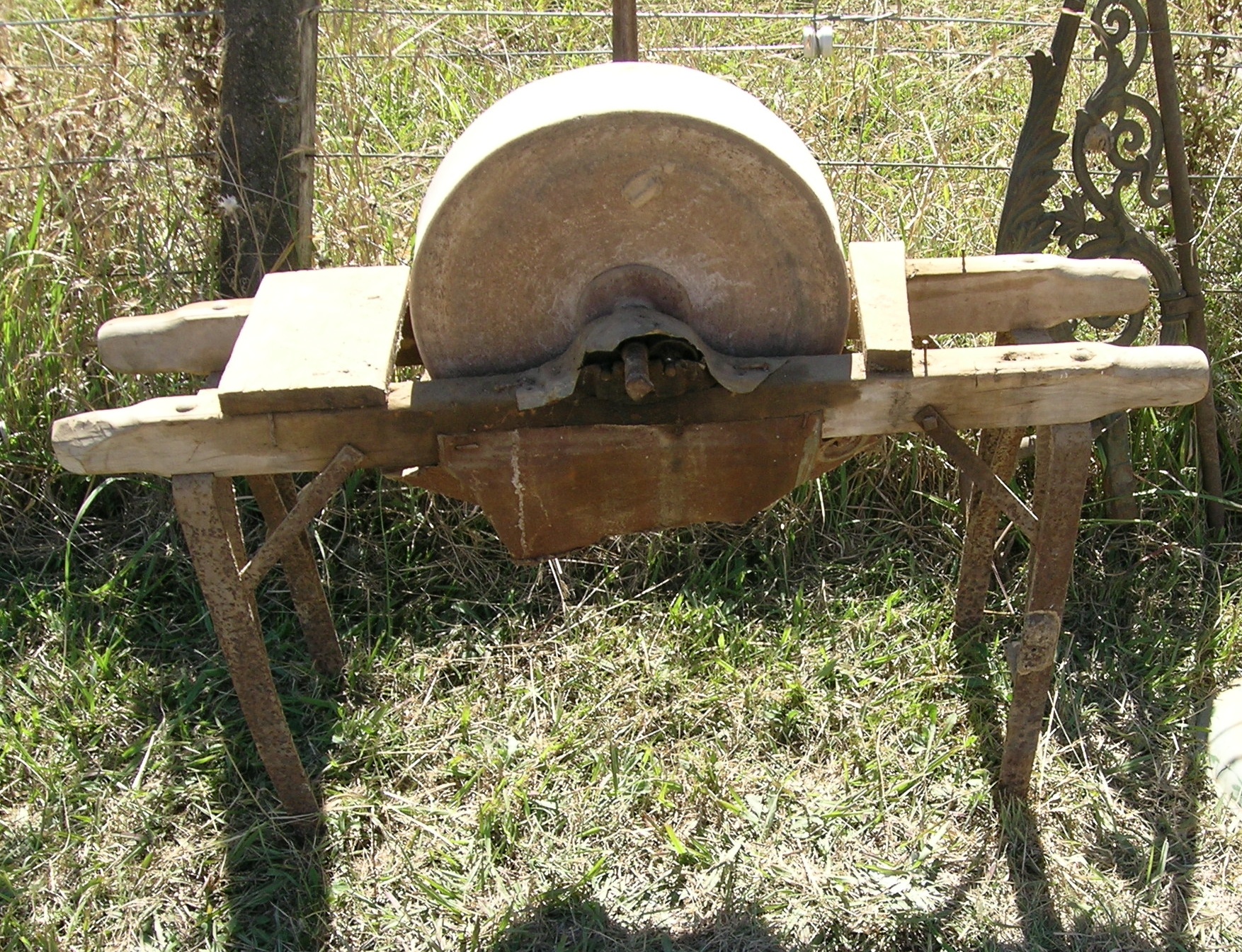
A wetgrinder is a hand-operated grinding stone where the swarf is gathered below the stone in water
A modern wetgrinder

A blade's grind is its cross-sectional shape in a plane normal to the edge. Grind differs from blade profile, which is the blade's cross-sectional shape in the plane containing the blade's edge and the centre contour of the blade's back (meaning the shape of the blade when viewed from the side, i.e. clip point, spear point, etc.). The grind of a blade should not be confused with the bevel forming the sharpened edge; it more usually describes the overall cross-section of the blade, not inclusive of the beveled cutting edge which is typically of a different, less acute angle as the bevel ground onto the blade to give it a cross-sectional shape. For example, the famous Buck 110 hunting knife has a "hollow ground" blade, with concave blade faces (which aid in slicing through materials), but the cutting edge itself is a simple, flat-ground bevel of lesser angle. It would be difficult, if not impossible, to put a "hollow grind" onto the actual cutting edge of the blade itself, which is a very narrow and small bevel.

Grinding

[edit]

Grinding is the process of creating grinds. It involves removing significant portions of material from a blade, which distinguishes it from honing and polishing. Blades are ground during their initial sharpening or after having been sufficiently damaged, such as by breaking a tip, chipping, or extensive corrosion. Well-maintained blades need grinding less frequently than neglected or maltreated ones do.

Edge angle and included angle typically characterize a blade's grind. An edge angle is measured between a line lying in the plane of one of the edge's faces and a second line intersecting the back's centre contour, both lines lying in the same plane normal to the edge. The included angle is the sum of the edge angles. Ceteris paribus, the smaller the included angle, the sharper the blade and the more easily damaged its edge.

An appropriate grind depends upon a blade's intended use and the material composing it. Knife manufacturers may offer the same blade with different grinds and blade owners may choose to regrind their blades to obtain different properties. A trade-off exists between a blade's ability to take an edge and its ability to keep one. Some grinds are easier to maintain than others, better retaining their integrity as repeated sharpening wears away the blade. Harder steels take sharper edges, but are more brittle and hence chip more easily, whereas softer steels are tougher. The latter are used for knives such as cleavers, which must be tough but do not require a sharp edge. In the range of blade materials' hardnesses, the relationship between hardness and toughness is fairly complex and great hardness and great toughness are often possible simultaneously.

As a rough guide, Western kitchen knives are generally double-bevelled (about 15° on the first bevel and 20°–22° on the second), whereas East Asian kitchen knives, made of harder steel and being either wedge- (double-ground) to 15°–18° or chisel-shaped (single-ground) to 20°–30°.

Care should be taken to avoid confusing the grind of the blade as describing its cross-section and the angle that is ground onto the edge to form a cutting edge. It is very rare to have a knife with a single ground angle forming both the profile and the cutting edge (the exception being perhaps straight razors). For example, the famous Buck 110 folding hunting knife is described as having a "hollow grind" - meaning the faces of the blade are ground into a concave – but the blade also contains a second, less acute, conventional bevel that makes up the cutting edge. A classic Opinel folding knife has a "flat grind" blade, meaning that the faces of the blade are flat, without convexity or concavity, tapering towards the cutting edge: but the actual cutting edge is again formed of another, less acute bevel ground on the narrow edge. A classic Morakniv has a saber or "Scandi" grind, with flat, perpendicular sides on the body, with a secondary bevel formed below to create a tapered edge, but again, the actual cutting edge comprises a third, less-acute bevel. Thus the "grind" of the blade most often refers to the overall cross-section of the blade and should not be confused with the actual style of cutting edge put in the blade, even though this cutting edge is created by grinding as well. If the cutting edge was included in the description of the "grind", the vast majority of blades would have to be described as "compound angle grind". And of course one can purchase an unsharped blade in any style grind you desire, and there is rarely need to grind the entire surface of the blade to create a cutting edge.

Process

[edit]

A sharp object works by concentrating forces which creates a high pressure due to the very small area of the edge, but high pressures can nick a thin blade or even cause it to roll over into a rounded tube when it is used against hard materials. An irregular material or angled cut is also likely to apply much more torque to hollow-ground blades due to the "lip" formed on either side of the edge. More blade material can be included directly behind the cutting edge to reinforce it, but during sharpening some proportion of this material must be removed to reshape the edge, making the process more time-consuming. Also, any object being cut must be moved aside to make way for this wider blade section, and any force distributed to the grind surface reduces the pressure applied at the edge.[1]

One way around this dilemma is to use the blade at an angle, which can make a blade's grind seem less steep, much as a switchback makes a trail easier to climb. Using the edge in this way is made easier by introducing a curve in the blade, as seen in sabers, tulwars, shamshirs, and katanas, among many others. Some old European swords (most memorably Hrunting) and the Indonesian style of kris have a wavelike shape, with much the same effect in drawing or thrusting cuts.

If it is required to measure the angles of cutting edges, it is achieved by using a goniometer, or blade edge protractor.

Typical grinds

[edit]
Blade cross-sections for typical grinds

Typical grinds include:[2]

  1. Hollow grind: A knife blade ground to create a characteristic concave, beveled cutting edge. This is characteristic of straight razors, used for shaving, and yields a very sharp but weak edge, which requires stropping for maintenance.
  2. Flat grind: The blade tapers all the way from the spine to the edge from both sides. A lot of metal is removed from the blade, so it is thus more difficult to grind, which is one factor that limits its commercial use. It sacrifices edge durability in favor of more sharpness. A true flat-ground knife having only a single bevel is somewhat of a rarity (meaning that usually "flat grind" just describes the general shape of the blade, while there is a second, more conventional bevel ground creating the actual cutting edge, although this is generally true of most blade shapes; few knives are ground with one bevel angle comprising both the blade shape and the cutting edge).
  3. Sabre grind: Similar to a flat grind blade, except that the bevel starts at about the middle of the blade, not the spine. Also sometimes referred to as a "V grind", made with strength in mind and found on tactical and military knives. A Sabre grind without a secondary bevel is called a "Scandinavian (Scandi) grind", which is easier to sharpen due to the large surface. The Finnish puukko is an example of a Scandinavian-ground knife.
  4. Chisel grind: As on a chisel, a single bevel-ground is only on one side, (ground often at an edge angle of about 20°–30°); the other remains flat. As many Japanese culinary knives tend to be chisel-ground, they are often sharper than a typical double-bevelled Western culinary knife; a chisel grind has only a single edge angle; if a sabre-ground blade has the same edge angle as a chisel grind, it still has angles on both sides of the blade centreline, and so has twice the included angle. Knives that are chisel-ground come in left- and right-handed varieties, depending upon which side is ground. The flat side should be on the inside of the cut. Japanese knives feature subtle variations on the chisel grind. Firstly, the back side of the blade is often concave, to reduce drag and adhesion, so the food separates more cleanly; this feature is known as urasuki.[3] Secondly, the kanisaki deba, used for cutting crab and other shellfish, has the grind on the opposite side (left side angled for right-handed use), so that the meat is not cut when chopping the shell.[4] Chisel grinds excel in knives, where the top priority is getting the deepest cut and penetration with the least effort, but do wander when cutting rigid materials like cardboard and rubber.
  5. Double bevel or compound bevel: A back bevel, similar to a sabre or flat grind, is put on the blade behind the edge bevel (the bevel which is the foremost cutting surface). This back bevel keeps the section of blade behind the edge thinner, which improves cutting ability. Being less acute at the edge than a single-bevel grind, it sacrifices sharpness for resilience: such a grind is much less prone to chipping or rolling than a single-bevel blade. This profile is commonly found in Japanese swords, such as the familiar katana. The shape of the bevel is much more efficient in reducing drag than the sabre grind typically found on Western sword blades. In practice, double bevels are common in a variety of edge angles and back bevel angles, and Western kitchen knives generally have a double bevel, with an edge angle of 14–16° (included angle of 28–32°) and a maximum of 40° as specified by International standard ISO 8442.1 (knives for the preparation of food).
  6. Convex grind: Rather than tapering with straight lines to the edge, the taper is curved, though in the opposite manner to a hollow grind. Such a shape keeps a lot of metal behind the edge, making for a stronger edge while still allowing a good degree of sharpness. This grind can be used on axes and is sometimes called an axe grind. As the angle of the taper is constantly changing, this type of grind requires some degree of skill to reproduce on a flat stone. Convex blades usually need to be made from thicker stock than other blades.[1] This is also known as hamaguriba in Japanese kitchen knives, both single- and double-beveled. Hamaguriba means "clam-shaped edge".[citation needed]

It is possible to combine grinds or produce other variations. For example, some blades may be flat-ground for much of the blade but be convex ground towards the edge.[citation needed]

See also

[edit]

References

[edit]
Revisions and contributorsEdit on WikipediaRead on Wikipedia
from Grokipedia
In skateboarding, a grind is a trick in which the skateboarder slides the trucks—the metal axles beneath the board—along of an obstacle such as a rail, ledge, or , requiring precise balance and speed to execute. This maneuver distinguishes itself from slides, which use the deck's edges, by relying on the trucks' contact for and control. Grinds are fundamental to and are categorized by the board's position, the skater's approach (frontside or backside), and which make contact. Common variations include the 50-50 grind, where both lock evenly onto the obstacle; the 5-0 grind, balancing on the back alone; the nosegrind, using the front ; and the smith grind (named after skater Mike Smith), a crooked frontside variation where the front hangs off the edge. More advanced types, such as the feeble grind (a variation using the rear with the board tilted forward) and crooked grind (a tweaked, diagonal lock-in), demand greater body and often incorporate for entry and exit. These tricks typically begin with an to pop the board onto the surface, followed by weight shifts to maintain momentum, and end with a dismount to avoid . Originating in the evolution of freestyle and vert skating in the late 1970s, particularly through pool skating by pioneers like the during California's drought, grinds adapted to urban obstacles in the 1980s as transitioned to street-style sessions, enabling creative interactions with city like handrails and stairs. These tricks have become iconic in competitions and videos, symbolizing technical prowess and risk-taking in the sport. Today, they form the basis for combo tricks in professional routines, with innovations continuing through events like those hosted by .

Fundamentals of Blade Grinds

Definition and Purpose

A blade grind refers to the of a 's cross-section, specifically how it tapers from the spine to the edge through the removal of to form the cutting wedge. This shape is distinct from the blade's overall profile and directly supports the edge , influencing the blade's interaction with materials during use. The primary purpose of a blade grind is to optimize by balancing cutting efficiency, structural strength, , and ease of . Thinner grinds, such as those that taper more acutely, enhance slicing ability by reducing resistance and allowing cleaner separation of materials, though they may be prone to chipping under lateral stress. Conversely, thicker grinds provide greater robustness for heavy-duty tasks, sacrificing some precision for improved resistance to deformation and longer edge retention. Additionally, grind affects ; acute tapers often require less material removal to restore sharpness, while broader ones demand more effort but hold edges longer in abrasive conditions. Blade grinding as a deliberate shaping method originated in early , with evidence of multi-stage grinding processes using stones and abrasives dating back to ancient civilizations like the and Romans, where it was essential for crafting sharp, durable tools and weapons such as the sword. In modern contexts, this technique continues to define blade functionality across applications. For instance, in straight razors, a hollow grind thins the blade to enable a closer shave by minimizing skin drag and irritation through its lightweight, flexible profile. The grind relates briefly to the edge bevel, which is the final sharpened angle applied atop the primary taper.

Key Terminology

In blade geometry, the grind refers to the cross-sectional shape of the blade perpendicular to the cutting edge, which determines how the blade tapers from the spine to the edge and influences cutting performance, strength, and sharpness retention. In contrast, the profile describes the overall outline or shape of the blade as viewed from the side, such as a drop point or clip point, which primarily affects the blade's functionality and aesthetics rather than its thickness reduction. This distinction is crucial, as the grind focuses on the internal structure for edge formation, while the profile outlines the external form. The grind should not be confused with the bevel, which is the final, precisely angled facet ground into the blade immediately adjacent to the cutting edge to create the sharpened surface. Whereas the grind encompasses the broader tapering process from the blade's body to the bevel, the bevel itself is a narrower, refined surface often applied after the primary grinding to achieve the ultimate edge geometry. Misuse of these terms is common, but the bevel specifically denotes the slanted relief that enables slicing, while the grind provides the foundational thickness control. Several other terms are essential for describing blade anatomy in relation to grinds. The spine is the thickest, heaviest portion of the blade, located opposite the cutting edge, which provides structural support and rigidity to the overall blade. The designates the unsharpened, flat section of the blade base between the end of the grind and the handle or guard, serving as a transition area that enhances safety during use and allows for full sharpening of the edge. Finally, the plunge line (also known as the grind termination) marks the curved or straight boundary where the grind meets the ricasso, a detail that reflects the maker's precision and impacts the blade's strength at the base.

Grinding Process

Material Removal Techniques

Material removal in blade grinding primarily involves abrasive processes that shape the blade blank by subtracting stock to achieve the desired bevel geometry. The most common techniques include belt grinding, which employs flexible abrasive belts tensioned over contact wheels or flat platens to efficiently remove bulk material; wheel grinding, utilizing rotary abrasive wheels such as serrated or smooth-edged variants for hollow or flat profiles; and hand grinding, where files, rasps, or sharpening stones are used for precise, custom adjustments in small-scale or artisanal work. These methods allow for controlled stock removal, with belt and wheel grinding dominating modern production due to their speed and consistency. At the microscopic level, material removal occurs as abrasive particles, typically alumina or grits bonded to the grinding medium, fracture the surface through micro-chipping or plowing actions, generating small chips that are cleared away to reveal the underlying material. Effective grinding requires balancing or belt speed—often 3,000 to 5,000 surface feet per minute—with applied to optimize chip formation while minimizing buildup, as excessive can draw the temper of the . For high-carbon s common in blades, temperatures should be managed to avoid softening from unintended tempering, which typically begins around 175–200°C depending on the . Industrial grinding techniques for blades trace their origins to the early , when water-powered rotary wheels enabled large-scale production in centers like , , replacing manual methods with mechanized abrasion for and tools. By the 1970s, the advent of computer numerical control (CNC) grinders revolutionized precision, allowing automated replication of complex profiles with tolerances under 0.01 mm, a capability that became widespread in by the 1990s. Safety in grinding emphasizes thermal management to avoid defects like warping or metallurgical damage; operators frequently apply quenchants, such as water or oil-based coolants, directly to the blade during operation to dissipate heat and maintain structural integrity. Overheating can lead to "blueing," an oxide layer formation at 300–350°C indicating surface tempering, which softens the steel and compromises edge retention. These practices ensure the initial grind contributes reliably to subsequent edge geometry refinement without introducing vulnerabilities.

Edge Formation and Finishing

After the initial grinding of the blade body, edge formation begins with establishing the primary bevel, typically at an of 10° to 20° per side for most knives, which converges to form the main . This step removes material to create a thin wedge, often using progressively finer to refine the bevel while minimizing heat buildup that could affect steel hardness. A secondary micro-bevel is then applied at a slightly steeper , such as 2° to 5° more than the primary, to enhance edge without significantly altering the overall ; this micro-bevel strengthens the apex against chipping during use. Honing follows to remove the burr—a thin deformed layer of metal formed during beveling—by drawing the edge across a fine abrasive at a consistent , ensuring a clean transition to the final edge. The of the finished edge is defined by the included θ, the total angle between the two faces, commonly ranging from 20° to 40° for balanced performance. This relates the edge's fragility to its sharpness, as smaller θ values yield thinner profiles for superior slicing but increase susceptibility to rolling or chipping under lateral forces. For instance, a 20° included provides acute keenness suitable for precision tasks, while a 40° prioritizes robustness for demanding cuts. Finishing refines the edge to achieve optimal keenness and polish, employing methods such as stone honing on Japanese water stones with grits from 1000 to 8000, which progressively smooth the bevel surfaces for reduced during cutting. Stropping on or compound-loaded surfaces further aligns the microscopic edge teeth, enhancing immediate sharpness without removal. For high-precision applications, electrochemical sharpening uses an to dissolve minute amounts of metal, producing mirror-like finishes ideal for surgical or specialty blades. Bevel angle optimization tailors the edge to specific cutting demands: thinner angles around 15° per side (total 30°) excel in slicing tasks, as seen in sushi knives like the for clean, drag-free cuts through delicate fish. Conversely, thicker angles of about 25° per side (total 50°) are preferred for chopping tools like cleavers, providing the necessary strength to withstand impact on denser materials such as or .

Types of Grinds

Hollow Grinds

A hollow grind refers to a blade geometry characterized by a concave bevel that tapers from the spine to the edge, creating a scooped-out profile on each side of the . This shape is typically produced by applying the blade blank to the surface of a or a belt sander wrapped around a , where the loose contact removes material in a curved manner; the depth of the concavity depends on the diameter of the or used. The primary characteristics of a hollow grind include an extremely thin edge that excels in slicing tasks due to minimal resistance and low drag during cuts, as the concave surfaces reduce the amount of in contact with the material being sliced. However, this thinness behind the results in reduced lateral strength, making the more susceptible to chipping or rolling under side loads compared to thicker geometries. In straight razors, a full hollow grind is particularly valued for its ability to deliver with minimal drag on the skin, enhancing precision and comfort. Variations of the hollow grind include the full hollow, where the concave taper extends from the edge all the way to the spine across the blade's width, and partial or half hollow grinds, which limit the concavity to the lower portion near the edge while leaving the upper blade thicker for added durability. These adaptations allow for customization based on the blade's intended use, balancing sharpness with structural integrity. Hollow grinds are commonly found in high-end straight razors, where the full hollow design optimizes shaving performance, and in certain hunting knives suited for skinning and precise cuts. This grind type originated in 18th-century Sheffield steelworking, where innovations in cast steel production enabled the creation of such refined blade profiles for razors.

Flat and Sabre Grinds

The flat grind features a straight planar taper from the blade's spine to , creating symmetrical flat bevels that form a V-shaped cutting edge. This design provides versatility for general-purpose tasks, offering above-average performance in cutting, slicing, and piercing while maintaining decent resistance to dulling. It is commonly used in , , and daily carry knives due to its balanced geometry, which supports good durability without excessive weight. In contrast, the sabre grind incorporates flat bevels that begin midway down the blade height, leaving a thicker spine section for enhanced structural strength. This configuration excels in demanding applications like chopping and heavy use, prioritizing durability over refined slicing ability, though it results in slightly reduced cutting performance compared to full flat grinds. The sabre grind is particularly suited to camping, tactical, and military knives where robustness is essential. Both flat and sabre grinds achieve a balance of sharpness and edge retention, making them more durable than thinner profiles while being easier to sharpen than hollow grinds, as their planar surfaces allow straightforward maintenance with basic tools. A notable variation of the sabre grind is the Scandinavian (Scandi) grind, which omits a secondary bevel and features a single flat primary bevel typically at 20°–25° inclusive angle, providing exceptional ease of field sharpening. The sabre grind, including its Scandi form, gained popularity through Scandinavian puukko knives, traditional utility tools originating in Nordic regions during the Viking era and refined for woodworking and hunting in harsh environments. The flat grind has become a standard in many factory-produced blades since the early 20th century, valued for its simplicity in mass manufacturing and consistent performance.

Chisel and Convex Grinds

The is an asymmetrical characterized by a single ground on one side of the , while the opposite side remains flat from the spine to . This design creates a sharp, chisel-like edge ideal for precision tasks requiring controlled slicing or carving, as the flat side provides a stable reference against the material being cut. The is typically oriented to favor the dominant hand—for instance, angled on the right side for right-handed users—to facilitate straight cuts without deviation. In contrast, the convex grind features a continuously rounded, outward-curving taper from the blade's spine to , often described as an "apple " profile due to its smooth, bulbous contour. This geometry is achieved through hammering, belt grinding, or specialized techniques, resulting in a robust edge that maintains thickness toward the apex for enhanced . Convex grinds are particularly suited for heavy-duty tools like axes, where they distribute stress evenly during impacts. Key characteristics of these grinds include the 's inherent directional bias, which promotes clean, wedging-free cuts in fibrous materials by guiding the blade along the flat face, and the convex grind's superior resistance to chipping and deformation under lateral forces, avoiding the vulnerabilities of flat planes. A notable example of the grind appears in Japanese single-bevel knives, such as the usuba, a vegetable designed for thin, precise slicing where the allows the blade to glide smoothly over the . The convex grind, known as hamaguriba in Japanese tradition, is employed in tough tools like axes for chopping tasks, providing wedge-like performance without brittleness. Compound grinds may integrate elements of both, such as a with a convex primary taper, to balance sharpness and strength in specialized blades.

Applications and Selection

By Blade Function

The selection of blade grinds is closely tied to the intended function of the tool, optimizing performance for tasks ranging from precise slicing to heavy chopping. For slicing blades, such as those in straight razors and fillet knives, hollow or flat grinds are preferred due to their thin profiles that minimize drag and facilitate clean, effortless cuts through soft materials like or . Hollow grinds, in particular, create a concave taper that reduces resistance during or filleting, allowing for smoother motion and less wedging into the material. Flat grinds provide a balanced alternative, offering similar slicing efficiency while maintaining slightly more edge durability for repeated passes. In chopping tools like cleavers and axes, or convex grinds excel by prioritizing high strength and impact resistance, essential for withstanding forceful strikes without chipping or deforming. grinds, which feature a partial flat starting midway down the blade, deliver robust support behind the edge, making them ideal for heavy-duty cleavers used in butchery or . Convex grinds, with their rounded, apple-seed-like profile, further enhance durability for axes and machetes, distributing stress evenly during chopping and splitting tasks to prevent edge failure under high loads. For precision carving applications, such as in wood chisels and Japanese knives, the chisel grind provides exceptional directional control by featuring a single bevel on one side and a flat back on the other, allowing the blade to follow the grain or guide precisely without wandering. This asymmetrical design is standard in Japanese culinary knives like usuba or deba knives, enabling fine, controlled incisions in proteins during detailed work, and in woodworking tools like Japanese chisels, offering superior stability for paring or shaping where accuracy is paramount. In culinary knives, grind selection significantly influences food release, with convex grinds reducing sticking during processing by promoting smoother separation from sticky surfaces like proteins; this advantage has been recognized in professional butchery tools.

Influencing Factors

The selection of a blade grind is profoundly shaped by the properties of the , which determine edge retention, , and resistance to environmental factors. Hard carbon steels, such as 1095, are particularly compatible with thin hollow grinds, as their high carbon content allows for a razor-sharp edge that maintains keenness during precision slicing without rapid deformation. Conversely, stainless steels like stainless are often favored with grinds to capitalize on their superior resistance, ensuring longevity in humid or wet conditions while supporting a robust edge suitable for everyday tasks. User requirements introduce additional layers of influence, tailoring the grind to ergonomic and functional demands. Chisel grinds, for example, are asymmetrically beveled to accommodate right- or left-handed users, optimizing one-sided cutting efficiency in specialized applications like woodworking or culinary preparation. For scenarios involving heavy abuse or impact, such as outdoor chopping or batoning, convex grinds are selected for their rounded geometry, which enhances durability by evenly distributing forces and reducing the risk of chipping along the edge. Manufacturing processes and associated costs also guide grind design, balancing precision with economic feasibility. Computer numerical control (CNC) excels in producing consistent flat grinds, offering high precision at lower costs for large-scale production due to its automated repeatability. In contrast, convex grinds demand more labor-intensive methods like hand-forging or belt grinding, which elevate costs but allow for nuanced control over the blade's strength profile in custom or high-end applications.

References

Add your contribution
Related Hubs
Contribute something
User Avatar
No comments yet.