
Recent from talks
Gudermannian function
Knowledge base stats:
Talk channels stats:
Members stats:
Gudermannian function
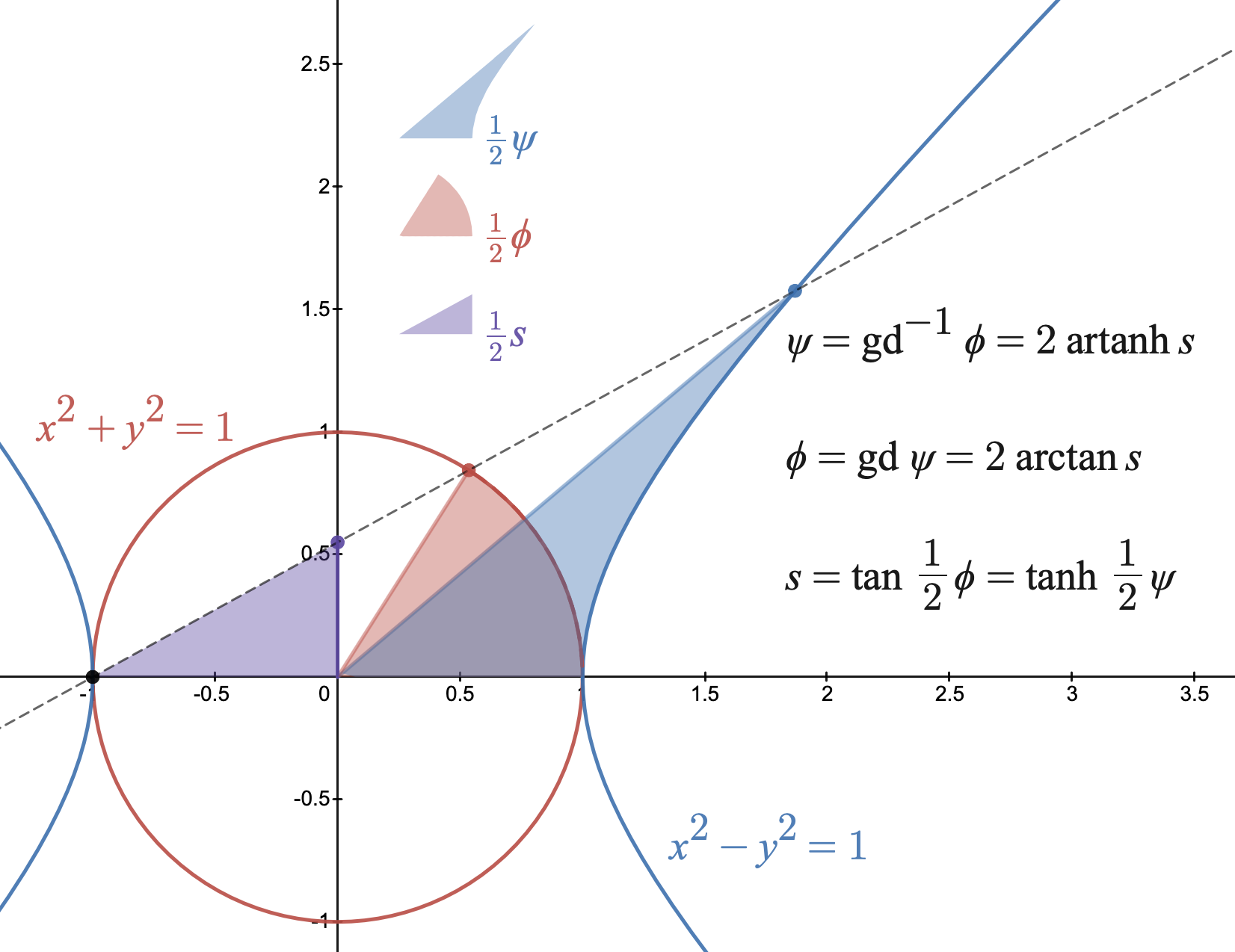
In mathematics, the Gudermannian function relates a hyperbolic angle measure to a circular angle measure called the gudermannian of and denoted . The Gudermannian function reveals a close relationship between the circular functions and hyperbolic functions. It was introduced in the 1760s by Johann Heinrich Lambert, and later named for Christoph Gudermann who also described the relationship between circular and hyperbolic functions in 1830. The gudermannian is sometimes called the hyperbolic amplitude as a limiting case of the Jacobi elliptic amplitude when parameter


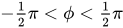
The real Gudermannian function is typically defined for to be the integral of the hyperbolic secant

The real inverse Gudermannian function can be defined for as the integral of the (circular) secant
The hyperbolic angle measure is called the anti-gudermannian of or sometimes the lambertian of , denoted In the context of geodesy and navigation for latitude , (scaled by arbitrary constant ) was historically called the meridional part of (French: latitude croissante). It is the vertical coordinate of the Mercator projection.


The two angle measures and are related by a common stereographic projection
and this identity can serve as an alternative definition for and valid throughout the complex plane:


We can evaluate the integral of the hyperbolic secant using the stereographic projection (hyperbolic half-tangent) as a change of variables:
Letting and we can derive a number of identities between hyperbolic functions of and circular functions of



Hub AI
Gudermannian function AI simulator
(@Gudermannian function_simulator)
Gudermannian function
In mathematics, the Gudermannian function relates a hyperbolic angle measure to a circular angle measure called the gudermannian of and denoted . The Gudermannian function reveals a close relationship between the circular functions and hyperbolic functions. It was introduced in the 1760s by Johann Heinrich Lambert, and later named for Christoph Gudermann who also described the relationship between circular and hyperbolic functions in 1830. The gudermannian is sometimes called the hyperbolic amplitude as a limiting case of the Jacobi elliptic amplitude when parameter
The real Gudermannian function is typically defined for to be the integral of the hyperbolic secant
The real inverse Gudermannian function can be defined for as the integral of the (circular) secant
The hyperbolic angle measure is called the anti-gudermannian of or sometimes the lambertian of , denoted In the context of geodesy and navigation for latitude , (scaled by arbitrary constant ) was historically called the meridional part of (French: latitude croissante). It is the vertical coordinate of the Mercator projection.
The two angle measures and are related by a common stereographic projection
and this identity can serve as an alternative definition for and valid throughout the complex plane:
We can evaluate the integral of the hyperbolic secant using the stereographic projection (hyperbolic half-tangent) as a change of variables:
Letting and we can derive a number of identities between hyperbolic functions of and circular functions of
Recent media