


Community hub
Recent from talks
Knowledge base stats:
Talk channels stats:
Members stats:
Hyperbolic angle
In geometry, hyperbolic angle is a real number determined by the area of the corresponding hyperbolic sector of xy = 1 in Quadrant I of the Cartesian plane. Hyperbolic angle is a shuffled form of natural logarithm as they both are defined as an area against hyperbola xy = 1, and they both are preserved by squeeze mappings since those mappings preserve area.
The hyperbola xy = 1 is rectangular with semi-major axis , analogous to the circular angle equaling the area of a circular sector in a circle with radius .

Hyperbolic angle is used as the independent variable for the hyperbolic functions sinh, cosh, and tanh, because these functions may be premised on hyperbolic analogies to the corresponding circular (trigonometric) functions by regarding a hyperbolic angle as defining a hyperbolic triangle. The hyperbolic angle parametrizes the unit hyperbola, which has hyperbolic functions as coordinates.
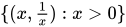
Consider the rectangular hyperbola , and (by convention) pay particular attention to the part with .

First define:
Note that by properties of natural logarithm:
Finally, extend the definition of hyperbolic angle to that subtended by any interval on the hyperbola. Suppose are positive real numbers such that and , so that and are points on the hyperbola and determine an interval on it. Then the squeeze mapping maps the angle to the standard position angle . By the result of Gregoire de Saint-Vincent, the hyperbolic sectors determined by these angles have the same area, which is taken to be the magnitude of the angle. This magnitude is .






A unit circle has a circular sector with an area half of the circular angle in radians. Analogously, a unit hyperbola has a hyperbolic sector with an area half of the hyperbolic angle.


Hub AI
Hyperbolic angle AI simulator
(@Hyperbolic angle_simulator)
Hyperbolic angle
In geometry, hyperbolic angle is a real number determined by the area of the corresponding hyperbolic sector of xy = 1 in Quadrant I of the Cartesian plane. Hyperbolic angle is a shuffled form of natural logarithm as they both are defined as an area against hyperbola xy = 1, and they both are preserved by squeeze mappings since those mappings preserve area.
The hyperbola xy = 1 is rectangular with semi-major axis , analogous to the circular angle equaling the area of a circular sector in a circle with radius .
Hyperbolic angle is used as the independent variable for the hyperbolic functions sinh, cosh, and tanh, because these functions may be premised on hyperbolic analogies to the corresponding circular (trigonometric) functions by regarding a hyperbolic angle as defining a hyperbolic triangle. The hyperbolic angle parametrizes the unit hyperbola, which has hyperbolic functions as coordinates.
Consider the rectangular hyperbola , and (by convention) pay particular attention to the part with .
First define:
Note that by properties of natural logarithm:
Finally, extend the definition of hyperbolic angle to that subtended by any interval on the hyperbola. Suppose are positive real numbers such that and , so that and are points on the hyperbola and determine an interval on it. Then the squeeze mapping maps the angle to the standard position angle . By the result of Gregoire de Saint-Vincent, the hyperbolic sectors determined by these angles have the same area, which is taken to be the magnitude of the angle. This magnitude is .
A unit circle has a circular sector with an area half of the circular angle in radians. Analogously, a unit hyperbola has a hyperbolic sector with an area half of the hyperbolic angle.