


Community hub
Recent from talks
Contribute something
Nothing was collected or created yet.
Gulf of Alexandretta
View on Wikipedia

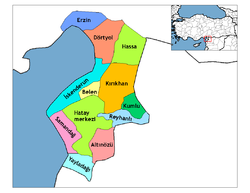
The Gulf of Alexandretta or İskenderun (Turkish: İskenderun Körfezi) is a gulf of the eastern Mediterranean or Levantine Sea. It lies beside the southern Turkish provinces of Adana and Hatay.
Names
[edit]The gulf is named for the nearby Turkish city of İskenderun, the classical Alexandretta. It was also formerly known as the Sea or the Gulf of Issus (Latin: Mare Issicum or Issicus Sinus)[1] (Ancient Greek: Ἰσσικὸς κόλπος).[2][3] Herodotus and Stephanus of Byzantium[4] also records it as the Marandynian Bay (Ancient Greek: Μυριανδικὸς κόλπος), after the nearby town of Myriandus.[5] Between the 9th and 12th centuries, the gulf was known as the Armenian Gulf[6] or the Armenian Bay (Armenian: Հայկական ծոց).[7]
Geography
[edit]The Gulf of Alexandretta forms the easternmost bay or inlet of the Mediterranean Sea. It lies beside the southern coast of Turkey, near its border with Syria. In antiquity, the adjacent Nur Mountains were usually thought to separate the regions of Cilicia and Syria, although Herodotus at one point places the division further south at Ras al-Bassit (the classical Posidium).
Pollution
[edit]There is a lot of heavy industry around Iskenderun Bay, including five cement factories, ten steel factories, and three coal-fired power stations: İsken Sugözü, Atlas and Emba Hunutlu. The mountains around the bay trap air pollution,[8] but because smokestack details are sent to the government unpublished, it is difficult to apportion responsibility for deaths and illnesses caused by air pollution in the area.[9] The water too is polluted by land-based, shipping and fish farming activities.[10]
See also
[edit]- Çukurova, the modern equivalent to Cilicia
- List of gulfs
References
[edit]Citations
[edit]- ^ Gulf of Alexandretta can be found at GEOnet Names Server, at this link, by opening the Advanced Search box, entering "-754985" in the "Unique Feature Id" form, and clicking on "Search Database".
- ^ Strabo, Geography, 14.6.1
- ^ Strabo, Geography, 16.1.1
- ^ Stephanus of Byzantium, Ethnica, §M463.5
- ^ Rennell (1830), pp. 321–2.
- ^ Svazlian, Verjine (2020). "The Tercentennial Glory Of The Armenian Kingdom Of Cilicia And The Self-Defensive Battles Of The Zeytountsis". Fundamental Armenology.
- ^ Yepremyan, Tigran (2018). "Armenian Migration from War-torn Syria to Europe: From Diaspora to Diaspora or Homeland?". Eurolimes (23+24): 191–205.
- ^ Myllyvirta, Lauri (2020). Air Quality and Health Impacts of the Proposed EMBA Hunutlu Coal Power Project (PDF) (Report).
- ^ Stauffer & Gümüşel (2016), pages 4-6
- ^ Yilmaz, Hilal KARGIN; Sönmez, Hatice (2018-05-11). "Environmental problems and precautions of Iskenderun Gulf in Eastern Mediterranean region". Acta Biologica Turcica. 31 (3): 69–81. ISSN 2458-7893.
Bibliography
[edit]- Rennell, James (1830), The Geographical System of Herodotus Examined and Explained..., vol. I (2nd ed.), London: C.J.G. & F. Rivington.
- Anne Stauffer; Deniz Gümüşel (2016). Genon K. Jensen (ed.). Coal power generation and health in Iskenderun Bay, Turkey (PDF) (Report). Health and Environment Alliance (HEAL).
| Black Sea |
|
|---|---|
| Marmara | |
| Aegean | |
| Mediterranean | |
| Related geographical features | |


36°45′N 36°00′E / 36.750°N 36.000°E
 | This article about a Mediterranean region of Turkey location is a stub. You can help Wikipedia by adding missing information. |
Gulf of Alexandretta
View on GrokipediaNomenclature
Historical and Etymological Origins
The name "Gulf of Alexandretta" derives from the adjacent port city of Alexandretta (modern İskenderun), which preserves the Hellenistic designation Alexandria ad Issum, established in 333 BC by Alexander the Great to commemorate his victory over Darius III at the nearby Battle of Issus and to replace the earlier settlement of Myriandus.[5] [6] This foundation marked a strategic repopulation effort in the region, leveraging the gulf's position as a natural harbor controlling access through the Syrian Gates (Belen Pass).[4] Etymologically, "Alexandretta" is the Late Greek diminutive of Alexandria (Αλεξανδρέττα), translating to "Little Alexandria" to differentiate it from the major Egyptian metropolis founded by the same conqueror; the term appears in Byzantine sources like John Malalas as Alexandreia hē mikra ("the small Alexandria").[7] The gulf's nomenclature followed suit in European cartography and nautical references from the medieval period onward, supplanting earlier designations tied to ancient landmarks, such as the Gulf or Sea of Issus (Latin: Mare Issicum), referencing the 333 BC battle site on its eastern shores.[4] Prior to the Alexandrian era, the gulf lacked a distinct named identity in surviving records but was implicitly linked to Cilician coastal features, including the Myriandic Gulf (Myriandikos kolpos) after the pre-Hellenistic port of Myriandus, which Alexander's settlement aimed to eclipse.[6] During the medieval Armenian Kingdom of Cilicia (11th–14th centuries), some sources occasionally termed it the "Armenian Gulf" due to regional political control, though this usage was transient and not etymologically foundational.[8] The persistence of "Alexandretta" for both city and gulf reflects enduring Hellenistic toponymic influence amid successive Roman, Byzantine, and Islamic administrations, with the name solidifying in Western usage by the 15th century as evidenced in pilgrim accounts like that of Bertrandon de La Broquière.[9]Contemporary Designations and Usage
In modern Turkish nomenclature, the body of water formerly known as the Gulf of Alexandretta is officially designated as İskenderun Körfezi, reflecting the Turkish name of the port city of İskenderun on its eastern shore. This designation aligns with Turkey's administrative standardization following the 1939 annexation of the Hatay region, emphasizing national linguistic conventions in geographical naming.[10] Internationally, the gulf is commonly referred to as the Gulf of İskenderun in English-language geographical and maritime contexts, appearing as such in official nautical publications. For instance, British Admiralty Nautical Chart 247, which covers northern terminals of the gulf, explicitly titles the area "Iskenderun Körfezi," facilitating standardized navigation for vessels entering ports like İskenderun and Dörtyol.[11] Similarly, global maritime tracking systems identify the primary port as İskenderun (UN/LOCODE: TRISK), underscoring its role in contemporary shipping routes for bulk cargo, including coal and iron ore, with annual throughput exceeding 30 million tons as of 2023.[12] The historical appellation "Gulf of Alexandretta" persists sporadically in non-Turkish academic literature or older maps but lacks official endorsement in Turkish state documents or international hydrographic surveys, where İskenderun variants predominate to avoid associations with pre-annexation French mandate-era naming. This shift supports Turkey's sovereign claims over the region, integrated into Hatay Province since 1939, and is reflected in domestic usage by institutions like the Turkish Hydrographic and Oceanographic Research Center (TAUD).[13]Physical Geography
Location and Topographical Features
The Gulf of Alexandretta, known contemporarily as İskenderun Bay, constitutes the easternmost embayment of the Mediterranean Sea, positioned along the southeastern coastline of Turkey within Hatay Province, proximate to the Syrian frontier.[14] Its central coordinates approximate 36°37′35″N 35°54′10″E, spanning roughly 35 kilometers in width from the Turkish mainland to the open sea.[15][16] The gulf's configuration arises from tectonic interactions at the triple junction of the African, Arabian, and Anatolian plates, rendering it a dynamically evolving feature susceptible to seismic influences.[17] Topographically, İskenderun Bay manifests as a relatively shallow basin, with bathymetric surveys indicating depths predominantly under 20 meters in nearshore zones and gradual increases seaward, shaped by faulting and sedimentation processes.[18] The seabed comprises tectonic depressions, submarine ridges, and sediment-filled lows, reflective of ongoing pull-apart basin dynamics associated with the Dead Sea Fault system.[19] Shoreline morphology features a mix of depositional plains, including the İskenderun Plain, flanked by the rugged Nur Mountains to the north and east, which rise sharply to elevations exceeding 2,000 meters, contrasting the gulf's subdued marine floor.[20] This juxtaposition of coastal lowlands and orographic barriers influences local sediment transport and erosion patterns.[14]Oceanography and Hydrology
The Gulf of İskenderun features a shallow bathymetry, with a maximum depth of 87 meters across its rectangular expanse measuring approximately 60 kilometers in length and 35 kilometers in width.[14] Its floor exhibits predominantly flat morphology, punctuated by localized tectonic deformations along the eastern and southwestern margins, reflecting ongoing convergence between the African and Anatolian plates.[17] Hydrologically, the gulf receives substantial freshwater inputs from major rivers, including the Ceyhan River with an average discharge of 180 cubic meters per second near Yumurtalık Bay, the Asi (Orontes) River entering at its northeastern head, and the Seyhan River contributing to deltaic formations exceeding 100 square kilometers.[21][22][23] These inflows create estuarine zones with reduced salinity gradients near the deltas, influencing sediment deposition and nutrient loading, while the gulf's semi-enclosed nature limits overall water exchange with the open Levantine Sea.[24][25] Oceanographic conditions reflect eastern Mediterranean characteristics, with surface water temperatures varying seasonally from approximately 10°C in winter to 28°C in summer, and a mean summer surface temperature around 30°C in nearshore areas.[26][27] Salinity averages 38 practical salinity units (psu), with narrower fluctuations in offshore waters but dilutions to below 37 psu adjacent to river plumes due to freshwater mixing.[28][25] Circulation patterns are modulated by the broader Levantine Basin's cyclonic gyre system, featuring anticlockwise summer inflows from the open sea with subsurface return flows, contrasted by clockwise winter gyres; coastal current speeds reach up to 15 centimeters per second.[29][22][14] These dynamics promote dynamic water movement, though industrial effluents and eutrophication from riverine nutrients have intensified stratification and hypoxia risks in shallower sub-basins.[30]Climate and Weather Patterns
The Gulf of İskenderun, located along the northeastern Mediterranean coast, features a Mediterranean climate (Köppen classification Csa) with pronounced seasonal contrasts: hot, arid summers driven by subtropical high-pressure systems and mild, rainy winters influenced by mid-latitude cyclones from the north and west.[31] Annual average temperatures hover around 17°C (63°F), with minimal frost risk due to maritime moderation, though occasional cold snaps from continental air masses can lower minima to 5°C (41°F).[31][32] Summer (June–September) highs typically reach 30–32°C (86–90°F), peaking in August at an average daily maximum of 31°C (88°F), accompanied by low humidity (40–60%) and negligible rainfall under 10 mm monthly, fostering clear skies and prolonged daylight.[33] Winter (December–February) brings cooler conditions with highs of 15–17°C (59–63°F) and lows around 7–9°C (45–48°F), while precipitation concentrates here, averaging 80–140 mm per month, primarily from frontal systems yielding 7–9 rainy days.[33] Total annual precipitation measures approximately 700–800 mm, with over 70% falling between October and March, supporting episodic flash flooding in coastal lowlands but limited snow accumulation at sea level.[31][33]| Month | Avg. High (°C) | Avg. Low (°C) | Precipitation (mm) |
|---|---|---|---|
| January | 16 | 7 | 82 |
| February | 16 | 7 | 86 |
| March | 18 | 9 | 86 |
| April | 22 | 12 | 64 |
| May | 26 | 16 | 36 |
| June | 30 | 20 | 9 |
| July | 32 | 22 | 1 |
| August | 32 | 23 | 3 |
| September | 29 | 20 | 14 |
| October | 25 | 16 | 49 |
| November | 20 | 12 | 70 |
| December | 17 | 9 | 110 |