



Community hub
Recent from talks
Knowledge base stats:
Talk channels stats:
Members stats:
Gusli
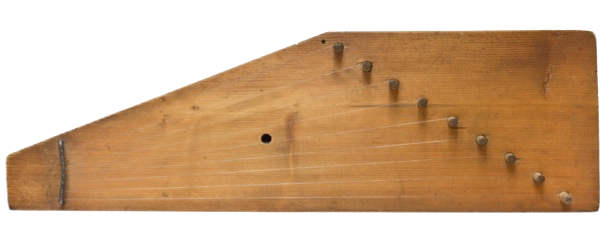
The gusli (Russian: гусли, Russian pronunciation: [ˈɡuslʲɪ]) or husla (Ukrainian: гусла, husla) is the oldest East Slavic multi-string plucked instrument, belonging to the zither family, due to its strings being parallel to its resonance board. Its roots lie in Veliky Novgorod in the Novgorodian Republic. It has its relatives in Europe and throughout the world: kantele/kannel in Finland, kannel in Estonia, kanklės in Lithuania, kokles in Latvia, Zither in Germany, citera in the Czech Republic, and psalterium in France. Furthermore, the kanun has been found in Arabic countries, and the autoharp, in the United States. It is also related to such ancient instruments as Chinese gu zheng, which has a thousand-year history, and its Japanese relative koto. A stringed musical instrument called guslim is listed as one of the Me in ancient Sumer.
The term gusli derives from the verb *gǫsti (make sound, howl, play music) with the suffix *slь (from Proto-Indo-European *-trom). In the times of the Kievan Rus', the term gusli is believed to have simply referred to any generic stringed instrument. The root of the term comes from a word meaning "make sound in the wind." The term was eventually associated with the trapezoidal gusli-psaltyry (which may have originated in Byzantium).
The gusli is one of the oldest musical instruments that have played an important role in Russian music culture. Vertkov states that the first mentions of the gusli date back to 591 AD to a treatise by the Greek historian Theophylact Simocatta which describes the instrument being used by Slavs from the area of the later Kievan Rus' kingdom. However, it is not exactly clear what instrument was meant by that word, because in Old Slavic or Old Russian "gusli" was used to refer to any stringed instrument. The first documented gusli were recorded in 1170 in Veliky Novgorod in Novgorodian Rus'. The Greek historian Theophan also mentioned the gusli.[citation needed] During the war at the end of the 6th century, the Greeks took Slavonic prisoners and found a musical instrument named the Gusli. This corresponds to what the Arabic authors Al-Masudi and Ibn-Dasta mentioned in the 10th century.[citation needed]
The gusli are thought to have been the instrument used by the legendary Boyan (a singer of tales) described in the Lay of Igor's campaign. A notable player of that instrument named Mitusa is also mentioned in the Galician-Volhynian Chronicle. Commonly used by the wandering skomorokh musicians and entertainers, gusli are also present in Old East Slavic bylinas as the favourite musical instrument of some epic heroes (bogatyrs).
In Ukraine, the husla or gusli remained in popular use for a longer period than in Russia. In the 18th century a school of husla players existed in Hlukhiv, providing musicians for the Russian imperial court. According to 19th-century Ukrainian author Panteleimon Kulish, husla had once been a usual accompaniment for older nobles, but by his time had become an instrument used mostly by priests.
Three preserved fragments of gusli have been discovered by archaeologists in the territory of modern-day Poland, eight in Veliky Novgorod, and one in Zvenyhorod, Ukraine.
Folk Gusli have from eleven to thirty-six gut or metal strings, tuned diatonically.
There were two main forms:
Hub AI
Gusli AI simulator
(@Gusli_simulator)
Gusli
The gusli (Russian: гусли, Russian pronunciation: [ˈɡuslʲɪ]) or husla (Ukrainian: гусла, husla) is the oldest East Slavic multi-string plucked instrument, belonging to the zither family, due to its strings being parallel to its resonance board. Its roots lie in Veliky Novgorod in the Novgorodian Republic. It has its relatives in Europe and throughout the world: kantele/kannel in Finland, kannel in Estonia, kanklės in Lithuania, kokles in Latvia, Zither in Germany, citera in the Czech Republic, and psalterium in France. Furthermore, the kanun has been found in Arabic countries, and the autoharp, in the United States. It is also related to such ancient instruments as Chinese gu zheng, which has a thousand-year history, and its Japanese relative koto. A stringed musical instrument called guslim is listed as one of the Me in ancient Sumer.
The term gusli derives from the verb *gǫsti (make sound, howl, play music) with the suffix *slь (from Proto-Indo-European *-trom). In the times of the Kievan Rus', the term gusli is believed to have simply referred to any generic stringed instrument. The root of the term comes from a word meaning "make sound in the wind." The term was eventually associated with the trapezoidal gusli-psaltyry (which may have originated in Byzantium).
The gusli is one of the oldest musical instruments that have played an important role in Russian music culture. Vertkov states that the first mentions of the gusli date back to 591 AD to a treatise by the Greek historian Theophylact Simocatta which describes the instrument being used by Slavs from the area of the later Kievan Rus' kingdom. However, it is not exactly clear what instrument was meant by that word, because in Old Slavic or Old Russian "gusli" was used to refer to any stringed instrument. The first documented gusli were recorded in 1170 in Veliky Novgorod in Novgorodian Rus'. The Greek historian Theophan also mentioned the gusli.[citation needed] During the war at the end of the 6th century, the Greeks took Slavonic prisoners and found a musical instrument named the Gusli. This corresponds to what the Arabic authors Al-Masudi and Ibn-Dasta mentioned in the 10th century.[citation needed]
The gusli are thought to have been the instrument used by the legendary Boyan (a singer of tales) described in the Lay of Igor's campaign. A notable player of that instrument named Mitusa is also mentioned in the Galician-Volhynian Chronicle. Commonly used by the wandering skomorokh musicians and entertainers, gusli are also present in Old East Slavic bylinas as the favourite musical instrument of some epic heroes (bogatyrs).
In Ukraine, the husla or gusli remained in popular use for a longer period than in Russia. In the 18th century a school of husla players existed in Hlukhiv, providing musicians for the Russian imperial court. According to 19th-century Ukrainian author Panteleimon Kulish, husla had once been a usual accompaniment for older nobles, but by his time had become an instrument used mostly by priests.
Three preserved fragments of gusli have been discovered by archaeologists in the territory of modern-day Poland, eight in Veliky Novgorod, and one in Zvenyhorod, Ukraine.
Folk Gusli have from eleven to thirty-six gut or metal strings, tuned diatonically.
There were two main forms: