Hubbry Logo
HlukhivHlukhivMain
Open search
Hlukhiv
Community hub
Hlukhiv
logo
8 pages, 0 posts
0 subscribers
Be the first to start a discussion here.
Hlukhiv
Hlukhiv
from Wikipedia

Hlukhiv (Ukrainian: Глухів, IPA: [ˈɦluxʲiu̯] ; Russian: Глухов, romanizedGlukhov)[1] is a small historic city on the Esman River. It belongs to Shostka Raion of Sumy Oblast of Ukraine. Population: 31,789 (2022 estimate).[2]

Key Information

It is known for being a capital of the Cossack Hetmanate after the deposition of Ivan Mazepa in 1708–1764.

History

[edit]
Coat of arms of Hlukhiv Regiment (1663–65), a province of the Cossack Hetmanate

Hlukhiv was first noticed by chroniclers as a Severian town in 1152. Around 1247 it became the seat of a branch of the princely house of Chernihiv following the Mongol invasion of Rus. Between 1320 and 1503 it was part of the Grand Duchy of Lithuania before being conquered by the Grand Duchy of Moscow. In 1618 it became part of the Polish–Lithuanian Commonwealth (in the Czernihów Voivodeship of the Crown of Poland) and was granted Magdeburg Rights in 1644 by Władysław IV Vasa. In 1648–1764 it was part of the Cossack Hetmanate within the Nizhyn Regiment (province).

In 1654 the Cossack Hetmanate came under military protectorate of the Tsardom of Russia in accordance with the Treaty of Pereiaslav and in 1664, during the siege of Hlukhiv, the Russo-Cossack garrison of the town successfully defended against a superiour Polish army which suffered great losses during the following retreat. According to the Truce of Andrusovo along with the rest Left-bank Ukraine it was ceded to the Tsardom of Muscovy in 1667.

In 1708, after realizing that Ivan Mazepa sided with Carl XII, Peter the Great ordered the destruction of Baturyn and the transfer of the capital to Hlukhiv. Here in November 1708, Ivan Skoropadsky, a new Hetman of Zaporizhian Host, was elected, while the Metropolitan of Kyiv, Halych and all Little Russia Ioasaf was forced to proclaim anathema onto Mazepa in the St. Trinity Cathedral (destroyed in 1962). Hlukhiv served as the capital of the Cossack Hetmanate in 1708-64 and until 1773 the administrative center of the Little Russia Governorate. Under the last hetmans of Ukraine, the town was remodeled in the Baroque style. Subsequently, it declined in consequence of frequent fires, so that very few of its architectural gems survived.

Since the first school of singing in the Russian Empire was established there in 1738, the town has a rich musical heritage. Composers Dmytro Bortniansky and Maksym Berezovsky, whose statues grace the Bortniansky Square of Hlukhiv, are believed to have studied there.

In 1874, in a college was established in Hlukhiv (today Hlukhiv National Pedagogical University of Oleksandr Dovzhenko). In 1879, the Tereshchenko brothers, who were Russian millionaires of Ukrainian descent, established a free hospital of St. Euphrosyne and supported it financially. In 1899 on the funds of Tereshchenko family in Hlukhiv was established another college (today Agrarian college of the Sumy Agrarian University).

In 1918, the city became part of Ukraine; however, already in January 1918 it was occupied by the Soviet troops for several months. Soviet control returned again to the city a year later in 1919.

During World War II, Hlukhiv was occupied by the German Army from 9 September 1941 to 30 August 1943.

While the region was a part of the Soviet Union, an airfield was built near Hlukhiv at Chervone-Pustohorod.

In 1994 in the city was established the State Historical and Cultural Heritage Park.

In October 2015 at the local election, the mayor of the city became Michel Tereshchenko, a naturalized Ukrainian from France and great grandson of Mikhail Tereshchenko. Tereshchenko stepped down as mayor in October 2018 with the intention to become a candidate in the 2019 Ukrainian presidential election.[3] Yet, during the November–December 30 days martial law in Ukraine he resumed his position as mayor and on 3 January 2019 he declared his support for (another) presidential candidate Andriy Sadovyi during a congress of Sadovyi's party Self Reliance.[4]

In the October 2020 Ukrainian local elections Nadiia Vailo , candidate from the political party "Our Land" was elected as the city's new mayor.

2022 Russian invasion

[edit]

Clashes occurred in Hlukhiv between the Ukrainian Armed Forces and the invading Russian Armed Forces in the city and its surrounding areas during the night of 24–25 February 2022.[5] The city was occupied by Russian forces until April 2022.[6]

Demographics

[edit]
Demographic Breakdown[7][8][9]
1897 1989 2001
Ukrainian 58.1% 81.5% 90.8%
Jewish 25.9% 0.4% 0.1%
Russian 15.0% 17.0% 8.4%
Poles 0.2% 0.0% 0.0%
Germans 0.2% 0.0% 0.0%
Belarusians 0.2% 0.4% 0.2%
Other 0.7% 0.5%
Total Population 14,828 35,869 35,244

Sights

[edit]

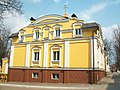
The oldest building in the town is the church of St. Nicholas (1693), modeled after traditional wooden churches and executed in the Ukrainian Baroque style. The church, repaired and renovated in 1871, has three pear-shaped domes and a two-storey bell tower.

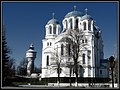
The church of the Savior's Transfiguration (1765) straddles the line between Baroque and Neoclassicism, while the massive Neo-Byzantine cathedral (1884–93) resembles St Volodymyr's Cathedral in Kyiv.

Probably the best known landmark of modern Hlukhiv is the conspicuous water tower (1927–29), though more historical interest attaches to the triumphal arch, dated either to 1744 or 1766. It has been suggested that the architect of this rather plain structure was Andrey Kvasov. The arch, the oldest in Ukraine, sustained damage during World War II but was subsequently restored.

Many of Hlukhiv's historic and architectural monuments are part of National State Historical and Cultural Reserve "Hlukhiv".

Religion

[edit]

The most dominant religious presentation in the city has the Russian Orthodox Church through the Ukrainian Orthodox Church (Moscow Patriarchate).

Near Hlukhiv in the village of Sosnivka is located a small monastery (Russian Orthodox Church) Glinsk Hermitage.

Agricultural research

[edit]

Due to the traditional cultivation of industrial hemp in the area, Hlukhiv has become home to the Institute of Bast Crops of the Ukrainian Academy of Agrarian Sciences, working on breeding improved hemp and flax cultivars. In the 1970s, the institute developed low-THC hemp varieties for industrial cultivation.[10][11]

Notable people

[edit]

Born in Hlukhiv

[edit]
Ada Rohovtseva
Heorhiy Narbut

Lived in Hlukhiv

[edit]
[edit]

See also

[edit]

References

[edit]
[edit]
Revisions and contributorsEdit on WikipediaRead on Wikipedia
from Grokipedia
Hlukhiv (Ukrainian: Глухів) is a city of regional significance and administrative center of Shostka Raion in Sumy Oblast, northeastern Ukraine, situated on the Esman River approximately 135 km northwest of the oblast capital Sumy. As of 2022, its population was estimated at 31,789, reflecting a decline amid regional challenges including proximity to the Russian border. The city holds profound historical importance as the primary residence of the Hetman of the Zaporozhian Host from 1708 to 1764, serving as the de facto capital of the Cossack Hetmanate following the Russian destruction of the prior capital Baturyn during the Great Northern War; this era marked a period of relative autonomy for Left-Bank Ukraine under hetmans such as Ivan Skoropadsky and Kyrylo Rozumovsky. Hlukhiv also emerged as a cradle of Ukrainian musical culture with the founding of the Hlukhiv Singing School in 1738, the first specialized music academy in the Russian Empire, which trained composers like Maksym Berezovsky and Dmytro Bortnianskyi and laid foundations for professional choral and instrumental traditions. Today, it preserves Baroque-era architecture, educational institutions such as Hlukhiv National Pedagogical University, and a legacy as a center of Cossack governance and cultural innovation, though its strategic location has exposed it to modern geopolitical tensions.

Geography

Location and terrain


Hlukhiv is situated in Shostka Raion of Sumy Oblast in northern Ukraine, at geographical coordinates approximately 51°40′N 33°55′E. The city lies on the banks of the Esman River, a tributary of the Seym River, and is positioned about 10 kilometers south of the international border with Russia. This proximity to the border has historically shaped regional dynamics, including cross-border interactions affecting trade routes and security considerations. It is roughly 140 kilometers northwest of the oblast administrative center, Sumy.
The terrain around Hlukhiv forms part of the Polissia lowlands, a physical-geographical region of flat plains interspersed with mixed forests, wetlands, and river valleys in northeastern Ukraine. The landscape features gentle undulations, with elevations averaging around 170 meters above sea level, and the Esman River valley providing natural drainage and defining settlement patterns through its meandering course and floodplain features. This northern plain environment, transitional between forest and steppe zones, supports a mix of arable land and wooded areas, with the river contributing to local soil fertility via alluvial deposits.

Climate and environment

Hlukhiv lies within the zone (Köppen Dfb), featuring pronounced seasonal variations with cold, snowy winters and warm, relatively humid summers. Winters are marked by freezing temperatures, frequent snowfall, and overcast skies, while summers are comfortable with partial and longer daylight hours. The transition seasons of spring and autumn are short, with increasing wind speeds peaking in at around 11.6 mph. Average January temperatures hover around -7°C, with daily highs near -5°C and lows dropping to -12°C, accompanied by about 7.4 inches of snowfall. In contrast, July sees average temperatures of 19°C, with highs reaching 24°C and lows at 14°C, marking the peak of the warmer period from mid-May to mid-September. Annual precipitation approximates 600 mm, concentrated during a wetter season from May to August, including rainfall and occasional thunderstorms, though the region experiences no prolonged dry spells. The surrounding environment encompasses the Desna Plateau's mixed forest-steppe landscape, with fertile soils prone to from agricultural use and seasonal runoff, supporting diverse synanthropic dominated by summer-green adapted to moderate humidity and continental conditions. Local water bodies, such as the Esman River, exhibit variable quality influenced by upstream and hydrological fluctuations, as documented in biological assessments. Ecological studies highlight the presence of rare requiring conservation amid broader regional shifts linked to variability.

History

Origins through medieval period

Archaeological investigations indicate human activity in the Hlukhiv area dating back to the early centuries of the Common Era, with settlements identified near the modern city center and along the Esman River, suggesting prehistoric occupation by local tribes prior to Slavic expansion. These findings point to small-scale habitation rather than organized urban development, likely tied to the forested-steppe transition zone favorable for hunting and early agriculture. The first documentary reference to Hlukhiv appears in the Hypatian Codex, a 15th-century compilation of earlier East Slavic chronicles, recording it in 1152 as a fortified settlement (город) within the Principality of Chernihiv, a key polity of Kievan Rus'. Positioned on the Esman River—a tributary of the Desna—this location facilitated regional trade along waterways connecting to the Dnieper basin while serving as a defensive outpost against nomadic incursions from the Pontic steppe, such as those by Pechenegs and Cumans. As part of Kievan Rus' frontier defenses, Hlukhiv's early fortifications likely consisted of earthen ramparts and wooden palisades typical of 12th-century Slavic strongholds, aimed at securing borders amid inter-princely conflicts and steppe raids. Historical records provide scant details on its medieval trajectory, with the town experiencing stagnation or depopulation following the Mongol invasions of the 1230s–1240s, which disrupted Rus' principalities and shifted power dynamics eastward. Verifiable growth remained limited until the 16th century, underscoring its role as a peripheral outpost rather than a major center during this era.

Cossack Hetmanate era

In November 1708, after Russian forces under Tsar Peter I razed Baturyn—the prior capital of the Cossack Hetmanate—for Hetman Ivan Mazepa's defection to Sweden during the Great Northern War, Peter appointed Ivan Skoropadsky as the new Hetman and shifted the administrative residence to Hlukhiv. Hlukhiv, previously the center of its namesake regiment, now hosted the Hetman's chancery and the General Military Chancellery, consolidating its role as the de facto capital of Left-Bank Ukraine. This relocation positioned the city nearer the Russian border, facilitating oversight by Moscow while preserving nominal Cossack autonomy. From 1708 to 1764, Hlukhiv served as the primary seat for successive Hetmans, including Skoropadsky (1708–1722), acting Hetman Pavlo Polubotok (1722–1724), Danylo Apostol (1727–1734), and Kyrylo Rozumovsky (1750–1764), who governed the Hetmanate's 10–12 regimental districts east of the Dnieper. The city functioned as the hub for military administration, with regimental colonels convening there for policy decisions and Cossack starshyna (officer elite) maintaining estates, underscoring Hlukhiv's strategic importance in balancing Cossack self-rule against Russian influence. This era marked Hlukhiv's cultural and architectural zenith, as Hetman patronage funded constructions in the Cossack Baroque style, blending Ukrainian Orthodox traditions with ornate Western influences to symbolize elite status and autonomy. Notable examples include the Transfiguration Church, built in the 1720s under Apostol's oversight, featuring tiered domes and decorative facades typical of the period's ecclesiastical architecture. Hetman residences and fortifications also expanded, reflecting the influx of administrative personnel and resources. The Hetmanate's dissolution began in earnest after Rozumovsky's forced resignation in 1764 under Empress Catherine II, who abolished the office and subordinated Left-Bank Ukraine to direct Russian governance via the Little Russia Collegium, thereby demoting Hlukhiv from capital to a provincial center. This centralization eroded Cossack institutions, though Hlukhiv retained some regimental functions until the 1780s.

Russian Empire period

Following the abolition of the Cossack Hetmanate in 1764, Hlukhiv transitioned from a center of semi-autonomous governance to an administrative outpost within the Russian Empire's centralized system, marking a clear erosion of local political autonomy through imperial reorganization of Left-Bank Ukraine. Initially incorporated into the Little Russia Governorate (Malorossiia), the town became the administrative seat of Glukhov uezd (county) in the newly formed Chernigov Governorate in 1802, one of 15 counties encompassing agricultural lands and facilitating imperial tax collection and military recruitment. This shift subordinated former Hetmanate elites to St. Petersburg's oversight, with empirical records showing reduced Cossack privileges and increased Russification policies that curtailed Ukrainian-language administration by the mid-19th century. The Hlukhiv Singing School, established in 1738 as the Russian Empire's inaugural professional music institution, persisted as a cultural anchor, training choristers primarily from Ukrainian backgrounds for service in the Imperial Court Chapel in St. Petersburg. By the late 18th and 19th centuries, the school supplied a majority of the chapel's singers, exerting outsized Ukrainian influence on Russian imperial sacred music despite broader cultural suppression efforts; composers like Dmytro Bortnianskyi, who studied there before directing the chapel from 1796 to 1825, exemplified this dynamic. Empirical accounts confirm the school's role in sustaining a pipeline of talent, with records indicating annual recruitment of boys aged 7–10 for rigorous vocal and instrumental training geared toward court needs. Economic activity centered on trade in grain, tobacco, and livestock, bolstered by the town's position as a uezd hub along regional routes, alongside handicrafts such as weaving, pottery, and metalworking that supported local markets. Population growth reflected this modest expansion, with the urban settlement reaching about 11,700 residents by the 1897 imperial census, driven by administrative functions and Jewish merchant communities within the Pale of Settlement. However, imperial policies favoring large estates limited broader industrialization, maintaining Hlukhiv as a secondary provincial node. In early 1918, amid the Russian Civil War's onset and power vacuums following Bolshevik consolidation, Hlukhiv experienced an antisemitic pogrom involving attacks on Jewish residents, resulting in dozens to hundreds of deaths and property destruction, as documented in contemporaneous reports of localized violence by irregular forces and mobs. This event, one of the initial "red pogroms" in Ukraine, highlighted ethnic tensions exacerbated by wartime disorder rather than systematic policy, with victims later commemorated at the local Jewish cemetery.

20th century upheavals

Following the chaos of the Russian Revolution and Civil War (1917–1921), Hlukhiv was the site of a violent pogrom in March 1918 targeting its Jewish population, part of broader antisemitic attacks amid the power vacuum and Bolshevik advances. By late 1920, Bolshevik forces had secured control over the region, integrating it into the emerging Ukrainian Soviet Socialist Republic formalized in 1922. The interwar period brought further disruptions through forced collectivization starting in 1929, which dismantled private farming and triggered resistance, followed by the Holodomor famine of 1932–1933 engineered via grain requisitions exceeding harvests and restrictions on movement. Hlukhiv, lying in what was then Kharkiv Oblast, suffered acute effects, with the oblast registering 179 excess deaths per 1,000 residents—among the highest rates nationally—compounding losses from Stalin's purges of perceived kulaks and intellectuals in 1937–1938. These policies halved rural populations in affected areas and eroded local leadership. World War II intensified destruction when Nazi Germany invaded on June 22, 1941, occupying Hlukhiv within weeks as part of Reichskommissariat Ukraine until Soviet liberation in September 1943. The occupation saw systematic plunder, forced labor, and cultural erasure, including the demolition of the Golden-Domed (Choral) Synagogue, a 19th-century landmark reduced to ruins amid broader anti-Jewish measures. Ukrainian partisans operated in surrounding forests, conducting sabotage against German supply lines, though reprisals targeted civilians. Collectively, these upheavals—from civil war violence and pogroms, to famine and purges, to wartime occupation—inflicted demographic losses estimated at 20–30 percent on Ukrainian territories like Hlukhiv's, driven by direct mortality and migration amid policy-induced scarcity and conflict. Post-liberation reconstruction prioritized infrastructure repair and light industry expansion, yet entrenched repression delayed full recovery until later Soviet initiatives.

Soviet era

In the late 1920s and early 1930s, Hlukhiv, as part of the Ukrainian Soviet Socialist Republic, underwent forced collectivization, where individual peasant holdings were consolidated into kolkhozes (collective farms) under state directives issued from 1928 to 1933. This process involved dekulakization campaigns targeting wealthier farmers, resulting in the deportation or execution of thousands across Ukraine, including in northern regions like Sumy Oblast encompassing Hlukhiv, with empirical records indicating over 1.8 million kulaks repressed nationwide by 1931. While collectivization enabled centralized mechanization and scaled production—facilitating efficiency gains in labor allocation and input distribution by the mid-1930s—the policy's coercive grain procurement quotas exceeded harvest capacities, contributing to the Holodomor famine of 1932–1933, which caused 3.9 million deaths in Ukraine through starvation and related factors, driven by disrupted incentives and livestock slaughter in resistance. In Hlukhiv's agrarian context, traditional hemp cultivation was integrated into collectives, with manual harvesting persisting until mechanized shifts in the 1930s. Amid this, the All-Union Research Institute of Hemp was established in Hlukhiv in 1931 to advance bast crop (hemp and flax) breeding and agronomy, reflecting Soviet prioritization of industrial fiber production for textiles and ropes, later merging in 1944 into the broader All-Union Institute of Bast Crops. Post-World War II reconstruction emphasized agronomic specialization, with the institute focusing on variety development and farm techniques; by the 1950s, it supported state farms (sovkhozes) in Sumy Oblast through experimental stations testing resilient hemp strains suited to local soils, contributing to national output increases in non-food crops amid broader USSR agricultural mechanization drives. During the Brezhnev era (1964–1982), Hlukhiv's collectives benefited from heavy subsidies—including fertilizers and machinery inputs totaling billions of rubles annually across Soviet agriculture—but underlying productivity stagnated due to central planning rigidities, weak worker incentives, and soil degradation, with grain yields per hectare in Ukraine hovering below Western levels despite inflated procurement statistics. Declassified Soviet data reveal that by the 1980s, kolkhoz inefficiencies in regions like Sumy masked chronic shortfalls through private plots supplying up to 30% of produce, underscoring the policy's failure to achieve sustainable gains without state props.

Post-independence developments

Following Ukraine's independence in 1991, Hlukhiv experienced economic challenges typical of rural areas in the post-Soviet transition, including the decollectivization of agriculture that fragmented collective farms into smaller private holdings, leading to reduced productivity and output due to limited access to capital, machinery, and markets. The town's economy, heavily reliant on agriculture in Sumy Oblast, saw stagnation amid hyperinflation and GDP contraction across Ukraine, with industrial enterprises struggling to adapt to market conditions. Population levels in Hlukhiv's town council remained relatively stable, registering 36.2 thousand in the 1989 Soviet census and 36.1 thousand in the 2001 Ukrainian census, though broader demographic pressures like out-migration contributed to gradual urban decline in subsequent years. Decentralization reforms initiated in 2014 empowered local governments with greater fiscal autonomy and funding, enabling Hlukhiv to invest in infrastructure such as road repairs, public utilities, and community facilities. Under Mayor Yuriy Tereshchenko, elected in 2015 with 65% support on a platform to revitalize the town drawing on his family's historical ties, efforts focused on modernizing local governance and attracting investment, though internal conflicts led to his resignation in 2018. These reforms facilitated projects like utility upgrades and cultural site preservation, aligning with national trends where amalgamated communities gained resources for development until 2021. Cultural initiatives emphasized Hlukhiv's legacy as the Cossack Hetmanate's capital from 1708 to 1764, with the establishment and promotion of the National Historical and Cultural Reserve "Glukhov" highlighting sites like churches and monuments tied to that era. Commemorative events, including those tied to Ukrainian Independence Day, featured reconstructions and festivals celebrating Hetmanate history, fostering local identity and drawing domestic tourists to attractions such as the Water Tower and historical ensembles. This contributed to modest tourism growth, supported by the town's preserved architecture and proximity to regional routes, though quantitative data remains limited amid national economic constraints.

Russian invasion since 2022

Since February 2022, Hlukhiv in Sumy Oblast has faced repeated cross-border attacks from Russian forces based in adjacent Bryansk and Kursk oblasts, primarily involving artillery, mortars, multiple-launch rocket systems (MLRS), and drones, due to its proximity—approximately 35 kilometers—to the international border. Ukrainian armed forces have prevented any ground incursions or occupation of the city, maintaining defensive positions amid ongoing shelling that has damaged civilian infrastructure, including administrative buildings, gas stations, and residential areas. Russian state media and military statements assert that such strikes target Ukrainian military assets and logistics near the border, while Ukrainian regional authorities describe the attacks as indiscriminate, affecting non-combatants and essential services without verified military justification in many cases. Notable incidents include a March 10, 2025, FPV drone strike on a gas station in Hlukhiv, causing structural damage but no reported immediate casualties. On April 17, 2025, drones targeted critical infrastructure in the Hlukhiv community, disrupting local utilities. By July 2025, shelling had damaged civilian facilities in the area, with reports of hits on apartment blocks and private homes in nearby communities, contributing to broader regional patterns of over 85 daily attacks in Sumy Oblast. A significant escalation occurred on November 18, 2024, when two Russian combat drones struck a dormitory in Hlukhiv, killing at least eight civilians—including one child—and injuring 13 others, according to initial Ukrainian emergency service assessments that later varied slightly in totals across reports. These attacks have led to civilian casualties, with at least one resident from Hlukhiv seeking treatment for shrapnel wounds from prior strikes as of October 9, 2025, amid patterns of injuries from explosive remnants. Infrastructure damage has included non-residential structures and administrative sites, as seen in late July 2025 strikes, exacerbating disruptions to education—such as school closures or relocations—and agriculture, a key local sector reliant on border-proximate fields now under frequent fire, halting operations and contributing to economic stagnation without direct occupation. Ukrainian authorities have conducted evacuations, including families from Hlukhiv in October 2025, amid dependency on international aid for repairs and humanitarian support, though sustainability remains challenged by persistent strikes exceeding 100-150 per day in Sumy Oblast by late 2025. Regional data indicate no full-scale assaults but sustained low-intensity harassment, with Ukrainian defenses relying on mobile artillery countermeasures and drone interceptions to mitigate incursions.

Demographics

Population dynamics

Hlukhiv's population was estimated at 31,789 in 2022, reflecting a density of approximately 1,374 inhabitants per square kilometer across its 23.14 km² area. This figure marks a continuation of long-term decline from Soviet-era highs, driven primarily by net emigration and sub-replacement fertility rates nationwide, with Ukraine's total fertility rate hovering around 1.2 children per woman in recent years. Pre-war trends in Sumy Oblast, including Hlukhiv, showed persistent outflows of working-age residents to urban centers like Kyiv or abroad, exacerbating depopulation amid economic stagnation and limited local opportunities. Birth rates remained low, mirroring national patterns where deaths consistently outpaced births since the 1990s, contributing to a gradual shrinkage without significant immigration inflows. The Russian invasion since February 2022 intensified these dynamics in border-adjacent Hlukhiv, prompting evacuations and displacement to safer western or central Ukrainian regions due to frequent shelling in Sumy Oblast. National estimates indicate Ukraine's overall population dropped by at least 10 million by mid-2025 through emigration, occupation, and excess mortality, with northern oblasts like Sumy experiencing acute outflows. Aging demographics have worsened, with roughly 20% of residents over 65, straining local resources amid low youth retention. Projections from Ukrainian demographic institutes and UN data foresee further contraction for small cities like Hlukhiv, potentially stabilizing at lower levels only if war ends and repatriation occurs, though sustained low fertility and emigration suggest no near-term reversal. Absent policy interventions, regional models for Sumy predict heightened dependency ratios by 2030 due to these inertial forces.

Ethnic and linguistic makeup

According to the 2001 All-Ukrainian census, Hlukhiv's population was 81.5% ethnic Ukrainian, 17% Russian, 0.4% Belarusian, 0.4% Jewish, and 0.7% other ethnicities, reflecting a historically Ukrainian-majority composition with a notable Russian minority likely influenced by Soviet-era migration and Russification policies that favored Russian settlement in urban centers. This breakdown aligns with broader Sumy Oblast trends, where Ukrainians comprised 88.8% oblast-wide, but Hlukhiv's urban profile showed higher Russian presence compared to rural areas. Linguistically, the 2001 census indicated that Ukrainian was the native language for approximately 83% in the Hlukhiv area (district level), with Russian at 16.4%, underscoring bilingualism in a border region where Russian served as a lingua franca under Soviet promotion despite the ethnic Ukrainian majority. Post-2014 language laws mandating Ukrainian in public administration, education, and media have shifted usage toward greater Ukrainian dominance, with surveys showing national increases in Ukrainian identification from 78% ethnic self-reporting in 2001 to over 90% by 2022 amid decommunization efforts, though persistent Russian usage in private spheres and family settings remains evident in northeastern Ukraine due to cultural inertia and proximity to Russia. The Russian invasion since 2022, involving repeated shelling of Hlukhiv from across the border, has not produced documented ethnic cleavages or displacements along linguistic lines, with empirical reports indicating community cohesion centered on Ukrainian sovereignty rather than inter-ethnic conflict, consistent with pre-war stability in mixed areas.

Government and administration

Local governance structure

Hlukhiv's local governance follows the standard Ukrainian municipal model of a mayor-council system, where the elected city council (міська рада) acts as the representative legislative body responsible for approving budgets, local regulations, and development plans, while the directly elected mayor heads the executive branch and oversees daily administration. As a city of oblast significance prior to reforms, Hlukhiv retained its status as the center of the Hlukhiv urban territorial community (hromada) following the July 18, 2020, administrative reorganization, which consolidated it within the expanded Shostka Raion of Sumy Oblast without subordinating its core municipal functions to raion-level authorities. The 2014 decentralization laws fundamentally strengthened hromada-level autonomy by enabling voluntary amalgamation of communities, devolving powers over essential services including primary education, healthcare facilities, social welfare, and communal infrastructure, while prohibiting arbitrary dissolution by central government. In Hlukhiv, this manifests in the hromada's control over local executive bodies, such as departments for economic development, social services, and utilities, supported by permanent commissions within the council for policy oversight. Municipal funding relies on own-source revenues like property taxes, land fees, and a 60% share of personal income tax generated within the hromada, supplemented by formula-based state transfers and grants for delegated functions. Since the onset of martial law in February 2022 amid the Russian invasion, Hlukhiv's governance has incorporated wartime protocols, including enhanced coordination with national defense structures and reliance on international aid for budget shortfalls, yet maintains operational independence in non-security domains.

Political developments

In the October 2015 local elections, Michel Tereshchenko, a France-born descendant of the Tereshchenko merchant dynasty, secured the mayoralty of Hlukhiv with 65.3% of the vote, reflecting post-Euromaidan support for reformist candidates. His administration pursued modernization initiatives, including tripling the municipal budget from 2015 to 2017 through efficient resource management and grant acquisition. These efforts encompassed infrastructure upgrades, such as park renovations and monument restorations, alongside cultural projects like establishing five new museums and a municipal radio station, earning Tereshchenko recognition as one of Ukraine's four most innovative mayors in 2017. Tereshchenko's tenure, extending to 2020, emphasized transparency and anti-corruption measures aligned with national decentralization reforms, though it encountered resistance from city council factions linked to lawmaker Andriy Derkach, who allegedly obstructed state funding transfers, resulting in stalled projects and heightened local tensions. Critics attributed some administrative approaches to paternalistic tendencies rooted in his familial legacy, potentially limiting broader civic participation despite evident fiscal gains. The October 2020 local elections proceeded amid national trends favoring incumbent or independent local figures, though specific Hlukhiv vote data underscores continued fragmentation between reform-oriented and entrenched interests. Following Russia's full-scale invasion in February 2022, Hlukhiv's political landscape shifted toward unified wartime mobilization, with martial law suspending elections and redirecting governance to defense coordination and civilian resilience against border-proximate shelling. Community solidarity manifested in volunteer efforts and infrastructure fortification advocacy, overriding partisan divides while national debates weighed military hardening of the Sumy Oblast frontier against broader diplomatic strategies.

Economy

Agricultural sector and research

The agricultural sector in Hlukhiv and its surrounding areas primarily revolves around grain production and livestock, including dairy farming, consistent with broader patterns in Sumy Oblast where grains such as wheat and barley dominate cultivated lands. Sumy Oblast's grain output peaked at 3,940.6 thousand tons in 2014, underscoring the region's historical reliance on these crops before wartime disruptions reduced overall agricultural production by over 20% in the first nine months of 2025 due to persistent shelling and border proximity. Cultivated farmland in Sumy Oblast has contracted by 4% since the onset of the Russian invasion in 2022, with farmers in areas like Hlukhiv facing additional risks from drones, mines, and infrastructure damage that hinder planting, harvesting, and machinery use. These challenges have exacerbated soil management issues and export logistics, limiting pre-war contributions to local GDP from farm outputs. Research and technical support for agriculture in Hlukhiv are anchored by the Hlukhiv Agrotechnical Vocational College, a structural unit of Sumy National Agrarian University established in 1899 and focused on vocational training for agrotechnical specialties such as crop cultivation, animal husbandry, and farm machinery operation. The college prepares junior specialists through programs emphasizing practical skills for improving farm efficiency, including preparatory courses for secondary school graduates entering fields like grain processing and livestock management, though specific innovations in hybrid seeds or yield optimization tied to Hlukhiv remain undocumented in public records. State subsidies in Ukraine's agricultural framework have historically supported such institutions, but critiques highlight inefficiencies from over-reliance on them, potentially distorting market-driven productivity in regions like Sumy where wartime conditions amplify vulnerabilities rather than fostering adaptive research. Ongoing conflict has curtailed field trials and extension services, redirecting efforts toward survival-oriented farming over long-term soil or yield enhancements.

Other industries and challenges

Hlukhiv's non-agricultural sector remains limited, focusing on small-scale processing industries and retail trade, which mirror regional patterns in Sumy Oblast where such activities account for approximately 13% of employment each, alongside services. Local employment centers have supported job placement in these areas, with 323 individuals employed through assistance since early 2024, including vocational training for 63 and vouchers for 34 others. The Russian invasion has intensified economic pressures, driving national unemployment from 9.5% in 2021 to 18.5% in 2022, with a gradual decline to 14.3% by 2024 amid labor shortages and displacement. In border areas like Hlukhiv, these effects are compounded by population outflows and reliance on humanitarian aid for entrepreneurs and small businesses. Recurrent infrastructure disruptions, including power outages from Russian strikes on energy facilities in Sumy Oblast—such as those reported in early 2022 and ongoing drone attacks—hamper manufacturing and trade operations, exacerbating production halts and supply chain issues. Public works programs, reinstated in Hlukhiv around 2021, provide temporary relief for the unemployed but highlight structural vulnerabilities in sustaining non-agricultural growth.

Education and science

Key institutions

The primary higher education institution in Hlukhiv is the Hlukhiv National Pedagogical University of Oleksandr Dovzhenko, established in 1874 as a teachers' institute and elevated to university status in 2001. It specializes in pedagogical training, offering bachelor's programs in primary education, secondary education with emphases in natural and physical-mathematical sciences, and other fields that integrate STEM curricula alongside teacher preparation. Enrollment has declined since Russia's 2022 invasion, with displacement reducing student numbers amid broader regional population outflows. Affiliated with the university, the Professional Pedagogical Specialty College provides vocational pre-higher education, training junior specialists in bachelor's-level programs focused on practical teaching skills. Curricula emphasize professional development in education, incorporating elements of music and arts heritage tracing back to the Hlukhiv Singing School, founded in 1738 as the Russian Empire's first professional music academy, which produced composers like Maksym Berezovsky and Dmytro Bortnyansky. This legacy influences modern programs, including those at the Hlukhiv Children's School of Arts, which continues training in vocal and instrumental music. Local secondary schools have adapted to wartime conditions through hybrid models combining in-person classes with online instruction, though access gaps persist due to infrastructure damage and security issues reported in 2025. Enrollment in these institutions dropped post-2022, reflecting displacement affecting over 4.6 million Ukrainian children nationwide, with Hlukhiv's proximity to the border exacerbating local challenges. STEM-focused curricula in schools build on the university's model, prioritizing mathematics, physics, and biology amid efforts to maintain educational continuity.

Agricultural research contributions

The Institute of Bast Crops of the National Academy of Agrarian Sciences of Ukraine, established in Hlukhiv in 1931 as the All-Union Research Institute of Hemp, has specialized in breeding and agronomic research on bast fiber crops, particularly industrial hemp (Cannabis sativa) and long-fiber flax (Linum usitatissimum). During the Soviet era, it collaborated extensively with union-wide entities to develop varieties suited to northern climates, emphasizing fiber yield and mechanical harvesting compatibility, which contributed to standardized cultivation practices across the USSR. Post-independence, the institute shifted toward non-narcotic, low-THC hemp strains, achieving milestones such as the world's first monoecious (hermaphroditic) hemp varieties for stable seed production and fiber quality. Key advancements include over 20 registered hemp cultivars optimized for fiber length, tensile strength, and environmental resilience, with research demonstrating photoperiod-induced epigenetic shifts enabling unisexual hybrids to adapt sex expression for higher yields under variable conditions. Publications from the institute report yield improvements of up to 20-30% in fiber output through selective breeding and intensive retting technologies, alongside innovations in harvesting equipment like combined picker-threshers reducing labor by 40% compared to manual methods. These outputs supported Soviet-era quotas but revealed limitations in over-specialization; state-directed focus on bulk fiber production overlooked diversified markets, leading to post-1991 declines in hemp acreage from 100,000+ hectares annually to under 5,000 by 2010 due to insufficient processing infrastructure and export barriers. Since Russia's 2022 invasion, operations in Hlukhiv—15 km from the border—have faced severe disruptions, including multiple strikes on facilities (e.g., November 2024 attacks damaging warehouses and workshops) and fieldwork under drone surveillance, halting experimental plots and causing researcher displacement. Despite this, the institute has adapted by prioritizing war-relevant applications, such as hemp-derived materials for gunpowder stabilizers and ballistic fabrics, while maintaining seed banks for varietal preservation. Pre-war yields averaged 1.5-2 tons of fiber per hectare for elite strains, but current data indicate 20-50% reductions from insecurity and input shortages, underscoring vulnerabilities in localized research amid geopolitical instability.

Culture and landmarks

Historical sites and monuments

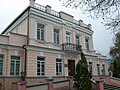
Hlukhiv preserves several architectural remnants and monuments tied to its tenure as the capital of the Cossack Hetmanate from 1708 to 1765, when it served as the administrative center following the destruction of Baturyn. These sites, many incorporated into the National Historical and Cultural Reserve "Hlukhiv," highlight the city's defensive and civic structures from the 18th century onward. The Kyiv Gate, constructed between 1766 and 1769, stands as the sole surviving element of the Hlukhiv fortress fortifications, originally comprising four entrances to the old town and underscoring the city's strategic role on trade routes from Kyiv to Moscow. This brick archway exemplifies late Baroque defensive architecture adapted for ceremonial access. The Water Tower, erected in 1927–1929 to a height of 41 meters on the site of the former Putivl Gate, functions as a prominent landmark of early Soviet infrastructure while evoking the fortress's historical footprint. Its conical base transitioning to a cylindrical upper section marks it as a unique engineering monument of local significance. The Tereshchenko House represents the earliest extant structure linked to the Tereshchenko family, 19th-century industrialists and philanthropists whose sugar refining enterprises bolstered the regional economy; built in the mid-19th century, it embodies merchant architecture from Hlukhiv's post-Hetmanate commercial era. The Hlukhiv Local Lore Museum, established in 1902 from a private collection of Ukrainian antiquities amassed by Mykola Shuhurov, curates artifacts spanning prehistoric settlements to the Cossack period, including documents and relics from the Hetmanate's governance in the city. Its exhibits preserve evidence of Hlukhiv's role in Cossack statehood, such as administrative records and regimental artifacts. Among monuments, the Partisan Monument commemorates local resistance fighters from World War II, while the Memorial to Victims of the Second World War, unveiled in 1991, honors those lost in the 1941–1943 Nazi occupation, reflecting mid-20th-century commemorative efforts amid Soviet-era reconstructions.

Religious heritage

Hlukhiv's religious heritage centers on Eastern Orthodox churches from the Cossack Hetmanate era, when the city served as a political and ecclesiastical hub. The Transfiguration Church, erected in 1765 on the site of a 17th-century wooden predecessor, was designed by architect Andriy Kvasov and blends Baroque elements with later Neoclassical additions, including a tiered bell tower completed in the early 19th century; it holds national monument status and remains active for services. The Saint Nicholas Church, constructed from 1683 to 1695 at the behest of Cossack colonel Vasyl Yalotsky, represents the oldest extant religious edifice in Hlukhiv, featuring a unique triconch layout typical of Ukrainian temple architecture of the period. The Three-Anastasius Church, built in the early 18th century as a private chapel for Hetman Ivan Skoropadsky's family, exemplifies domestic sacral architecture and was designated a national heritage site for its monumental and artistic value. These structures underscore a legacy of Orthodox institutional growth amid relative confessional tolerance in the Hetmanate, though punctuated by episodic violence. Jewish religious life in Hlukhiv featured the Golden-Domed Choral Synagogue, a prominent 19th-century edifice that functioned as a central communal hub until its destruction by German forces during World War II; archival records detail its prewar role in rituals and education. The community endured severe pogroms in 1918–1919, with documented fatalities exceeding hundreds, reflecting broader anti-Semitic upheavals during the Russian Civil War rather than systemic local policy. Soviet rule from 1917 onward enforced atheism, closing most churches and repurposing buildings for secular uses, which eroded active religious practice until partial restorations post-1991. In the contemporary era, Orthodox congregations in Hlukhiv have largely affiliated with the autocephalous Orthodox Church of Ukraine established in 2018, diminishing ties to Moscow-aligned structures amid national ecclesiastical realignments. Small Protestant communities persist but maintain limited institutional presence compared to Orthodox dominance.)

Notable people

Individuals born in Hlukhiv

Maksym Berezovsky (1745–1777), a composer of operas, symphonies, and sacred choral works, received early training at Hlukhiv's singing school before studying in Italy and serving in St. Petersburg's court chapel; he became the first composer from Eastern Slavs elected to the Accademia Filarmonica di Bologna in 1773. Dmytro Bortniansky (1751–1825), renowned for his polyphonic Orthodox liturgical music and operas such as Alcide (1778), began as a chorister in Hlukhiv before advancing to direct the St. Petersburg Imperial Choir and compose over 100 sacred concertos that influenced Russian ecclesiastical tradition. Oleksandr Bezborodko (1747–1799), a Cossack-descended diplomat, served as secretary of petitions under Catherine II and later as Grand Chancellor, shaping Russian foreign policy through treaties like the 1793 Second Partition of Poland. Ada Rohovtseva (b. 1937), a stage and film actress awarded the title of People's Artist of the USSR in 1988, starred in over 100 roles including Salyut, Mariya! (1971) and continued performing in Ukrainian theater post-independence. Hlukhiv's 18th-century music academy, established under Hetman Kyrylo Rozumovsky, supplied talents to imperial ensembles, elevating the town's role in classical music development despite limited surviving biographical details for some alumni.

Figures associated with Hlukhiv

Ivan Skoropadsky (1646–1722), Hetman of the Zaporozhian Host from 1708 to 1722, relocated the administrative center of the Cossack Hetmanate to Hlukhiv in November 1708 after the Russian forces destroyed Baturyn in retaliation for Ivan Mazepa's alliance with Sweden. His decision positioned Hlukhiv as the de facto capital of Left-Bank Ukraine for over half a century, fostering administrative and cultural development under Russian oversight. Skoropadsky resided in Hlukhiv until his death there on 3 July 1722. Danylo Apostol (ca 1654–1734), Hetman from 1727 to 1734, governed from Hlukhiv and oversaw a period of urban expansion, including infrastructure improvements and population growth that solidified the city's role as a regional hub. Elected amid tensions with Russian authorities, Apostol's tenure emphasized Cossack autonomy while navigating imperial constraints, contributing to Hlukhiv's prominence before the Hetmanate's further curtailment. Kyrylo Rozumovsky (1728–1803), the final Hetman serving from 1750 to 1764, was elected at the Hlukhiv Council of 1750 and maintained his residence there, where he pursued reforms in education, nobility privileges, and Cossack administration. Under his rule, Hlukhiv hosted assemblies addressing state reforms, though his efforts ultimately yielded to Catherine II's 1764 abolition of the Hetmanate, after which he relocated to Kozelets. In the 20th and 21st centuries, Hlukhiv attracted figures through heritage and governance. Michel Terestchenko (b. 1975), a French-born businessman and descendant of the 19th-century Tereshchenko merchant family originating from Hlukhiv, served as the city's mayor from 2015 to 2020, implementing reforms in transparency, tourism, and local economy amid challenges from entrenched interests. His initiatives, including digital governance and historical preservation, aimed to revive Hlukhiv's legacy but faced resistance, leading to his resignation in 2018 after disputes with the city council.

References

Add your contribution
Related Hubs
User Avatar
No comments yet.