
Recent from talks
HMS Swordfish (1916)
Knowledge base stats:
Talk channels stats:
Members stats:
HMS Swordfish (1916)
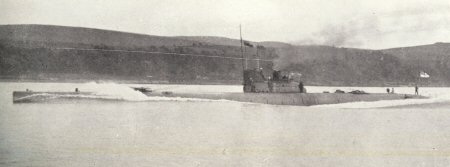
HMS Swordfish was an experimental submarine built for the Royal Navy before the First World War to meet the Navy's goal of an "overseas" submarine capable of 20 knots (37 km/h; 23 mph) on the surface. Diesel engines of the period were unreliable and not very powerful so steam turbines were proposed instead to meet the RN's requirement. Swordfish proved to be slower than designed and unstable while surfacing, and consequently she was modified as an anti-submarine patrol vessel in 1917. She was paid off before the end of the war and sold for scrapping in 1922.
HMS Swordfish was developed to meet a requirement of Royal Navy's Submarine Committee for a large submarine capable of operating with the fleet at a surfaced speed of 20 knots (37 km/h; 23 mph). Most of the earlier British submarines had been single-hulled vessels built by Vickers, and the Navy was interested in evaluating other designs. Captain Roger Keyes, Inspecting Captain of Submarines, had previously served as naval attaché in Italy and had kept abreast of Italian submarine developments, which notably included double-hulled submarines designed by Cesare Laurenti of Fiat-San Giorgio. Three boats of the S class were ordered first and Laurenti was invited to submit a design to meet the RN requirement.
Fiat-San Giorgio "was wary about using heavy oil diesel engines and hesitated to guarantee the success of such engines of the power required. At the same time Laurenti prepared a design with geared steam turbines having a speed of 18 knots on a surface displacement of 856 tons." His design was modified by Scotts Shipbuilding and Engineering Company, Greenock, to include guns. Swordfish kept the same main dimensions as Laurenti's original design, but had a greater displacement and less endurance.
Swordfish had an overall length of 231 ft 3.5 in (70.498 m), a beam of 22 ft 11 in (6.99 m), and a draught of 14 feet 11 inches (4.55 m). She displaced 932 long tons (947 t) on the surface and 1,105 long tons (1,123 t) submerged. She had a partial double hull, which extended over 75% of her length. The upper portion of the double hull was controlled free-flooding while the rest was devoted to watertight 'baling flats', ballast and fuel tanks. Her hull was divided into eight compartments by seven watertight bulkheads.
Swordfish's diving depth and time are not known because the records from her sea trials have not survived. Shutting down her boiler, retracting the funnel and sealing the boiler uptake required about a minute and a quarter, which included switching over to the electric motors. In marked contrast to contemporary Vickers designs much attention was paid to safety arrangements, including her extensive subdivision. Indicator and telephone buoys, which could be released from inside the submarine were provided together with external air connections and a charged high-pressure line which could provide air to any manned compartment or the living spaces. Furthermore, the main ballast tanks could be blown from either end of the ship.
Swordfish had two Parsons geared impulse-reaction steam turbine sets, each driving one of the two propeller shafts. The turbines were powered by a single Yarrow-type boiler. They were designed to produce a total of 4,000 shaft horsepower (3,000 kW) at a working pressure of 250 psi (1,700 kPa; 18 kgf/cm2) which used a superheater to increase the working temperature by 100 °F (38 °C). She was fitted with two electric motors which had a combined output of 1,400 bhp (1,000 kW). Two battery rooms each had 64 battery cells. It is uncertain if the ship reached her designed speed of 18 knots (33 km/h; 21 mph) on the surface, although it seems unlikely given her increased displacement over Laurenti's original design. Maximum speed was 10 knots (19 km/h; 12 mph) underwater.
Swordfish could carry 102 long tons (104 t) of fuel oil, which her builders estimated gave her an endurance of 3,000 nautical miles (5,600 km; 3,500 mi) at a speed of 8.5 knots (15.7 km/h; 9.8 mph) on the surface. On her batteries her submerged endurance was 60 nautical miles (110 km; 69 mi) at a speed of 6 knots (11 km/h; 6.9 mph).
Swordfish had two tubes for 21-inch (530 mm) torpedoes in her bow. They were stepped vertically and positioned well back from the stem in a notch from the keel to preserve the fine lines of the bow. Two 18-inch (460 mm) torpedo tubes were positioned on each beam amidships. Each torpedo tube was provided with one reload. Two 3-inch (76 mm) guns were fitted on the deck in disappearing mounts, one each fore and aft of the conning tower. They were covered by watertight hoods to preserve the streamlining of the submarine.
Hub AI
HMS Swordfish (1916) AI simulator
(@HMS Swordfish (1916)_simulator)
HMS Swordfish (1916)
HMS Swordfish was an experimental submarine built for the Royal Navy before the First World War to meet the Navy's goal of an "overseas" submarine capable of 20 knots (37 km/h; 23 mph) on the surface. Diesel engines of the period were unreliable and not very powerful so steam turbines were proposed instead to meet the RN's requirement. Swordfish proved to be slower than designed and unstable while surfacing, and consequently she was modified as an anti-submarine patrol vessel in 1917. She was paid off before the end of the war and sold for scrapping in 1922.
HMS Swordfish was developed to meet a requirement of Royal Navy's Submarine Committee for a large submarine capable of operating with the fleet at a surfaced speed of 20 knots (37 km/h; 23 mph). Most of the earlier British submarines had been single-hulled vessels built by Vickers, and the Navy was interested in evaluating other designs. Captain Roger Keyes, Inspecting Captain of Submarines, had previously served as naval attaché in Italy and had kept abreast of Italian submarine developments, which notably included double-hulled submarines designed by Cesare Laurenti of Fiat-San Giorgio. Three boats of the S class were ordered first and Laurenti was invited to submit a design to meet the RN requirement.
Fiat-San Giorgio "was wary about using heavy oil diesel engines and hesitated to guarantee the success of such engines of the power required. At the same time Laurenti prepared a design with geared steam turbines having a speed of 18 knots on a surface displacement of 856 tons." His design was modified by Scotts Shipbuilding and Engineering Company, Greenock, to include guns. Swordfish kept the same main dimensions as Laurenti's original design, but had a greater displacement and less endurance.
Swordfish had an overall length of 231 ft 3.5 in (70.498 m), a beam of 22 ft 11 in (6.99 m), and a draught of 14 feet 11 inches (4.55 m). She displaced 932 long tons (947 t) on the surface and 1,105 long tons (1,123 t) submerged. She had a partial double hull, which extended over 75% of her length. The upper portion of the double hull was controlled free-flooding while the rest was devoted to watertight 'baling flats', ballast and fuel tanks. Her hull was divided into eight compartments by seven watertight bulkheads.
Swordfish's diving depth and time are not known because the records from her sea trials have not survived. Shutting down her boiler, retracting the funnel and sealing the boiler uptake required about a minute and a quarter, which included switching over to the electric motors. In marked contrast to contemporary Vickers designs much attention was paid to safety arrangements, including her extensive subdivision. Indicator and telephone buoys, which could be released from inside the submarine were provided together with external air connections and a charged high-pressure line which could provide air to any manned compartment or the living spaces. Furthermore, the main ballast tanks could be blown from either end of the ship.
Swordfish had two Parsons geared impulse-reaction steam turbine sets, each driving one of the two propeller shafts. The turbines were powered by a single Yarrow-type boiler. They were designed to produce a total of 4,000 shaft horsepower (3,000 kW) at a working pressure of 250 psi (1,700 kPa; 18 kgf/cm2) which used a superheater to increase the working temperature by 100 °F (38 °C). She was fitted with two electric motors which had a combined output of 1,400 bhp (1,000 kW). Two battery rooms each had 64 battery cells. It is uncertain if the ship reached her designed speed of 18 knots (33 km/h; 21 mph) on the surface, although it seems unlikely given her increased displacement over Laurenti's original design. Maximum speed was 10 knots (19 km/h; 12 mph) underwater.
Swordfish could carry 102 long tons (104 t) of fuel oil, which her builders estimated gave her an endurance of 3,000 nautical miles (5,600 km; 3,500 mi) at a speed of 8.5 knots (15.7 km/h; 9.8 mph) on the surface. On her batteries her submerged endurance was 60 nautical miles (110 km; 69 mi) at a speed of 6 knots (11 km/h; 6.9 mph).
Swordfish had two tubes for 21-inch (530 mm) torpedoes in her bow. They were stepped vertically and positioned well back from the stem in a notch from the keel to preserve the fine lines of the bow. Two 18-inch (460 mm) torpedo tubes were positioned on each beam amidships. Each torpedo tube was provided with one reload. Two 3-inch (76 mm) guns were fitted on the deck in disappearing mounts, one each fore and aft of the conning tower. They were covered by watertight hoods to preserve the streamlining of the submarine.
Recent media