


Community hub
Recent from talks
Contribute something
Nothing was collected or created yet.
HR 8799 c
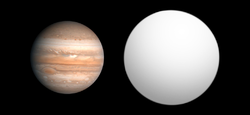
View on Wikipedia Size comparison of HR 8799 c (gray) with Jupiter. | |
| Discovery | |
|---|---|
| Discovered by | Marois et al. |
| Discovery site | Keck and Gemini observatories in Hawaii |
| Discovery date | November 13, 2008 |
| Direct imaging | |
| Orbital characteristics | |
| ~ 38 AU | |
| ~ 190[1][note 1] y | |
| Star | HR 8799 |
| Physical characteristics | |
| 1.3[2] RJ | |
| Mass | 7+3 −2[3] MJ |
Mean density | 4.702 g/cm3[4] |
| Temperature | 1090+10 −90[1] K |
HR 8799 c is an extrasolar planet located approximately 129 light-years away in the constellation of Pegasus, orbiting the 6th magnitude Lambda Boötis star HR 8799. This planet has a mass between 5 and 10 Jupiter masses and a radius from 20 to 30% larger than Jupiter's. It orbits at 38 AU from HR 8799 with an unknown eccentricity and a period of 190 years; it is the 2nd planet discovered in the HR 8799 system. Along with two other planets orbiting HR 8799, this planet was discovered on November 13, 2008, by Marois et al., using the Keck and the Gemini observatories in Hawaii. These planets were discovered using the direct imaging technique.[1][5][6][7][8] In January 2010, HR 8799 c became the 9th exoplanet candidate to have a portion of its spectrum directly observed (following 2M1207b, DH Tau b, GQ Lup b, AB Pic b, CHXR 73 b, HD 203030 b, CT Cha b and 1RXS J1609b), confirming the feasibility of direct spectrographic studies of exoplanets.[2][9]
Spectra
[edit].jpg)
Near infrared spectroscopy from 995 to 1769 nanometers made with the Palomar Observatory show evidence of ammonia, perhaps some acetylene but neither carbon dioxide nor substantial methane.[10] High resolution spectroscopy with the OSIRIS instrument on the Keck Observatory show numerous well resolved lines of molecular absorption in the planet's atmosphere in the K band. Although methane is absent, the planet's atmosphere contains both water and carbon monoxide; the carbon-to-oxygen ratio of HR 8799 c is higher than that of its star, suggesting that the planet formed through the core accretion process.[11][12]
Later, in November 2018, researchers confirmed the existence of water and the absence of methane in the atmosphere of HR 8799c, using high-resolution spectroscopy and near-infrared adaptive optics (NIRSPAO) at the Keck Observatory.[13][14]
The detection of water and carbon monoxide in the planetary atmosphere was announced in 2021.[15]
See also
[edit]Notes
[edit]- ^ Value given assuming the planet's orbit is circular and is being observed face-on.
References
[edit]- ^ a b c Marois, Christian; et al. (November 2008). "Direct Imaging of Multiple Planets Orbiting the Star HR 8799". Science. 322 (5906): 1348–1352. arXiv:0811.2606. Bibcode:2008Sci...322.1348M. doi:10.1126/science.1166585. PMID 19008415. S2CID 206516630.
- ^ a b Jason, M.; C. Bergfors; M. Goto; W. Brandner; D. Lafrenière (2010). "Spatially resolved spectroscopy of the exoplanet HR 8799 c" (PDF). The Astrophysical Journal. 710 (1): L35 – L38. arXiv:1001.2017. Bibcode:2010ApJ...710L..35J. doi:10.1088/2041-8205/710/1/l35. S2CID 9159181. Retrieved 2010-01-13.
- ^ Marois; Zuckerman; Konopacky; Macintosh; Barman (2010). "Images of a fourth planet orbiting HR 8799". Nature. 468 (7327): 1080–1083. arXiv:1011.4918. Bibcode:2010Natur.468.1080M. doi:10.1038/nature09684. PMID 21150902. S2CID 4425891.
- ^ "Exoplanet HR 8799 c". Retrieved 29 July 2024.
- ^ "Astronomers capture first images of newly-discovered solar system" (Press release). W. M. Keck Observatory. 2008-11-13. Archived from the original on 2013-11-26. Retrieved 2008-12-02.
- ^ "Gemini Releases Historic Discovery Image of Planetary First Family" (Press release). Gemini Observatory. 2008-11-13. Retrieved 2008-12-02.
- ^ Achenbach, Joel (2008-11-13). "Scientists Publish First Direct Images of Extrasolar Planets". The Washington Post. Retrieved 2008-12-02.
- ^ Fabrycky; et al. (2010). "Stability of the directly imaged multiplanet system HR 8799: resonance and masses". Astrophys. J. 710 (2): 1408–1421. arXiv:0812.0011. Bibcode:2010ApJ...710.1408F. doi:10.1088/0004-637X/710/2/1408. S2CID 11760422.
- ^ Janson, M. (13 January 2010). "VLT Captures First Direct Spectrum of an Exoplanet". ESO. La Silla Observatory: 2. Bibcode:2010eso..pres....2. Retrieved 2010-01-13.
- ^ B. R. Oppenheimer (2013). "Reconnaissance of the HR 8799 Exosolar System I: Near IR Spectroscopy". The Astrophysical Journal. 768 (1). Cornell University: 24. arXiv:1303.2627. Bibcode:2013ApJ...768...24O. doi:10.1088/0004-637X/768/1/24. S2CID 7173368.
- ^ "Alien planet's atmosphere contains water and carbon monoxide". Archived from the original on 2019-03-30. Retrieved 2013-03-14.
- ^ "Giant Alien Planet in Supersized Solar System May Solve Mystery". Space.com. 2013-03-14. Archived from the original on 2023-06-07.
- ^ W. M. Keck Observatory (20 November 2018). "Exoplanet stepping stones - Researchers are perfecting technology to one day look for signs of alien life". EurekAlert!. Retrieved 21 November 2018.
- ^ Wang, Ji; et al. (20 November 2018). "Detecting Water in the Atmosphere of HR 8799 c with L-band High-dispersion Spectroscopy Aided by Adaptive Optics". The Astronomical Journal. 156 (6): 272. arXiv:1809.09080. Bibcode:2018AJ....156..272W. doi:10.3847/1538-3881/aae47b. S2CID 119372301.
- ^ Wang, Jason J.; et al. (2021), "Detection and Bulk Properties of the HR 8799 Planets with High-resolution Spectroscopy", The Astronomical Journal, 162 (4): 148, arXiv:2107.06949, Bibcode:2021AJ....162..148W, doi:10.3847/1538-3881/ac1349, S2CID 235898867
External links
[edit] Media related to HR 8799 c at Wikimedia Commons
- "HR 8799 c". Exoplanets. Archived from the original on 2012-03-04. Retrieved 2008-12-02.
