


Community hub
Recent from talks
Contribute something
Nothing was collected or created yet.
Alpheratz
View on Wikipedia
  | |
| Observation data Epoch J2000.0 Equinox J2000.0 (ICRS) | |
|---|---|
| Constellation | Andromeda |
| Right ascension | 00h 08m 23.25988s[1] |
| Declination | +29° 05′ 25.5520″[1] |
| Apparent magnitude (V) | 2.06 (2.22 + 4.21)[2] |
| Characteristics | |
| U−B color index | −0.46[3] |
| B−V color index | −0.11[3] |
| R−I color index | −0.10[3] |
| Primary | |
| Spectral type | B8IV-VHgMn[4] |
| B−V color index | −0.06[5] |
| Secondary | |
| Spectral type | A7V[5] |
| B−V color index | 0.22[5] |
| Astrometry | |
| Primary | |
| Radial velocity (Rv) | −10.6 ± 0.3[a] km/s |
| Proper motion (μ) | RA: 135.68[6] mas/yr Dec.: −162.95[6] mas/yr |
| Parallax (π) | 33.62±0.35 mas[1] |
| Distance | 97 ± 1 ly (29.7 ± 0.3 pc) |
| Absolute magnitude (MV) | −0.193[5][b] |
| Secondary | |
| Absolute magnitude (MV) | 1.797[5] |
| Orbit[7] | |
| Period (P) | 96.69 days |
| Semi-major axis (a) | 23.917±0.127 mas[7] (0.7146±0.0327 AU)[5] |
| Eccentricity (e) | 0.526±0.013 |
| Inclination (i) | 105.8±0.17° |
| Longitude of the node (Ω) | 104.46±0.48° |
| Periastron epoch (T) | MJD 47374.563 ± 0.095[2] |
| Argument of periastron (ω) (secondary) | 257.4 ± 0.31[2]° |
| Details | |
| Primary | |
| Mass | 3.63±0.201[7] M☉ |
| Radius | 2.94 ± 0.34[5][c] R☉ |
| Luminosity (bolometric) | 158+41 −33[5] L☉ |
| Surface gravity (log g) | 3.75[8] cgs |
| Temperature | 11,950[5] K |
| Rotation | 2.38 d[9] |
| Rotational velocity (v sin i) | 53[10] km/s |
| Age | 60;[8] 200+117 −74[5] Myr |
| Secondary | |
| Mass | 1.875±0.096[7] M☉ |
| Radius | 2.03 ± 0.23[5][d] R☉ |
| Luminosity (bolometric) | 14.79+3.83 −3.04[5] L☉ |
| Surface gravity (log g) | 4.0[8] cgs |
| Temperature | 7,935[5] K |
| Age | 70;[8] 447+184 −130[5] Myr |
| Other designations | |
| Alpheratz, Sirrah, Sirah, H 5 32A, α And, Alpha Andromedae, Alpha And, δ Pegasi, δ Peg, Delta Pegasi, Delta Peg, 21 Andromedae, 21 And, BD+28°4, FK5 1, GC 127, HD 358, HIP 677, HR 15, SAO 73765, PPM 89441, ADS 94 A, CCDM J00083+2905A, WDS 00084+2905A/Aa, LTT 10039, NLTT 346[6][11][12] | |
| Database references | |
| SIMBAD | data |
Alpheratz is a prominent star system in the constellation of Andromeda. Pronounced /ælˈfɪəræts/,[13][14] it has the Bayer designation Alpha Andromedae, Latinised from α Andromedae, and abbreviated Alpha And or α And, respectively. Alpheratz is the brightest star in the constellation when Mirach (β Andromedae) undergoes its periodical dimming. Immediately northeast of the constellation of Pegasus, it is the upper left star of the Great Square of Pegasus. It is located at a distance of 97 light-years from Earth.
Although it appears to the naked eye as a single star with overall apparent visual magnitude +2.06, it is actually a binary system composed of two stars in close orbit. The chemical composition of the brighter of the two stars is unusual as it is a mercury-manganese star whose atmosphere contains abnormally high abundances of mercury, manganese, and other elements, including gallium and xenon.[15] It is the brightest mercury-manganese star known.[15]
Nomenclature
[edit]
α Andromedae (Latinised to Alpha Andromedae) is the star's Bayer designation. Ptolemy considered the star (system) to be shared by Pegasus and Johann Bayer assigned it a designation in both constellations: Alpha Andromedae (α And) and Delta Pegasi (δ Peg). Since the IAU standardized constellation boundaries and widely published them two years after in 1930, the Pegasi alternate name has dropped from use, putting it slightly outside of that constellation.[16]
To most European centres of learning the star bore names Alpheratz (/ælˈfiːræts/[17]) or the cognate simplification Alpherat or the other part of the fabled description: Sirrah /ˈsɪrə/. The name has no relation with the word "alpha".
The origin of these three, the Arabic phrasal name, is سرة الفرس surrat al-faras "navel of the mare/horse", attracting a hard consonant not present above due to a following vowel. The horse corresponds equivalently to the winged horse of the Greeks, Pegasus. The star is in almost all depictions part of the main asterism of Pegasus and Andromeda.[18] In 2016, the International Astronomical Union organized a Working Group on Star Names (WGSN)[19] to catalog and standardize proper names for stars. The WGSN's first bulletin of July 2016[20] confirmed Alpheratz as the name for the main star.
Other terms for this star used by some medieval astronomers writing were راس المراة المسلسلة rās al-mar'a al-musalsala (head of the woman in chains),[18] al-kaff al-khaḍīb and kaff al-naṣīr (palm of the faithful). The chained woman referenced Andromeda.[21]
In the Hindu lunar zodiac, this star, together with the other stars in the Great Square of Pegasus (α, β, and γ Pegasi), makes up the nakshatras of Pūrva Bhādrapadā and Uttara Bhādrapadā.[18]
In Chinese, 壁宿 (Bì Sù), meaning wall, refers to an asterism consisting of α Andromedae and γ Pegasi.[22] Consequently, the Chinese name for α Andromedae itself is 壁宿二 (Bì Sù èr, English: the second star of the wall.)[23]
It is also known as one of the "Three Guides" that mark the prime meridian of the heavens, the other two being Beta Cassiopeiae and Gamma Pegasi. It was believed to bless those born under its influence with honour and riches.[24]
System
[edit]
The radial velocity of a star away from or towards the observer can be determined by measuring the red shift or blue shift of its spectrum. The American astronomer Vesto Slipher made a series of such measurements from 1902 to 1904 and discovered that the radial velocity of α Andromedae varied periodically. He concluded that it was in orbit in a spectroscopic binary star system with a period of about 100 days.[25] A preliminary orbit was published by Hans Ludendorff in 1907,[26] and a more precise orbit was later published by Robert Horace Baker.[27]
The fainter star in the system was first resolved interferometrically by Xiaopei Pan and his coworkers during 1988 and 1989, using the Mark III Stellar Interferometer at the Mount Wilson Observatory, California, United States. This work was published in 1992.[28] Because of the difference in luminosity between the two stars, its spectral lines were not observed until the early 1990s, in observations made by Jocelyn Tomkin, Xiaopei Pan, and James K. McCarthy between 1991 and 1994 and published in 1995.[29]
The two stars are now known to orbit each other with a period of 96.9 days.[7] The larger, brighter star, called the primary, has a spectral type of B8IV-VHgMn,[30] a mass of approximately 3.6 solar masses,[7] a surface temperature of about 11,900 K (or 13,850 K[10]), and, measured over all wavelengths, a luminosity of about 160 times the Sun's.[5] Its smaller, fainter companion, the secondary, has a mass of approximately 1.9 solar masses[7] and a surface temperature of about 7,900 K, and, again measured over all wavelengths, a luminosity of about 15 times the Sun's. It is a late-type A star whose spectral type is estimated as A7V.[5]
Chemical peculiarities
[edit]In 1906, Norman Lockyer and F. E. Baxandall reported that α Andromedae had a number of unusual lines in its spectrum.[31] In 1914, Baxandall pointed out that most of the unusual lines came from manganese, and that similar lines were present in the spectrum of μ Leporis.[32] In 1931, W. W. Morgan identified 12 additional stars with lines from manganese appearing in their spectra.[33] Many of these stars were subsequently identified as part of the group of mercury-manganese stars,[34] a class of chemically peculiar stars which have an excess of elements such as mercury, manganese, phosphorus, and gallium in their atmospheres.[35], §3.4. In the case of α Andromedae, the brighter primary star is a mercury-manganese star which, as well as the elements already mentioned, has excess xenon.
In 1970, Georges Michaud suggested that such chemically peculiar stars arose from radiative diffusion. According to this theory, in stars with unusually calm atmospheres, some elements sink under the force of gravity, while others are pushed to the surface by radiation pressure.[35], §4.[36] This theory has successfully explained many observed chemical peculiarities, including those of mercury-manganese stars.[35], §4.
Variability of primary
[edit]α Andromedae has been reported to be slightly variable,[37] but observations from 1990 to 1994 found its brightness to be constant to within less than 0.01 magnitude.[38] However, Adelman and his co-workers have discovered, in observations made between 1993 and 1999 and published in 2002, that the mercury line in its spectrum at 398.4 nm varies as the primary rotates. This is because the distribution of mercury in its atmosphere is not uniform. Applying Doppler imaging to the observations allowed Adelman et al. to find that it was concentrated in clouds near the equator.[39] Subsequent Doppler imaging studies, published in 2007, showed that these clouds drift slowly over the star's surface.[9]
Observation
[edit].png)
The location of α Andromedae in the sky is shown on the left. It can be seen by the naked eye and is theoretically visible at all latitudes north of 60° S. During evening from August to October, it will be high in the sky as seen from the northern midlatitudes.[40]
Optical companion
[edit]| Observation data Epoch J2000.0 Equinox J2000.0 (ICRS) | |
|---|---|
| Constellation | Andromeda |
| Right ascension | 00h 08m 16.626s[41] |
| Declination | +29° 05′ 45.49″[41] |
| Apparent magnitude (V) | 10.8[41] |
| Characteristics | |
| Spectral type | G5[41] |
| B−V color index | 1.0[41] |
| Astrometry | |
| Proper motion (μ) | RA: −3.9[41] mas/yr Dec.: −24.0[41] mas/yr |
| Parallax (π) | 2.3990±0.0369 mas[42] |
| Distance | 1,360 ± 20 ly (417 ± 6 pc) |
| Position (relative to A) | |
| Epoch of observation | 2000 |
| Angular distance | 89.3″ [11] |
| Position angle | 284° [11] |
| Other designations | |
| H 5 32B, BD+28°4B, PPM 89439, CCDM J00083+2905B, WDS 00084+2905B[11][41] | |
| Database references | |
| SIMBAD | data |
The binary system described above has an optical visual companion, discovered by William Herschel on July 21, 1781.[11][43][44] Designated as ADS 94 B in the Aitken Double Star Catalogue, it is a G-type star with an apparent visual magnitude of approximately 10.8.[41] Although by coincidence it appears near to the other two stars in the sky, it's much more distant from Earth; the parallax observed by Gaia place this star more than 1,300 light years away.[43]
Notes
[edit]- ^ Value is for the center of mass of the system.
- ^ The system's combined absolute magnitude is -0.354.
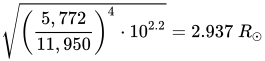
- ^ Applying the Stefan–Boltzmann law with a nominal solar effective temperature of 5,772 K:
- .
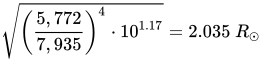
- ^ Applying the Stefan–Boltzmann law with a nominal solar effective temperature of 5,772 K:
- .
References
[edit]- ^ a b c Van Leeuwen, F. (2007). "Validation of the new Hipparcos reduction". Astronomy and Astrophysics. 474 (2): 653–664. arXiv:0708.1752. Bibcode:2007A&A...474..653V. doi:10.1051/0004-6361:20078357. S2CID 18759600.
- ^ a b c Entry, WDS identifier 00084+2905, Sixth Catalog of Orbits of Visual Binary Stars Archived 2017-11-12 at the Wayback Machine, William I. Hartkopf & Brian D. Mason, U.S. Naval Observatory. Accessed on line August 12, 2008.
- ^ a b c Hoffleit, D.; Warren, W. H. Jr. "HR 15". The Bright Star Catalogue (5th Revised ed.). VizieR. and Hoffleit, D.; Warren, W. H. Jr. "Detailed Description of V/50". The Bright Star Catalogue (5th Revised ed.). Centre de Données astronomiques de Strasbourg.
- ^ Gray, R. O.; Corbally, C. J.; Garrison, R. F.; McFadden, M. T.; Robinson, P. E. (2003). "Contributions to the Nearby Stars (NStars) Project: Spectroscopy of Stars Earlier than M0 within 40 Parsecs: The Northern Sample. I.". The Astronomical Journal. 126 (4): 2048. arXiv:astro-ph/0308182. Bibcode:2003AJ....126.2048G. doi:10.1086/378365.
- ^ a b c d e f g h i j k l m n o p Piccotti, Luca; Docobo, José Ángel; Carini, Roberta; Tamazian, Vakhtang S.; Brocato, Enzo; Andrade, Manuel; Campo, Pedro P. (2020-02-01). "A study of the physical properties of SB2s with both the visual and spectroscopic orbits". Monthly Notices of the Royal Astronomical Society. 492 (2): 2709–2721. Bibcode:2020MNRAS.492.2709P. doi:10.1093/mnras/stz3616. ISSN 0035-8711. Alpha Andromedae's database entry at VizieR.
- ^ a b c "* alf And". SIMBAD. Centre de données astronomiques de Strasbourg. Retrieved August 12, 2008.
- ^ a b c d e f g Branham Jr, Richard L. (2017-01-01). "A three-dimensional orbit for the binary star Alpha Andromedae". Monthly Notices of the Royal Astronomical Society. 464 (1): 1095–1101. Bibcode:2017MNRAS.464.1095B. doi:10.1093/mnras/stw2393. hdl:11336/64233. ISSN 0035-8711.
- ^ a b c d Ryabchikova, T.; Malanushenko, V.; Adelman, S. J. (1998). "The double-lined spectroscopic binary alpha Andromedae: Orbital elements and elemental abundances". Contributions of the Astronomical Observatory Skalnate Pleso. 27 (3): 356. arXiv:astro-ph/9805205. Bibcode:1998CoSka..27..356R.
- ^ a b Kochukhov, O.; et al. (2007). "Weather in stellar atmosphere revealed by the dynamics of mercury clouds in α Andromedae". Nature Physics. 3 (8): 526–529. arXiv:0705.4469. Bibcode:2007NatPh...3..526K. doi:10.1038/nphys648. S2CID 117951514.
- ^ a b David, Trevor J.; Hillenbrand, Lynne A. (2015-05-01). "The Ages of Early-type Stars: Strömgren Photometric Methods Calibrated, Validated, Tested, and Applied to Hosts and Prospective Hosts of Directly Imaged Exoplanets". The Astrophysical Journal. 804 (2): 146. arXiv:1501.03154. Bibcode:2015ApJ...804..146D. doi:10.1088/0004-637X/804/2/146. ISSN 0004-637X. Alpheratz's database entry at VizieR.
- ^ a b c d e Entry 00084+2905, discoverer code H 5 32, components Aa-B, The Washington Double Star Catalog Archived 2011-08-16 at the Wayback Machine, United States Naval Observatory. Accessed on line August 15, 2017.
- ^ Entry 00084+2905, discoverer code MKT 11, components Aa, The Washington Double Star Catalog Archived 2011-08-16 at the Wayback Machine, United States Naval Observatory. Accessed on line August 15, 2017.
- ^ Kunitzsch, Paul; Smart, Tim (2006). A Dictionary of Modern star Names: A Short Guide to 254 Star Names and Their Derivations (2nd rev. ed.). Cambridge, Massachusetts: Sky Pub. ISBN 978-1-931559-44-7.
- ^ "IAU Catalog of Star Names". Retrieved 28 July 2016.
- ^ a b Alpheratz, Kaler Stars [1] 2/14/2013
- ^ Bayer's Uranometria and Bayer letters
- ^ Merriam-Webster Dictionary 2017 – Alpheratz
- ^ a b c Allen, R. A. (1899). Star-names and Their Meanings. G. E. Stechert. p. 35. LCCN 99004138.
- ^ "IAU Working Group on Star Names (WGSN)". Retrieved 22 May 2016.
- ^ "Bulletin of the IAU Working Group on Star Names, No. 1" (PDF). Retrieved 28 July 2016.
- ^ Goldstein, B. R. (1985). "Star Lists in Hebrew". Centaurus. 28 (3): 185–208. Bibcode:1985Cent...28..185G. doi:10.1111/j.1600-0498.1985.tb00745.x.
- ^ 陳久金 (2005). 中國星座神話 (in Chinese). 台灣書房出版有限公司. p. 170. ISBN 978-986-7332-25-7.
- ^ 香港太空館 - 研究資源 - 亮星中英對照表 (in Chinese). Hong Kong Space Museum. Archived from the original on 25 October 2008. Retrieved November 26, 2008.
- ^ Olcott, W. T. (1911). Star Lore of All Ages. G.P. Putnam's Sons. p. 26. LCCN 11031153.
- ^ Slipher, V. M. (1904). "A list of five stars having variable radial velocities". The Astrophysical Journal. 20: 146. Bibcode:1904ApJ....20..146S. doi:10.1086/141148.
- ^ Ludendorff, H. (1907). "Provisorische Bahnelemente des spektroskopischen Doppelsterns α Andromedae". Astronomische Nachrichten. 176 (20): 327–328. Bibcode:1907AN....176..327L. doi:10.1002/asna.19071762007.
- ^ Baker, R. H. (1910). "The orbit of α Andromedae". Publications of the Allegheny Observatory of the Western University of Pennsylvania. 1 (3): 17. Bibcode:1910PAllO...1...17B.
- ^ Pan, X.; et al. (1992). "Determination of the visual orbit of the spectroscopic binary Alpha Andromedae with submilliarcsecond precision". The Astrophysical Journal. 384: 624. Bibcode:1992ApJ...384..624P. doi:10.1086/170904.
- ^ Tomkin, J.; Pan, X.; McCarthy, J. K. (1995). "Spectroscopic detection of the secondaries of the Hyades interferometric spectroscopic binary theta2 Tauri and of the interferometric spectroscopic binary alpha Andromedae". Astronomical Journal. 109: 780. Bibcode:1995AJ....109..780T. doi:10.1086/117321.
- ^ "Alpheratz". SIMBAD. Centre de données astronomiques de Strasbourg. Retrieved 2023-12-18.
- ^ Lockyer, N.; Baxandall, F. E. (1906). "Some Stars with Peculiar Spectra". Proceedings of the Royal Society of London. Series A. 77 (520): 550. Bibcode:1906RSPSA..77..550L. doi:10.1098/rspa.1906.0049. JSTOR 92668.
- ^ Baxandall, F. E. (1914). "Stars, Spectra of, on the enhanced lines of Manganese in the spectrum of α Andromedae". Monthly Notices of the Royal Astronomical Society. 74 (3): 250. Bibcode:1914MNRAS..74..250B. doi:10.1093/mnras/74.3.250.
- ^ Morgan, W. W. (1931). "Studies in Peculiar Stellar Spectra. I. The Manganese Lines in α Andromedae". The Astrophysical Journal. 73: 104. Bibcode:1931ApJ....73..104M. doi:10.1086/143299.
- ^ Cowley, C. R.; Aikman, G. C. L. (1975). "A study of the lambda 3984 feature in the mercury-manganese stars". Publications of the Astronomical Society of the Pacific. 87: 513. Bibcode:1975PASP...87..513C. doi:10.1086/129801.
- ^ a b c Smith, K. C. (1996). "Chemically peculiar hot stars". Astrophysics and Space Science. 237 (1–2): 77–105. Bibcode:1996Ap&SS.237...77S. doi:10.1007/BF02424427. S2CID 189836091.
- ^ Michaud, G. (1970). "Diffusion Processes in Peculiar a Stars". The Astrophysical Journal. 160: 641. Bibcode:1970ApJ...160..641M. doi:10.1086/150459.
- ^ "alf And * (entry 019001)". General Catalogue of Variable Stars. Sternberg Astronomical Institute. Archived from the original on June 20, 2017. Retrieved August 12, 2008.
- ^ Adelman, S. J.; et al. (1994). "uvby photometry of the chemically peculiar stars Alpha Andromedae, HD 184905, HR 8216, and HR 8434". Astronomy and Astrophysics Supplement. 106: 333. Bibcode:1994A&AS..106..333A.
- ^ Adelman, S. J.; et al. (2002). "The Variability of the Hgiiλ3984 Line of the Mercury-Manganese Star α Andromedae". The Astrophysical Journal. 575 (1): 449–460. Bibcode:2002ApJ...575..449A. doi:10.1086/341140.
- ^ "Alpheratz". MSN Encarta. Archived from the original on 2009-11-03. Retrieved August 19, 2008.
- ^ a b c d e f g h i "TYC 1735-3181-1". SIMBAD. Centre de données astronomiques de Strasbourg. Retrieved August 12, 2008.
- ^ Brown, A. G. A.; et al. (Gaia collaboration) (August 2018). "Gaia Data Release 2: Summary of the contents and survey properties". Astronomy & Astrophysics. 616. A1. arXiv:1804.09365. Bibcode:2018A&A...616A...1G. doi:10.1051/0004-6361/201833051.
- ^ a b Burnham, R. (1978). Burnham's Celestial Handbook: An Observer's Guide to the Universe Beyond the Solar System. Vol. 1. Courier Dover Publications. p. 111. ISBN 0-486-23567-X.
- ^ See p.140, entry 32 in Herschel, M.; Watson, D. (1782). "Catalogue of Double Stars. By Mr. Herschel, F. R. S. Communicated by Dr. Watson, Jun". Philosophical Transactions of the Royal Society of London. 72: 112–162. Bibcode:1782RSPT...72..112H. doi:10.1098/rstl.1782.0014. JSTOR 106455. S2CID 186209247.
External links
[edit]| Stars |
| ||||||||||||
|---|---|---|---|---|---|---|---|---|---|---|---|---|---|
| |||||||||||||
| Star clusters |
| ||||||||||||
| Nebulae |
| ||||||||||||
| Galaxies |
| ||||||||||||
| |||||||||||||
| |||||||||||||

Alpheratz
View on GrokipediaNomenclature
Historical Names
The traditional name Alpheratz derives from the Arabic phrase surrat al-faras, meaning "the navel of the horse," reflecting its historical association with the constellation Pegasus as the central point on the mythical winged horse's underbelly.[9] This etymology stems from medieval Arabic astronomy, where the star was positioned as δ Pegasi, the fourth-brightest in Pegasus, before modern boundaries shifted its primary designation.[7] An alternative name, Sirrah (or Sirah), also originates from the same Arabic root al-surrā, emphasizing "the navel," and was used interchangeably in early European star catalogs to denote the same stellar position.[10] In ancient Greek astronomy, as recorded in Ptolemy's Almagest (2nd century CE), the star was cataloged under Pegasus as the "navel star" but noted as shared with Andromeda, marking the chained princess's head in the myth where Perseus rescues her using the winged horse Pegasus born from Medusa's blood.[11] This dual mythological role tied Alpheratz to both the heroic narrative of Andromeda's peril and Pegasus's flight, with the star visually linking the two figures in the night sky.[9] Until the International Astronomical Union formalized constellation boundaries in 1930—adopted in 1928 and published shortly after—Alpheratz was commonly regarded as part of Pegasus, leading to its occasional reference as δ Pegasi in pre-20th-century texts.[4] Alpheratz forms the northeastern corner of the Great Square asterism in Pegasus, further underscoring its historical equestrian ties.[7]Catalog Designations
Alpheratz holds the Bayer designation α Andromedae, assigned to the primary star as the brightest in the constellation Andromeda, while it also bears the historical Bayer label δ Pegasi reflecting its position on the shared boundary with Pegasus.[12] This dual nomenclature arose from early cartographers' decisions on constellation borders, with the star ultimately standardized in Andromeda by the International Astronomical Union.[12] The Flamsteed designation for Alpheratz is 21 Andromedae, part of John Flamsteed's 17th-century catalog numbering stars sequentially by right ascension within each constellation.[12] Additional formal identifiers appear across major astronomical catalogs, facilitating cross-referencing in databases like SIMBAD and the CDS Strasbourg Astronomical Data Center. These include HR 15 from the Bright Star Catalogue, HD 358 from the Henry Draper Catalogue, HIP 677 from the Hipparcos astrometric mission, and BD+28°4 from the Bonner Durchmusterung survey.[12] As a variable star exhibiting small-amplitude pulsations, it is designated V* α And in the General Catalogue of Variable Stars.[12]| Catalog | Designation | Description |
|---|---|---|
| Bayer | α Andromedae / δ Pegasi | Greek-letter naming by brightness; dual due to constellation boundary. |
| Flamsteed | 21 Andromedae | Sequential numbering by right ascension in Andromeda. |
| Harvard Revised (HR) | HR 15 | From the 20th-century revision of Harvard photometry. |
| Henry Draper (HD) | HD 358 | Spectral classification and photometry catalog. |
| Hipparcos (HIP) | HIP 677 | Astrometric data from the 1990s ESA satellite mission. |
| Bonner Durchmusterung (BD) | BD+28°4 | 19th-century visual survey of northern stars. |
| General Catalogue of Variable Stars (GCVS) | V* α And | Designation for its α² CVn variability type. |
Location and Visibility
Position in the Sky
Alpheratz occupies equatorial coordinates of right ascension 00h 08m 23.3s and declination +29° 05′ 26″ (epoch J2000.0).[13] In galactic coordinates, it resides at longitude 111.73° and latitude -32.84°.[13] The star lies at a distance of 97 light-years (29.7 parsecs) from the Sun, derived from a parallax of 33.62 ± 0.35 milliarcseconds, consistent with measurements from the Gaia mission as of data release 3 in 2022.[13] It forms the northeastern vertex of the Great Square asterism associated with Pegasus while marking the head of the neighboring Andromeda constellation.[7] With an apparent visual magnitude of 2.06, Alpheratz is readily visible to the naked eye from northern latitudes during autumn evenings under clear, dark skies.[13] Observers can locate it by tracing a line from Polaris through the W-shaped asterism of Cassiopeia or by identifying the Great Square of Pegasus and noting its upper-left corner.[14] Alpheratz exhibits a proper motion of 135.68 mas per year in right ascension and -162.95 mas per year in declination, yielding a total annual shift of approximately 212 mas across the sky.[13] Its radial velocity measures -10.1 km/s, indicating motion toward the Solar System.[13]Observational History
Alpheratz, known as Alpha Andromedae, has been observed since antiquity, appearing in Ptolemy's Almagest (circa 150 CE) as a second-magnitude star marking the head of Andromeda and shared with the neighboring Pegasus constellation. This early cataloging positioned it prominently in classical astronomy, with its brightness making it a key reference for celestial navigation and constellation delineation. In the 18th century, systematic telescopic surveys advanced its study, notably when William Herschel discovered its optical visual companion on July 21, 1781, during his comprehensive search for double stars, cataloged as H I 25 and later ADS 94 B. This finding highlighted Alpheratz as part of the growing catalog of binary systems, sparking interest in its potential physical association, though early spectroscopy was not yet available to probe deeper. The 20th century brought revelations through spectroscopic techniques; in 1904, Vesto Slipher at Lowell Observatory detected periodic radial velocity shifts in Alpheratz's spectrum, establishing its nature as a single-lined spectroscopic binary with an orbital period of approximately 97 days. Photometric variability was noted in the 1950s through ground-based observations, indicating low-amplitude fluctuations likely tied to its binary motion and stellar properties. Telescopic advancements resolved the secondary's spectrum by 1995, when high-resolution observations separated the lines of both components, confirming a double-lined spectroscopic binary and enabling refined orbital analysis. In 2017, three-dimensional orbital modeling integrated interferometric data with astrometric measurements from Hipparcos, yielding a comprehensive visual orbit independent of radial velocities. The modern era has benefited from space-based missions; the Gaia mission, from its 2013 launch through its third data release in 2022, has refined Alpheratz's distance to 97 light-years and proper motion to RA: +135.68 mas/yr, Dec.: −162.95 mas/yr, via parallax measurements of 33.62 ± 0.35 mas. Concurrently, Transiting Exoplanet Survey Satellite (TESS) photometry from 2018 to 2023 confirmed the low-amplitude variability, with light curves from multiple sectors revealing periodic signals on the order of millimagnitudes. Chemical peculiarities were first noted in mid-20th century spectra, attributing anomalous line strengths to elevated abundances of mercury and manganese.Stellar System
Binary Components
Alpheratz is a close spectroscopic binary system consisting of two main stellar components, designated α And A (the primary) and α And B (the secondary), which orbit each other with a period of 96.7 days and remain visually unresolved even with high-resolution telescopes. The system has a total mass of approximately 5.3 , with the primary dominating the combined light output and apparent visual magnitude of +2.06. Both stars are hot and relatively young, providing a valuable laboratory for studying early stellar evolution and chemical peculiarities in binary contexts.[15] The primary component, α And A, is classified as a B8IVp subgiant with mercury-manganese (HgMn) chemical peculiarities, making it the brighter and more massive member of the pair. It has a mass of approximately 3.5 , a luminosity of about 158 , a surface temperature of 12,940 K, and a radius of . This star is evolving off the main sequence, as indicated by its subgiant luminosity class, and exhibits enhanced abundances of elements like mercury, manganese, and rare earths, which influence its atmospheric structure.[15][16][17] The secondary component, α And B, is a main-sequence star of spectral type A2V, fainter than the primary but readily identifiable through its distinct spectral lines in double-lined observations. It possesses a mass of approximately 1.8 , a luminosity of roughly 13 , a surface temperature of 8,500 K, and a radius of . Remaining on the main sequence, the secondary contributes about 5% to the system's total luminosity and shows mild chemical anomalies, including deficiencies in calcium and overabundances in strontium and barium.[15] Based on fitting to theoretical isochrones, the system has an estimated age of around 60 million years for the primary and 70 million years for the secondary, consistent with their positions in the Hertzsprung-Russell diagram.[15]Orbital Parameters
Alpheratz is a double-lined spectroscopic binary system with an orbital period of 96.7 days, as determined from extensive radial velocity measurements beginning with Slipher's discovery in 1904 and incorporating data spanning over a century.[18] The orbit is retrograde with an inclination of approximately 130°, a semi-major axis of about 0.23 AU for the primary's motion around the barycenter, and a low eccentricity of 0.04, rendering it nearly circular.[5] Three-dimensional modeling of the system, utilizing Hipparcos astrometry and early Gaia data, yields masses of approximately 3.5 M_⊙ for the primary and 1.8 M_⊙ for the secondary.[5] The radial velocity semi-amplitudes are K_1 = 43 km/s for the primary and K_2 = 83 km/s for the secondary, consistent with the mass ratio derived from the orbit.[5] The dynamics of the binary follow Kepler's third law adapted for two bodies, where P is the orbital period, a is the semi-major axis of the relative orbit, and M_1 and M_2 are the stellar masses; substituting the observed values confirms the system's close separation and stability.[5]Physical Properties
Primary Star Characteristics
Alpheratz's primary star is classified as a B8IVpMn chemically peculiar subgiant, characterized by overabundances of manganese and mercury in its atmosphere, with an effective temperature of approximately 12,300 K.[16] This temperature places it among the hotter B-type stars, contributing to its blue-white appearance and strong ultraviolet emission. The star's surface gravity is log g = 3.7, indicative of its evolved subgiant status, while its projected rotational velocity is v sin i = 20 km/s, suggesting a relatively slow rotation for a B-type star consistent with its evolutionary stage. The primary has a radius of 2.8 solar radii (R⊙), a mass of 3.6 solar masses (M⊙), and a bolometric luminosity of 200 solar luminosities (L⊙), reflecting its post-main-sequence evolution where core hydrogen fusion has ceased and the star has begun expanding.[16][4] These parameters position it as a moderately massive star that has left the main sequence after an age of roughly 60 million years, with lithium depletion in its atmosphere typical for such evolved hot stars due to mixing processes during the subgiant phase. The absolute visual magnitude is M_V ≈ -0.3, derived from the Hipparcos parallax measurement of approximately 33.6 mas, corresponding to a distance of about 97 light-years. Recent studies, including interferometric observations as of 2016, refine the mass to 3.63 ± 0.20 M⊙.[5] This combination of properties highlights the primary's role as the dominant light source in the system, powering its photometric variability through atmospheric dynamics while providing key insights into the evolution of intermediate-mass B stars.Secondary Star Characteristics
The secondary star in the Alpheratz system is classified as an A3V main-sequence dwarf, with an effective temperature of approximately 8,500 K.[19][5] Its radius measures about 1.65 ± 0.3 solar radii (R☉), and it possesses a mass of 1.85 ± 0.13 solar masses (M☉), consistent with the orbital mass ratio derived from spectroscopic observations.[19] The star's luminosity is estimated at log(L/L☉) = 1.10 ± 0.2, equivalent to roughly 13 solar luminosities (L☉), and its surface gravity is log g = 4.0 (cgs units).[19] Recent refinements place the mass at 1.88 ± 0.10 M⊙ as of 2016 observations.[5] This component exhibits higher metallicity compared to the primary, featuring small overabundances of iron-peak elements and enhancements of up to 1.0 dex in strontium (Sr) and barium (Ba), though with a noted deficiency in calcium (Ca).[19] Evolutionarily, it resides near the zero-age main sequence, with an age of about 7 × 10⁷ years, and displays a projected rotational velocity of v sin i = 110 km s⁻¹, indicative of relatively slower rotation within the context of the system.[19] In low-resolution observations, the secondary's spectrum blends with that of the primary due to their proximity, but it can be disentangled through Doppler shifts in high-resolution spectroscopy, particularly near orbital nodes where the lines are least overlapped.[19]Variability
Photometric Behavior
Alpheratz is classified as an Alpha2 Canum Venaticorum (ACV) type variable star, characterized by low-amplitude brightness variations due to rotation and surface chemical inhomogeneities in its mercury-manganese primary component.[20] However, detailed photometric studies have established that the star shows no significant variability, with brightness constant to within less than 0.01 magnitudes in the V-band.[21] The apparent visual magnitude remains stable at 2.06, with a reported range of 2.06 to 2.07 mag likely attributable to measurement precision rather than intrinsic changes.[10] Early observations suggested possible multi-periodic variations with a dominant period of approximately 0.96 days, potentially linked to non-radial surface effects, but these have not been confirmed photometrically and are suspected to stem from spectroscopic rather than brightness fluctuations.[22] Monitoring by the Hipparcos satellite and the All Sky Automated Survey (ASAS) revealed irregular light curves consistent with noise levels, showing no evidence of eclipses from the binary orbit, which has an inclination insufficient for geometric alignment.[10] Data from the Transiting Exoplanet Survey Satellite (TESS) spanning 2018–2023 similarly indicate overall variations below 0.01 magnitudes, reinforcing the star's photometric stability.[23] These minimal flux changes, less than 1%, translate to magnitude variations given by the relation , where and are the fluxes at maximum and minimum, yielding mag.[21]Spectroscopic Variations
The spectroscopic variations in Alpheratz arise mainly from the Doppler shifts induced by the orbital motion in its binary system, manifesting as periodic changes in the radial velocities of absorption lines from both components. The radial velocity curve follows a sinusoidal pattern with a period of 96.693 days, reflecting the orbital dynamics. For the primary star, the semi-amplitude of this curve is 31.77 km/s, while for the secondary, it is 61.48 km/s; these values enable precise tracking of the stars' motions along the line of sight.[5] The radial velocity for each component is given by the equation where is the semi-amplitude specific to the component, is the orbital period, is the time from a reference epoch, and is the phase angle at periastron.[5] This formulation, derived from extensive radial velocity measurements spanning over a century, underscores the near-circular orbit and low eccentricity of the system.[5] Line profile variations are prominent due to the Doppler broadening caused by the relative orbital velocities, with the two sets of spectral lines shifting in opposition. At quadrature phases, the maximum separation between primary and secondary lines reaches approximately 93 km/s, though early approximations described it as up to 100 km/s.[5] Occasional asymmetries in these profiles, particularly in the primary's lines, arise from intrinsic non-radial pulsations with periods around 52 minutes, which distort the line shapes beyond pure orbital effects. Modern high-resolution echelle spectra, with resolutions exceeding 40,000, clearly resolve these double-lined features across multiple epochs, allowing disentangling of the components' spectra.[24] The discovery of Alpheratz's spectroscopic binary nature dates to 1904, when Vesto Slipher identified double lines in low-dispersion spectra, indicating velocity variations of tens of km/s. Subsequent observations treated it as single-lined until 1995, when Tomkin et al. detected the faint secondary lines, confirming the double-lined status.[24] Multiplicity indicators include triple-line spectra at phases near conjunction, where the closely approaching lines blend into a central absorption flanked by separated peaks, highlighting the challenge of resolving the fainter secondary in lower-resolution data.[24] These spectroscopic signatures provide key evidence for the system's geometry, distinct from its minor photometric variability, which lacks direct correlation with the velocity curve.[5]Chemical Peculiarities
Atmospheric Composition
Alpheratz's primary star exhibits a highly peculiar atmospheric composition typical of mercury-manganese (HgMn) stars, with pronounced overabundances of select heavy elements relative to solar values. Measurements indicate enhancements of [Hg] = +5.0 dex, [Mn] = +2.5 dex, [Ga] = +3.0 dex, and [Xe] = +4.0 dex, derived from detailed spectroscopic analyses.[25] These overabundances are evident in prominent spectral features, such as the Hg I/II resonance line at 3984 Å and the Mn II line at 4230 Å, which are significantly stronger than expected for normal B-type stars.[26] In contrast, the atmosphere shows underabundances of helium at [He] = -0.5 dex, normal iron abundance ([Fe] = 0.0 dex), and depletions in light elements such as carbon, oxygen, and magnesium.[27] These elemental discrepancies are quantified through high-resolution spectroscopy, including datasets from instruments like HARPS acquired in the 2000s, employing curve-of-growth techniques to model line profiles and derive precise logarithmic abundances.[25] The distribution of elements within the atmosphere is not uniform, featuring vertical stratification where heavier metals like mercury and manganese are concentrated in the upper layers. This phenomenon arises from radiative diffusion in the stable, quiescent outer atmosphere, which selectively transports ions based on their radiative acceleration and gravitational settling.[28] The following table summarizes key elemental abundances relative to solar ([El/H]) for the primary star:| Element | [El/H] (dex) |
|---|---|
| He | -0.5 |
| Fe | 0.0 |
| Mn | +2.5 |
| Ga | +3.0 |
| Xe | +4.0 |
| Hg | +5.0 |