
Recent from talks
Halszkaraptor
Knowledge base stats:
Talk channels stats:
Members stats:
Halszkaraptor
Halszkaraptor (/ˈhɑːlʃkəræptər/; meaning "Halszka's seizer") is a genus of waterfowl-like dromaeosaurid dinosaurs from Mongolia that lived during the Late Cretaceous period. It contains only one known species, Halszkaraptor escuilliei.
The type specimen (holotype) has been compared to the bones of extant crocodilians and aquatic birds, and displayed evidence of a semiaquatic lifestyle, while some researchers question a semiaquatic ecology. A phylogenetic analysis revealed it was a member of the basal subfamily Halszkaraptorinae, along with Mahakala and Hulsanpes.
The holotype specimen of Halszkaraptor likely came from the Djadochta Formation at Ukhaa Tolgod in southern Mongolia, and was illegally removed by fossil poachers in or before 2011. The fossil found its way to Japan and Great Britain, being owned by several collectors for some years until the Eldonia company of fossil dealer François Escuillié obtained it. He identified it as a new species, and in 2015 took it to the Royal Belgian Institute of Natural Sciences in Brussels, showing it to paleontologists Pascal Godefroit and Andrea Cau for further verification. After verifying its authenticity, among other means by scanning it with synchrotron radiation, a beam of X-rays, at the European Synchrotron Radiation Facility, Cau and other prominent paleontologists described the genus in a detailed study published in the journal Nature. The fossil was returned to the Mongolian authorities.
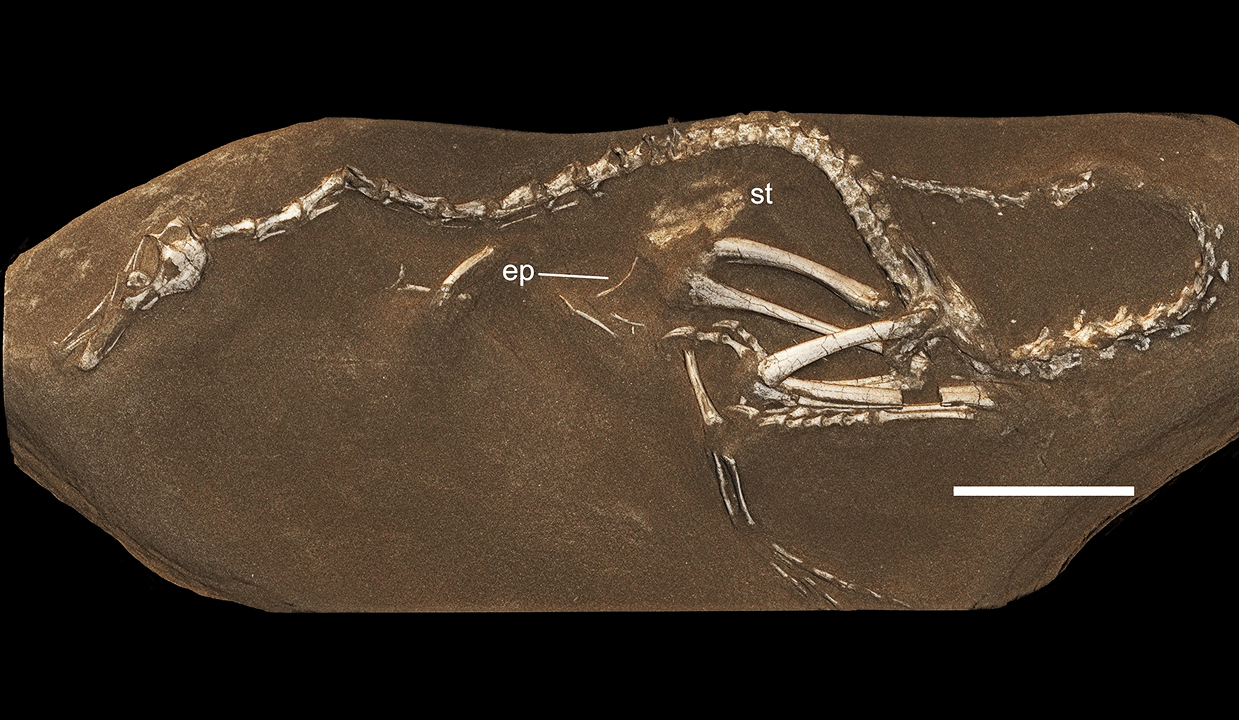
The holotype, MPC D-102/109, was found in a layer of orange sandstone of the Bayn Dzak Member of the Djadochta Formation, dating from the late Campanian, about seventy-five million years old. It consists of a relatively complete skeleton with skull. In 2017, the fossil was not further prepared. Work by the fossil dealers had at that point generally exposed the left side of the skeleton. The synchrotron revealed that the bones continued into the rock and that the piece was probably not a chimaera, an artificial assembly of bones of disparate species, though the top of the snout had been restored with plaster and some elements had been reattached to the rock by glue. The skeleton is largely articulated and not compressed. It represents a subadult individual, about one year old.
The type species Halszkaraptor escuilliei was in 2017 named and described by Andrea Cau, Vincent Beyrand, Dennis F. A. E. Voeten, Vincent Fernandez, Paul Tafforeau, Koen Stein, Rinchen Barsbold, Khishigjav Tsogtbaatar, Philip John Currie, and Pascal Godefroit. The generic name combines a reference to the late Polish paleontologist Halszka Osmólska, who was involved in many expeditions to Mongolia and named the closely related Hulsanpes, with Latin raptor, "robber." The specific name honours Escuillié for having made the specimen available to science.
Halszkaraptor was about the size of a mallard duck. The head was about 7 cm (2.8 in) long, the neck 20 cm (7.9 in), the back 13 cm (5.1 in) and the sacrum 5 cm (2.0 in). The describing authors indicated some distinguishing traits. Some of these were autapomorphies, unique derived characters. The premaxilla, the front snout bone, forms a flattened snout, occupying 32% of the snout length. The premaxilla bears eleven teeth. The jugal bone is rod-shaped and its ascending branch occupies only a tenth of the bar behind the eye socket, not reaching the orbit. The neck is extremely elongated, representing half of the snout-sacrum length. The postzygapophyses, rear joint processes, of the neck vertebrae bear no epipophyses, additional processes on their upper rim. The neck vertebrae have extremely reduced neural spines: on the second to fifth vertebrae these are only low ridges and subsequent neck vertebrae lack them completely. In the second to fifth neck vertebrae the normally paired postzygapophyses have fused into a single lobe-shaped process. The neural spines of the tail vertebrae are extremely shortened: at the first three tail vertebrae they are formed like low bumps and subsequent tail vertebrae lack them completely. The chevrons of the tail base are large with a pentagonal profile. The first phalanx of the third finger has 47% of the length of the third metacarpal.
Furthermore, a unique combination is present of traits that in themselves are not unique. The external bony nostril is situated behind the main body of the premaxilla, the point where it connects to the front branch of the maxilla. The descending branch of the postorbital bone is rod-shaped. The number of vertebrae of the neck and back totals twenty-two. Only the seventh, eighth and ninth neck vertebrae have pleurocoels, pneumatic depressions on their sides. The transition between the tail base and the middle tail is situated at the seventh to eighth vertebra. The third finger is longer than the second finger.
The snout, though elongated, is transversely expanded in front, creating a spoon-shaped profile in top view. It is also flat, and its width is 180% of its height. The top profile in side view is hollow. The expanded area consists of a relatively long premaxilla. This bone is internally excavated by a system of air chambers. From a larger chamber in the rear, neurovascular channels permeate the entire bone, not just the sides as in Neovenator, but the top also. These channels probably housed electro-sensory organs. Each premaxilla bears eleven teeth, a record among the entire Dinosauria. Theropods normally have four premaxillary teeth and the previous record for this group was seven, as found in spinosaurids. In Halskaraptor, the premaxillary teeth are very closely packed, touching each other, and are very elongated, gradually recurving. The teeth in the maxilla, estimated in number at twenty to twenty-five, are more robust, curve only at their tips, and are spaced at a larger distance. They are more transversely flattened, with an oval cross-section. The dentary of the lower jaw likewise bears an estimated twenty to twenty-five teeth. The nostrils are relatively retracted. They are also unique for a theropod in being obliquely oriented to the top in front view. Despite the length of the snout, the main opening in the side of the front skull, the antorbital fenestra, is short; shorter than high. The rear skull roof is vaulted.
Hub AI
Halszkaraptor AI simulator
(@Halszkaraptor_simulator)
Halszkaraptor
Halszkaraptor (/ˈhɑːlʃkəræptər/; meaning "Halszka's seizer") is a genus of waterfowl-like dromaeosaurid dinosaurs from Mongolia that lived during the Late Cretaceous period. It contains only one known species, Halszkaraptor escuilliei.
The type specimen (holotype) has been compared to the bones of extant crocodilians and aquatic birds, and displayed evidence of a semiaquatic lifestyle, while some researchers question a semiaquatic ecology. A phylogenetic analysis revealed it was a member of the basal subfamily Halszkaraptorinae, along with Mahakala and Hulsanpes.
The holotype specimen of Halszkaraptor likely came from the Djadochta Formation at Ukhaa Tolgod in southern Mongolia, and was illegally removed by fossil poachers in or before 2011. The fossil found its way to Japan and Great Britain, being owned by several collectors for some years until the Eldonia company of fossil dealer François Escuillié obtained it. He identified it as a new species, and in 2015 took it to the Royal Belgian Institute of Natural Sciences in Brussels, showing it to paleontologists Pascal Godefroit and Andrea Cau for further verification. After verifying its authenticity, among other means by scanning it with synchrotron radiation, a beam of X-rays, at the European Synchrotron Radiation Facility, Cau and other prominent paleontologists described the genus in a detailed study published in the journal Nature. The fossil was returned to the Mongolian authorities.
The holotype, MPC D-102/109, was found in a layer of orange sandstone of the Bayn Dzak Member of the Djadochta Formation, dating from the late Campanian, about seventy-five million years old. It consists of a relatively complete skeleton with skull. In 2017, the fossil was not further prepared. Work by the fossil dealers had at that point generally exposed the left side of the skeleton. The synchrotron revealed that the bones continued into the rock and that the piece was probably not a chimaera, an artificial assembly of bones of disparate species, though the top of the snout had been restored with plaster and some elements had been reattached to the rock by glue. The skeleton is largely articulated and not compressed. It represents a subadult individual, about one year old.
The type species Halszkaraptor escuilliei was in 2017 named and described by Andrea Cau, Vincent Beyrand, Dennis F. A. E. Voeten, Vincent Fernandez, Paul Tafforeau, Koen Stein, Rinchen Barsbold, Khishigjav Tsogtbaatar, Philip John Currie, and Pascal Godefroit. The generic name combines a reference to the late Polish paleontologist Halszka Osmólska, who was involved in many expeditions to Mongolia and named the closely related Hulsanpes, with Latin raptor, "robber." The specific name honours Escuillié for having made the specimen available to science.
Halszkaraptor was about the size of a mallard duck. The head was about 7 cm (2.8 in) long, the neck 20 cm (7.9 in), the back 13 cm (5.1 in) and the sacrum 5 cm (2.0 in). The describing authors indicated some distinguishing traits. Some of these were autapomorphies, unique derived characters. The premaxilla, the front snout bone, forms a flattened snout, occupying 32% of the snout length. The premaxilla bears eleven teeth. The jugal bone is rod-shaped and its ascending branch occupies only a tenth of the bar behind the eye socket, not reaching the orbit. The neck is extremely elongated, representing half of the snout-sacrum length. The postzygapophyses, rear joint processes, of the neck vertebrae bear no epipophyses, additional processes on their upper rim. The neck vertebrae have extremely reduced neural spines: on the second to fifth vertebrae these are only low ridges and subsequent neck vertebrae lack them completely. In the second to fifth neck vertebrae the normally paired postzygapophyses have fused into a single lobe-shaped process. The neural spines of the tail vertebrae are extremely shortened: at the first three tail vertebrae they are formed like low bumps and subsequent tail vertebrae lack them completely. The chevrons of the tail base are large with a pentagonal profile. The first phalanx of the third finger has 47% of the length of the third metacarpal.
Furthermore, a unique combination is present of traits that in themselves are not unique. The external bony nostril is situated behind the main body of the premaxilla, the point where it connects to the front branch of the maxilla. The descending branch of the postorbital bone is rod-shaped. The number of vertebrae of the neck and back totals twenty-two. Only the seventh, eighth and ninth neck vertebrae have pleurocoels, pneumatic depressions on their sides. The transition between the tail base and the middle tail is situated at the seventh to eighth vertebra. The third finger is longer than the second finger.
The snout, though elongated, is transversely expanded in front, creating a spoon-shaped profile in top view. It is also flat, and its width is 180% of its height. The top profile in side view is hollow. The expanded area consists of a relatively long premaxilla. This bone is internally excavated by a system of air chambers. From a larger chamber in the rear, neurovascular channels permeate the entire bone, not just the sides as in Neovenator, but the top also. These channels probably housed electro-sensory organs. Each premaxilla bears eleven teeth, a record among the entire Dinosauria. Theropods normally have four premaxillary teeth and the previous record for this group was seven, as found in spinosaurids. In Halskaraptor, the premaxillary teeth are very closely packed, touching each other, and are very elongated, gradually recurving. The teeth in the maxilla, estimated in number at twenty to twenty-five, are more robust, curve only at their tips, and are spaced at a larger distance. They are more transversely flattened, with an oval cross-section. The dentary of the lower jaw likewise bears an estimated twenty to twenty-five teeth. The nostrils are relatively retracted. They are also unique for a theropod in being obliquely oriented to the top in front view. Despite the length of the snout, the main opening in the side of the front skull, the antorbital fenestra, is short; shorter than high. The rear skull roof is vaulted.
Recent media