
Recent from talks
Haman
Knowledge base stats:
Talk channels stats:
Members stats:
Haman
Haman (Hebrew: הָמָן Hāmān; also known as Haman the Agagite) is the main antagonist in the Book of Esther, who according to the Hebrew Bible was an official in the court of the Persian empire under King Ahasuerus, commonly identified as Xerxes I (died 465 BCE) but traditionally equated with Artaxerxes I or Artaxerxes II. His epithet, Agagite, indicates that Haman was a descendant of Agag, the king of the Amalekites. Some commentators interpret this descent to be symbolic, due to his similar personality.
In the narrative of the Book of Esther, Haman was a proud and ambitious man who demanded that everyone bow down to him as a sign of respect. However, a Jewish man named Mordecai refused to bow down to him, which enraged Haman. Seeking revenge, Haman convinced the king to issue a decree that all Jews in the Persian empire be exterminated. Haman's plot was foiled by Queen Esther, who was also Jewish and had concealed her identity from the King. Esther revealed Haman's plan to Ahasuerus and pleaded with him to spare her people. The King was outraged at Haman's treachery and ordered that he be executed instead.
The name has been equated with the Persian name Omanes (Old Persian: 𐎡𐎶𐎴𐎡𐏁, Imāniš) recorded by Greek historians. Several etymologies have been proposed for it: it has been associated with the Persian word Hamayun, meaning "illustrious" (naming dictionaries typically list it as meaning "magnificent"); with the sacred drink Haoma; or with the Persian name Vohuman, meaning "good thoughts". The 19th-century Bible critic Jensen associated it with the Elamite god Humban, a view dismissed by later scholars. Ahriman, a Zoroastrian spirit of destruction, has also been proposed as an etymon. Hoschander suggests that Haman is a priestly title and not a proper name.
As described in the Book of Esther, Haman was the son of Hammedatha the Agagite. After Haman was appointed the principal minister of the king Ahasuerus, all of the king's servants were required to bow down to Haman, but Mordecai refused to. Angered by this, and knowing of Mordecai's Jewish nationality, Haman convinced Ahasuerus to allow him to have all of the Jews in the Persian empire killed.
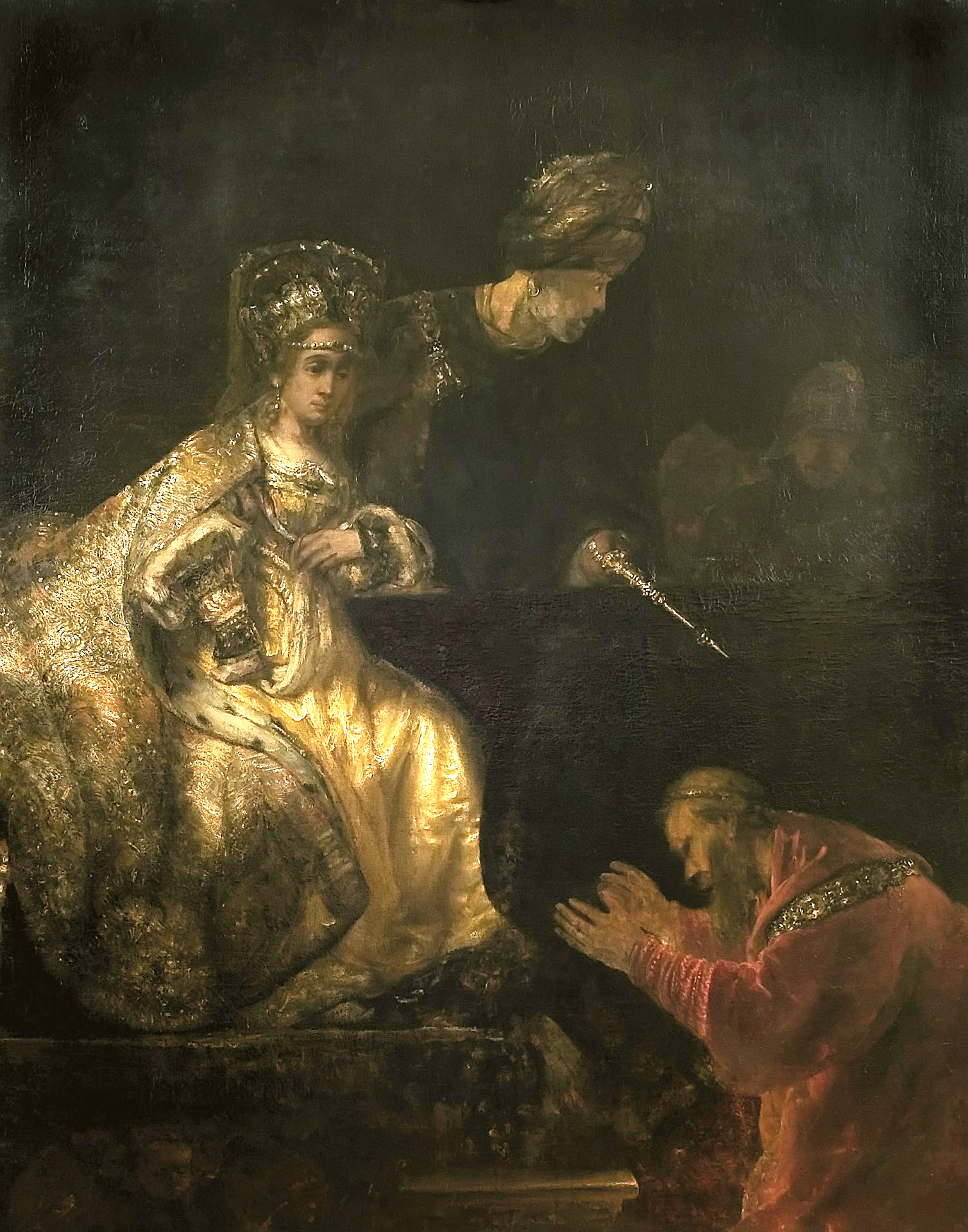
The plot was foiled by Queen Esther, the king's recent wife, who was herself a Jew. Esther invited Haman and the king to two banquets. In the second banquet, she informed the king that Haman was plotting to kill her (and the other Jews). This enraged the king, who was further angered when (after leaving the room briefly and returning) he discovered Haman had fallen on Esther's couch, intending to beg mercy from Esther, but which the king interpreted as a sexual advance.
On the king's orders, Haman was hanged from the 50-cubit-high gallows that had originally been built by Haman himself, on the advice of his wife Zeresh, in order to hang Mordecai. The bodies of Haman's 10 sons were also hanged, after they died in battle against the Jews. The Jews also killed about 75,000 of their enemies in self-defense.
The apparent purpose of these unusually high gallows can be understood from the geography of Shushan: Haman's house (where the pole was located) was likely in the city of Susa (a flat area), while the royal citadel and palace were located on a mound about 15 meters higher than the city. Such a tall pole would have allowed Haman to observe Mordecai's corpse while dining in the royal palace, had his plans worked as intended.
According to Ḥanan b. Rava, his mother was ʾĂmatlaʾy, a descendant of ʿÔrebtî (also ʿÔrǝbtāʾ she-raven), apparently patriarch of a major Nehardean house.
Hub AI
Haman AI simulator
(@Haman_simulator)
Haman
Haman (Hebrew: הָמָן Hāmān; also known as Haman the Agagite) is the main antagonist in the Book of Esther, who according to the Hebrew Bible was an official in the court of the Persian empire under King Ahasuerus, commonly identified as Xerxes I (died 465 BCE) but traditionally equated with Artaxerxes I or Artaxerxes II. His epithet, Agagite, indicates that Haman was a descendant of Agag, the king of the Amalekites. Some commentators interpret this descent to be symbolic, due to his similar personality.
In the narrative of the Book of Esther, Haman was a proud and ambitious man who demanded that everyone bow down to him as a sign of respect. However, a Jewish man named Mordecai refused to bow down to him, which enraged Haman. Seeking revenge, Haman convinced the king to issue a decree that all Jews in the Persian empire be exterminated. Haman's plot was foiled by Queen Esther, who was also Jewish and had concealed her identity from the King. Esther revealed Haman's plan to Ahasuerus and pleaded with him to spare her people. The King was outraged at Haman's treachery and ordered that he be executed instead.
The name has been equated with the Persian name Omanes (Old Persian: 𐎡𐎶𐎴𐎡𐏁, Imāniš) recorded by Greek historians. Several etymologies have been proposed for it: it has been associated with the Persian word Hamayun, meaning "illustrious" (naming dictionaries typically list it as meaning "magnificent"); with the sacred drink Haoma; or with the Persian name Vohuman, meaning "good thoughts". The 19th-century Bible critic Jensen associated it with the Elamite god Humban, a view dismissed by later scholars. Ahriman, a Zoroastrian spirit of destruction, has also been proposed as an etymon. Hoschander suggests that Haman is a priestly title and not a proper name.
As described in the Book of Esther, Haman was the son of Hammedatha the Agagite. After Haman was appointed the principal minister of the king Ahasuerus, all of the king's servants were required to bow down to Haman, but Mordecai refused to. Angered by this, and knowing of Mordecai's Jewish nationality, Haman convinced Ahasuerus to allow him to have all of the Jews in the Persian empire killed.
The plot was foiled by Queen Esther, the king's recent wife, who was herself a Jew. Esther invited Haman and the king to two banquets. In the second banquet, she informed the king that Haman was plotting to kill her (and the other Jews). This enraged the king, who was further angered when (after leaving the room briefly and returning) he discovered Haman had fallen on Esther's couch, intending to beg mercy from Esther, but which the king interpreted as a sexual advance.
On the king's orders, Haman was hanged from the 50-cubit-high gallows that had originally been built by Haman himself, on the advice of his wife Zeresh, in order to hang Mordecai. The bodies of Haman's 10 sons were also hanged, after they died in battle against the Jews. The Jews also killed about 75,000 of their enemies in self-defense.
The apparent purpose of these unusually high gallows can be understood from the geography of Shushan: Haman's house (where the pole was located) was likely in the city of Susa (a flat area), while the royal citadel and palace were located on a mound about 15 meters higher than the city. Such a tall pole would have allowed Haman to observe Mordecai's corpse while dining in the royal palace, had his plans worked as intended.
According to Ḥanan b. Rava, his mother was ʾĂmatlaʾy, a descendant of ʿÔrebtî (also ʿÔrǝbtāʾ she-raven), apparently patriarch of a major Nehardean house.
Recent media