Hubbry Logo
ProskynesisProskynesisMain
Open search
Proskynesis
Community hub
Proskynesis
logo
8 pages, 0 posts
0 subscribers
Be the first to start a discussion here.
Contribute something
Proskynesis
Proskynesis
from Wikipedia
Moravians performing proskynesis during Christian worship in 1735

Proskynesis (/ˌprɒskɪˈnsɪs/), also called proscynesis (/ˌprɒsɪˈnsɪs/) or proskinesis (/ˌprɒskɪˈnsɪs/; Greek: προσκύνησις proskýnēsis; Latin: adoratio), was a solemn gesture of respect towards gods and people in many societies. Among the Persians, it referred to a man prostrating himself and kissing the hand or the limbs of a respected person. It was also one of the religious rites among both Greeks and Romans.[1]

In Byzantine society, it was a common gesture of supplication or reverence. The physical act ranged from full-fledged prostration or alternatively genuflection, a bow, or a simple greeting that concretized the relative positions of performer and beneficiary within a hierarchical order (τάξις táxis).[2]

Etymology

[edit]

The Greek word προσκύνησις is derived from the verb προσκυνέω, proskyneo, itself formed from the compound words πρός, pros (towards) and κυνέω, kyneo ([I] kiss).[3] It describes an attitude of humbling, submission, or worship adoration – particularly towards a sovereign ruler, God or the gods.[citation needed]

Practice

[edit]

According to Herodotus in his Histories, a person of equal rank received a kiss on the lips; someone of a slightly lower rank gave a kiss on the cheek; and someone of a very inferior social standing had to completely bow down to the other person before them.[4] To the Greeks, giving proskynesis to a mortal was seen as barbaric and ludicrous. In his Anabasis (3.2.13), Xenophon cites the Greek refusal to perform proskynesis as a sign of their freedom distinguishing them from the Persians: "As tokens of these victories [over Xerxes's invasion] we may, indeed, still behold the trophies, but the strongest witness to them is the freedom of the states in which you were born and bred; for to no human creature do you pay homage as master, but to the gods alone [οὐδένα γὰρ ἄνθρωπον δεσπότην ἀλλὰ τοὺς θεοὺς προσκυνεῖτε]."

Applications

[edit]

The Persian custom may have led some Greeks to believe that they worshipped their king as a god, the only person who received proskynesis from everyone, and other misinterpretations caused cultural conflicts. Proskynȇsis was not a specific custom of the Achaemenid court alone, since it was practiced earlier in the Assyrian court. Contrary to the suggestions of Greek authors, Near Eastern sources leave no doubt that proskynȇsis did not have the character of a religious gesture, but was an element of the court ceremony.[5]

Alexander the Great proposed this practice during his lifetime in adapting to the local customs of the Persian areas he conquered, but it was not accepted by his Greek companions (such as noted by the court historian, Callisthenes); he later did not insist on the practice. Most of his men could cope with Alexander's interest for having a Persian wardrobe, but honoring the king as if he was a god with proskynesis went a bit too far.[6] According to Arrian, Callisthenes explains the existence of separated ways of honoring a god or a human and that prostration is a way to explicitly honor gods. It is seen as a threat to the Greeks, ‘who are men most devoted to freedom’. According to Callisthenes, prostration was a foreign and degrading fashion.[6]

The emperor Diocletian (AD 284–305) is usually thought to have introduced the practice to the Roman Empire, forming a break with the Republican institutions of the principate, which preserved the form, if not the intent, of republican government. However, there is some evidence that an informal form of proskynesis was already practiced at the court of Septimius Severus.[7] The political reason for this change was to elevate the role of the emperor from "first citizen" to an otherworldly ruler, remote from his subjects, thus reducing the likelihood of successful revolt, which had plagued the Empire during the preceding 50 years.

Certain forms of proskynesis, such as those which entailed kissing the emperor's breast, hands, or feet, were reserved to specific categories of officials. The audience granted to native or foreign delegations included multiple series of proskynesis at points marked by porphyry disks (omphalia) set in the floor. Until the 10th century at least, imperial ceremonial avoided proskynesis on Sundays out of reverence for the God. As a show of loyalty, proskynesis had strong political overtones; it recurs in imperial iconography and its importance in imperial ceremonial could sometimes raise delicate diplomatic dilemmas when foreign potentates were involved.[8]

Similarly, the emperor was hailed no longer as "Imp(erator)" on coins, which meant "commander in chief" but as "D(ominus) N(oster)" – "Our Lord." With the conversion of Constantine, I to Christianity, proskynesis became part of an elaborate ritual, whereby the emperor became God's viceregent on earth.[9][full citation needed] Titular inflation also affected the other principal offices of the Empire. Justinian I and Theodora both insisted on an extreme form of proskynesis, even from members of the Roman Senate,[10] and they were attacked for it by Procopius in his Secret History.[11]

In Christianity

[edit]

The verb προσκυνέω (proskyneo) is often used in the Septuagint and New Testament for the worship of pagan gods or the worship of the God of Israel. In addition, this word in some cases was used for the worship of angels.[12]

As with the Greeks five centuries earlier, the practice was shocking but prevailed.[13] With the conversion of Constantine to Christianity, it became part of an elaborate ritual, making the emperor "vice-regent of God on earth."

The question of the admissibility of proskynesis in relation to icons (bowing and kissing to icons) was raised in the 8th century during the period of iconoclasm. Opponents of proskynesis in relation to the icons referred to the second commandment of the Law of Moses:

"You shall not make for yourself a carved image any likeness of anything that is in heaven above, or that is in the earth beneath, or that is in the water under the earth; you shall not bow down (προσκυνήσεις) to them nor serve (λατρεύσῃς) them. For I, the LORD your God, am a jealous God."[14][15]

One defender of proskynesis in relation to icons was John of Damascus. He wrote Three Treatises on the Divine Images in defense of the icons, in which he described several kinds of proskynesis. The first kind is the proskynesis of latreia (λατρεία), which people give to God, who alone is adorable by nature. John believed that only the first kind of proskynesis associated with latreia was forbidden by God. Other kinds of proskynesis: proskynesis performed in relation to saints and images of them (icons) are permitted by God.[16]

In Christian theology, proskynesis denotes that simple veneration which is also permitted to saints, icons, etc., as opposed to latreia (worship), which is due only to triune God. Different authors translate the Greek word "προσκύνησις" from Christian texts into English differently: adoration,[17][18] worship,[19][20] veneration,[21] bow,[citation needed] reverence.[22]

"Greetings and respected proskynesis" (Greek: "ἀσπασμόν καί τιμητικήν προσκύνησιν"; Latin: "osculum et honorariam adorationem") for icons was established by the Second Council of Nicaea (Seventh Ecumenical Council) in 787.[23]

In the Book of Mormon

[edit]

In the Church of Jesus Christ of Latter-day Saints, proskynesis occurs in a number of the narratives in the Book of Mormon.[24][25][26][27]

See also

[edit]

References

[edit]

Further reading

[edit]
[edit]
Revisions and contributorsEdit on WikipediaRead on Wikipedia
from Grokipedia
Proskynesis (Ancient Greek: προσκύνησις, proskúnēsis, lit. 'kissing towards') was a ritual gesture of reverence and submission entailing prostration, bowing, or a symbolic kiss directed toward superiors, deities, or the ground in ancient Near Eastern and Mediterranean societies. Originating as a formal court protocol in the Achaemenid Persian Empire, where subjects would fall to their knees, touch their forehead to the earth, or kiss it in homage to the king—depicted in reliefs at sites like Persepolis—it signified hierarchical deference without implying divinity of the ruler. Greeks, observing it through Herodotus's accounts, distinguished their own milder forms of proskynēsis—such as hand-kissing or bowing toward gods, heroes' graves, or statues—from the Persian variant, which they deemed excessively servile and unfit for free men. A notable controversy arose when Alexander the Great, after conquering Persia, sought to integrate proskynesis into his multicultural court around 327 BCE, sparking mutiny among Macedonian elites who rejected it as eroding equality among companions and equating the king to a god. The practice influenced Hellenistic royal etiquette, persisted in Roman imperial ceremonies with adaptations like adoratio, and evolved in early Christianity into prostrations during liturgy, retaining its connotation of profound respect while aligning with monotheistic worship.

Etymology

Linguistic Origins

The term proskynēsis derives from the Ancient Greek noun προσκύνησις (proskynēsis), formed from the verb προσκυνέω (proskyneō), a compound of πρός (pros, "towards" or "to") and κυνέω (kyneō, "to kiss"). This literal etymology, first attested in descriptions by Herodotus in the fifth century BCE, evokes "kissing towards" a superior, suggesting a gesture of reverence such as blowing a kiss or extending the hand from lips without direct contact. The root κυνέω traces to a Proto-Indo-European onomatopoeic base *kʷes- or *ku- mimicking kissing sounds, yielding cognates across , including cumbati ("he kisses") in Vedic texts and related forms in for lip-based affectionate actions. These parallels underscore a shared conceptual foundation for reverential gestures involving the , though proskynēsis semantically evolved in Greek to denote obeisance adapted from Persian court protocols rather than purely Indo-Iranian homage terms like Avestan ritual supplications. Linguistically, the term's focus on "kissing towards" distinguishes its verbal origin from fuller prostration practices it later described, as Greek writers like Herodotus emphasized the non-physical directional aspect when contrasting it with native Hellenic customs of equality among free men. This adaptation reflects semantic expansion, where etymological literalism yielded to cultural borrowing, broadening proskynēsis to encompass hierarchical deference without implying divine worship in its core Greek usage.

Historical Development

Ancient Near Eastern and Persian Roots

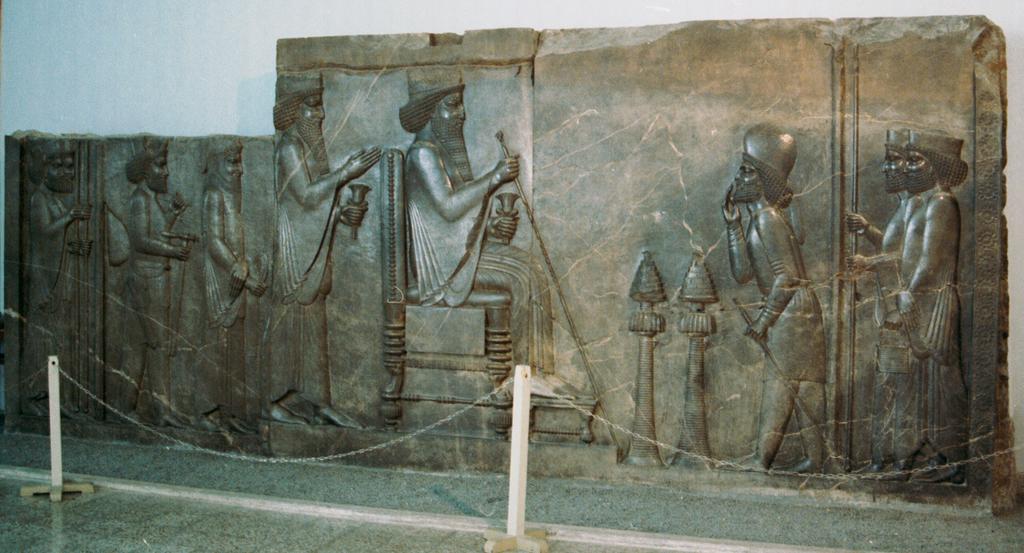
In ancient Mesopotamian civilizations, including and , prostration rituals formed part of ceremonies affirming hierarchical submission to rulers and deities, as seen in the festival where the king ritually humbled himself before Marduk's statue to renew divine kingship and ensure cosmic order. Such acts of physical , involving falling to the ground, ritually reinforced and social stability by embedding loyalty within repeated performative submission. Parallels appear in Egyptian practices, where subjects kissed the earth or pharaoh's feet in gestures of absolute obeisance, paralleling proskynesis as a marker of to divine-human rulers. The Achaemenid Persian Empire systematized these traditions from the mid-6th century BCE, with proskynesis emerging as a court protocol under (r. 559–530 BCE) and formalized by Darius I (r. 522–486 BCE), who constructed as a ceremonial center. Reliefs at depict tribute-bearing delegates approaching the royal throne with hands joined in a prayer-like pose, symbolizing respect and integration into the imperial order, though textual sources confirm fuller in practice. Greek historian , writing in the 5th century BCE, detailed the graded nature of Persian proskynesis: equals exchanged mouth kisses, slight inferiors cheek kisses, and marked subordinates performed , often kissing the ground, with the utmost deference reserved for the . This hierarchy of gestures, varying by rank—nobles potentially kissing the king's hands while commoners touched the ground—functioned causally to sustain empire-wide cohesion by visually enacting and perpetuating stratified loyalty, preventing challenges to royal supremacy.

Hellenistic and Classical Adoption

Alexander the Great (r. 336–323 BCE) sought to integrate Persian court practices into his administration after conquering the Achaemenid Empire, notably introducing proskynesis around 327 BCE during symposia at Bactra (modern Balkh) to symbolize equality between Macedonians and Persians in his unified realm. This ritual, involving prostration or obeisance graded by social rank, aimed to foster loyalty across ethnic lines but provoked vehement opposition from Macedonian officers and Greek intellectuals, who equated it with servility unfit for free citizens and divine honors improper for a mortal king. Led by the philosopher-historian Callisthenes of Olynthus—Aristotle's nephew and former tutor to Alexander—the resisters argued that proskynesis blurred distinctions between men and gods, eroding Greek egalitarian ideals. The controversy escalated into a philosophical debate, with proponents like Anaxarchus defending it as mere respect, while opponents invoked Peripatetic notions of inherent Greek superiority over "barbarian" customs, viewing full prostration as emblematic of despotism rather than hierarchy. Alexander's persistence led to Callisthenes' arrest and execution on conspiracy charges in 327 BCE, marking the failure of wholesale adoption and highlighting irreconcilable cultural tensions. In the successor Hellenistic kingdoms, proskynesis saw limited, selective incorporation, primarily in interactions with Persian subjects rather than among Greek elites, who retained their critique of it as degrading. Ptolemaic rulers in Egypt occasionally employed modified forms in ceremonial contexts by the 3rd century BCE, but Seleucid monarchs largely eschewed it to avoid alienating Macedonian settlers, preserving Greek aversion to rituals implying absolute subjugation. Roman elites, encountering proskynesis through eastern diplomacy, equated it with oriental tyranny and preferred adoratio—a restrained gesture like raising the hand to the lips—eschewing prostration to uphold virtues of liberty and equality among citizens. This stance persisted in classical literature, where Eastern obeisance underscored contrasts with Roman republicanism.

Forms and Practice

Variations of the Gesture

The primary form of proskynesis involved full , with the performer falling to the knees, touching the forehead to the ground, and often kissing the earth, the feet, or the hem of the superior's garment. This gesture, as described by in the 5th century BCE, signified profound respect toward kings or deities in Persian court protocol. Lesser variations included without full prostration or a deep bow from the waist, sometimes accompanied by raising one hand to the mouth in a kissing motion toward the superior. Adaptations occurred based on social status and context; Achaemenid officials typically performed proskynesis as hand-kissing or a bow, while common subjects might kneel or prostrate more fully before the king. The depth and repetition of the gesture varied: shallower bows sufficed for equals or lesser superiors, whereas encounters with the king demanded multiple prostrations upon approach. Material evidence from Persepolis reliefs depicts tribute bearers in graded postures of obeisance, ranging from standing with joined hands to kneeling figures before the royal throne, illustrating hierarchical differentiation without uniform full prostration. In Egyptian-influenced contexts, similar gestures appeared in wall reliefs as scaled acts of deference, with nobles shown bowing or prostrating proportionally to the pharaoh's or god's status, often integrating arm extensions or ground-touching elements. These variations underscored proskynesis as a flexible protocol, calibrated by the performer's rank and the recipient's authority, rather than a rigid single motion.

Social and Ceremonial Applications

![Relief from Persepolis depicting a royal audience scene][float-right] In the Achaemenid Empire, proskynesis formed a central component of court audiences and diplomatic protocols, requiring subjects, officials, and foreign envoys to perform obeisance through gestures such as bowing, kneeling, or prostration before the Great King to affirm hierarchical subordination and loyalty. These rituals occurred at designated points within audience halls, often involving multiple repetitions to emphasize submission, thereby reinforcing the king's authority and deterring potential rebellion by publicly enforcing fealty among vassals and delegates. Greek ambassadors, for instance, were compelled to observe this protocol during encounters with Persian rulers, underscoring its role in interstate relations as a visible marker of respect or capitulation. The practice extended to military submissions, where defeated adversaries or tributary rulers executed proskynesis to symbolize surrender and integration into the imperial order, as depicted in Persepolis reliefs showing tribute-bearers in postures of homage approaching the throne. This ceremonial act legitimized conquests by transforming physical into political allegiance, with variations in gesture intensity—hand-kissing for high officials versus full for inferiors—calibrating the degree of deference based on rank. Proskynesis also featured in enthronement ceremonies, where assembled nobles and regional satraps performed the gesture to validate the new sovereign's divine right and consolidate power through collective submission, mirroring audience rituals but amplified for dynastic continuity. Cross-cultural diffusion occurred via Achaemenid expansion into northwest India around the 6th-4th centuries BCE, influencing local court etiquettes with analogous prostration practices documented in the Arthashastra circa 300 BCE, which prescribes hierarchical greetings to maintain order in royal assemblies.

Contexts in Abrahamic Religions

In Judaism and Hebrew Bible

In the , the Hebrew verb hishtachavayah (הִשְׁתַּחֲוָיָה), denoting bowing down or with the face to the ground, serves as the primary equivalent to proskynesis, encompassing gestures of reverence toward superiors, in social interactions, or devotion to , while being condemned in contexts of . For example, in Genesis 23:7, Abraham rises and "bows down" (vayishtachu) to the sons of to negotiate the purchase of the cave of Machpelah, illustrating the gesture as a cultural norm of in Hittite society without implying . Likewise, Daniel 2:46 records King Nebuchadnezzar falling prostrate (nephal al-panav) before Daniel upon hearing the dream's interpretation, then ordering offerings and incense presented to the as honor for his divine insight, distinct from deifying the individual. These instances highlight hishtachavayah as a multifaceted act adaptable to monotheistic boundaries, unlike the Persian proskynesis tied to imperial . Theological limits on such gestures appear explicitly in prohibitions against directing prostration toward manufactured images or foreign deities, as in Exodus 20:4–5, which forbids crafting idols "in the form of anything" and commands, "You shall not bow down to them or serve them; for I the your am a jealous ." This clause, part of the Decalogue given at Sinai circa 1446–1406 BCE per traditional dating, establishes causal realism in worship: prostration must reflect exclusive allegiance to , rejecting with Canaanite or Mesopotamian practices where bowing to statues invoked presumed spiritual causation. Violations, such as Israelite prostrations before the (Exodus 32:4), incurred , reinforcing empirical patterns of covenant fidelity yielding prosperity versus leading to , as evidenced in prophetic critiques like 44:15–17. In Second Temple Judaism (516 BCE–70 CE), hishtachavayah-like bowing integrated into Temple liturgy while adhering to anti-idolatrous strictures, with worshippers bowing at each of the Temple's gates upon entry and during specific prayers to signify humility before God. Full prostration occurred annually on Yom Kippur, when the high priest's pronunciation of the Tetragrammaton prompted the congregation to fall face-down in the Temple courts, a practice rooted in Levitical rites but limited to this atonement context to prevent routine sacralization resembling pagan excess. Pharisaic traditions, influencing post-Temple prayer like the Amidah, retained partial bowing—such as at "Baruch atah Adonai" (Blessed are You, Lord)—as measured obeisance, drawing from Temple precedents while prohibiting stone-prostration per Leviticus 26:1 to avoid mimetic idolatry. Essene sects, associated with Qumran communities via the Dead Sea Scrolls (c. 3rd century BCE–1st century CE), critiqued Jerusalem Temple practices for perceived impurities, favoring communal purity rituals over public prostrations that risked Hellenistic or pagan conflation, though scrolls like 1QS describe disciplined reverence without endorsing exaggerated forms. This reflects broader Second Temple diversity, where gestures honored divine sovereignty absent visual aids, prioritizing textual fidelity over performative spectacle.

In Christianity

In the New Testament, the Greek verb proskuneō describes physical acts of prostration or bowing directed toward Jesus, frequently connoting worship or divine homage rather than mere civil respect. In Matthew 2:11, the Magi enter the house, see the child with Mary, and proskuneō him by falling down, accompanied by offering gifts of gold, frankincense, and myrrh, an act underscoring recognition of his messianic kingship. In Mark 5:6, the Gerasene demoniac—indwelt by unclean spirits—sees Jesus from afar, runs and proskuneō him, highlighting even supernatural entities' compelled submission to his authority. Post-resurrection, Matthew 28:9 records the women grasping Jesus' feet and proskuneō him, while verse 17 notes the disciples proskuneō upon seeing him, though some doubted; these scenes affirm Jesus' divine vindication after crucifixion. Scholarly examination of these usages argues that proskuneō applied to Jesus elevates him as a legitimate object of adoration, distinct from obeisance to humans or angels elsewhere in biblical texts, signaling early Christian affirmation of his deity amid Jewish monotheistic constraints. Early Church Fathers viewed New Testament proskuneō toward Christ as befitting latria (supreme worship due to God), integrating it into theological defenses against perceived idolatry or subordinationism. Tertullian (c. 160–220 CE), in works like Adversus Praxeas, upheld distinct yet co-equal honor to the Son alongside the Father, interpreting scriptural prostrations to Jesus as evidence of his divine personhood without conflating with pagan rites. This stance contrasted with Jewish reservations against human-directed proskynesis, as seen in patristic exegesis emphasizing Christ's incarnation as warranting embodied reverence. By the 3rd century, such interpretations facilitated ritual adaptations in worship, prioritizing spiritual intent over gesture form. In the Byzantine era, proskynesis permeated Christian liturgy and imperial protocol from the 4th century onward, fusing Hellenistic-Persian obeisance traditions with Trinitarian devotion. Emperors like Constantine (r. 306–337 CE) received courtly prostrations mirroring divine honor, while liturgical texts such as the Divine Liturgy of St. John Chrysostom (formalized c. 398 CE) incorporated full prostrations (metanoia) during the epiclesis and Great Entrance, symbolizing total submission to Christ's real presence in the Eucharist. This adoption, evident in 5th-century mosaics and conciliar canons (e.g., Council of Laodicea, c. 363–364 CE, regulating genuflections), distinguished Christian proskynesis from imperial cult excesses by reserving ultimate form for Godward prayer, though debates over icons later intensified scrutiny of its boundaries.

In Islam

In Islamic practice, (prostration) constitutes the primary equivalent to proskynesis, integrated as an obligatory element of the five daily (ritual prayers), where worshippers bow low with forehead, nose, palms, knees, and toes touching the ground, facing the in . Each prayer cycle (rak'ah) includes two prostrations, resulting in 34 or more sujud per day across the obligatory prayers (Fajr: 2 rak'ahs; Zuhr: 4; Asr: 4; Maghrib: 3; Isha: 4). This posture symbolizes utter humility and submission to God alone, as affirmed in Quranic verses enjoining prostration upon recitation of divine signs, such as 17:107–109, which describe believers falling prostrate and weeping in devotion. The gesture draws from pre-Islamic Arabian customs, where Arabs performed prostrations (sujud) before idols, sacred stones, or tribal leaders as acts of veneration or supplication, often at sites termed masajid (places of prostration). Islam reformed this by confining sujud to worship of the one God, explicitly rejecting its application to created beings to preserve tawhid (strict monotheism), while retaining the physical form as a universal marker of devotion inherited from regional Semitic traditions familiar to Arabs through Jewish and Christian influences. Prophet Muhammad explicitly redirected any attempted proskynesis toward himself or others to God, underscoring the prohibition against prostrating to humans. In a hadith narrated by Muadh ibn Jabal, upon returning from Yemen where he observed Christian prostrations to clergy, Muadh offered to prostrate before the Prophet, who refused, declaring, "Do not do so. If I were to command anyone to prostrate to another, I would command a woman to prostrate to her husband," but affirming prostration belongs solely to Allah. Similar accounts in Sahih collections emphasize this boundary, preventing the elevation of prophetic or authoritative figures to divine status. In governance, early caliphal courts (7th–10th centuries under Rashidun and Umayyad rule) eschewed required proskynesis, adhering to the Prophet's egalitarian model where allegiance (bay'ah) involved hand-clasping or verbal oaths rather than physical prostration, to avoid idolatrous implications. Later Abbasid (8th–13th centuries) and regional dynasties incorporated Persian-influenced courtly deference, such as kissing the ruler's hand or hem, but full sujud remained forbidden, with Sunni traditions stressing caliphal authority as political guardianship without ritual worship, while Shia perspectives reserved deeper reverence for infallible Imams through narrative emulation rather than prostration, maintaining the monotheistic restriction across sects.

Proskynesis in the

Key Instances

The describes numerous instances of proskynesis, where individuals or groups fall prostrate to the earth during encounters with divine power, visions, or conversions, often accompanied by worship or awe. These events, documented over 20 times across the text, typically involve physical collapse "as if dead" or deliberate bowing in response to spiritual manifestations. In Lehi's initial vision around 600 B.C., he is overcome by the Spirit, leading to a state of prostration-like submission as he receives revelation from God sitting on his throne. Similarly, Nephi's visionary experience includes elements of humbled prostration before divine figures guiding the revelation. Among Lamanite conversions circa 90 B.C., King Lamoni's people witness healings by Ammon, prompting many to fall to the earth and declare the power of God, marking a mass spiritual awakening. In a related episode around 30 B.C., Lamanite guards and prisoners, encircled by a miraculous pillar of fire during Nephi and Lehi's missionary efforts, fall to the earth as if dead for many hours before rising converted and praising God (Helaman 5:24–48). The most prominent instance occurs in A.D. 34, when Jesus Christ descends to the at the temple in Bountiful; the assembled multitude, numbering in the thousands, falls prostrate to the earth upon hearing his voice and seeing his wounds, worshiping him at his feet before he bids them to arise.

Interpretations in Latter-day Saint Scholarship

In Latter-day Saint scholarship, proskynesis in the Book of Mormon is analyzed as a marker of ancient Near Eastern cultural continuity, particularly from Lehi's seventh- to sixth-century BCE context. Matthew L. Bowen, in a 2005 examination published in Studia Antiqua, identifies over a dozen instances where the gesture involves falling to the earth, often with elements of embracing or touching the ground, paralleling attested practices in texts (e.g., histaḥăwâ in Genesis 23:7, 12) and extra-biblical sources like and Egyptian ritual descriptions from the Late Bronze and Iron Ages. These alignments, Bowen contends, reflect authentic Hebraic customs rather than post-exilic Hellenistic influences, as proskynesis motifs predate Alexander's conquests by centuries and appear in pre-600 BCE Levantine artifacts and inscriptions. Bowen's analysis counters critiques by emphasizing the gesture's rarity in 19th-century American religious discourse and Joseph Smith's limited exposure to specialized orientalist scholarship, which only began documenting such details post-1830 via figures like . Instead, the Book of Mormon's formulations—such as sequential actions of falling, worshiping, and rising—mirror empirical patterns in ancient theophanies, including Egyptian prescribing ground-kissing before deities around 2400–2300 BCE, adapted in Semitic contexts by Lehi's era. This textual fidelity, per Bowen, bolsters claims of , as the narrative's integration of proskynesis with covenantal motifs (e.g., oath-taking via ) evinces first-millennium BCE Israelite over modern invention. Scholarly debate within Latter-day Saint circles centers on proskynesis's semantic range, with Bowen and citing analysts like those at Book of Mormon Central affirming its primary denotation of worship (latreia-like adoration) toward divine figures, distinct from secular obeisance, based on consistent collocations with verbs of divine encounter in ancient corpora. However, some interpretations allow contextual flexibility for respect toward prophetic intermediaries, akin to biblical usages (e.g., 1 Kings 1:16), prioritizing empirical consistency across Semitic texts over rigid binaries. This nuanced view underscores causal links between the Book of Mormon's phrasing and pre-exilic Judean practices, evidenced by archaeological parallels like Lachish reliefs depicting prostration circa 590 BCE.

Controversies and Debates

Cultural Resistance and Refusals

In 327 BCE, Alexander the Great sought to integrate Persian court practices by introducing proskynesis among his Macedonian and Greek companions during a banquet debate, framing it as a respectful gesture rather than divine worship, but many refused, viewing it as servile obeisance unfit for equals or mortals. The philosopher Callisthenes led the opposition, arguing that such prostration was reserved for gods and contradicted Greek principles of human equality and autonomy, a stance that resonated with the Macedonians and highlighted cultural resistance to Persianization as a threat to Hellenic identity. This refusal escalated tensions, contributing to Callisthenes' eventual execution and underscoring philosophical justifications for rejecting rituals symbolizing hierarchical subservience. The of 167–160 BCE exemplified Jewish resistance to Seleucid impositions under , whose edicts enforced Hellenistic religious observances, including sacrifices and likely prostrations to Olympian in the Temple, which Jews rejected as idolatrous violations of monotheism and covenantal autonomy. Priest ignited the uprising by slaying a royal official and a complying Jew at Modiin, prioritizing adherence over imperial decrees that demanded conformity to foreign cultic gestures and customs. This defiance, rooted in preserving cultural and religious independence, propelled ' guerrilla campaigns, culminating in the Temple's rededication and temporary expulsion of Seleucid forces. Roman senators demonstrated aversion to proskynesis amid eastern influences during the imperial period, perceiving full as degrading to their status and republican heritage, though specific impositions varied by emperor. Under (r. 180–192 CE), adoption of exotic rituals and self-deification as evoked senatorial unease with servile eastern precedents, as Dio Cassius critiqued the emperor's excesses blurring Roman dignity with oriental pomp. Such resistance preserved elite cultural boundaries against rituals implying absolute monarchical divinity.

Theological Implications of Worship

In Christian theology, the New Testament's use of proskynēsis—the Greek term for prostration or bowing—toward Jesus consistently conveys divine worship (latria), rather than mere civil homage, as evidenced by its application in contexts affirming his divinity, such as the Magi's act in Matthew 2:11 and post-resurrection scenes in Matthew 28:17. This interpretation aligns with patristic exegesis, where early Church Fathers distinguished latria reserved for God and Christ from lesser veneration (dulia or hyperdulia) extended to saints or icons, ensuring proskynēsis to the divine does not equate to hierarchical obeisance but acknowledges Christ's unique status as worthy of adoration. Origen (c. 185–253 CE), in works like Contra Celsum, critiqued pagan proskynēsis to emperors as idolatrous while affirming its propriety toward the divine Logos, emphasizing intent and object as determinants of worship's theological validity. In , proskynēsis-like gestures in the , rendered as hištahăwâ (to bow down), denote worship when directed to but mere respect toward human superiors, with theological safeguards against conflation to prevent , as seen in prohibitions against bowing to foreign gods or images (Exodus 20:4–5). Rabbinic tradition reinforces this by redirecting all prostrations ultimately to God, viewing undifferentiated proskynēsis as risking violation of monotheistic exclusivity, where hierarchical origins of the gesture—rooted in ancient Near Eastern court protocols—necessitate contextual discernment to maintain covenantal purity. Islamic theology strictly limits sujūd (prostration, akin to proskynēsis) to acts of directed solely to , deeming any extension to humans or intermediaries as shirk (associating partners with ), a cardinal sin unforgivable if unrepented (Qur'an 4:48). This safeguard, articulated in and , redirects all reverential gestures to divine (oneness), rejecting the gesture's pre-Islamic Persian hierarchical connotations to preserve egalitarian submission before alone, with scholars like Ibn Taymiyyah (d. 1328 CE) emphasizing intention () as the boundary against unwitting . Across these traditions, proskynēsis' origins in status-based reverence pose theological tensions with doctrines of spiritual equality, prompting debates on whether its adoption inherently imports undue into , though empirical analyses of scriptural usage prioritize object and over form.

References

Add your contribution
Related Hubs
Contribute something
User Avatar
No comments yet.