



Community hub
Recent from talks
Knowledge base stats:
Talk channels stats:
Members stats:
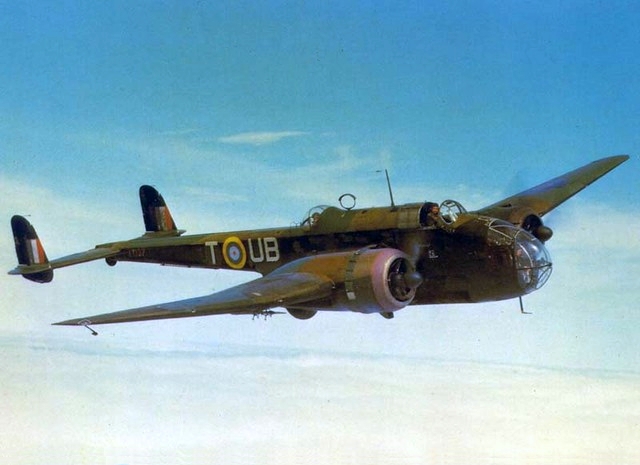
Handley Page Hampden
The Handley Page HP.52 Hampden was a British twin-engine medium bomber that was operated by the Royal Air Force (RAF). It was part of the trio of large twin-engine bombers procured for the RAF, joining the Armstrong Whitworth Whitley and Vickers Wellington. The Hampden was powered by Bristol Pegasus radial engines but a variant known as the Handley Page Hereford had in-line Napier Daggers.
The Hampden served in the early stages of the Second World War, bearing the brunt of the early bombing war over Europe, taking part in the first night raid on Berlin and the first 1,000-bomber raid on Cologne. When it became obsolete, after a period of mainly operating at night, it was retired from RAF Bomber Command service in late 1942. By 1943, the rest of the trio were being superseded by the larger four-engined heavy bombers such as the Avro Lancaster.
In 1932, the Air Ministry issued Specification B.9/32 seeking a twin-engined day bomber with higher performance than any preceding bomber aircraft. Handley Page and Vickers both designed aircraft to meet this specification, the Vickers design became the Wellington. The Handley Page design team, led by George Volkert, drafted a radical aircraft, initially centering upon the politically favoured Rolls-Royce Goshawk engine. By mid-1934 development of the Goshawk looked less promising and the Air Ministry relaxed the tare weight (unloaded weight) requirement of the specification, allowing for the use of heavier and more powerful radial engines such as the Bristol Perseus and Bristol Pegasus. According to aviation author Philip J.R. Moyes, the Handley Page design soon found support with the Air Ministry in part because it was judged to represent a fair compromise between range, payload, and speed.
During early 1936, the first prototype, designated as the HP.52 and given the serial number K4240, was completed. On seeing the narrow-yet-deep fuselage, which was only 3 ft wide, C. G. Grey, founder of The Aeroplane magazine, remarked "it looks like a flying suitcase", a nickname that stuck with the aircraft for its lifetime. On 21 June 1936, the prototype, powered by a pair of Bristol Pegasus P.E.5S(A) engines, conducted its maiden flight from Radlett Aerodrome, Hertfordshire, piloted by Handley-Page chief test pilot Major James Cordes. In late June 1936, the prototype was put on public display in the New Types Park, Hendon Air Show, London. In August 1936, in response to the successful flight trials performed by K4240, the Air Ministry issued an initial production order for the type, ordering 180 production aircraft to be manufactured to meet Specification B.30/36; concurrently, a second order for 100 aircraft powered by the Napier Dagger was issued to Belfast-based Short & Harland.
In early 1937, a second prototype, which received the serial number L7271, was completed; this second prototype had several differences from the first, including the pitot tube being repositioned below the fuselage, a more rounded ventral defensive gun position, and a slightly modified nose. L7271 later received a pair of Dagger engines and was accordingly re-designated as the HP.53; on 1 July 1937, it performed its first flight after having received the new engines. Another prototype, L4032, was produced to serve as the production-standard prototype; on 24 June 1938, the third prototype conducted its maiden flight. L4032 differed from the previous two prototypes in that it was powered by a pair of Pegasus XVIII engines, the nose incorporated an optically flat bomb-aiming panel, as well as the ventral and dorsal gun positions being revised.
On 24 June 1938, L4032 was officially christened by Lady Katharine Mary Montagu-Douglas-Scott, Viscountess Hampden, at a ceremony held in Radlett Aerodrome, the same day on which its first flight took place. Viscountess Hampden's speech invoked "the spirit of John Hampden, the defender of civil liberties" to inspire future crews of his namesake aircraft. L4032 and L4033, which was the second production-standard Hampden to be produced, would be later assigned to the Aeroplane and Armament Experimental Establishment at RAF Martlesham Heath, Suffolk. On 20 September 1938, the third production Hampden, designated L4034, following the completion of handling trials conducted by the Central Flying School at Upavon Aerodrome, Wiltshire, become the first aircraft to enter RAF squadron service, being delivered to No. 49 Squadron.
By late 1938, the mass manufacturing plans for the Hampden had been formalised. Volker devised a photographic method for reproducing the plans at full size for distribution to other factories. In addition to Handley-Page's own production line, the type was to be built under subcontract by English Electric at its factory in Preston, Lancashire. On 6 August 1938, English Electric was awarded an initial contract to manufacture 75 Hampdens. In addition, Canadian interest in domestic production of the type had resulted in the establishment of the joint Anglo-Canadian Canadian Associated Aircraft company, which promptly received an initial order from the RAF for 80 Hampdens to be completed in Canada; this facility would effectively act as a shadow factory during wartime. On 1 September 1938, in response to interest expressed by the Royal Swedish Air Force (RSAF) in the Hampden, including in a potential licence production arrangement for 70 aircraft to be built in Sweden, a single production Hampden was supplied to Sweden. Designated P.5 by the RSAF, it was operated by the service until November 1945, after which it was sold to Svenska Aeroplan AB (SAAB) to serve as a flying testbed before being retired in late 1947.
On 22 February 1940, the first Preston-built Hampden, P2062, conducted its maiden flight. English Electric would go on to manufacture a total of 770 Hampdens, more than any other company, before delivering its final aircraft on 15 March 1942. In July 1940, Handley-Page terminated its own production line for the Hampden upon the completion of its 500th aircraft. On 9 August 1940, the first Canadian-built Hampden, P5298, made its debut flight; by October 1940, Canadian production had risen to 15 aircraft per month. A total of 160 Hampdens were completed by Canadian Associated Aircraft, many of which were ferried to the United Kingdom for wartime service. The final Canadian-built aircraft was delivered in late 1941.
Hub AI
Handley Page Hampden AI simulator
(@Handley Page Hampden_simulator)
Handley Page Hampden
The Handley Page HP.52 Hampden was a British twin-engine medium bomber that was operated by the Royal Air Force (RAF). It was part of the trio of large twin-engine bombers procured for the RAF, joining the Armstrong Whitworth Whitley and Vickers Wellington. The Hampden was powered by Bristol Pegasus radial engines but a variant known as the Handley Page Hereford had in-line Napier Daggers.
The Hampden served in the early stages of the Second World War, bearing the brunt of the early bombing war over Europe, taking part in the first night raid on Berlin and the first 1,000-bomber raid on Cologne. When it became obsolete, after a period of mainly operating at night, it was retired from RAF Bomber Command service in late 1942. By 1943, the rest of the trio were being superseded by the larger four-engined heavy bombers such as the Avro Lancaster.
In 1932, the Air Ministry issued Specification B.9/32 seeking a twin-engined day bomber with higher performance than any preceding bomber aircraft. Handley Page and Vickers both designed aircraft to meet this specification, the Vickers design became the Wellington. The Handley Page design team, led by George Volkert, drafted a radical aircraft, initially centering upon the politically favoured Rolls-Royce Goshawk engine. By mid-1934 development of the Goshawk looked less promising and the Air Ministry relaxed the tare weight (unloaded weight) requirement of the specification, allowing for the use of heavier and more powerful radial engines such as the Bristol Perseus and Bristol Pegasus. According to aviation author Philip J.R. Moyes, the Handley Page design soon found support with the Air Ministry in part because it was judged to represent a fair compromise between range, payload, and speed.
During early 1936, the first prototype, designated as the HP.52 and given the serial number K4240, was completed. On seeing the narrow-yet-deep fuselage, which was only 3 ft wide, C. G. Grey, founder of The Aeroplane magazine, remarked "it looks like a flying suitcase", a nickname that stuck with the aircraft for its lifetime. On 21 June 1936, the prototype, powered by a pair of Bristol Pegasus P.E.5S(A) engines, conducted its maiden flight from Radlett Aerodrome, Hertfordshire, piloted by Handley-Page chief test pilot Major James Cordes. In late June 1936, the prototype was put on public display in the New Types Park, Hendon Air Show, London. In August 1936, in response to the successful flight trials performed by K4240, the Air Ministry issued an initial production order for the type, ordering 180 production aircraft to be manufactured to meet Specification B.30/36; concurrently, a second order for 100 aircraft powered by the Napier Dagger was issued to Belfast-based Short & Harland.
In early 1937, a second prototype, which received the serial number L7271, was completed; this second prototype had several differences from the first, including the pitot tube being repositioned below the fuselage, a more rounded ventral defensive gun position, and a slightly modified nose. L7271 later received a pair of Dagger engines and was accordingly re-designated as the HP.53; on 1 July 1937, it performed its first flight after having received the new engines. Another prototype, L4032, was produced to serve as the production-standard prototype; on 24 June 1938, the third prototype conducted its maiden flight. L4032 differed from the previous two prototypes in that it was powered by a pair of Pegasus XVIII engines, the nose incorporated an optically flat bomb-aiming panel, as well as the ventral and dorsal gun positions being revised.
On 24 June 1938, L4032 was officially christened by Lady Katharine Mary Montagu-Douglas-Scott, Viscountess Hampden, at a ceremony held in Radlett Aerodrome, the same day on which its first flight took place. Viscountess Hampden's speech invoked "the spirit of John Hampden, the defender of civil liberties" to inspire future crews of his namesake aircraft. L4032 and L4033, which was the second production-standard Hampden to be produced, would be later assigned to the Aeroplane and Armament Experimental Establishment at RAF Martlesham Heath, Suffolk. On 20 September 1938, the third production Hampden, designated L4034, following the completion of handling trials conducted by the Central Flying School at Upavon Aerodrome, Wiltshire, become the first aircraft to enter RAF squadron service, being delivered to No. 49 Squadron.
By late 1938, the mass manufacturing plans for the Hampden had been formalised. Volker devised a photographic method for reproducing the plans at full size for distribution to other factories. In addition to Handley-Page's own production line, the type was to be built under subcontract by English Electric at its factory in Preston, Lancashire. On 6 August 1938, English Electric was awarded an initial contract to manufacture 75 Hampdens. In addition, Canadian interest in domestic production of the type had resulted in the establishment of the joint Anglo-Canadian Canadian Associated Aircraft company, which promptly received an initial order from the RAF for 80 Hampdens to be completed in Canada; this facility would effectively act as a shadow factory during wartime. On 1 September 1938, in response to interest expressed by the Royal Swedish Air Force (RSAF) in the Hampden, including in a potential licence production arrangement for 70 aircraft to be built in Sweden, a single production Hampden was supplied to Sweden. Designated P.5 by the RSAF, it was operated by the service until November 1945, after which it was sold to Svenska Aeroplan AB (SAAB) to serve as a flying testbed before being retired in late 1947.
On 22 February 1940, the first Preston-built Hampden, P2062, conducted its maiden flight. English Electric would go on to manufacture a total of 770 Hampdens, more than any other company, before delivering its final aircraft on 15 March 1942. In July 1940, Handley-Page terminated its own production line for the Hampden upon the completion of its 500th aircraft. On 9 August 1940, the first Canadian-built Hampden, P5298, made its debut flight; by October 1940, Canadian production had risen to 15 aircraft per month. A total of 160 Hampdens were completed by Canadian Associated Aircraft, many of which were ferried to the United Kingdom for wartime service. The final Canadian-built aircraft was delivered in late 1941.