



Community hub
Recent from talks
Contribute something
Nothing was collected or created yet.
Feature hashing
View on WikipediaIn machine learning, feature hashing, also known as the hashing trick (by analogy to the kernel trick), is a fast and space-efficient way of vectorizing features, i.e. turning arbitrary features into indices in a vector or matrix.[1][2] It works by applying a hash function to the features and using their hash values as indices directly (after a modulo operation), rather than looking the indices up in an associative array. In addition to its use for encoding non-numeric values, feature hashing can also be used for dimensionality reduction.[2]
This trick is often attributed to Weinberger et al. (2009),[2] but there exists a much earlier description of this method published by John Moody in 1989.[1]
Motivation
[edit]Motivating example
[edit]In a typical document classification task, the input to the machine learning algorithm (both during learning and classification) is free text. From this, a bag of words (BOW) representation is constructed: the individual tokens are extracted and counted, and each distinct token in the training set defines a feature (independent variable) of each of the documents in both the training and test sets.
Machine learning algorithms, however, are typically defined in terms of numerical vectors. Therefore, the bags of words for a set of documents is regarded as a term-document matrix where each row is a single document, and each column is a single feature/word; the entry i, j in such a matrix captures the frequency (or weight) of the j'th term of the vocabulary in document i. (An alternative convention swaps the rows and columns of the matrix, but this difference is immaterial.) Typically, these vectors are extremely sparse—according to Zipf's law.
The common approach is to construct, at learning time or prior to that, a dictionary representation of the vocabulary of the training set, and use that to map words to indices. Hash tables and tries are common candidates for dictionary implementation. E.g., the three documents
- John likes to watch movies.
- Mary likes movies too.
- John also likes football.
can be converted, using the dictionary
| Term | Index |
|---|---|
| John | 1 |
| likes | 2 |
| to | 3 |
| watch | 4 |
| movies | 5 |
| Mary | 6 |
| too | 7 |
| also | 8 |
| football | 9 |
to the term-document matrix

(Punctuation was removed, as is usual in document classification and clustering.)
The problem with this process is that such dictionaries take up a large amount of storage space and grow in size as the training set grows.[3] On the contrary, if the vocabulary is kept fixed and not increased with a growing training set, an adversary may try to invent new words or misspellings that are not in the stored vocabulary so as to circumvent a machine learned filter. To address this challenge, Yahoo! Research attempted to use feature hashing for their spam filters.[4]
Note that the hashing trick isn't limited to text classification and similar tasks at the document level, but can be applied to any problem that involves large (perhaps unbounded) numbers of features.
Mathematical motivation
[edit]Mathematically, a token is an element in a finite (or countably infinite) set . Suppose we only need to process a finite corpus, then we can put all tokens appearing in the corpus into , meaning that is finite. However, suppose we want to process all possible words made of the English letters, then is countably infinite.


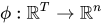
Most neural networks can only operate on real vector inputs, so we must construct a "dictionary" function .

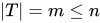
When is finite, of size , then we can use one-hot encoding to map it into . First, arbitrarily enumerate , then define . In other words, we assign a unique index to each token, then map the token with index to the unit basis vector .




One-hot encoding is easy to interpret, but it requires one to maintain the arbitrary enumeration of . Given a token , to compute , we must find out the index of the token . Thus, to implement efficiently, we need a fast-to-compute bijection , then we have .




In fact, we can relax the requirement slightly: It suffices to have a fast-to-compute injection , then use .

In practice, there is no simple way to construct an efficient injection . However, we do not need a strict injection, but only an approximate injection. That is, when , we should probably have , so that probably .


At this point, we have just specified that should be a hashing function. Thus we reach the idea of feature hashing.

Algorithms
[edit]Feature hashing (Weinberger et al. 2009)
[edit]The basic feature hashing algorithm presented in (Weinberger et al. 2009)[2] is defined as follows.
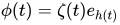
First, one specifies two hash functions: the kernel hash , and the sign hash . Next, one defines the feature hashing function:Finally, extend this feature hashing function to strings of tokens bywhere is the set of all finite strings consisting of tokens in .





Equivalently,

Geometric properties
[edit]We want to say something about the geometric property of , but , by itself, is just a set of tokens, we cannot impose a geometric structure on it except the discrete topology, which is generated by the discrete metric. To make it nicer, we lift it to , and lift from to by linear extension: There is an infinite sum there, which must be handled at once. There are essentially only two ways to handle infinities. One may impose a metric, then take its completion, to allow well-behaved infinite sums, or one may demand that nothing is actually infinite, only potentially so. Here, we go for the potential-infinity way, by restricting to contain only vectors with finite support: , only finitely many entries of are nonzero.



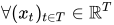

Define an inner product on in the obvious way: As a side note, if is infinite, then the inner product space is not complete. Taking its completion would get us to a Hilbert space, which allows well-behaved infinite sums.

Now we have an inner product space, with enough structure to describe the geometry of the feature hashing function .
First, we can see why is called a "kernel hash": it allows us to define a kernel byIn the language of the "kernel trick", is the kernel generated by the "feature map" Note that this is not the feature map we were using, which is . In fact, we have been using another kernel , defined by The benefit of augmenting the kernel hash with the binary hash is the following theorem, which states that is an isometry "on average".







Theorem (intuitively stated)—If the binary hash is unbiased (meaning that it takes value with equal probability), then is an isometry in expectation:

![{\displaystyle \mathbb {E} [\langle \phi (x),\phi (x')\rangle ]=\langle x,x'\rangle .}](https://wikimedia.org/api/rest_v1/media/math/render/svg/21adb87e5264a193d14707da8d7c979aa4330694)
By linearity of expectation, Now, , since we assumed is unbiased. So we continue
![{\displaystyle \mathbb {E} [\langle \phi (x),\phi (x')\rangle ]=\sum _{t,t'\in T}(x_{t}x'_{t'})\cdot \mathbb {E} [\zeta (t)\zeta (t')]\cdot \langle e_{h(t)},e_{h(t')}\rangle }](https://wikimedia.org/api/rest_v1/media/math/render/svg/b1289066e107d50d2b2aed8eb3e0d1503b72c5e0)
![{\displaystyle \mathbb {E} [\zeta (t)\zeta (t')]={\begin{cases}1\quad {\text{ if }}t=t'\\0\quad {\text{ if }}t\neq t'\\\end{cases}}}](https://wikimedia.org/api/rest_v1/media/math/render/svg/9683bb9906403df01c90d4109d18bcd91f22c1c8)
![{\displaystyle \mathbb {E} [\langle \phi (x),\phi (x')\rangle ]=\sum _{t\in T}(x_{t}x'_{t})\langle e_{h(t)},e_{h(t)}\rangle =\langle x,x'\rangle }](https://wikimedia.org/api/rest_v1/media/math/render/svg/2289827566cdb4dd560c270ebd4bdd9a0592770f)
The above statement and proof interprets the binary hash function not as a deterministic function of type , but as a random binary vector with unbiased entries, meaning that for any .



This is a good intuitive picture, though not rigorous. For a rigorous statement and proof, see [2]
Pseudocode implementation
[edit]Instead of maintaining a dictionary, a feature vectorizer that uses the hashing trick can build a vector of a pre-defined length by applying a hash function h to the features (e.g., words), then using the hash values directly as feature indices and updating the resulting vector at those indices. Here, we assume that feature actually means feature vector.
 function hashing_vectorizer(features : array of string, N : integer):
     x := new vector[N]
     for f in features:
         h := hash(f)
         x[h mod N] += 1
     return x
Thus, if our feature vector is ["cat","dog","cat"] and hash function is if is "cat" and if is "dog". Let us take the output feature vector dimension (N) to be 4. Then output x will be [0,2,1,0]. It has been suggested that a second, single-bit output hash function ξ be used to determine the sign of the update value, to counter the effect of hash collisions.[2] If such a hash function is used, the algorithm becomes


 function hashing_vectorizer(features : array of string, N : integer):
     x := new vector[N]
     for f in features:
         h := hash(f)
         idx := h mod N
         if ξ(f) == 1:
             x[idx] += 1
         else:
             x[idx] -= 1
     return x
The above pseudocode actually converts each sample into a vector. An optimized version would instead only generate a stream of pairs and let the learning and prediction algorithms consume such streams; a linear model can then be implemented as a single hash table representing the coefficient vector.

Extensions and variations
[edit]Learned feature hashing
[edit]Feature hashing generally suffers from hash collision, which means that there exist pairs of different tokens with the same hash: . A machine learning model trained on feature-hashed words would then have difficulty distinguishing and , essentially because is polysemic.



If is rare, then performance degradation is small, as the model could always just ignore the rare case, and pretend all means . However, if both are common, then the degradation can be serious.
To handle this, one can train supervised hashing functions that avoids mapping common tokens to the same feature vectors.[5]
Applications and practical performance
[edit]Ganchev and Dredze showed that in text classification applications with random hash functions and several tens of thousands of columns in the output vectors, feature hashing need not have an adverse effect on classification performance, even without the signed hash function.[3]
Weinberger et al. (2009) applied their version of feature hashing to multi-task learning, and in particular, spam filtering, where the input features are pairs (user, feature) so that a single parameter vector captured per-user spam filters as well as a global filter for several hundred thousand users, and found that the accuracy of the filter went up.[2]
Chen et al. (2015) combined the idea of feature hashing and sparse matrix to construct "virtual matrices": large matrices with small storage requirements. The idea is to treat a matrix as a dictionary, with keys in , and values in . Then, as usual in hashed dictionaries, one can use a hash function , and thus represent a matrix as a vector in , no matter how big is. With virtual matrices, they constructed HashedNets, which are large neural networks taking only small amounts of storage.[6]





Implementations
[edit]Implementations of the hashing trick are present in:
See also
[edit]- Bloom filter – Data structure for approximate set membership
- Count–min sketch – Probabilistic data structure in computer science
- Heaps' law – Heuristic for distinct words in a document
- Locality-sensitive hashing – Algorithmic technique using hashing
- MinHash – Data mining technique
References
[edit]- ^ a b Moody, John (1989). "Fast learning in multi-resolution hierarchies" (PDF). Advances in Neural Information Processing Systems. Archived from the original (PDF) on 2016-04-11. Retrieved 2018-12-14.
- ^ a b c d e f g Kilian Weinberger; Anirban Dasgupta; John Langford; Alex Smola; Josh Attenberg (2009). Feature Hashing for Large Scale Multitask Learning (PDF). Proc. ICML.
- ^ a b K. Ganchev; M. Dredze (2008). Small statistical models by random feature mixing (PDF). Proc. ACL08 HLT Workshop on Mobile Language Processing.
- ^ Josh Attenberg; Kilian Weinberger; Alex Smola; Anirban Dasgupta; Martin Zinkevich (2009). "Collaborative spam filtering with the hashing trick". Virus Bulletin.
- ^ Bai, B.; Weston J.; Grangier D.; Collobert R.; Sadamasa K.; Qi Y.; Chapelle O.; Weinberger K. (2009). Supervised semantic indexing (PDF). CIKM. pp. 187–196.
- ^ Chen, Wenlin; Wilson, James; Tyree, Stephen; Weinberger, Kilian; Chen, Yixin (2015-06-01). "Compressing Neural Networks with the Hashing Trick". International Conference on Machine Learning. PMLR: 2285–2294. arXiv:1504.04788.
- ^ Owen, Sean; Anil, Robin; Dunning, Ted; Friedman, Ellen (2012). Mahout in Action. Manning. pp. 261–265.
- ^ "gensim: corpora.hashdictionary – Construct word<->id mappings". Radimrehurek.com. Retrieved 2014-02-13.
- ^ "4.1. Feature extraction — scikit-learn 0.14 documentation". Scikit-learn.org. Retrieved 2014-02-13.
- ^ "sofia-ml - Suite of Fast Incremental Algorithms for Machine Learning. Includes methods for learning classification and ranking models, using Pegasos SVM, SGD-SVM, ROMMA, Passive-Aggressive Perceptron, Perceptron with Margins, and Logistic Regression". Retrieved 2014-02-13.
- ^ "Hashing TF". Retrieved 4 September 2015.
Maps a sequence of terms to their term frequencies using the hashing trick.
- ^ "FeatureHashing: Creates a Model Matrix via Feature Hashing With a Formula Interface". 10 January 2024.
- ^ "tf.keras.preprocessing.text.hashing_trick — TensorFlow Core v2.0.1". Retrieved 2020-04-29.
Converts a text to a sequence of indexes in a fixed-size hashing space.
- ^ "dask_ml.feature_extraction.text.HashingVectorizer — dask-ml 2021.11.17 documentation". ml.dask.org. Retrieved 2021-11-22.
External links
[edit]- Hashing Representations for Machine Learning on John Langford's website
- What is the "hashing trick"? - MetaOptimize Q+A
Feature hashing
View on GrokipediaIntroduction
Definition and overview
Feature hashing, also known as the hashing trick, is a fast dimensionality reduction technique that maps high-dimensional, sparse feature vectors—such as those from bag-of-words representations—to a lower-dimensional sparse vector space using a hash function. This method transforms categorical or textual data into numerical features suitable for machine learning models without requiring the storage of an explicit feature dictionary, making it particularly useful for handling vast numbers of possible features like words in natural language processing tasks.[5] The core mechanism involves hashing each feature to an index within a fixed-size vector of dimension , often chosen as a power of 2 for efficient computation, where collisions—multiple features mapping to the same index—are resolved by summing their corresponding values. No permutation or explicit mapping is stored, allowing the process to operate in constant time per feature. Formally, for a feature with associated value , the hashed feature vector is constructed such that where is a universal hash function, such as the signed 32-bit MurmurHash3, and is a random sign function that helps provide an unbiased estimator for inner products and mitigate collision biases.[5][6] This approach offers key benefits, including significant memory efficiency for large vocabularies—such as millions of terms—by avoiding the need to store sparse matrices explicitly, constant-time feature extraction regardless of vocabulary size, and scalability to streaming or dynamically growing datasets where new features may appear unpredictably. These properties enable its widespread use in large-scale machine learning applications, such as text classification and recommendation systems, while addressing challenges posed by high-dimensional data.[5]Historical origins
The concept of feature hashing was first introduced by John Moody in his 1989 paper on fast learning in multi-resolution hierarchies, where it was described as a method for efficiently handling continuous features in neural network approximations by mapping them into a fixed-size discrete space via hashing functions.[7] This early formulation focused on reducing computational complexity for locally tuned processing units but received limited attention in the broader machine learning community at the time.[7] The technique gained practical prominence through its integration into the Vowpal Wabbit machine learning library, released in 2007 by John Langford and colleagues, which employed hashing for efficient processing of high-dimensional text data without the need for explicit feature indexing or vocabulary storage.[5] This implementation demonstrated the method's utility in online learning scenarios, enabling scalable handling of sparse, large-scale datasets in resource-constrained environments.[5] A formal theoretical analysis and extension of feature hashing were provided by Kilian Weinberger, Anirban Dasgupta, Josh Attenberg, John Langford, and Alex Smola in their 2009 paper "Feature Hashing for Large Scale Multitask Learning," which introduced probabilistic bounds on collisions and adaptations for multitask settings; the work appeared as an arXiv preprint in February 2009 before publication at ICML.[8] This contribution shifted the approach from an empirical tool to a rigorously analyzed technique, emphasizing its efficacy in reducing dimensionality while preserving learning performance.[8] In the 2010s, feature hashing saw widespread adoption in open-source libraries, notably with the introduction of the FeatureHasher class in scikit-learn version 0.13 in 2013, which facilitated its use in Python-based workflows for text and categorical feature vectorization.[9] More recent developments include integrations in deep learning contexts, such as the node2hash algorithm proposed in 2018 for graph representation learning, which leverages hashing to embed network nodes efficiently.[10] Overall, feature hashing evolved from an overlooked ad-hoc mechanism in early neural architectures to a theoretically grounded staple in scalable machine learning, exemplified by the influential 2009 paper.[8]Theoretical Background
High-dimensional data challenges
In machine learning, high-dimensional data presents significant challenges due to the curse of dimensionality, where the volume of the feature space grows exponentially with the number of dimensions, leading to increased storage requirements and computational demands during model training. For instance, in natural language processing tasks involving text corpora, the vocabulary size can easily exceed 10^6 unique terms, resulting in feature vectors that demand substantial memory and processing resources, often making full explicit representations impractical. This exponential growth exacerbates issues in algorithm performance, as the distance between data points becomes less meaningful, complicating tasks like nearest-neighbor searches or density estimation. Sparsity further compounds these problems, as high-dimensional datasets, such as those derived from one-hot encoding categorical variables or bag-of-words representations in text data, typically contain mostly zero values, with only a small fraction of features being non-zero for any given instance.[11] Maintaining explicit dictionaries for such features requires space proportional to the full vocabulary size, O(|V|), which can overwhelm available memory in large-scale settings, while sparse storage formats like CSR (compressed sparse row) mitigate but do not eliminate the overhead of indexing and access. In practice, this sparsity leads to inefficient use of resources, as algorithms must navigate vast empty spaces, slowing down operations like gradient computations or similarity calculations. Scalability bottlenecks arise particularly with traditional feature extraction methods, such as TF-IDF, which involve building and indexing full-term document matrices that scale linearly with the number of documents and vocabulary size, O(n \times |V|), rendering them unsuitable for streaming data or big data environments where processing must occur in real-time or with limited resources.[12] For example, in natural language processing applications like document classification on web-scale corpora, the inability to fit the entire index in RAM forces approximations or distributed computing, introducing delays and complexity. Similarly, multitask learning scenarios, where features are shared across domains (e.g., text from multiple languages or topics), amplify these issues, as the combined feature space grows even larger without coordinated reduction strategies. From a statistical perspective, high dimensionality promotes overfitting, where models capture noise rather than underlying patterns due to the abundance of parameters relative to available samples, necessitating dimensionality reduction techniques to maintain generalization. Methods that preserve inner products between original feature vectors are particularly valuable, as they ensure that kernel-based or linear models retain their discriminative power post-reduction, avoiding distortion of similarity measures critical for tasks like classification. Without such preservation, the effective signal-to-noise ratio diminishes, further hindering reliable inference in sparse, high-dimensional regimes.Fundamentals of hashing in machine learning
Hash functions provide a foundational technique in machine learning for mapping data from potentially unbounded input spaces to fixed-size outputs, enabling efficient processing of high-dimensional or sparse features. A hash function is a deterministic algorithm that transforms variable-length inputs, such as strings representing categorical variables or n-grams from text, into fixed-size values, typically 32-bit or 64-bit integers. Key properties include uniformity, where outputs are evenly distributed across the possible range, and low collision probability, meaning distinct inputs rarely map to the same output, which supports reliable indexing and approximation in vector representations.[5][13] In machine learning contexts, non-cryptographic hash functions are preferred over cryptographic ones due to their emphasis on computational speed rather than security against adversarial attacks. Examples include the Fowler-Noll-Vo (FNV) algorithm, which uses simple XOR and multiplication operations for rapid hashing, and MurmurHash, a family of functions designed for excellent distribution with minimal overhead, as implemented in libraries like scikit-learn's FeatureHasher. For theoretical guarantees, universal hashing families, introduced by Carter and Wegman, ensure that the probability of collision between any two distinct keys is at most 1/m, where m is the output range size, providing provable bounds on performance independent of input distribution. These properties make such hashes suitable for feature engineering tasks without requiring extensive preprocessing.[14][15][6] Hashing plays a critical role in feature engineering by converting unstructured or categorical data into numerical indices for model input, avoiding the need to store explicit mappings like dictionaries for high-cardinality variables. For instance, categorical features such as user IDs or word n-grams can be hashed directly to vector positions, creating sparse representations that implicitly encode the data while supporting scalability in large datasets. This approach is particularly useful in scenarios with evolving feature sets, as no vocabulary maintenance is required during inference.[5][13] Collisions, where distinct features map to the same index, are inherent in hashing and are handled in feature vectors by accumulating contributions in the shared bin, resulting in an approximate but unbiased representation under uniform hashing assumptions. This summation introduces a trade-off: smaller vector sizes m reduce memory usage but increase collision rates, potentially degrading model accuracy, while larger m improves fidelity at higher computational cost. Empirical analyses show that with m around 2^{18} to 2^{20}, collisions have negligible impact on linear models for typical text or categorical data.[5] Essential prerequisites for feature hashing include modulo reduction to constrain hash outputs to the desired vector dimension m, computed as index = |h(input)| mod m, ensuring all mappings fit within the fixed space. Additionally, signed variants address bias from unsigned hashing by randomly assigning positive or negative signs to hashed features, which mitigates variance introduced by collisions and centers the feature distribution around zero, improving convergence in optimization-based learners. Unsigned hashing simply adds absolute values, which can introduce positive bias, whereas signed hashing alternates signs to balance the vector.[5]Motivation
Practical motivating example
In a typical scenario for text classification, such as distinguishing spam from legitimate emails, the bag-of-words representation is commonly used to convert documents into feature vectors. However, with a large corpus, the vocabulary can easily exceed 1 million unique words, making explicit one-hot encoding impractical due to excessive memory requirements for storing sparse vectors of that dimensionality.[5] Feature hashing addresses this by mapping words to a fixed, smaller number of dimensions using a hash function, allowing efficient processing without maintaining a vocabulary dictionary. To ensure unbiased estimates and mitigate collision effects, a random sign function is applied to each feature.[5] Consider a simple spam email with the content "buy viagra now." In the bag-of-words approach, each unique word is treated as a feature with a count of 1 (assuming no repetitions). Using a hash function (such as the FNV or MurmurHash, as implemented in tools like Vowpal Wabbit), the words are hashed into a vector space of size dimensions. For illustration, suppose the hash function maps "buy" to index 5 with sign +1, "viagra" to index 12,345 with sign +1, and "now" to index 5 with sign +1 (resulting in a collision between "buy" and "now"). The hashed feature vector then has a value of (+1)\cdot1 + (+1)\cdot1 = 2 at index 5 and (+1)\cdot1 = 1 at index 12,345, with all other indices zero. (Note: signs are randomly assigned and fixed for each feature across documents, so collisions may partially cancel depending on the signs.) This process is repeated for each document in the dataset.[5] Compared to the explicit representation, where the vector would be 1 million dimensions long with exactly three 1s (one for each word) and the rest zeros, the hashed version reduces the dimensionality dramatically while remaining sparse. Although collisions introduce approximations, the signed method preserves approximate inner products between vectors unbiasedly in expectation, which is sufficient for linear models like logistic regression used in spam classification.[5] This approach enables training models on millions of documents efficiently, without the need to store or update a full vocabulary, as the hash function handles mapping on-the-fly. Empirical evaluations in large-scale text tasks show minimal accuracy degradation compared to infeasible explicit encodings.[5] The following table illustrates the transformation for the example document:| Word | Assumed Original Index (in 1M vocab) | Hashed Index (mod ) | Sign | Contribution to Hashed Vector |
|---|---|---|---|---|
| buy | 42,567 | 5 | +1 | +1 at index 5 |
| viagra | 289,314 | 12,345 | +1 | +1 at index 12,345 |
| now | 456,789 | 5 | +1 | +1 at index 5 |
Mathematical justification
The primary goal of feature hashing is to map high-dimensional feature vectors (where is potentially very large) to lower-dimensional hashed representations (with ) such that the inner product is an unbiased estimator of , with concentration around the true value ensuring for small , thereby enabling the use of linear models on the hashed features without significant loss in predictive performance.[5] This approximation is crucial because linear models rely on accurate inner products for tasks like regression and classification, and feature hashing preserves these in expectation while reducing computational and storage costs.[5] Under a random pairwise independent hash function and independent random signs , the hashed feature is defined as . The hashed inner product is then , which equals error terms from collisions where . The expectation is unbiased: , since for . The variance of the error is bounded as , assuming bounded features; this scales as , implying the standard deviation of the error is .[5] Applying Bernstein's inequality to the bounded collision terms yields exponential tail bounds on the approximation error: for unit-norm vectors (), the probability of significant deviation concentrates around the true inner product with high probability as increases.[5] More generally, Bernstein's inequality provides a refined bound: , which confirms that the hashed features distort linear predictions minimally for weights .[5] For norm preservation, the signed hashing acts as an unbiased estimator: , and high-probability bounds hold via for , ensuring the geometry of individual vectors is largely retained.[5] In the multitask setting, where multiple tasks share a common hash space but use task-specific linear models for tasks , the interference between subspaces is negligible: the probability that a task- feature collides with a non- feature is , and Theorem 7 bounds the cross-task distortion exponentially, , allowing scalable multitask learning without subspace overlap issues.[5]Core Algorithms
Original feature hashing method
The original feature hashing method, as introduced by Weinberger et al., transforms sparse, high-dimensional input features—typically represented as a dictionary mapping terms (keys) to their values—into a fixed-dimensional vector of size using a universal hash family to map features to indices while preserving sparsity and enabling efficient computation.[8] This approach addresses the challenges of handling large vocabularies in machine learning tasks by hashing feature indices rather than storing explicit mappings, which reduces memory usage without requiring feature selection or truncation.[8] The core steps involve processing each feature pair (key, value) as follows: apply a hash function to map the key to an index (where indices are 0 to ); apply a separate hash function to assign a random sign ; and add to position in a vector of size . This signed hashing mitigates collision effects by providing an unbiased estimator for inner products.[8] A practical pseudocode implementation in a Python-like notation, using built-in hash for simplicity (noting that production uses universal hashes like MurmurHash), is:def hash_features(features, m):
vec = [0.0] * m
for key, val in features.items():
i = hash(key) % m # Hash for index
s = 1 if hash(key + '_[sign](/page/Sign)') % 2 == 0 else -1 # Hash for [sign](/page/Sign)
vec[i] += s * val
return vec # Output vector of dimension m
def hash_features(features, m):
    vec = [0.0] * m
    for key, val in features.items():
        i = hash(key) % m  # Hash for index
        s = 1 if hash(key + '_[sign](/page/Sign)') % 2 == 0 else -1  # Hash for [sign](/page/Sign)
        vec[i] += s * val
    return vec  # Output vector of dimension m
Geometric and probabilistic properties
Feature hashing can be interpreted geometrically as a form of random projection that maps high-dimensional sparse feature vectors into a lower-dimensional subspace of dimension , where hash collisions introduce minor distortions but approximately preserve pairwise angles and distances between vectors. This projection maintains the sparsity of the original data while reducing computational overhead, akin to sparse Johnson-Lindenstrauss (JL) transforms with sparsity level .[16] In terms of inner product geometry, the hashed feature map satisfies , providing an unbiased estimator of the original inner product with expectation . For illustration, consider two-dimensional original vectors and with a small angle between them; after hashing to a low-dimensional space, the vectors may shift slightly due to collisions, but their angle remains largely preserved, as collisions randomly overlap components without systematic bias. From a probabilistic perspective, each coordinate of the hashed vector is the sum of feature values hashed to that bin, following a distribution influenced by collision events that resemble a binomial process, where the probability of a feature colliding with others decreases as increases. The variance of this estimator scales as , ensuring that larger hash table sizes lead to more concentrated distributions around the true inner products. Signed hashing variants incorporate random signs for each hashed feature, reducing bias in the coordinate expectations such that and thereby improving norm preservation by centering the distribution. This signing mechanism lowers the bias in squared norms while the overall variance still decreases proportionally to . Theoretically, feature hashing achieves low distortion in Euclidean distances, inspired by the JL lemma: with , the relative distortion satisfies with probability at least , adapted for sparse hashing under bounded norms.[16]Extensions and Variations
Unsigned and signed hashing variants
Feature hashing variants include unsigned and signed approaches, which modify the core algorithm to handle different feature characteristics and reduce estimation bias. Unsigned hashing, introduced in hash kernel methods, maps features to indices using a hash function , where the value at each bucket is the sum of all feature values such that . This approach is suitable for non-negative features, such as term frequencies in text data, but introduces bias in inner product estimates due to collisions always adding positively, leading to overestimation of norms and similarities.[17] Signed hashing addresses this bias by incorporating random signs via an auxiliary hash function , defining the hashed feature as . The expected inner product is unbiased, with variance , making it preferable for centered or signed data where bias could distort model training. To implement signed hashing within dimensions without a separate sign function, one common technique hashes to buckets and folds pairs: compute temporary vector of size where for , then for each to , set the final vector entry as (or equivalently, ). This preserves unbiased estimates while halving the space requirement, though it trades some sparsity for collision handling.[5] Unsigned hashing is often used for positive-valued representations like TF-IDF vectors in text classification, where additive collisions do not violate feature semantics, whereas signed hashing suits tasks with potentially negative or centered features, such as normalized embeddings. Empirically, signed hashing improves performance in multitask settings; for instance, in personalized email spam filtering using logistic regression, signed hashing reduced uncaught spam by up to 30% compared to a global baseline with , while maintaining a 1% false positive rate. In general linear models like logistic regression, signed variants can yield accuracy improvements over unsigned on high-dimensional sparse datasets by mitigating norm bias.[5] Minor extensions include multi-level hashing, which chains multiple hash functions to effectively expand beyond memory limits for ultra-high-dimensional inputs, and pairwise hashing for capturing feature interactions by hashing pairs into the same space (though higher-order interactions are addressed in other methods). These tweaks maintain the core efficiency of feature hashing while adapting to specific scalability needs.[18]Learned and deep learning integrations
Learned feature hashing extends the traditional random projection approach by treating the hashing matrix as learnable parameters that can be optimized through gradient-based methods, such as stochastic gradient descent, to better align with the data distribution and minimize collisions in a task-specific manner.[19] Early extensions, including complementary projection hashing, demonstrated how sequential optimization of hyperplanes via gradient descent could refine hash functions for balanced bucket distribution and improved nearest neighbor preservation, though primarily in dense feature contexts.[19] However, a key challenge arises from the loss of sparsity: unlike fixed random hashing, which maintains efficient sparse representations by avoiding explicit storage of the projection matrix, learned versions often result in dense matrices that increase memory and computational demands, partially undermining the scalability benefits of the original method.[20] Deep hashing further integrates feature hashing principles with neural architectures, such as autoencoders and convolutional neural networks (CNNs), to generate compact binary codes that capture semantic similarities for tasks like retrieval and embedding generation. In graph-based applications, methods like node2hash employ feature hashing within an encoder-decoder framework to map node features into low-dimensional embeddings, leveraging graph structure to reduce collisions and enhance representation quality for network analysis.[21] These approaches produce binary codes optimized for Hamming distance-based similarity search, enabling efficient approximate nearest neighbor queries in high-dimensional spaces.[22] Recent developments continue to advance these integrations, such as the Feature Parsing Hashing Deep embedding (FPHD) method, which uses hashing to extract attributes from entity data before feeding them into deep networks for embedding generation, particularly effective for knowledge graph completion and entity resolution.[23] More recent advancements include HASH-RAG (2025), which integrates deep hashing into retrieval-augmented generation pipelines to enhance efficiency in handling large knowledge bases.[24] Surveys of deep supervised hashing highlight its prevalence in retrieval tasks, where end-to-end training with CNN backbones and supervised losses (e.g., pairwise or triplet-based) learns hash functions that preserve label-aware similarities.[22] One primary advantage of these learned and deep integrations is the adaptive reduction of collisions through end-to-end optimization, which tailors the hashing to the dataset and task, outperforming fixed random hashing in scenarios requiring precise similarity preservation. For instance, in recommendation systems, learned hashing within two-tower deep models has been shown to improve AUC by 2-5% compared to static baselines, while also accelerating inference via binary operations.[25] Nonetheless, the non-differentiable nature of hashing operations, particularly the sign or quantization functions, poses optimization hurdles; these are commonly mitigated using approximations like the straight-through estimator, which propagates gradients as if the binarization were identity during backpropagation, enabling stable training despite the discrete constraints.[22]Applications
Key use cases in machine learning
Feature hashing, also known as the hashing trick, finds prominent application in natural language processing (NLP) tasks, particularly for representing bag-of-words features in classification problems such as spam detection and sentiment analysis.[5] By mapping high-dimensional text vocabularies—potentially exceeding millions of unique terms—into a fixed low-dimensional space, it enables efficient processing of sparse data without explicit vocabulary storage.[26] This approach is especially valuable in real-time scenarios where rapid feature vectorization is required for large-scale text corpora.[27] In recommendation systems, feature hashing is widely employed to encode user-item interactions for collaborative filtering models, facilitating scalable personalization in domains like online advertising.[26] It transforms sparse interaction matrices into compact representations, allowing algorithms to handle vast numbers of users and items without memory-intensive one-hot encodings.[5] The technique has been integral to tools like Vowpal Wabbit, which applies it in production ad recommendation pipelines to process high-volume click-through data efficiently.[28] For encoding categorical data with high cardinality, such as user IDs or product categories, feature hashing avoids the dimensionality explosion associated with one-hot encoding by projecting categories into a bounded feature space via hash functions. This method is commonly integrated into gradient boosting pipelines like XGBoost, where it supports the handling of features with thousands of unique values, preserving model performance while reducing computational overhead. Feature hashing supports multitask learning by enabling shared low-dimensional representations across multiple related tasks, minimizing interference from feature collisions through probabilistic guarantees.[8] Emerging applications include graph embeddings, where methods like node2hash leverage feature hashing to generate compact node representations for network analysis and link prediction.[10] In federated learning, it aids privacy-preserving feature mapping by anonymizing high-dimensional inputs before aggregation, reducing the risk of data leakage in distributed training across devices.[29] As of 2025, feature hashing has also found use in network traffic classification, where hashing techniques enhance deep learning models for protocol identification in cybersecurity applications.[30]Empirical performance and benchmarks
In empirical evaluations, feature hashing demonstrates significant efficiency gains with minimal accuracy degradation, particularly in high-dimensional sparse settings. In the foundational study by Weinberger et al. (2009), the method was applied to a large-scale multitask learning task on a proprietary email spam classification dataset comprising 3.2 million emails across 433,167 users and 40 million unique words. Using a hash table size of (approximately 4 million bins), the personalized hashed classifier reduced uncaught spam by up to 30% relative to a non-hashed global baseline, with negligible impact from hash collisions on convergence and performance. This configuration achieved substantial memory savings by compressing the feature space from an estimated parameters (trillions) to , enabling practical deployment on massive datasets without explicit vocabulary storage.[8] Speed benchmarks highlight feature hashing's scalability advantages, as training time scales linearly with document length rather than vocabulary size, avoiding expensive dictionary lookups or matrix operations. For instance, on subsets of text corpora like the 20 Newsgroups dataset, vectorization with feature hashing (at ) processes data 1.7 times faster than explicit dictionary-based methods, with throughput exceeding 10 MB/s on standard hardware. In larger-scale scenarios with millions of features, such as sparse text or categorical data, hashing can yield significant speedups, often several-fold in feature extraction and model updates compared to explicit indexing approaches, as implemented in tools like Vowpal Wabbit.[31][8] Accuracy trade-offs arise primarily from hash collisions, with theoretical bounds indicating collision-induced variance scales as , leading to an expected error degradation of approximately . Empirically, this manifests as small performance drops; for example, on the RCV1 dataset (Reuters Corpus Volume I) with 804,414 documents for binary classification, feature hashing at (1 million bins) yields a misclassification error of 5.594%, compared to near-full feature performance, despite a 12.52% collision rate, retaining over 95% of the accuracy while drastically reducing dimensionality. Similar results hold on other text classification benchmarks, with hashed representations achieving competitive accuracy but with model sizes reduced by orders of magnitude.[32][8] Recent evaluations of extensions, particularly deep hashing integrations, further underscore these trade-offs in modern applications like image retrieval. A 2023 study on deep attention sampling hashing reported a 3-5% improvement in mean average precision (mAP) over fixed random hashing baselines on the MS COCO dataset, with hash codes enabling efficient retrieval at scales up to samples due to binary compactness and constant-time lookups. Compared to alternatives like PCA, feature hashing excels on sparse data by preserving sparsity without densification or normality assumptions, avoiding the information loss PCA incurs in ultra-high dimensions (e.g., >1 million features), while offering inference speeds comparable to learned embeddings but with lower computational overhead.[22][8]Practical Considerations
Software implementations
Feature hashing is implemented in several popular machine learning libraries, enabling efficient processing of high-dimensional sparse data. In Python, the scikit-learn library provides theFeatureHasher class, introduced in version 0.13 in February 2013, which transforms sequences of symbolic feature names into sparse matrices using the hashing trick.[9] This implementation employs the signed 32-bit version of MurmurHash3 as its hash function and supports both signed and unsigned variants through the alternate_sign parameter (default True, which applies random signs to mitigate collisions).[6] It is designed as a low-memory alternative to explicit dictionary-based vectorization, suitable for large-scale text or categorical data processing.[6]
Other tools offer native or integrated support for feature hashing in distributed and deep learning contexts. Vowpal Wabbit includes built-in feature hashing as a core mechanism for online learning, using a 32-bit variant of MurmurHash3 to map features into a fixed-size weight vector, which facilitates handling massive datasets without explicit feature storage.[33][34] In distributed environments, Apache Spark's MLlib provides the FeatureHasher transformer, which projects categorical or numerical features into a lower-dimensional space using MurmurHash3, enabling scalable processing across clusters.[35] For deep learning integrations, TensorFlow offers the tf.keras.layers.Hashing layer, which hashes and bins categorical inputs for embedding models.[36] Similarly, PyTorch has community add-ons such as flexi_hash_embedding for hashing variable-sized feature dictionaries into fixed embeddings, and implementations like Hash-Embeddings for online NLP tasks.[37][38]
A simple Python example using scikit-learn's FeatureHasher demonstrates its usage for transforming a list of feature dictionaries into a sparse matrix:
from sklearn.feature_extraction import FeatureHasher

# Example input: list of dictionaries with string keys
docs = [{"feature1": 1, "feature2": 2}, {"feature2": 3, "feature3": 4}]

h = FeatureHasher(n_features=2**18)
X = h.fit_transform(docs)
from sklearn.feature_extraction import FeatureHasher

# Example input: list of dictionaries with string keys
docs = [{"feature1": 1, "feature2": 2}, {"feature2": 3, "feature3": 4}]

h = FeatureHasher(n_features=2**18)
X = h.fit_transform(docs)
FeatureHasher expects string-valued feature names; for instance, integer keys can be str-converted before passing as (str(key), value) pairs to avoid errors.[6]
Community resources further extend feature hashing capabilities. The node2hash framework, which incorporates graph-aware semantic hashing for text, has an associated GitHub repository for its implementation, building on deep learning techniques.[39] As of 2025, MLflow integrations with libraries like scikit-learn and Vowpal Wabbit support logging and deploying feature hashing pipelines, with numerous community-contributed examples in experiment tracking for reproducible workflows.[40]