



Community hub
Recent from talks
Knowledge base stats:
Talk channels stats:
Members stats:
Hauberk
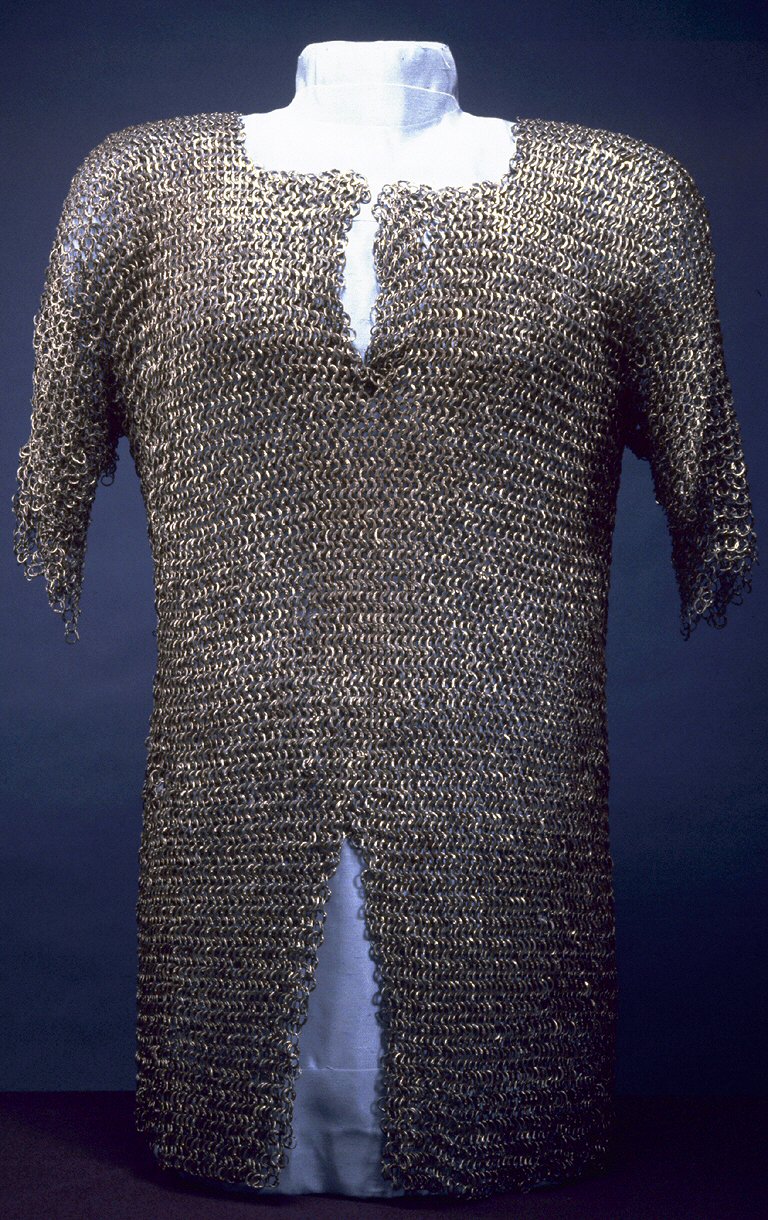
A hauberk or byrnie is a mail shirt. The term is usually used to describe a shirt reaching at least to mid-thigh and including sleeves. A haubergeon ("little hauberk") refers to a smaller mail shirt, that was sometimes sleeveless, but the terms are occasionally used interchangeably. Mail armor, likely invented by the Celts, became widely adopted for its flexibility and spread throughout Europe and Asia, becoming a staple in Roman legions and medieval warfare. By the 11th century, the hauberk evolved into a knee-length, sleeved mail shirt, as depicted in the Bayeux Tapestry and it remained in use in Europe until the Renaissance despite the rise of plate armor.
The word hauberk (c. 1300) comes from the Old French word hauberc, meaning "coat of mail", which originally derived from the earlier Frankish or similar Germanic word halsberg, literally translating to "neck protector". This word breaks down into two parts: hals, meaning "neck", which has counterparts in various languages like Old English, Old Norse, and Old High German, and bergan, meaning "to cover or protect". The root of bergan comes from the Proto-Indo-European (PIE) root bhergh- meaning "to hide or protect". Meanwhile, the word hals traces its origin to the PIE root kwel-, meaning "to revolve or move around".
The term byrnie comes from the Old English word byrne, which is connected to the Old Norse brynja and the Gothic brunjō, all referring to a coat of mail. Similarly, in Old High German, the word brunnia carries the same meaning. It is also related to the Old Irish word bruinne, meaning "breast".
In the Hebrew Bible the shiryon, translated "habergeon" or a "coat of mail," is mentioned as part of the armor of Nehemiah's workers, and one of the pieces of armor supplied by King Uzziah to his soldiers. Goliath was also armed with a "coat of mail", weighing five thousand shekels (55 kg (121 lb)), as he confronted David.
Mail armor, consisting of interwoven metal rings, is credited by some, including Varro, as having been invented by the Celts. Archaeological evidence supports this, with notable finds like the Ciumești Celtic grave, containing a mail hauberk made of butted rings. This type of body armor was widely adopted due to its flexibility and ease of movement compared to other armor types. The Celts are said to have used mail armor, though it was expensive and likely limited to the wealthier members of society, such as chieftains and officers. The armor spread throughout Europe and Asia, becoming a popular form of protection, particularly among the Roman legions.
The will of Eberhard of Friuli, an important figure of the Carolingian Empire, includes the term "helmum cum hasbergha", likely referring to a helmet with a neck protector. While "hasbergha" later came to mean a shirt of mail, in the 9th century it likely referred to a neck guard, as suggested by its etymology and historical finds like the Spangenhelm and Anglo-Saxon helmets with mail curtains for neck protection. Initially made from leather to protect the neck and throat, it gradually evolved into more comprehensive armor, incorporating mail and extending to cover the head, neck, and shoulders.
By the 10th century, the hauberk was common among well-armored warriors, often paired with a helmet. In the 11th and 12th centuries, the hauberk merged with the mail shirt, forming a single protective garment that reached the knees, offering better defense against weapons. Such armor was quite expensive due to the cost of materials, such as iron wire, and the time and skill required for its manufacture. As a result, common foot soldiers were rarely equipped with it. By the mid-12th century, hauberks had expanded to include longer sleeves and more protection for the legs.
The Bayeux Tapestry depicts Norman soldiers, both cavalry and infantry, wearing a knee-length version of the hauberk, with three-quarter length sleeves and a split from hem to crotch to allow for easier movement, especially while riding, which evolved from the Carolingian byrnie. Hauberks were likely worn over heavy padded undergarments called a gambeson, which helped prevent bruising from weapon blows. While some figures are shown with additional protection for their forearms and colored bands around the sleeves, most soldiers lack arm and leg armor, though leaders like William the Conqueror wore mail leggings called chausses. Several Norman horsemen, including William, are depicted with colored rectangles on the breast of their hauberks.
Hub AI
Hauberk AI simulator
(@Hauberk_simulator)
Hauberk
A hauberk or byrnie is a mail shirt. The term is usually used to describe a shirt reaching at least to mid-thigh and including sleeves. A haubergeon ("little hauberk") refers to a smaller mail shirt, that was sometimes sleeveless, but the terms are occasionally used interchangeably. Mail armor, likely invented by the Celts, became widely adopted for its flexibility and spread throughout Europe and Asia, becoming a staple in Roman legions and medieval warfare. By the 11th century, the hauberk evolved into a knee-length, sleeved mail shirt, as depicted in the Bayeux Tapestry and it remained in use in Europe until the Renaissance despite the rise of plate armor.
The word hauberk (c. 1300) comes from the Old French word hauberc, meaning "coat of mail", which originally derived from the earlier Frankish or similar Germanic word halsberg, literally translating to "neck protector". This word breaks down into two parts: hals, meaning "neck", which has counterparts in various languages like Old English, Old Norse, and Old High German, and bergan, meaning "to cover or protect". The root of bergan comes from the Proto-Indo-European (PIE) root bhergh- meaning "to hide or protect". Meanwhile, the word hals traces its origin to the PIE root kwel-, meaning "to revolve or move around".
The term byrnie comes from the Old English word byrne, which is connected to the Old Norse brynja and the Gothic brunjō, all referring to a coat of mail. Similarly, in Old High German, the word brunnia carries the same meaning. It is also related to the Old Irish word bruinne, meaning "breast".
In the Hebrew Bible the shiryon, translated "habergeon" or a "coat of mail," is mentioned as part of the armor of Nehemiah's workers, and one of the pieces of armor supplied by King Uzziah to his soldiers. Goliath was also armed with a "coat of mail", weighing five thousand shekels (55 kg (121 lb)), as he confronted David.
Mail armor, consisting of interwoven metal rings, is credited by some, including Varro, as having been invented by the Celts. Archaeological evidence supports this, with notable finds like the Ciumești Celtic grave, containing a mail hauberk made of butted rings. This type of body armor was widely adopted due to its flexibility and ease of movement compared to other armor types. The Celts are said to have used mail armor, though it was expensive and likely limited to the wealthier members of society, such as chieftains and officers. The armor spread throughout Europe and Asia, becoming a popular form of protection, particularly among the Roman legions.
The will of Eberhard of Friuli, an important figure of the Carolingian Empire, includes the term "helmum cum hasbergha", likely referring to a helmet with a neck protector. While "hasbergha" later came to mean a shirt of mail, in the 9th century it likely referred to a neck guard, as suggested by its etymology and historical finds like the Spangenhelm and Anglo-Saxon helmets with mail curtains for neck protection. Initially made from leather to protect the neck and throat, it gradually evolved into more comprehensive armor, incorporating mail and extending to cover the head, neck, and shoulders.
By the 10th century, the hauberk was common among well-armored warriors, often paired with a helmet. In the 11th and 12th centuries, the hauberk merged with the mail shirt, forming a single protective garment that reached the knees, offering better defense against weapons. Such armor was quite expensive due to the cost of materials, such as iron wire, and the time and skill required for its manufacture. As a result, common foot soldiers were rarely equipped with it. By the mid-12th century, hauberks had expanded to include longer sleeves and more protection for the legs.
The Bayeux Tapestry depicts Norman soldiers, both cavalry and infantry, wearing a knee-length version of the hauberk, with three-quarter length sleeves and a split from hem to crotch to allow for easier movement, especially while riding, which evolved from the Carolingian byrnie. Hauberks were likely worn over heavy padded undergarments called a gambeson, which helped prevent bruising from weapon blows. While some figures are shown with additional protection for their forearms and colored bands around the sleeves, most soldiers lack arm and leg armor, though leaders like William the Conqueror wore mail leggings called chausses. Several Norman horsemen, including William, are depicted with colored rectangles on the breast of their hauberks.