
Recent from talks
Hebridean terrane
Knowledge base stats:
Talk channels stats:
Members stats:
Hebridean terrane
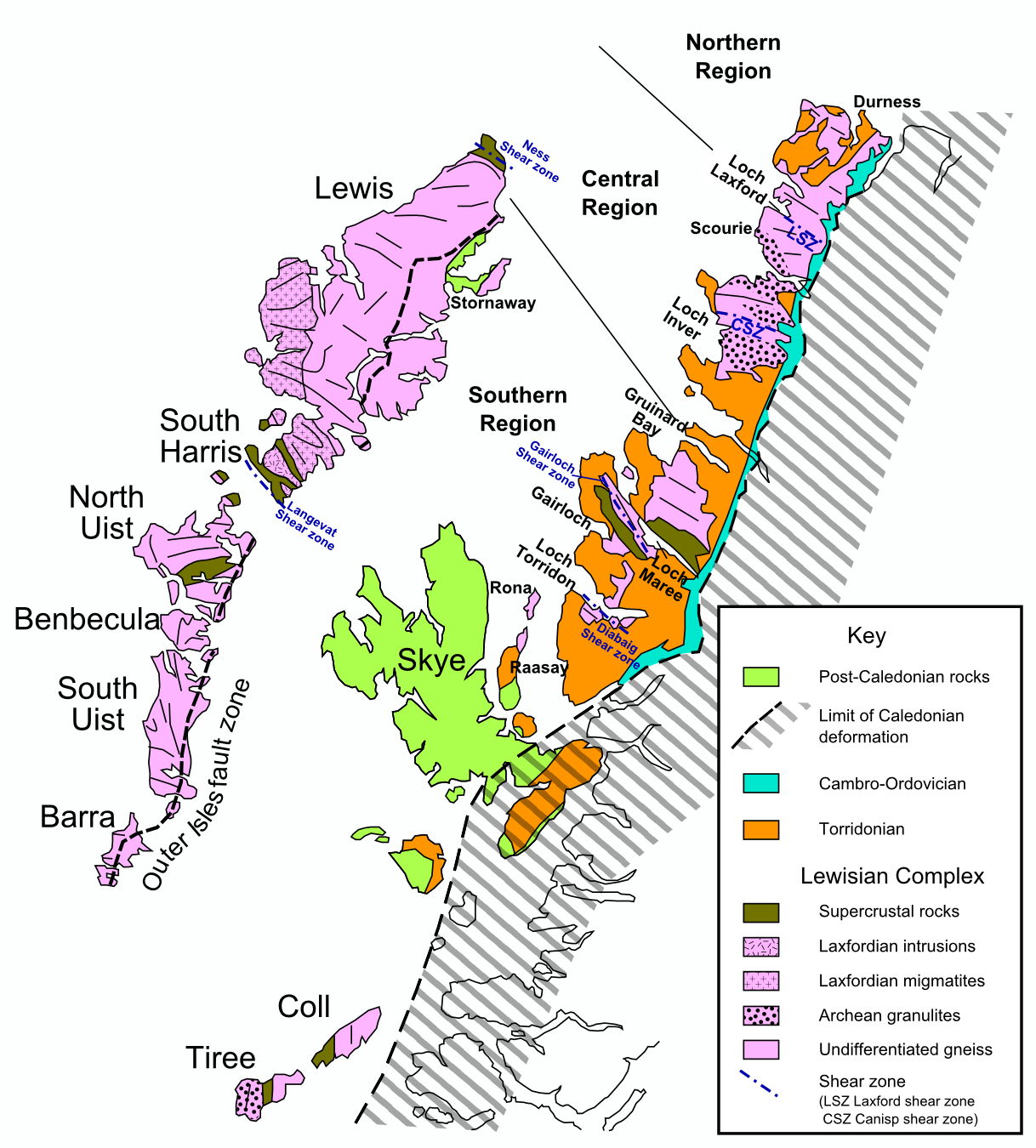
The Hebridean terrane is one of the terranes that form part of the Caledonian orogenic belt in northwest Scotland. Its boundary with the neighbouring Northern Highland terrane is formed by the Moine Thrust Belt. The basement is formed by Archaean and Paleoproterozoic gneisses of the Lewisian complex, unconformably overlain by the Neoproterozoic Torridonian sediments, which in turn are unconformably overlain by a sequence of Cambro–Ordovician sediments. It formed part of the Laurentian foreland during the Caledonian continental collision.
The Hebridean terrane forms the westernmost strip of mainland Scotland, most of the Inner Hebrides and all of the Outer Hebrides. Similar rocks are also thought to be present in Shetland and have been proved west and north of the Outer Hebrides by BGS shallow boreholes and hydrocarbon exploration wells. The full extent of this terrane to the west is obscured by the effects of Mesozoic rifting.
The Lewisian complex consists of mainly granitic gneisses, subject to a series of metamorphic and tectonic events, interrupted by the intrusion of a major dyke swarm.
The protoliths for the Scourian complex were mainly granitic plutonic rocks intruded in the interval 3.0–2.7 Ga. They were metamorphosed to granulite facies and deformed towards the end of the Archaean. At the beginning of the Proterozoic, the Scourian gneisses were locally affected by deformation and retrogression to amphibolite facies in the Inverian event, which overlapped in time with the emplacement of the Scourie dykes.
This swarm of mainly dolerite dykes, postdates the Scourian deformation and metamorphism and has therefore been used to identify the later Laxfordian event. Many of the dykes were intruded into hot country rock.
This event is associated with the development of shear zones, in which the Scourie dykes occur as concordant amphibolite sheets. This deformation was accompanied by retrogression to amphibolite facies and subsequently locally to greenschist facies.
The Torridonian is a sequence of Neoproterozoic sediments, mainly sandstones that rest unconformably on an old land surface, with up to 300 m of relief locally. The Torridonian is divided into the older Stoer Group and the younger Sleat and Torridon Groups separated by an angular unconformity. Paleomagnetic data[example needed] suggest that this unconformity represents a major time break.[further explanation needed] These sediments are interpreted to have been deposited during a period of rifting.
The Stoer Group outcrops on the peninsula of Stoer, near Assynt, Sutherland. A basal breccia is present in many areas with large clasts derived from the underlying Lewisian. The breccia passes up into muddy sandstones, often with well-preserved desiccation structures, and into deposits of a braided river system, trough cross-bedded sandstones and conglomerates. A thin sequence of siltstones and fine sandstones alternate with muddy sandstones, suggesting deposition in a lacustrine environment. The uppermost part of the sequence consists of trough cross-bedded sandstones thought to have been deposited by braided rivers.
Hub AI
Hebridean terrane AI simulator
(@Hebridean terrane_simulator)
Hebridean terrane
The Hebridean terrane is one of the terranes that form part of the Caledonian orogenic belt in northwest Scotland. Its boundary with the neighbouring Northern Highland terrane is formed by the Moine Thrust Belt. The basement is formed by Archaean and Paleoproterozoic gneisses of the Lewisian complex, unconformably overlain by the Neoproterozoic Torridonian sediments, which in turn are unconformably overlain by a sequence of Cambro–Ordovician sediments. It formed part of the Laurentian foreland during the Caledonian continental collision.
The Hebridean terrane forms the westernmost strip of mainland Scotland, most of the Inner Hebrides and all of the Outer Hebrides. Similar rocks are also thought to be present in Shetland and have been proved west and north of the Outer Hebrides by BGS shallow boreholes and hydrocarbon exploration wells. The full extent of this terrane to the west is obscured by the effects of Mesozoic rifting.
The Lewisian complex consists of mainly granitic gneisses, subject to a series of metamorphic and tectonic events, interrupted by the intrusion of a major dyke swarm.
The protoliths for the Scourian complex were mainly granitic plutonic rocks intruded in the interval 3.0–2.7 Ga. They were metamorphosed to granulite facies and deformed towards the end of the Archaean. At the beginning of the Proterozoic, the Scourian gneisses were locally affected by deformation and retrogression to amphibolite facies in the Inverian event, which overlapped in time with the emplacement of the Scourie dykes.
This swarm of mainly dolerite dykes, postdates the Scourian deformation and metamorphism and has therefore been used to identify the later Laxfordian event. Many of the dykes were intruded into hot country rock.
This event is associated with the development of shear zones, in which the Scourie dykes occur as concordant amphibolite sheets. This deformation was accompanied by retrogression to amphibolite facies and subsequently locally to greenschist facies.
The Torridonian is a sequence of Neoproterozoic sediments, mainly sandstones that rest unconformably on an old land surface, with up to 300 m of relief locally. The Torridonian is divided into the older Stoer Group and the younger Sleat and Torridon Groups separated by an angular unconformity. Paleomagnetic data[example needed] suggest that this unconformity represents a major time break.[further explanation needed] These sediments are interpreted to have been deposited during a period of rifting.
The Stoer Group outcrops on the peninsula of Stoer, near Assynt, Sutherland. A basal breccia is present in many areas with large clasts derived from the underlying Lewisian. The breccia passes up into muddy sandstones, often with well-preserved desiccation structures, and into deposits of a braided river system, trough cross-bedded sandstones and conglomerates. A thin sequence of siltstones and fine sandstones alternate with muddy sandstones, suggesting deposition in a lacustrine environment. The uppermost part of the sequence consists of trough cross-bedded sandstones thought to have been deposited by braided rivers.
Recent media